Thursday, February 27, 2020

Living in Lent - how and why


The story is told of Sean O'Flannery, a lad who moved to Boston from Dublin. Coming home from school one day he went into an ice cream shop and told the jerk behind the counter (the soda jerk) "One scoop of yer best chocolate ice cream in four dishes!"

Soda jerks get strange requests, so he set four dishes with one scoop each in front of Sean. Sean took a spoon of one, held it before his face and loudly announced, "This is me beloved cousin eating ice cream back in the old country!" He ate the ice cream and took a spoonful from another scoop, "This is me dear friend Kelly eating ice cream back in me homeland!" The third dish he said was his favorite uncle, Finian, eating ice cream back home.

Sean raised the last scoop and said, "And this dish is for me!"

This practice went on for several months until one evening as the soda jerk was filling the four dishes Sean stopped him and said quietly, "Only three dishes today, please."

The soda jerk asked, "Did you suffer a loss and that is why you only want three scoops?"

"Heaven's no!" protested Sean O'Flannery. "It's Lent now, and I've given up ice cream!"

The word “Lent” comes from the Anglo-Saxon word, “lencten,” meaning Spring, the season in which Easter occurs. The forty days before Easter constitute the Lenten season, but the forty-day count does not include Sundays. All Sundays celebrate the resurrection, and so are excluded from the forty days count. The forty days duration is drawn from the length of time Jesus spent in prayer and fasting in the wilderness before he set out on his three-year ministry.

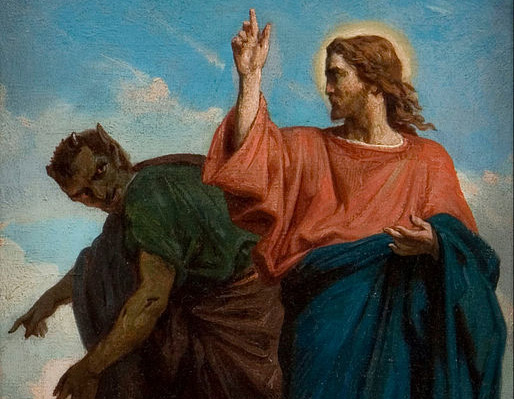
Matthew 4.1-4:

1 Then Jesus was led by the Spirit into the wilderness to be tempted by the devil. 2 After fasting forty days and forty nights, he was hungry. 3 The tempter came to him and said, “If you are the Son of God, tell these stones to become bread.”
4 Jesus answered, “It is written: ‘Man shall not live on bread alone, but on every word that comes from the mouth of God.
As originally conceived by the church long ago, the Lenten sacrifice was instituted as a “means of penitential preparation and preparation for baptism, which in the early church customarily took place on Easter Sunday.”

The tradition of fasting during Lent is an early one, originally done between Good Friday and Easter morning, the forty hours that Jesus was in the tomb. Christians would partake of no food or drink at all during that time. The fast was extended to the forty days before Easter sometime between 300 and 325, and changed so that food could be eaten only when evening had come.

The idea behind the fast was to imitate Christ. In addition to fasting, Christians would devote themselves to making prayer a faithful habit. So “prayer and fasting” have been closely linked for a long time.

And that brings me, by a rather circuitous route, to chocolate.

Chocolate is an absolutely unessential food, nutritionally speaking. We eat chocolate for no reason other than it is pleasurable. Since denial of the flesh is a prominent theme of Lent, rejection of chocolate in Lent is often offered as the Lenten sacrifice, particularly by people who wish to diet anyway.

But the Lenten season is also a time we ponder and wonder about the love of God. God’s love knows no bounds or limits and was so strong that not even the prospect of cruel death could deter Jesus from his redemptive mission. While we deny the pleasures of life during Lent, Jesus denied his life itself for the sake of his love for us.

Perhaps that fact could put a different spin on our concepts of giving something up for Lent. The Lenten sacrifice is best oriented toward that which most blocks our spiritual growth. It is each to ask ourselves, “What is it that most keeps me from Christ-likeness?” If that thing is chocolate, then it is appropriate to give up chocolate for Lent. But if something else is your greatest obstacle in being more Christlike, then giving up chocolate is a spiritually pointless exercise.

The question is this: “What is the one thing that most hinders my Christian growth into the person whom God wants me to be?” The answer may not be easy, but it will always involve self-denial. We think that following Christ is hard because to obey Christ we must first disobey ourselves, and it is disobeying ourselves that makes us think following Christ is hard.

But Jesus said his yoke is easy, his burden is light. We just have to get over ourselves to do it.

As Robert Mulholland put it, “Jesus is not talking about giving up candy for Lent. He is calling for the abandonment of our entire, pervasive, deeply entrenched matrix of self-referenced being.”

If we focus on that between now and Easter Day, then we have a chance to become more mature in Christian faith and practice. It may be a habit that is out of true with Christian character that needs to be overcome for further growth. Or it may be a thing undone which must be done for deeper development to occur. The Lenten idea is for our habits to change enough in the next few weeks so that we can continue at a higher level of discipleship after Easter. The Lenten season and the Lenten sacrifice are not the points in and of themselves, the whole life of discipleship is.

Focusing on the one big thing is not the only Lenten discipline that would be helpful for spiritual development. Methodism’s founder, John Wesley, insisted that the only thing that distinguishes the Christian from the non-Christian are how we use our time and money. So, for the period of Lent I would suggest focusing on those two things in addition to whatever one big spiritual obstacle you might have. Some suggestions:
  • Tithe all your income until Easter. 
  • Devote yourself to prayer daily and attending worship every Sunday. If you are traveling, say on business or spring break, then worship wherever you are.
  • Read the Bible each day. 
  • Call someone you love and let them know. 
  • Ask people who live alone to join you for lunch or whether you can visit them. 
  • Become involved in Christian ministries.
  • Re-establish or reinforce important relationships in your life.
Spiritually speaking, it is not enough to simply excise sin or personal vices from our lives. We have to replace vice with virtue. Thus, simply giving up something like chocolate for Lent is simply silly if we are only counting the days when we can start doing it again. That’s a game, not a spiritual discipline.


Lent should be a period of joyful, God-directed introspection into how we may be further united with Christ in godly love. If we make Lent into a severe, joyless, self-justifying exercise in self-denial, we have missed the point. Jesus sternly admonished teachers of the religious law and the Pharisees not to practice the letter of the law while neglecting “the more important matters of justice, mercy and faithfulness” (Matt 23:23).

When a lawyer asked Jesus, “which is the greatest commandment in the Law?” Jesus replied, “‘Love the Lord your God with all your heart and with all your soul and with all your mind.” And the second is like it: ‘Love your neighbor as yourself.’”

That is the whole point of spiritual growth and spiritual discipline, and hence the whole point of Lent: love. We are to be living ambassadors from God to one another and the world at large in Christ’s name. Christ was crucified, buried and raised from the dead for our sake and the sake of the whole world. Let us rededicate ourselves to being Christ’s ambassadors. It’s Lent, after all; it’s all about love, you see, Lent is all about love.

Monday, February 10, 2020

50 Ways to Take Church to the Community

The Lewis Center is an agency of the Tennessee Conference. Here are its 50 Ways to Take Church to the Community. Herte is the link to download the PDF version.

Here is the text pasted:

Churches can no longer open their doors and expect that people will come in. Effective congregations go into the world to encounter those in need of the gospel. These 50 Ways provide tips on reaching beyond the walls of your church with worship, community events, ministries, and service.
Embrace an expansive concept of community
  1. Learn to regard your community as an extension of your congregation. A church’s mission field goes beyond its membership to include all the people God calls it to serve. You are connected to individuals who never set foot in your building.
  2. Know that what’s happening within the church — preaching, worship, music, Bible study — is no longer enough to attract people in an age when church attendance is no longer a cultural expectation.
  3. Don’t sit in your church building waiting for people to come. Be prepared to meet people where they are.
Prepare spiritually
  1. Acknowledge the synergy between the Great Commandment in Matthew 22 (love your neighbor as yourself) and the Great Commission in Matthew 28 (go and make disciples). Evangelistic outreach expresses our love of others.
  2. Remember that Jesus primarily engaged people through everyday encounters, rather than in the Temple or synagogues. He fed people, met their everyday needs, and enjoyed the fellowship of others.
  3. Express love and compassion for your community in big and small ways. Avoid judgmentalism.
  4. Pray regularly for your neighbors and lift up community concerns.
  5. Attend to the faith formation of existing members. Willingness to share faith and reach out to others develops as one grows in faith and discipleship.
  6. Prepare spiritually for the transformation that creative, risk-taking outreach will bring.
Get to know the community surrounding your church
  1. Review demographic data from public, private, and denominational sources, but don’t assume that statistics alone will tell the whole story.
  2. Get out in your neighborhood. Walk the streets. Map the area, and record your observations. Note how the community is changing.
  3. Assess community needs and assets. What are the needs of your context? Who are your neighbors, and how can you serve them?
  4. Be attuned to where God is already at work in your community.
Listen and learn
  1. Know that ministries that truly bless a community often arise out of conversations where you listen for the hopes and dreams of people in your community.
  2. Interview residents of the community. Sit in a park, diner, or coffee house. Ask simply, “What are your challenges, hopes, longings and dreams?”
  3. Get to know the major public officials. They are people with tremendous influence. They need to know of your church’s commitment to the community.
  4. Involve many people from your church in this work. Hold one another accountable to the tasks of engaging and learning from others.
  5. Discern clusters of issues and concerns that arise from these conversations. Ask what issues, suffering, injustices, or brokenness might you address.
Build authentic relationships
  1. Strive for meaningful engagement with others, not superficial gestures.
  2. Make sure you are reaching out to people for the right reasons. If your motive is simply to get them to come to church, people will see right through to it.
  3. Maintain appropriate boundaries, and respect all with whom you engage.
  4. Collaborate with others who are also passionate about the community. Don’t reinvent the wheel if you can partner with someone else serving the community.
Turn your existing ministries outward
  1. Challenge each church group with an inside focus to find a way to become involved with the community outside the church. A choir might sing at a nursing home, or trustees could sponsor a neighborhood clean-up.
  2. Extend recruiting and advertising for church groups and events to audiences beyond your congregation. For example, recruit for choir members in a local paper or community list serve.
  3. Build relationships with those taking part in existing programs that serve the community, such as ESL classes, food pantry or clothes bank users, daycare families, etc.
Reach out through community events
  1. Plan “bridge events” designed explicitly to draw people from the community by providing for them something they need or enjoy — block parties, free concerts, seasonal events, parenting classes, sports camps, or school supply giveaways, etc. Source: Get Their Name by Bob Farr, Doug Anderson, and Kay Kotan (Abingdon Press, 2013)
  2. Hold these events off church property or outside the church walls in venues where people feel comfortable and naturally congregate.
  3. Get the word out through a well-planned publicity campaign.
  4. Encourage church members to invite their friends and neighbors. It is less threatening for them to invite someone to a community event than to worship.
  5. Avoid explicitly religious themes: no preaching, prayers, pressure, or financial appeals that might turn people off or reinforce negative stereotypes about church.
  6. Remember, the event itself is not the purpose. The purpose is to meet people where they are and build relationships. Mingle. Get to know people.
  7. Have a well-trained hospitality team. Make sure guests are enjoying themselves and know their attendance is appreciated.
  8. Gathering people’s names and information about them will permit follow up to those for whom it is appropriate.
  9. Invite those who attend community events to another event — sometimes called a “hand off event” — planned to draw them into a deeper relationship.
Extend your congregation’s spiritual presence beyond church walls
  1. Recognize that many “unchurched” people are spiritually inclined but apprehensive about attending church because they feel unwelcome, distrust institutions, or have been hurt in the past.
  2. Pay attention to the heightened receptiveness to spiritual engagement around religious holidays such as Easter and Christmas.
  3. Offer offsite worship services on special days, such as Christmas Eve, Palm Sunday, and Easter. Select familiar venues where people feel comfortable — parks, restaurants, parking lots, coffee houses.
  4. Offer imposition of ashes on Ash Wednesday in public places.
  5. Partner with other institutions (such as nursing homes, hospitals, or prisons) or commercial establishments (restaurants, bars, shopping centers, or sports facilities) to offer worship services to their constituents or clientele on special days.
  6. Plan creative outdoor events, such as live nativities or “blessing of the animals” services, to help make your church visibly present to the community in creative ways.
  7. Hold your Vacation Bible School in a local park or recreation center. Canvas nearby neighborhoods to invite families.
  8. Reach out to local media. Community outreach is often newsworthy, and reporters are often looking for religiously themed stories around the holidays.
Connect spiritual outreach to community service
  1. Acknowledge that many served through feeding and clothing ministries, justice ministries, weekday children’s services, and other ministries of community service have no other connections with our churches.
  2. Ask if these ministries inadvertently convey an “us and them” attitude or communicate that “you are not worthy of joining us.”
  3. Identify aspects of church life, such as characteristics of the building or how people dress, that may make some feel unwelcome. Are there alternatives that may reduce barriers for some to enter?
  4. Treat everyone as a person of dignity who deserves respect.
  5. Extend genuine hospitality to those you serve.
  6. Focus first on building relationships of understanding and trust.
  7. Consider adding a spiritual or discipleship element to community service activities but without any sense of expectation or requirement. For example, have a service or study following ESL classes for any interested.
  8. Seek to conduct each activity in a way that connects people to God and the church.
Contributors: Robert Crossman, Ann A. Michel, Kim Mitchel, and Lovett H. Weems, Jr.

Tuesday, January 28, 2020

A note to the congregations

Greetings in the name of our Lord Jesus Christ!

As I briefly explained to Gideon and Greenbrier UMCs on Jan. 26, every year at this time, pastors and the Staff-Parish Relations Committee (SPRC) of their churches enter into a time of consultation about pastors' appointments. Appointments begin each each year at the end of June. In the Tennessee Conference, every appointment is for one year at a time, basically from the beginning of July to the end of the next June.

During the still-ongoing consultation process it became clear to the SPRC's of both Gideon and Greenbrier that I will not be returned to the Greenbrier-Gideon Charge as pastor. The two predominant reasons are:
  • Retirement of pastors in the Conference this year will likely be higher than average, which causes more moves than usual.
  • The financial condition of both congregations, especially forecasting to January 2021. 

Here is why January 2021 figures in. Starting this year, 2020, every church is fully responsible for paying all of its pastor(s)' health insurance premium and pension "match." For 2020 only, the Conference is paying half of the insurance premium and three-fourths of the pension match. Starting Jan. 1, 2021, both subsidies drop to zero. That means that in the middle of the appointment year, the direct-billing total rises very sharply -- for Greenbrier church alone more than $9,000 and for Gideon proportionately.

Both churches have been faced this year with declining offering amounts chiefly because of deaths of members whose giving has not been significantly offset by other members, and by persons moving away, either literally by moving van, or figuratively by attending another church.

(Almost every UM pastor either within our conference or outside it I have spoken with, and it has been a lot, have said their attendance has also dropped. That many, maybe most, of the departures have resulted from the ongoing turmoil in the UMC regarding actions of last February's General Conference, and the guaranteed continuation of it coming in this May's GC, there is little doubt. )

With all of this as background, in my consultation meetings with both SPRCs, we all agreed that my continuation as pastor of this charge was not financially supportable. Frankly, had the SPRCs' members not already understood that, I would have put it on the table. But we all knew this. The main task now for each church's SPRC is preparing for their own consultations with our district superintendent, the Rev. Scott Aleridge. I continue to work with both committees on that.

As for myself, Cathy and I had always planned on retiring in 2022. We frankly see little point, and have no desire, to move our home and begin new at another church, then retire after only two years there. I do not think it would be fair to that church. And, since Greenbrier is very north in the Conference, any move would almost certainly take us farther away from our new grandchild to be born in March. Add the hassle of selling our home and possibly having to buy a new one, or live in a parsonage for only two years, then move our household again, and other things like that. For these reasons, I informed Rev. Aleridge last weekend that I would retire this summer.

As I said Sunday, Cathy and I are deeply grateful to the people of Greenbrier and Gideon churches for the time we have been here, and for the five months I still have to enjoy as your pastor. It is possible that I may be asked to take a part-time appointment somewhere within driving distance, but there is no way to know now. But today, you and I serve our Lord and one another in love, thanks be to God!

Grace and peace,

Pastor Don

Thursday, January 9, 2020

The Methodists' coming punishment of God

I wrote this with non-UMC readers in mind, so I do not dwell on the minutiae of the recently-released "Protocol" document. Besides, this is long enough without that.

Just after New Year’s Day there was national and regional news coverage announcing, “United Methodist Church Announces Proposal to Split Over Gay Marriage” (NPR), or similar headlines.


Why did this become suddenly worthy of such large-scale coverage? That the church has been wrestling with homosexuality since at least 1972 is no secret. Accurate headlines would read, "United Methodist Church leaders agree to catch up to fact that the UMC is already splitting over gay rights."

The UMC is the America’s second-largest Protestant denomination with about 7.5 million US members, and about that many around the world, with the largest foreign numbers in Africa.

The massive coverage of the latest split proposal, called “Protocol of Reconciliation & Grace Through Separation,” does not really break much new ground. There were already a few breakup plans proposed and on the table several months ago.

So, what is the situation now, what comes next, and what after that?

“Status quo” is Latin for “the mess we’re in” 

In fact, nothing has been decided and no actual actions have been taken to split the UMC. That a split is nearly certain to come before this summer is not much in doubt. But what the details will be no one can predict.

The UMC’s only body that can determine policy denomination-wide is the General Conference. Presided over by bishops, who can speak to issues but may not vote, the GC convenes once per four years and does not exist in between. It will convene again on May 5. The “gay issue” will certainly be the priority matter. Voting delegates come from the church’s conferences, which is what the UMC calls dioceses. The number of delegates is fixed; how many come from each conference is based on their membership number. Delegates per conference must be both laity and clergy.

So, what will the fight be about?

The present canon law of the UMC, called the Book of Disciplinesays this:
• ¶ 304.3: The practice of homosexuality is incompatible with Christian teaching. Therefore self-avowed practicing homosexuals are not to be certified as candidates, ordained as ministers, or appointed to serve in The United Methodist Church. View full statement.

• ¶ 341.6: Ceremonies that celebrate homosexual unions shall not be conducted by our ministers and shall not be conducted in our churches.
This has been the policy for many years. However, a special, called General Conference in February 2019 added mandatory penalties for violations and prohibited giving …
… United Methodist funds to any gay caucus or group, or otherwise use such funds to promote the acceptance of homosexuality or violate the expressed commitment of The UMC "not to reject or condemn lesbian and gay members and friends."
That GC also adopted means by which churches that could not abide by these provisions could withdraw from the UMC while retaining possession of their real estate and buildings. Some did, but not many.

Instead, the vast majority of progressives remained in the UMC to continue the fight. This caused two major consequences:
  1. Traditionalists rebelled against the never-ending infighting and started to leave the UMC individually, causing a significant decline in attendance and collections. This was amplified by the relatively smaller number of progressive Methodists who made the same choice. Progressive churches (in aggregate) sharply dropped paying their apportionments (denominational dues) in protest. Only two months after the special GC, The Hill reported, "Liberal Methodist churches withholding dues after denomination vote to ban LGBT-inclusive practices." Presently, the denomination and its congregations are financially tenuous.
     
  2. While traditionalists patted themselves on the back for winning, progressives redoubled to orient on the election of delegates to this May’s GC. As a result, it is generally acknowledged that the majority of American delegates elected are clearly progressive.
Long before the “Protocol” was released on Jan. 3, clergy from one end of the spectrum to the other had concluded that some sort of split of the UMC was not merely inevitable, it was desirable.

That the new changes to the Discipline formally provided for churches to withdraw was simply dismissed by UM progressives. They were determined that the UMC itself would become fully progressive, not some church splintered from it. That determination has not lessened.

The near horizon

True, the Protocol is not even on the agenda for this May’s General Conference, although there are ways it can be added. Even so, that it was released by the COB in an obviously pre-planned, coordinated national media campaign for maximum coverage, compels pulpit pastors like me to understand a sobering fact: We may not be interested in the Protocol, but the Protocol is very interested in us.

Dale M. Coulter, associate professor of historical theology at Regent University, observed in First Things, that
... the Protocol does not allow local churches or conferences to remain neutral any longer. In its current configuration, the Protocol requires that a choice be made—even if that choice is not to vote and thus remain in the post-separation UMC after the dust settles. The fight will now be taken to the local level.
The Protocol simply torpedoes whatever remained of the center. The center, or what was left of it, now no longer exists. When the president of the Council of Bishops is a Protocol signatory and its first appearance is on the COB's web site, the idea that there remains sort of centrist path is shredded. It is reasonable to assume that this is the outcome preferred by a clear majority, perhaps all, of the UM's bishops. On the date of this post the UM News Service announced that members of the team that developed the Protocol "will be interviewed in a live-streamed panel discussion on Monday, Jan. 13" for an hour at 9.30 a.m. EST on umnews.org. No other proposal for General Conference on this or any other topic has received such genuflection, which IMO speaks volumes.

So even if some bishops think there should still be a middle way, their peers have shut them down. (Remember, though, that the Council of Bishops formally endorsed a centrist plan for the UMC at the February 2019 special General Conference, and it was promptly rejected by both left and right.)

Pastors' shepherding of congregations through the coming schism will be challenging, to say the least. Each pastor will have to choose a side while still pastoring all the people of the church, and the people will be choosing their sides, too. Most congregations' members will not be unified with one another. I have known, for example, members who hold the traditionalist position but who also have homosexual close family members. For them, the issue is very personal. And that puts ministers right here:


The reason is that congregants will fall into three basic groups of response:
  1. Those who will leave the church because the pastor chose the "wrong" position,
     
  2. Those who will leave the church because the pastor would not announce his/her position,
     
  3. And those who feel so deeply rooted that they are not going to leave their church no matter what, or who simply want this whole issue to just go away - at least until a very progressive or very traditionalist pastor takes the pulpit in their church. Then, to borrow Robert Heinlein's metaphor, they will hoist the Jolly Roger.
Which is to say, we ministers (but not only us) are being presented with a Star Trek Kobayashi Maru no-win scenario, for which this Forbes article is useful in understanding in trying to maintain ethical leadership. It explains, among other things,
A crucial feature of good ethical decision-making in the real world is understanding the limits of your powers. You try to make choices that bring lots of good consequences and minimal bad ones, that fulfill your obligations to everyone to whom you have obligations (including yourself) — but you’re doing it in a complicated world where you must make your choices on the basis of imperfect information, and where other people are doing things that may impose constraints on your options. Ethics cannot require us to be omniscient or omnipotent. This means that sometimes even the most creative and optimistic ethical decision-maker has to face a situation where none of the available choices or outcomes are very good.
Even allowing for all that, the Protocol's basic premise that traditionalists and progressives must divorce one another is hardly disputed within the UMC. The Protocol likely will be added to the handful of "split up" proposals already on the General Conference's agenda. For sure, no one expects “the mess we’re in” to continue post-GC.

A safe assumption is that at least two Methodist denominations will arise from this May's GC. One will be progressive/liberal and the other orthodox/traditionalist/conservative. What the actual names will be who knows, but theologically and ideologically that’s how they will be. There could be other denominations, too.

It must be recognized that individual churches will get to choose. If My Town UMC's conference votes to be in the progressive church but MTUMC's members are mostly traditionalist, then MTUMC's members will be able to vote to join another denomination. But they will still lose some members when they do. Likewise if a progressive congregation votes to leave a traditionalist conference. Not all the sheep will follow. Shrinkage, probably dramatic at that, is inevitable.

And then what? There will be no Promised Land for either faction.

Both or all new denominations will be significantly down-funded from now. Staffs at the denominational, conference, and local-church level will diminish and there will be significant downward pressure on salaries from top to bottom. That means that most pastors and staff who can retire will do so and those who cannot yet retire but have other options will take them. The already-over bureaucratic structure of today's UMC will not collapse, exactly, but it will shrink a lot.

Even assuming there is an amicable split, or at least not an angry one, the coming few years will not be unicorns and rainbows for either progressives of traditionalists. I think both denominations will have many difficulties getting organized (which is to be expected) but also fights over their respective purity codes will erupt also. That is, what is it that marks one as a True Traditionalist or a True Progressive? Neither side can answer that right now because any answer given now is mainly influenced by the "mess we're in" and not what will pertain then.

Both denominations will find themselves bickering about a whole host of matters other than homosexuality, which as a topic will be off the table anyway. This will further cause church members to vote with their feet, accelerating the decline of Methodism in America. The Baptists or the MCC , however, will probably be very grateful. And then there was this posted by a friend I have known since before the internet:
Went to a Catholic funeral. At the supper I mentioned how beautiful their church was.
The answer was, "Beautiful yes, but it takes a lot of money for upkeep. We couldn't afford it if it were not for all the Protestants that are converting."
That will continue.

Where do we find God here?


I hope for a far finer future than I envision. But as a very senior leader observed in my prior career, "Hope is not a method and wishes are not plans." In our history since our founding in the Christmas Conference of 1784, there have been quite a number of splits. The only one approaching the scale of what is coming this year was a full-scale  schism in 1844 over slavery. But slavery was ended and the two denominations finally reunited. The coming schism will be permanent. After all, homosexuality is not going to simply be ended like slavery was.

I know that God never withdraws his grace and guidance. Jesus' resurrection never becomes less efficacious. But I also remember this:


And we will get it good and hard.

If you think I am overstating all of this I only reply, wait and see. Because you ain't seen nothing yet.

The outcome will be like this, only it will not be funny.


Bookmark and Share

Friday, January 3, 2020

A formal plan for schism of the UMC

Today from the United Methodist Council of Bishops. I have pasted it in its entirely. 
---------------------

United Methodist Traditionalists, Centrists, Progressives & Bishops sign agreement aimed at separation


Members of the Mediation Team.
 FOR IMMEDIATE RELEASE
January 3, 2020

(Washington, D.C.) - A diverse group of representatives from United Methodist advocacy groups with contrasting views and bishops from around the world has collaborated on a proposed agreement for the separation of The United Methodist Church (UMC) that has the unanimous support of all the parties involved.

The agreement, the Protocol of Reconciliation & Grace Through Separation, was achieved on December 17, 2019, and announced today.

The action comes amid heightened tensions in the church over conflicting views related to human sexuality after the 2019 Special Session of the General Conference failed to resolve differences among church members.

Legislation to implement the Protocol statement — an eight-page document detailing the terms of a split of the 13+ million-member denomination — is expected to come before the United Methodist General Conference for a vote at their legislative meeting in Minneapolis, Minn. in May 2020.

The 16-member group came together as an outgrowth of a consultation initiated by bishops from Central Conferences located outside the United States.  The parties sought assistance from prominent attorney Kenneth Feinberg, who specializes in mediation and alternative dispute resolution. Feinberg, who served as Special Master of the September 11th Victim Compensation Fund and administrator of the BP Deepwater Horizon Disaster Victim Compensation Fund, along with a number of other complex matters, agreed to provide his services pro bono.

Meeting over several months, the unofficial group reached an agreement by signatories associated with all of the constituencies within the UMC for a mutually supported pathway for separation, bridging differences among other plans to be considered by the General Conference.  “The undersigned propose restructuring The United Methodist Church by separation as the best means to resolve our differences, allowing each part of the Church to remain true to its theological understanding, while recognizing the dignity, equality, integrity, and respect of every person,” says the Protocol Statement.

The document’s signers include representatives from Europe, Africa, the Philippines, and the United States, and include persons representing UMCNext; Mainstream UMC; Uniting Methodists; The Confessing Movement; Good News; The Institute on Religion & Democracy; the Wesleyan Covenant Association; Affirmation; Methodist Federation for Social Action; Reconciling Ministries Network; and the United Methodist Queer Clergy Caucus; as well as bishops from the United States and across the world.  The representatives have pledged to work together to support the proposal and develop legislation to implement it.

The Protocol anticipates the formation of a new traditionalist Methodist denomination. Once formed, the new church would receive $25 million over the next four years and give up further claim to the UMC’s assets. An additional $2 million would be allocated for potential additional new Methodist denominations which may emerge from the UMC. Acknowledging the historical role of the Methodist movement in systematic racial violence, exploitation and discrimination, the Protocol would allocate $39 million to ensure there is no disruption in supporting ministries for communities historically marginalized by racism.

Under the Protocol, conferences and local congregations could vote to separate from The United Methodist Church to affiliate with new Methodist denominations created under the agreement within a certain time frame.  Churches wishing to stay within the UMC would not be required to conduct a vote. Provisions exist for entities that choose to separate to retain their assets and liabilities. All current clergy and lay employees would keep their pensions regardless of the Methodist denomination with which they affiliate.

Under the Protocol, all administrative or judicial processes addressing restrictions in The Book of Discipline of The United Methodist related to self-avowed practicing homosexuals or same-sex weddings, as well as actions to close churches, would be held in abeyance until the separation is completed.  The Protocol also references a plan which calls for a special general conference of the post-separation United Methodist Church. The purpose of the Special Session would be to create regional conferences, remove the current prohibitions against LGBTQ persons, and to repeal the Traditional Plan.
 
Speaking on behalf of the group, Bishop John Yambasu (Sierra Leone) stated, “All of us are servants of the church and realize that we are not the primary decision makers on these matters.  Instead, we humbly offer to the delegates of the 2020 General Conference the work which we have accomplished in the hopes that it will help heal the harms and conflicts within the body of Christ and free us to be more effective witnesses to God’s Kingdom.”

The signatories to the Protocol have provided a FAQ document  to provide additional information about the agreement. Comments and questions may be directed to the signatories at mediationprotocol@outlook.com.

A livestream event will take place on Monday, January 13, to provide further clarity and explanations of the plan by members of the Mediation Team. 
 
This statement is being released by the Council of Bishops Office on behalf of the Mediation Team members.
###
Members of the Mediation Team

  • Bishop Christian Alsted (bishop@umc-ne.org), Nordic-Baltic Episcopal Area
  • Rev. Thomas Berlin (tberlin@florisumc.org), representing UMCNext, Mainstream UMC, Uniting Methodists
  • Bishop Thomas J. Bickerton (bishop@nyac.com), New York Episcopal Area
  • Rev. Keith Boyette (president@wesleyancovenant.org), representing The Confessing Movement, Good News, IRD/UM Action, and the Wesleyan Covenant Association
  • Bishop Kenneth H. Carter (bishop@flumc.org), Florida Episcopal Area
  • Rev. Junius Dotson (jdotson@umcdiscipleship.org), representing UMCNext, Mainstream UMC, United Methodists
  • Bishop LaTrelle Easterling (bishopeasterling@gmail.com), Washington Episcopal Area
  • Rev. Egmedio “Jun” Equila, Jr. (jun@brmc.org.sg), Philippines Central Conference
  • Bishop Cynthia Fierro Harvey (bishop@la-umc.org), Louisiana Episcopal Area
  • Bishop Rodolfo Rudy Juan (bishoprudyjuan@gmail.com), Davao Episcopal Area, Philippines
  • Janet Lawrence (jan@rmnetwork.org), representing Affirmation, Methodist Federation for Social Action, and Reconciling Ministries Network
  • Rev. David Meredith (dmeredith@cliftonumc.com), representing Affirmation, Methodist Federation for Social Action, and Reconciling Ministries Network, member of UM Queer Clergy Caucus
  • Patricia Miller (pmiller1224@gmail.com), representing The Confessing Movement, Good News, IRD/UM Action, and the Wesleyan Covenant Association
  • Dr. Randall Miller (randall4015@hotmail.com), representing Affirmation, Methodist Federation for Social Action, and Reconciling Ministries Network
  • Bishop Gregory Vaughn Palmer (wocbishop@woc.org), Ohio West Episcopal Area
  • Bishop John K. Yambasu (bishopyambasu@gmail.com), Sierra Leone Episcopal Area

https://www.unitedmethodistbishops.org/newsdetail/frequently-asked-questions-about-the-united-methodist-mediation-team-13133711

https://youthworkercollective.com/did-the-umc-just-split-5-tips-on-talking-to-kids-and-adults-about-what-happened/


Thursday, December 26, 2019

Facts are not important, politics is

This was posted by a very liberal long-time friend and fellow cleric of mine.


 I commented thus:
The Holy Family were never refugees. They did not move to Egypt illegally. They moved from Roman-controlled Judea to Roman-controlled Egypt. It was literally like if you moved from Tennessee to Kentucky.
Why did the Holy Family need to move to Egypt in a hurry? The answer is one word: government. Yet to my friend and others of his leanings, government is always the solution, never the problem.

But the facts don't matter when political hit jobs can be done even on pretense.

Update: In response to another minister's query (who is a friend and not just on FB), I wrote this:

Both Judea and Egypt were occupied and governed by Rome; of course you know this. Just as the Romans changed the name of the formerly independent country of Judah to Judea, they changed the name of Egypt to Aegyptus. But the key point is not really that they changed the name, but that they had the power (by force of arms, to be sure) to do so.

To say that Egypt and Judea were "countries" under Roman rule is about as accurate as saying that Kazakhstan was a country under Stalin. Maybe it was once, and wanted to be again, but in 1948 it was not. It was a Soviet province and nothing more.

Likewise Judea and Aegyptus. The Holy Family changed province of residence but it did not change who governed them.

Now, whether the Holy Family were refugees. Yes, Matthew is clear that they made the trek to Aegyptus because of Herod's lethal plans. But again, while they changed provincial government, there was no political difference, just as if someone moved from Virginia to North Carolina.

Which are states I use on purpose because, as I am sure you know, Virginia's Gov. Northam has publicly stated that he will call out the National Guard to enforce the state's new, draconian gun laws - laws that have caused 90 percent of the state's county commissions to declare that they will prohibit any local law officers to enforce or assist state authorities in enforcing.

Which is to say, Gov. Northam is in fact directly threatening to use actual soldiers to kill people who have committed no offense against the peace or safety of anyone at all or even can be remotely considered such a threat.

Think that cannot happen? In November of last year, Maryland police shot to death a 61-year-old man in his own home who had committed no crime but for whom a court had issued a "red flag" order.

IMO, Gov. Northam is today's Herod. So when (not if, btw) some Virginia 2nd Amendment advocates decide to leave potentially-fatal Virginia to live in North Carolina, will they be refugees? If not, why would the Holy Family have that status?

Tomorrow in my sermon I will quote the Rev. Joy Carol Wallis thus,
Herod represents the dark side of the gospel. He reminds us that Jesus didn't enter a world of sparkly Christmas cards or warm spiritual sentiment. Jesus enters a world of real pain, of serious dysfunction, a world of brokenness and political oppression.
So far, so good. Agree 100 percent. But then:
Jesus was born an outcast, a homeless person, a refugee, and finally he becomes a victim to the powers that be. Jesus is the perfect savior for outcasts, refugees, and nobodies.
I will omit the italicized part because it is simply incorrect.
  • Jesus was not, in fact, born “born an outcast." He was born a Jew in a nearly-totally Jewish land to a solidly ordinary and righteous family.
     
  • He was not "a homeless person" because his parents owned a home in Nazareth. If a Nashville woman gave birth to a child in Knoxville, would that make the baby homeless?
     
  • And as I have said, he was never "a refugee” at all, much less born one in his father’s ancestral town.
     
  • That “Jesus is the perfect savior for outcasts, refugees, and nobodies” is true, but then, he is also the perfect savior for absolutely everyone else.

Monday, December 9, 2019

10 Tough Questions


Link.

The 10th point is the toughest one:

10. Remember, the ‘wicked problem’ of the denomination far transcends sexuality 
This last point is not framed as a question because of its truth there is no question. No matter what the GC decides, decline and irrelevance will continue to accelerate unless larger issues are named and tamed. Examples are trust deficits, miscommunication, theological conflicts/contradictions, ineffective organization, inefficient structures, disjointed training and education of clergy or establishing coherent ministry career paths. Organizations facing a wicked problem either tend to ‘fail into collaboration’ among competing stakeholders…or they just fail (see above). Nurturing trust and affirming the claim of conscience for all parties sets the stage not for failure but new birth.
The author earlier posted an essay with a full explanation of what a wicked problem is, as distinguished from a simple problem or a complex one (click here). But briefly, a wicked problem is that which all parties agree exists but do not agree on how to describe it, nor on what a solution can be, nor even on how to implement a resolution or know when it has been accomplished.

I have elsewhere explained that one such wicked problem, which I think underlies all those listed just above, is Pournelle's Law, formulated by the late, great science fiction writer Jerry Pournelle. It is:

And no, I do not have a solution to it.

Thursday, December 5, 2019

An Advent reflection

Grace and peace to all!

I subscribe to a daily newsletter by a Canadian minister, the Rev. Carey Nieuwhof. He is one of only two or three such writers that I know who are always worthy of reading because the majority of his writing applies in some way to my ministry. He does not write merely for other pastors, but also for the people of churches. I do recommend taking a look at his site, https://careynieuwhof.com/.

Recently, his email included this nugget:


One of the most difficult things to do is self-challenge what we know. As someone once remarked, it is not what we do not know that is often the problem, it is that so much of what we think we know is not so. The balance between retaining what have tested and found enduring, and discarding what serves us well no longer—well, that can be tough.

Just imagine what the first followers of Jesus had to discard and adopt. Start with Peter, whom Jesus told to stop fishing for fish and start fishing for people. Or much earlier, the shepherds, who had to face that the Messiah was born in the humblest of settings to undistinguished parents. Or Mary, that she was being asked to face possible social disaster in being pregnant with a child that her fiancé could not say was his. And Joseph, who is described as a honorable man who elected to do what in his day was a dishonorable thing, marrying Mary anyway.

The story of Jesus’ nativity and ministry is one of turning over tables, both literally in the Temple confronting the money changers, but also figuratively, for bringing people to confront that so much of what they knew simply was not so:
“You have heard that it was said, ‘Love your neighbor and hate your enemy.’ But I tell you, love your enemies and pray for those who persecute you, that you may be children of your Father in heaven" -- Matthew 5.43-45
If we are truly blessed, we are seriously disturbed this Advent by the implications of Jesus’ coming and nativity. May the Holy Spirit lead us to think more deeply about what we think we know and what it means for the way we live and more importantly, why we live.

The gifts of Advent and Christmas are twofold, at least:

  • First, that “unto us a child is born, unto us a Son is given, and he will be called Wonderful Counselor, Mighty God, Everlasting Father, Prince of Peace.”
  • Second, that in celebrating that Christ is born, we can embrace that we are born anew. May we discern the renewing revelation of God through our worship and giving this season!

Thursday, October 31, 2019

The last best hope for America

I came across this post from 2017 by accident and am re-dating it to today. Today was the day that the US House of Representatives voted along strictly party lines to proceed with impeachment proceedings against the president. I make no comment here as to the merits or not of the proceedings. But as much as my colleague's words rang true two years ago, how much more compelling are they today.

From July 2017:
From former district superintendent in the Memphis Conference of the United Methodist Church, Sky McCracken:
In my opinion, the most powerful force in Christianity - if it wants to be - is a local church who decides to be a community of faith and discipleship in the manner of Jesus for its neighborhood, instead of a chapel for members who like things "just the way they are." No law, no entity, no politician has any power against such a force. Regardless of the happenings, fear mongering, and media hype of the last few weeks, they pale against the total history of God's presence with His people - which has always been unrelenting and ever-pursuing. I'll quote Bill Hybels:
"For eight years...I went to Washington, D.C., every month to meet in the foremost centers of power with some of the highest elected officials in our country. What I discovered was not how powerful those people are, but how limited their power really is. All they can actually do is rearrange the yard markers on the playing field of life. They can't change a human heart. They can't heal a wounded soul. They can't turn hatred into love. They can't bring about repentance, forgiveness, reconciliation, peace. They can't get to the core problem....I believe that only one power exists on this sorry planet that can do that. It's the power of the love of Jesus Christ, the love that conquers sin and wipes out shame and heals wounds and reconciles enemies and patches broken dreams and ultimately changes the world, one life at a time. And what grips my heart is the knowledge that the radical message of that transforming love has been given to the church. That means that in a very real way the future of the world rests in the hands of local congregations like yours and mine." - In his book, Courageous Leadership.
There is no political solution to the severe dysfunctions of America today because our national illness is not really political. It is spiritual. There will not be a better America until there are better Americans. That is the task for the Church today: to bring more and more people into the fullness of reconciliation to God through Christ so that we can be reconciled to one another. Absent that, our congregations are just religious clubs. 

Tuesday, October 29, 2019

The ground beneath our feet

The United Methodist Church is committing denominational hari-kiri, which will be nearly completed before the end of May, 2020. Recently, a long-term friend and law-enforcement officer posted an article from lawofficer.com: "The End of Law Enforcement, " written by a 20-plus year active LE officer and a trainer of LE officers around the country.

He says that this is the state of law enforcement today:


1. Retirement eligible officers are retiring even though they have many years of useful service ahead of them.


2. Mid-career officers are miserably trying to make it to retirement and are "are trying to get off the streets, afraid of the next 'viral' video showing them doing nothing wrong but ruining their reputation and ability to work forever." Some are leaving LE anyway.

3. Less than 10-year officers "have now realized that they work in the only profession that can ruin you for doing nothing wrong. They have stopped working. Some call it the 'Ferguson Effect' but they just call it trying to save their [hind ends]. It’s not worth staying and the majority are looking to leave."

I responded thus:


There is a French phrase from maritime history that was adopted by some other nations' services that is usually, though inaccurately, translated as, "every man for himself." The French is, "Sauve qui peut," and don't ask me how to pronounce it.


It was the command given when a vessel's captain decided the ship was lost and was going to sink no matter what. So he would order, "May he save himself, whoever can" (literal translation) or basically, "Stop trying to save the ship and save yourselves."


ISTM that is what this writer has concluded about the profession of law enforcement.


Regarding the UMC, I had a conversation recently with a senior staffer of one the UMC's general councils. It became clear to me that sauve qui peut has already been adopted by large numbers of our laity. Both attendance and giving have plummeted at UM churches across the nation, including mine. The laity who have left because of all the intra-church fighting over the homosexuality question have absolutely abandoned ship and are not going to return.


I can only wonder how many serving clergy will decide the same between now and the end of General Conference in May 2020. Will we see a parallel with what is going on in law enforcement? Will we see retirement-eligible ministers with several more years of possible service just hang it up now? Will mid-career pastors try simply to hang on until retirement and younger ones make (covert) plans to move to another denomination or profession?


Update, Dec. 10: I attended a Mon-Wed. GCFA conference last month with pastors from across the nation present, although the majority from the southeast and eastern seaboard. Here is my takeaway summary:

Basically, retirement-eligible pastors are doing so, even if they have years left to 72. I met some who are younger than I who are retiring in 2020, including two who pastor mega-churches (neither in my conference).

Several ministers from about age 50 openly told me that when they hit 62, they're gone. Very few were there much younger than that, but if I was 44 rather than 64, I almost certainly would be covertly making contingency plans.

And the denomination is going broke. Giving across America is way down. Way. Down. This is not going to be reversed and will, if anything, accelerate. At current trend, the GCFA's episcopal fund will be at zero dollars by the end of 2024. 

One minister told me that giving is down so much in his present appointment (not only because of people leaving a strife-torn denomination, also several major donors died) that his church can no longer afford his compensation. But he wonders what the point in a new appointment will be if it will probably run out of money also within a year. May as well retire, right?


BTW, even apart from people voting on the "issue" with their feet and checkbooks, the UMC will still be in accelerated rate of decline due to increasing deaths of an aging laity and our inability (and frankly, denominational unwillingness) to evangelize, especially evangelize unconnected to politics.


Just as law enforcement, the UMC still has many strengths and still is doing great work. But we are more and more resembling Centralia, Penn. Our foundation and "solid rock" on which we stand is being destroyed from underneath us.


Centralia was a coal-mining town where the mine shafts caught fire in 1962 and 
the town was destroyed from underneath. The fire is still burning. Estimates are that 
it will burn at least 250 more years.

The ground burning beneath our feet applies to much more than the UMC or law enforcement. I would be hard-challenged to find any national-level institution not affected by this threat.


Wesley said that when we are on fire for Christ people will come for miles around to watch us burn. The UMC is on fire, all right. But decide for yourself for what we are burning.

Monday, October 21, 2019

Kurds, Turkey, Syria - and US forces


Link to article


I worked with Petraeus when we were both at the Pentagon. He was a major then, promoted to Lt. Col. not long after I came to know him. I respect him immensely. He and US Marine Gen. James Mattis were the key, essential players in redirecting US strategy in Iraq away from the disastrous Rumsfeld model. I have never met Mattis, but have nothing but greatest respect for him. Marines I have known who worked with him are in awe, and that says a lot. 


So when Petraeus and Mattis both sharply disagree with the administration's decision, I have no choice but to pay attention. 


But having said that, I would say their view is very solidly an establishment one. S
enior military officers prosper very well. They gain their rank and status not only because of the military skills, but their political skills as well. They retire as comfortable members of the country's political class and often wind up with lucrative corporate consultancies and defense-related boards. I have seen this play out with three- and four-star generals I worked for. I do not blame them, actually, but we need to understand that they are far too invested in the status quo to try to change it. It what got them their rank and positions in the first place. Their incentives to change it are exactly zero. (This also applies to senior diplomatic personnel.) 

I wrote a long essay in 2008 on why the US should exit NATO, but of course, with both the outgoing Bush and incoming Obama administrations, there was so much Old Guardism at work that there was (and is) no chance. Petraeus and Mattis (and I, for that matter) were raised militarily and strategically with a Cold War, organizational mind-think that has not significantly subsided. They still think that what G. Washington warned against, "entangling alliances," should be normative and are simply the way things get done. 

Fifteen years ago Petraeus and Mattis and some others were the Young Turks. Now they are the Old Guard. And that should temper how we assess what they say. 


None of this is to say that all will turn out well today. In fact, it would be insane to say so. I mean, point to one time in the last several hundred years that things have worked out well in the Middle East! 

But it is also a real error to assume that had a mere 50 US troops been left in place, that everything would now be unicorns and rainbows. Turkey did not ask our permission to incur. They simply announced they were doing it. Turkey did not ask Trump to withdraw the troops; Trump just got them the heck out of the way. It would be nice for Petraeus and others to say how they would have responded to Turkey's announcement that it was coming, instead of just clutching their pearls in protest. They know better because they many times had to think through questions such those as I pose later in this essay. They know how to do it, but now they do not need to do it because the media will smile kindly upon them if they don't. And that is the problem.

My take: 


There is no solution to the problem of the Kurds. The Kurds have been screwed, they are being screwed, and they will continue to be screwed, because only Iraq, Turkey, and Syria (and Iran, as if) can resolve the issue and all of them see the Kurds as tools to be used for their own purposes against the others. No Western nation can possibly have any effective role - not the USA, not Britain, not NATO, not nobody.

The Kurdish PKK is Turkey's main target. The PKK, Partiya Karkerên Kurdistan, is a Marxist faction that has been launching cross-border raids into Turkey since 1984 - as have other Kurdish factions. The PKK is classified as a terrorist organization by the Turks -- and by the US, the European Union, NATO, and even Japan.

Anyone who is denouncing the withdrawal of a few dozen US troops from the affected area of Turkish operations, insisting they should not have been withdrawn, should first answer one basic question:
 
If you were president, would you have ordered US troops to stay in place and resist the Turkish incursion by force of arms? 

Then proceed to these:
  • If you would have given that order:
    • What is your strategic goal?
    • How many US troops are you are willing to have killed to attain that goal? 
    • Once US troops are killed, what would be your response? 
    • How many Turks are you willing to kill to attain the strategic goal? 
    • Would you escalate the violence if the Turks do not withdraw? If so, would you restrict US combat strikes to only the incursion area, or would you strike Turkish forces still inside Turkey proper? For either answer, explain why.
    • How will you ensure the safety of thousands of US Air Force personnel, aircraft, special weapons, and family members at the Turkish air base at Incirlik, Turkey? There are also large numbers British and Spanish military personnel there. 
    • Would you ask for a congressional authorization of use of military force against Turkey? 
      • If yes, are you really willing to go to war with a decades-long, US-ally member of NATO? 
      • If not, why not? Would you wage war against Turkey anyway?
          
  • If you would not have given that order:
    • What is your strategic goal?
    • Why would you leave the troops in place rather than withdraw them, if they are not to fight?
    • What would you have done specifically different from what the administration has done, and why?
Anyone who will not address those topics before slamming the administration is not thinking about this seriously at all. And yes, that includes congressional members of both parties and, I regret, many of my ministry colleagues who have posted about this topic.

Finally, here is a pretty well-balanced article that explains why Trump did not sell out the Kurds while also pointing out that Erdogan is pretty much a thug himself. (But we knew that.)