The story is told of Sean O'Flannery, a lad who moved to Boston from Dublin. Coming home from school one day he went into an ice cream shop and told the jerk behind the counter (the soda jerk) "One scoop of yer best chocolate ice cream in four dishes!"
Soda jerks get strange requests, so he set four dishes with one scoop each in front of Sean. Sean took a spoon of one, held it before his face and loudly announced, "This is me beloved cousin eating ice cream back in the old country!" He ate the ice cream and took a spoonful from another scoop, "This is me dear friend Kelly eating ice cream back in me homeland!" The third dish he said was his favorite uncle, Finian, eating ice cream back home.
Sean raised the last scoop and said, "And this dish is for me!"
This practice went on for several months until one evening as the soda jerk was filling the four dishes Sean stopped him and said quietly, "Only three dishes today, please."
The soda jerk asked, "Did you suffer a loss and that is why you only want three scoops?"
"Heaven's no!" protested Sean O'Flannery. "It's Lent now, and I've given up ice cream!"
The word “Lent” comes from the Anglo-Saxon word, “lencten,” meaning Spring, the season in which Easter occurs. The forty days before Easter constitute the Lenten season, but the forty-day count does not include Sundays. All Sundays celebrate the resurrection, and so are excluded from the forty days count. The forty days duration is drawn from the length of time Jesus spent in prayer and fasting in the wilderness before he set out on his three-year ministry.
Matthew 4.1-4:
1 Then Jesus was led by the Spirit into the wilderness to be tempted by the devil. 2 After fasting forty days and forty nights, he was hungry. 3 The tempter came to him and said, “If you are the Son of God, tell these stones to become bread.”
4 Jesus answered, “It is written: ‘Man shall not live on bread alone, but on every word that comes from the mouth of God.
As originally conceived by the church long ago, the Lenten sacrifice was instituted as a “means of penitential preparation and preparation for baptism, which in the early church customarily took place on Easter Sunday.”
The tradition of fasting during Lent is an early one, originally done between Good Friday and Easter morning, the forty hours that Jesus was in the tomb. Christians would partake of no food or drink at all during that time. The fast was extended to the forty days before Easter sometime between 300 and 325, and changed so that food could be eaten only when evening had come.
The idea behind the fast was to imitate Christ. In addition to fasting, Christians would devote themselves to making prayer a faithful habit. So “prayer and fasting” have been closely linked for a long time.
And that brings me, by a rather circuitous route, to chocolate.
Chocolate is an absolutely unessential food, nutritionally speaking. We eat chocolate for no reason other than it is pleasurable. Since denial of the flesh is a prominent theme of Lent, rejection of chocolate in Lent is often offered as the Lenten sacrifice, particularly by people who wish to diet anyway.
But the Lenten season is also a time we ponder and wonder about the love of God. God’s love knows no bounds or limits and was so strong that not even the prospect of cruel death could deter Jesus from his redemptive mission. While we deny the pleasures of life during Lent, Jesus denied his life itself for the sake of his love for us.
Perhaps that fact could put a different spin on our concepts of giving something up for Lent. The Lenten sacrifice is best oriented toward that which most blocks our spiritual growth. It is each to ask ourselves, “What is it that most keeps me from Christ-likeness?” If that thing is chocolate, then it is appropriate to give up chocolate for Lent. But if something else is your greatest obstacle in being more Christlike, then giving up chocolate is a spiritually pointless exercise.
The question is this: “What is the one thing that most hinders my Christian growth into the person whom God wants me to be?” The answer may not be easy, but it will always involve self-denial. We think that following Christ is hard because to obey Christ we must first disobey ourselves, and it is disobeying ourselves that makes us think following Christ is hard.
But Jesus said his yoke is easy, his burden is light. We just have to get over ourselves to do it.
As Robert Mulholland put it, “Jesus is not talking about giving up candy for Lent. He is calling for the abandonment of our entire, pervasive, deeply entrenched matrix of self-referenced being.”
If we focus on that between now and Easter Day, then we have a chance to become more mature in Christian faith and practice. It may be a habit that is out of true with Christian character that needs to be overcome for further growth. Or it may be a thing undone which must be done for deeper development to occur. The Lenten idea is for our habits to change enough in the next few weeks so that we can continue at a higher level of discipleship after Easter. The Lenten season and the Lenten sacrifice are not the points in and of themselves, the whole life of discipleship is.
Focusing on the one big thing is not the only Lenten discipline that would be helpful for spiritual development. Methodism’s founder, John Wesley, insisted that the only thing that distinguishes the Christian from the non-Christian are how we use our time and money. So, for the period of Lent I would suggest focusing on those two things in addition to whatever one big spiritual obstacle you might have. Some suggestions:
Tithe all your income until Easter.
Devote yourself to prayer daily and attending worship every Sunday. If you are traveling, say on business or spring break, then worship wherever you are.
Read the Bible each day.
Call someone you love and let them know.
Ask people who live alone to join you for lunch or whether you can visit them.
Become involved in Christian ministries.
Re-establish or reinforce important relationships in your life.
Spiritually speaking, it is not enough to simply excise sin or personal vices from our lives. We have to replace vice with virtue. Thus, simply giving up something like chocolate for Lent is simply silly if we are only counting the days when we can start doing it again. That’s a game, not a spiritual discipline.
Lent should be a period of joyful, God-directed introspection into how we may be further united with Christ in godly love. If we make Lent into a severe, joyless, self-justifying exercise in self-denial, we have missed the point. Jesus sternly admonished teachers of the religious law and the Pharisees not to practice the letter of the law while neglecting “the more important matters of justice, mercy and faithfulness” (Matt 23:23).
When a lawyer asked Jesus, “which is the greatest commandment in the Law?” Jesus replied, “‘Love the Lord your God with all your heart and with all your soul and with all your mind.” And the second is like it: ‘Love your neighbor as yourself.’”
That is the whole point of spiritual growth and spiritual discipline, and hence the whole point of Lent: love. We are to be living ambassadors from God to one another and the world at large in Christ’s name. Christ was crucified, buried and raised from the dead for our sake and the sake of the whole world. Let us rededicate ourselves to being Christ’s ambassadors. It’s Lent, after all; it’s all about love, you see, Lent is all about love.
“Lord Jesus Christ, Son of the living God, who as on this day rested in the sepulchre, and thereby sanctified the grave to be a bed of hope to Your people: Make us so to abound in sorrow for our sins, which were the cause of Your passion, that when our bodies rest in the dust, our souls may live with You; who lives and reigns with the Father and the Holy Spirit, one God, world without end.” – Titusonenine
Three in four worshippers say sermons a major factor in why they go
Youth programs, outreach and volunteer opportunities also important
Preferring to worship solo is main reason non-attenders eschew services
Belonging to a church, synagogue or mosque provides people with important social benefits that Gallup research shows improve personal well-being. While social benefits are clearly important to majorities of those who worship regularly, what most motivates them to attend is learning more about the tenets of their faith, as well as connecting that faith to their lives. Protestants, who have more control over their church leadership and flexibility in where they worship, place even greater emphasis on the quality of sermons than do Catholics, although both groups rate sermons highly.
Fulfilling these expectations could be critical in order for religious organizations to survive. But to expand their ranks, reigniting the interest of lapsed members should be a priority. Converting those who say they aren't very religious or who don't like organized religion may be futile. But churches and others may find some success with the message that worshipping in communion with others has benefits that can't be achieved worshipping alone -- addressing the No. 1 reason non-attendees give for not attending.
Much more at the link.
There is growing realization today that "attractional" church worship is not working in drawing people wither to long-term attendance or to personal commitment to Christ. "Worshiptainment," as we call it, is a failure in leading people to discipleship.
The poll made me wonder: When and why did music became such a prominent part of evangelical services? And are these churches missing out by focusing on music at the expense of other aspects of church life?
I suspect the former question might be linked to the increasing need for people in our culture to be entertained.
“Americans no longer talk to each other, they entertain each other," Neil Postman famously wrote in his 1985 book Amusing Ourselves to Death. "They do not exchange ideas, they exchange images.”
I’m not suggesting churches need to stop playing music. I’m merely wondering if dedicating nearly half of a church service to musical performances is the most efficient use of time.
One wonders if people in pews would not receive more spiritual nourishment from other church-led activities: An extended reading of scripture? Silent prayer? A longer sermon?
The Gallup survey corresponds to other research I have seen that reports that the fabled and much-derided Millennials are drawn to traditional or orthodox services far more than "contemporary" or attractional services.
I think the real bottom line is this: What are people finding, experiencing, and learning in a church that they cannot find in secular culture?
Ian Hutchison is a professor of nuclear science and engineering at MIT. Here he rebuts the idea that science is the ultimate way of knowing about the Real.
"Scientism" is used to describe faith in science. Prof. Hutchison is a Christian. In an address at the Veritas Forum, he spoke of three hypotheses to explain why he believes in the resurrection of Jesus:
Hypothesis one: We’re not talking about a literal resurrection. Perhaps it is just an inspiring myth that served to justify the propagation of Jesus’ exalted ethical teachings. A literal resurrection contradicts the known laws of nature. Maybe scientists can celebrate the idea of Jesus’s spirit living on, while his body remained in the grave.
Hypothesis two: We really believe in the bodily resurrection of the first century Jew known as Jesus of Nazareth. My Christian colleagues at MIT – and millions of other scientists worldwide – somehow think that a literal miracle like the resurrection of Jesus is possible. And we are following a long tradition. The founders of the scientific revolution and many of the greatest scientists of the intervening centuries were serious Christian believers.
Hypothesis 3: I was brainwashed as a child. ... But no, I did not grow up in a home where I was taught to believe in the resurrection. I came to faith in Jesus when I was an undergraduate at Cambridge University and was baptized in the chapel of Kings College on my 20th birthday.
Hypothesis two wins:
To explain how a scientist can be a Christian is actually quite simple. Science cannot and does not disprove the resurrection. Natural science describes the normal reproducible working of the world of nature. Indeed, the key meaning of “nature”, as Boyle emphasized, is “the normal course of events.” Miracles like the resurrection are inherently abnormal. ...
Today’s widespread materialist view that events contrary to the laws of science just can’t happen is a metaphysical doctrine, not a scientific fact. What’s more, the doctrine that the laws of nature are “inviolable” is not necessary for science to function. Science offers natural explanations of natural events. It has no power or need to assert that only natural events happen.
So if science is not able to adjudicate whether Jesus’ resurrection happened or not, are we completely unable to assess the plausibility of the claim? No. Contrary to increasingly popular opinion, science is not our only means for accessing truth. In the case of Jesus’ resurrection, we must consider the historical evidence, and the historical evidence for the resurrection is as good as for almost any event of ancient history.
It is refreshing that a scientist understands the principle of "limit questions." Limit questions are those that are outside the realm of a particular field of knowledge. For example, suppose you attended a concert by the London Symphony. As you are leaving afterward, you overhear a man in front of you say, "Speaking as a cardiologist, it is my medical opinion that this was the finest performance of Saint-Saux's Symphony Number Three in C Minor ever presented anywhere."
Immediately you can see that such a statement is simply nonsense. It may well have been the best-ever performance of the symphony, but true or false, it is not a medical question and so his opinion "as a cardiologist" has no authority at all. The quality of a concert is a limit question for physicians. It is outside medical science’s realm of knowledge and expertise.
This is exactly the mistake that many scientists, such as the late Stephen Hawking, make. When they denounce Christians for affirming the resurrection, they claim that science has proved it was impossible. But as Prof. Hutchison explains, miracles are inherently limit questions for science.It gets worse. Comes now Wharton School professor and forecasting expert J. Scott Armstrong, whose research shows that fewer than one percent of published scientific papers published in scientific journals actually follow the scientific method.
“We also go through journals and rate how well they conform to the scientific method. I used to think that maybe 10 percent of papers in my field … were maybe useful. Now it looks like maybe, one tenth of one percent follow the scientific method” said Armstrong... .
Scientific integrity requires scientists and non-scientists alike to recognize that there are limits to scientific knowledge. Failing this is the main error of the New Atheist movement, whose advocates insist that,
·only science reveals the Real,
·only science can discover truth
·scientific knowledge is exhaustive and inherently unlimited.
But these claims are themselves not testable with the scientific method. They are not scientific claims at all, but claims of faith in science, or scientism. Richard Lewontin, an evolutionary biologist and geneticist, explained in The New York Review of Books in 1997 (link) that scientism has a…
... prior commitment to materialism. It is not that the methods and institutions of science somehow compel us to accept a material explanation of the phenomenal world, but, on the contrary, we are forced by our a priori adherence to material causes to create an apparatus of investigation and a set of concepts that produce material explanations ... . Moreover, that materialism is absolute, for we cannot allow a Divine Foot in the door.
This is not evidence of an inquiring mind. The intellectual atheists' veil was further pulled back by Thomas Nagel, professor of philosophy and law at New York University:
I want atheism to be true and am made uneasy by the fact that some of the most intelligent and well-informed people I know are religious believers. It isn't just that I don't believe in God and, naturally, hope that I'm right in my belief. It's that I hope there is no God! I don't want there to be a God; I don't want the universe to be like that. My guess is that this cosmic authority problem is not a rare condition and that it is responsible for much of the scientism and reductionism of our time. One of the tendencies it supports is the ludicrous overuse of evolutionary biology to explain everything about human life, including everything about the human mind… This is a somewhat ridiculous situation… [I]t is just as irrational to be influenced in one’s beliefs by the hope that God does not exist as by the hope that God does exist. (The Last Word, pp. 130-131, quoted by fellow philosopher Edward Feser.)
Aldous Huxley, author of Brave New World, put it this way:
I had motives for not wanting the world to have a meaning; consequently I assumed that it had none and was able without any difficulty to find satisfying reasons for this assumption…. Those who detect no meaning in the world generally do so because, for one reason or another, it suits their books that the world should be meaningless. …
For myself as, no doubt, for most of my contemporaries, the philosophy of meaninglessness was essentially an instrument of liberation. The liberation we desired was …liberation from … a certain system of morality. We objected to the morality because it interfered with our sexual freedom…. There was one admirably simple method in our political and erotic revolt: We could deny that the world had any meaning whatsoever. Similar tactics had been adopted during the eighteenth century and for the same reasons. (Ends and Means, 270-273)
However, affirming the resurrection of Jesus is not wishful thinking, it is the most reasonable conclusion based on the non-supernatural facts and circumstances surrounding the issue. Note well, please: that the resurrection of Jesus did occur is the ending point of examination of the facts, not the beginning point.
The resurrection of Jesus is foremost an historical question, not primarily a scientific one or even, really, a religious one. And so there will be limits of what science can declare about it just as there are limits on what science can declare about any other historical event. For example, it cannot be "scientifically proven" that Gen. George Washington led his army across the Delaware River on Christmas night, 1776, to attack Hessian forces at Trenton, N.J. That is an historical question, not scientific one.
I posted about alternative explanations of the historical events just recently, so I'll not revisit them. Today, let's just deal with one, which is the claim by many scoffers and skeptics that Jesus never really existed in the first place. But what happens when, live and on the air, an atheist holding that position runs into a non-Christian, world-recognized scholar who says that position is silly? Well, this.
Update: Michael Polanyi, a Fellow of the Royal Society and former professor of physical chemistry at the University of Manchester: "Any account of science which does not explicitly describe it as something we believe in, is essentially incomplete and a false pretension. It amounts to a claim that science is essentially different from and superior to all human beliefs which are not scientific statements, and this is untrue... ." Read more.
... he argues that the scientist’s confidence in reason ultimately depends on the existence of a rational and purposeful Creator. Otherwise, our thoughts are nothing more than electro-chemical events, the chattering of soul-less synapses. “If you take the atheistic, naturalistic, materialistic view, you’re going to invalidate the reasoning process,” he says, “because in the end you’re going to say that the brain is simply the end product of a blind, unguided process. If that’s the case, why should you trust it?"
The materialist view inevitably gives birth to a form of determinism that appears to mock our essential humanity. Richard Dawkins, evolutionary biologist and atheist, expresses the modern scientific outlook thus: “The universe we observe has precisely the properties we should expect if there is, at the bottom, no design, no purpose, no evil and no good. Nothing but blind, pitiless indifference. DNA neither knows nor cares. DNA just is. And we dance to its tune.”
Dawkins routinely falls into confirmation bias: he examines the universe expecting to find purposelessness, and voila! That is indeed what he finds. And he says that his determination is scientific. Yet such a claim is not at all scientific because there is no "scientific" proof of any kind that the universe is purposeless.
To claim, as Dawkins does (along with other atheists) that there is no God is to claim, really, that one possesses infinite knowledge - enough to claim that no being exists that has infinite knowledge! But this kind of militant atheism is not a rational stance, it is a rebellious, emotion-based stance, as openly admitted by atheist Thomas Nagel, professor of philosophy and law at New York University:
I want atheism to be true and am made uneasy by the fact that some of the most intelligent and well-informed people I know are religious believers. It isn't just that I don't believe in God and, naturally, hope that I'm right in my belief. It's that I hope there is no God! I don't want there to be a God; I don't want the universe to be like that. My guess is that this cosmic authority problem is not a rare condition and that it is responsible for much of the scientism and reductionism of our time. One of the tendencies it supports is the ludicrous overuse of evolutionary biology to explain everything about human life, including everything about the human mind… This is a somewhat ridiculous situation… [I]t is just as irrational to be influenced in one’s beliefs by the hope that God does not exist as by the hope that God does exist. (The Last Word, pp. 130-131, quoted by fellow philosopher Edward Feser.)
Personally, I do not insist that atheism is either irrational or non-rational, though as Nagel points out, that is a very common stance among self-described atheists. I do say, however, that atheism is very unwise, as mathematician Blaise Pascal rather decisively demonstrated.
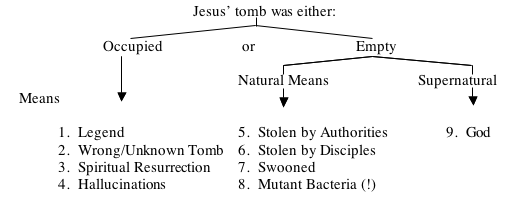
Last week I explained five
historical facts that must be accounted for either to affirm or deny that
Jesus rose from the dead. These facts do not rely on supernatural authority or
a claim that they must be believed because the Bible is inspired Scripture.
Historians,
and not just Christian ones, are in broad consensus that these were factual
events, not claims invented by the church, especially since absent these facts
there is no reason to assume there would have been a church to invent them in
the first place.
Thus,
seriously grappling with the claim that Jesus rose from the dead must include
these facts in the explanation. Explanations must explain. Simply to deny these
facts does not explain them. One might as well try to explain how the Civil War
started while denying that South Carolina ever bombarded Fort Sumter.
Skeptics
of the historical fact of Jesus's resurrection offer explanations that fall
into four main categories:
1. The key actors on Good Friday and Sunday morning
botched what they were doing.
2. Science proves Jesus’s resurrection is impossible.
3. The accounts of Jesus’s resurrection are mythical of
a kind common in the ancient world.
4. The apostles were either deluded or they mounted a
deliberate conspiracy of falsehoods.
The "they botched
it" theories
The "Swoon
Theory"
The first
allegedly-botched job was the crucifixion, in which the Romans incompetently
took Jesus down from the cross unconscious rather than dead. Joseph and the
women entombed Jesus still alive. This is called the “Swoon” theory; it dates to the 1780s.
The swoon
theory says that the coolness of the tomb and Friday’s partial application of
funereal spices made Jesus come to his senses. Before dawn Sunday he rolled
away the stone, and found some workman’s clothes, causing Mary Magdalene to
mistake him for a gardener. So, the swoon theory does explain why the women
found the tomb empty and why the presumed gardener claimed he was Jesus.
But it
assumes that
the brutal flogging that Jesus received from the Romans,
the shredding of his head by a wreath of thorns,
hanging on the cross with nailed hands and feet (with severe physical effects, including dislocation of the shoulders),
and the deep piercing of his chest by a Roman spear,
were all
relatively minor injuries that
left Jesus mentally fully competent,
were not severe enough and evoked too little bleeding to kill or even much weaken him,
insufficiently injured his hands and feet to degrade either his
dexterity or mobility,
left him with enough physical strength to single-handedly roll
away a one-ton stone from the tomb, in the dark.
did not hinder his ability to sneak past an armed guard standing only a few feet from the tomb,
had healed enough so that Mary did not recognize him as the
recently-crucified Jesus.
The swoon
theory also ignores the fact that Jesus would have consumed neither food nor
drink since Thursday evening but apparently suffered no ill effects from 84
hours or so without nourishment or water.
The
theory assumes that Roman soldiers, of all people, did not know how to kill a
defenseless man and ignores that their motivation to make sure Jesus was dead
very great: under Roman military law, Roman soldiers who failed to carry out a sentence properly could be punished by receiving the same sentence to serve instead, meaning the soldiers at the cross were highly motivated to be positive that Jesus and the two thieves crucified with him were dead for sure.
The swoon theory also requires that Joseph and the women who partially prepared
Jesus for burial on Friday did not detect that he still breathed and had a
heartbeat, however weak it may have been. People in ancient times were very
familiar with corpses. There were no funeral homes. Families did that work on
their own. The women friends of Jesus, like any women of the day, knew very
well about –
·livor mortis, the collection of blood
in the lowest parts of a corpse after the heart ceases beating, due to gravity.
Livor mortis causes marked purpling of the body where it occurs and is usually
noticeable starting about 20-30 minutes after death (though full discoloration takes somewhat longer). A man dead on a cross would
have been so colored at around the ankles and shoulders. If Jesus was not dead when
he was removed, livor mortis would not have occurred, and the
women would certainly have noticed.
·rigor mortis, the stiffening of the
limbs of a corpse caused by chemical changes in the muscles. A corpse is highly
resistant to manipulation because of this. To be fair to the swoon theory,
though, it takes between 4-6 hours after death for rigor mortis to
set in. Jesus was entombed by then.
The swoon
theory, then, requires not only that the Roman soldiers blundered the
crucifixion but that the women were blind to the lack of empirical evidence
that Jesus was dead, evidence which was common knowledge in their day.
The swoon
theory does not explain
·why Mary
said Jesus was risen rather than that he survived.
·why Jesus
apparently needed no medical care or convalescence.
·with whom
Jesus lodged after his botched crucifixion, because he is nowhere presented as
hanging out with the disciples.[1]
·why Paul
and James, who had not followed Jesus, said they knew Jesus risen (and Paul
first persecuted Christians).
·why the
Church would begin with such energy and devotion
·why the
apostles suffered hard lives and cruel deaths to insist that Jesus was a risen
Savior rather than merely a lucky convict.
·why the
Romans did not mount a manhunt for the surviving Jesus when we know that when
the Romans wanted you dead, they meant it. (The Romans didn't hunt for Jesus
after the actual resurrection, either, when Peter et. al. were proclaiming him
risen. Why? Because the Romans knew darn good and well they had killed him on
the cross.)
An
explanation, actually to explain, cannot create more unresolved issues than it
tries to solve. The swoon theory thus fails.
The “wrong-tomb” theory
This
theory simply says that on Sunday morning the women mistakenly went to an
unused, open tomb, talked with a gardener whom they mistook for Jesus, then
excitedly told the disciples that Jesus’s tomb was empty and Jesus was risen.
However,
·The women were not looking for an open, empty tomb. They had asked
themselves en route how they would get the stone rolled away. So, when coming
to an open, unused tomb, why didn't they keep going? Wrong-tomb
theorists do not say, except to claim that the women were confused. ("They
went to the wrong tomb because they were confused. How do we know they were
confused? Because they went to the wrong tomb." A bit circular, eh?)
·Having already been to Jesus's tomb on Friday, they knew which
tomb to go to.
The wrong
tomb theory does not explain:
·why the gardener Mary conversed with claimed he was Jesus
·why Mary called him Lord when he knew and she thought that Jesus
was dead elsewhere.
·why the gardener told Mary to tell the disciples he would meet
them in Galilee.
The
wrong-tomb theory also echoes the ancient belief that women could not be
trusted to relate facts rather than addle-headed nonsense. Its unspoken precept
is, “Let me tell you what those idiot women did.”
No
historian concerned about his reputation promotes either the swoon theory or
the wrong-tomb theory any more, but many people still argue them.
"Scientific" objections to
the resurrection
Many
people you will witness to will reply that science shows it to be impossible.
In fact, science shows no such thing. There are some scientists who say the
resurrection is scientifically impossible. But there are many other scientists
who profess religious faith. For example:
“A
scientific discovery is also a religious discovery. There is no conflict
between science and religion. Our knowledge of God is made larger with every
discovery we make about the world.” - Joseph H. Taylor, Jr., who
received the 1993 Nobel Prize in Physics for the discovery of the first known
binary pulsar, and for his work which supported the Big Bang theory of the
creation of the universe.
“Astronomers
… have proven … that the world began abruptly in an act of creation… . And they
have found that all this happened as a product of forces they cannot hope to
discover… . That there are what I or anyone would call supernatural forces at
work is now, I think, a scientifically proven fact”. – Robert Jastrow ,
Astronomer, physicist and founder of NASA’s Goddard Institute of Space Studies.
“The
common belief that… the actual relations between religion and science over the
last few centuries have been marked by deep and enduring hostility… is not only
historically inaccurate, but actually a caricature so grotesque that what needs
to be explained is how it could possibly have achieved any degree of
respectability.” – Colin Russell, Cambridge University historian of
science.
“Both
religion and science require a belief in God. For believers, God is in the
beginning, and for physicists He is at the end of all considerations… To the
former He is the foundation, to the latter, the crown of the edifice of every
generalized world view.” – Max Planck, Nobel Prize physicist, founder
of quantum theory, one of the most important physicists of the 20th century).[2]
Two other
examples are Dr. Francis Collins, director of the National Institutes of Health
and former head of the human genome project, and Dr. John Lennox, professor and
Fellow in Mathematics at Oxford University. There are many others.
Sociologist
Elaine Ecklund surveyed 1,700 scientists and conducted personal interviews with
275 of them at elite American universities, seeking to find out what their
views on religion were. She writes:
After
four years of research, at least one thing became clear: Much of what we
believe about the faith lives of elite scientists is wrong. The [presumed]
‘insurmountable hostility’ between science and religion is a caricature, a
thought-cliché, perhaps useful as a satire on group-think, but hardly
representative of reality.
Professor Ecklund's book is called Science vs. Religion: What Scientists Really Think. A long review with excerpts is here. Most of
the non-religious scientists Ecklund interviewed said that they just were not
interested in religion questions, any more than a Methodist preacher would be
much interested in how to mass produce elemental isotopes. And unlike the rest
of America, younger scientists are more religious than older ones.
So, it is
important to understand the difference between what science, as a discipline,
can do and what scientists may personally believe.
Scientists may deny or affirm the resurrection, but science as a discipline can
neither rebut nor confirm it. Every discipline, science included, is bounded by "limit questions," which are inquiries that the discipline itself cannot answer. For example, science does not and cannot tell you where to take your next vacation. Science is unsuited definitively to answer historical questions. You would think I was joking if I asked for scientific proof that George Washington crossed the Delaware River to fight Hessian forces at Trenton on Christmas 1776, though science may help answer many historical details. The resurrection of Jesus is an historical question that science as a discipline cannot answer. It's not a
scientific question. Every profession or skill or knowledge set is faced with limit questions. Imagine that someone at the end of a concert, you heard the man beside you say, “Speaking as a cardiologist, I have determined that this orchestra’s first violinist is the finest in North America.” Now that may be true, but it’s not a medical question. Similarly, science investigates the natural world and so cannot speak definitively about supernatural events, which is what the resurrection is. One big
reason is that the scientific method can't adequately address miracles. The
error some scientists make is in therefore saying that there are no such things
as miracles.
Scientific
integrity requires that scientists and non-scientists alike recognize that
there are limits to scientific knowledge. Failing this is the main error of the
so-called New Atheist movement, whose advocates insist that
·only science reveals the Real,
·only science can discover truth
·scientific knowledge is exhaustive and inherently unlimited.
But these
claims are themselves not testable with the scientific method. They are not
scientific claims, but claims of faith in science, or scientism. Richard
Lewontin, an evolutionary biologist and geneticist, explained in The
New York Review of Books in 1997 (link) that
scientism has a ...
... prior
commitment to materialism. It is not that the methods and institutions of
science somehow compel us to accept a material explanation of the phenomenal
world, but, on the contrary, we are forced by our a priori adherence
to material causes to create an apparatus of investigation and a set of
concepts that produce material explanations ... . Moreover, that materialism is
absolute, for we cannot allow a Divine Foot in the door.
But
nothing about Jesus' resurrection overturns science at all. Before he was Pope
Benedict, Cardinal Ratzinger wrote that the resurrection is
... no
contradiction of clear scientific data. The Resurrection accounts … speak of
something new, something unprecedented -- a new dimension of reality that is
revealed. What already exists is not called into question. Rather we are told
that there is a further dimension, beyond what was previously
known.
Hypothesis
one: We’re not talking about a literal resurrection. Perhaps it is just an
inspiring myth that served to justify the propagation of Jesus’ exalted ethical
teachings. A literal resurrection contradicts the known laws of nature. Maybe
scientists can celebrate the idea of Jesus’s spirit living on, while his body
remained in the grave.
Hypothesis
two: We really believe in the bodily resurrection of the first century Jew
known as Jesus of Nazareth. My Christian colleagues at MIT – and millions of other
scientists worldwide – somehow think that a literal miracle like the
resurrection of Jesus is possible. And we are following a long tradition. The
founders of the scientific revolution and many of the greatest scientists of
the intervening centuries were serious Christian believers.
Hypothesis
3: I was brainwashed as a child. ... But no, I did not grow up in a home where
I was taught to believe in the resurrection. I came to faith in Jesus when I
was an undergraduate at Cambridge University and was baptized in the chapel of
Kings College on my 20th birthday.
Hypothesis two wins:
To
explain how a scientist can be a Christian is actually quite simple. Science
cannot and does not disprove the resurrection. Natural science describes the
normal reproducible working of the world of nature. Indeed, the key meaning of
“nature”, as Boyle emphasized, is “the normal course of events.” Miracles like
the resurrection are inherently abnormal. ...
Today’s
widespread materialist view that events contrary to the laws of science just
can’t happen is a metaphysical doctrine, not a scientific fact. What’s more,
the doctrine that the laws of nature are “inviolable” is not necessary for
science to function. Science offers natural explanations of natural events. It
has no power or need to assert that only natural events happen.
So if
science is not able to adjudicate whether Jesus’ resurrection happened or not,
are we completely unable to assess the plausibility of the claim? No. Contrary
to increasingly popular opinion, science is not our only means for accessing
truth. In the case of Jesus’ resurrection, we must consider the historical
evidence, and the historical evidence for the resurrection is as good as for
almost any event of ancient history.
Much more here:
The Mythical Story theory
The next
rebuttal of the resurrection is the claim that stories about a divine hero
dying and returning to life were a dime a dozen among ancient peoples and that
Jesus's resurrection is just another example. In this claim, “Jesus Christ is a
mythological character along the same lines as the Greek, Roman, Egyptian,
Sumerian, Phoenician, Indian or other godmen, who are all presently accepted as
myths rather than historical figures.” [4]
However,
experts in the field are not making this claim. Professor Norman Geisler of
Loyola University explains, “No Greek or Roman myth spoke of a literal
incarnation of a monotheistic God into human form by way of a literal virgin
birth, followed by his death and physical resurrection.”
Nor were
such stories very common at all. Only about fifteen such ancient stories are
identified by claimants. British scholar Norman Anderson argues,
The basic
difference between Christianity and the mysteries is the historic basis of one
and the mythological character of the others. The deities of the mysteries were
no more than ‘nebulous figures of an imaginary past,’ while the Christ whom the
[apostles] proclaimed had lived and died only a few years before the first New
Testament documents were written.
As Peter
told the people of Jerusalem on Pentecost, you know this Jesus of whom I speak.
Peter was not referring to a mythical figure of a hazy, distant past, but one
whom his hearers had known personally.
Furthermore,
“Most of the evidence for the alleged similarities from the pagan myths date
between the second to fourth centuries,” [5] long after the New Testament had
been written. If anything, most of those ancient myths are likely based on
Jesus rather than the other way around.
Also,
myth theorists must explain why the fiercely monogamous Jews would have adopted
pagan myths to promote the Jewish Jesus and why they would have falsely claimed
Jesus dead and risen when the existing, well-developed concept of the messiah
had never included such a concept.
Finally,
the pagan-myth hypothesis makes no attempt at all to grapple with the
historical facts that are, well, facts, not myth.
For a more scholarly presentation, here is Dr. William Lane Craig:
The apostles were deluded
or frauds
Last is
the claim that the apostles were either deluded or they mounted a deliberate
conspiracy of falsehoods. Almost no one claims any more that the apostles were
deliberately lying because, as J.P. Moreland put it,
The
disciples had nothing to gain by lying and starting a new religion. They faced
hardship, ridicule, hostility, and martyr's deaths. In light of this, they
could never have sustained such unwavering motivation if they knew what they
were preaching was a lie. The disciples were not fools and Paul was a
cool-headed intellectual of the first rank. There would have been several
opportunities over three to four decades of ministry to reconsider and renounce
a lie.
Charles
Colson served Richard Nixon as "Special Counsel to the President" and
was a key player in the Watergate conspiracy that finally led to Nixon's
resignation. Colson was in fact one of the "Watergate Seven," the
core conspirators, and he was the first Watergate conspirator
to be sent to federal prison. In prison, Colson became a devout Christian;
after release he spent the rest of his life in evangelism, especially prison
ministries.
Here is
what he once said about the idea that Jesus was not really raised from the dead,
that the whole resurrection story came from collusion by the disciples:
I know
the resurrection is a fact, and Watergate proved it to me. How? Because 12 men
testified they had seen Jesus raised from the dead, then they proclaimed that
truth for 40 years, never once denying it. Every one was beaten, tortured,
stoned and put in prison. They would not have endured that if it weren't true.
Watergate embroiled 12 of the most powerful men in the world - and they
couldn't keep a lie for three weeks. You're telling me 12 apostles could keep a
lie for 40 years? Absolutely impossible.
Let’s
look at the delusion angle. Today’s leading figure in promoting this
theory is German scholar and self-admitted atheist Gerd Ludemann, who says
in What
Really Happened to Jesus that the apostles
undeniably believed what they proclaimed, but were so psychologically
distraught from the cruel death of Jesus that they all suffered exactly the
same hallucination that Jesus was alive again. Ludemann says that the source of
the disciples’ visions were psychological processes which occurred “completely
without divine intervention.” Therefore, “A consistent modern view must say
farewell to the resurrection of Jesus as a historical event.”
(Ludemann
taught for several years at Vanderbilt Divinity School, the source of my own
M.Div. I began there just after he had returned to Germany so I did not study
under him. However, What Really Happened to Jesus was an
assigned book in my New Testament class.)
On its
face the delusion theory seems plausible. But I would submit that it fails for
these reasons:
·First, delusion theory presumes from the outset that the
resurrection is false. When its greatest proponent is a self-described atheist,
it sort of gives the game away. That is, its intention is to conclude what it begins
with.
·Second, the delusion theory does not explain why the tomb was
empty or why deluded apostles would admit that a woman first bore the Easter
message.
·Third, that the apostles’ delusion was caused by their
psychological need to regain company with Jesus is suspect because the
pre-resurrection disciples seem less devoted to Jesus than the theory demands.
John 11, for example, records that eleven of the twelve were so upset with
Jesus that they wanted to quit and go home, staying only because Thomas talked
them into it. Every disciple abandoned Jesus to his fate when he was arrested,
hardly evidence of such intense love and loyalty that they would later see
hallucinations of Jesus alive.
·Fourth, the theory does not explain why Paul and Jesus's brother
James became deluded as well. Neither man followed Jesus before his death; Paul
never even met him. Ludemann simply dodges this question altogether.
·Fifth, Ludeman assumes that the psychology of each of the disciples
was identical and that they each spontaneously reacted mentally to Jesus’ death
in exactly the same way. But this is a mere assumption necessary to make
delusion theory work. It also assumes that their delusion was contagious and
that Thomas could be “infected” by it when he had emphatically rejected the other disciples' testimonies and instead demanded literally tangible,
physical proof.
Finally,
such a delusion seems unique in the entire world, having never occurred
before or since. Ludemann attempts to show analogous delusions in other figures
or groups of people in other historical occasion, but the examples are present only
superficial similarities; most are actually more dissimilar than similar.
If the apostles were deluded, then I want that same delusion! It is a delusion
that inspires people to become the finest they can be, to exhibit and live the
highest virtues and to order their lives around love, integrity, faithfulness
and devotion to the good of all. Delusion? May we all hope to be equally
deluded.
Summary
I will
leave the summary to Dr. Holly Ordway, Ph.D. (U-Mass. Amherst), a professor of
literature in Texas. She grew up atheist, convinced that belief in a deity was
mere superstition. But in 2012, she was baptized into the Catholic Church and
since has written several works on Christian literature. In an interview,[2] she
said,
There
were many pieces of evidence that all fit together to make a convincing case
for the Resurrection [of Jesus]; I’ll mention just a couple here. One of them
is the behavior of the disciples before and after the Resurrection. The Gospel
accounts do not portray their behavior after the Crucifixion in a particularly
flattering light. Even though Jesus had predicted his own resurrection, the
disciples gave up and went away, assuming that Jesus was a failed messiah. If
the disciples had made up the Resurrection story afterwards, why would they
have included details that made them look disloyal and cowardly? My academic
studies in literature allowed me to recognize that the Gospels were written as
history, not myth or parable, and that there hadn’t been enough time for a
legend to form. It began to seem like the best explanation for all these events
being recounted this way, was that they really happened.
Then,
after the Resurrection, there’s a complete turn-around in their behavior, and
they become bold proclaimers of the Risen Lord. There were plenty of words that
people in ancient times could have used to describe visions or sightings of
ghosts, and indeed, such language would have gotten them in much less trouble!
But they spoke of a Jesus who was alive, bodily resurrected, and in short order
were willing to die for that claim.
Perhaps
the most convincing evidence for the Resurrection, though, was the Church
itself. If I supposed that the Church had invented the Resurrection to explain
its own worship of Jesus, I had to ask, how did that worship arise in the first
place? If the Church was not the result of a miracle, it was itself a miracle.
It’s
important to say that there was no single, knock-out piece of evidence that
convinced me; I was convinced by the cumulative claim, the way it all fit
together. Historical events can’t be proved like a math problem or tested like
a scientific hypothesis, and there’s always a way to form an alternate
explanation. But just because an alternative exists doesn’t mean it’s is
equally reasonable or likely. Speaking within my own field of literature, there
are people who claim that William Shakespeare didn’t really write his plays.
There are even a few legitimately fuzzy areas: for instance, a few of his plays
were co-authored, and it seems likely to me that at least one passage in
Macbeth (Hecate’s speech) was a later interpolation. Nonetheless, the evidence
taken as whole points to Shakespearean authorship!