Showing posts with label Current Events. Show all posts

Monday, March 23, 2020

The coming crash and what it portends

If we continue on the present course, we will enter a depression that might make the 1930s a distant competitor. The number of jobless Americans could reach tens of millions.


WSJ: Rethinking the Coronavirus Shutdown:
Yet the costs of this national shutdown are growing by the hour, and we don’t mean federal spending. We mean a tsunami of economic destruction that will cause tens of millions to lose their jobs as commerce and production simply cease. Many large companies can withstand a few weeks without revenue but that isn’t true of millions of small and mid-sized firms. ...

The deadweight loss in production will be profound and take years to rebuild. In a normal recession the U.S. loses about 5% of national output over the course of a year or so. In this case we may lose that much, or twice as much, in a month.

Our friend Ed Hyman, the Wall Street economist, on Thursday adjusted his estimate for the second quarter to an annual rate loss in GDP of minus-20%. Treasury Secretary Steven Mnuchin’s assertion on Fox Business Thursday that the economy will power through all this is happy talk if this continues for much longer.
This is the first time ever that the US Government has deliberately shut the economy down, and the idea that it can just be turned back on like flipping a switch is delusional.

Consider: We will never be able to determine how many lives were saved from the virus. But we will easily know how many people died because of the economic crash to come - just count increased suicides and even some homicides, to say nothing of untold numbers of people thrown into permanent poverty.

The lockdowns and stay-at-home orders are saving lives now. But if they continue much longer, they will cost lives later and cause economic, literal suffering for years and years to come.

Also, The Atlantic, "Suicide and the Economy."
On April 12, 1937, the express train to New York roared across the New Jersey countryside. The train, a Pennsy Railroad electric locomotive the color of bull’s blood, usually passed through the station at Elizabeth at about 50 miles per hour. On this particular morning, it came to an unanticipated stop. As the express rounded the curve, my great-grandfather jumped down from the platform, where witnesses reported he had been pacing for 10 minutes, and lay down across the tracks.

When the engineer was finally able to halt the train 100 feet past the platform, Roy Humphrey had disappeared beneath its wheels. His last act: raising his head to look at the oncoming train.

Roy was one of at least 40,000 Americans who took their own lives that year and the next, the two-year span that suicide rate spiked to its highest recorded level ever: more than 150 per 1 million annually. 
Related: Why we cannot afford 99-cent gasoline.

Update:

"US unemployment could surge to 30% next quarter and GDP might plunge 50%, Fed's Bullard warns"

Also relevant: "The luxury of apocalypticism -- The elites want us to panic about Covid-19 – we must absolutely refuse to do so."

The point is, there is such a thing as doing too little and also such a thing as doing too much. Doing too little against Covid-19 would be perverse and nihilistic. Society ought to devote a huge amount of resources, even if they must be commandeered from the private sector, to the protection of human life. But doing too much, or acting under the pressure to act rather than under the aim of coherently fighting disease and protecting people’s livelihoods, is potentially destructive, too. People need jobs, security, meaning, connection. They need a sense of worth, a sense of social solidarity, a sense of belonging. To threaten those things as part of a performative ‘war’ against what ought to be treated as a health challenge rather than as an End Times event would be self-defeating and utterly antithetical to the broader aim of protecting our societies from this novel new threat. To decimate the stuff of human life in the name of saving human life is a questionable moral approach.
And why cheap gasoline is unaffordable.

Thursday, March 12, 2020

Going viral in faith and hope

There is an old Army saying we would joke with one another in times of stress or danger, “When everyone around you is losing their heads, and you’ve kept yours – well, then, you simply do not understand the situation!”


Perhaps the most stressful word in our language today is “Coronavirus,” also called Covid-19 (Coronavirus disease 2019). It seems to have come out of China so suddenly, and so apparently lethally, that we can almost understand how the ancient Egyptians might have felt coping with the plagues because they would not let the children of Israel go.

Fear or faith? Or fear with faith?

There are many admonishments and teachings about fear in the Bible. Some examples:

Isaiah 41:10 – Fear not, for I am with you; be not dismayed, for I am your God; I will strengthen you, I will help you, I will uphold you with my righteous right hand.

2 Timothy 1:7 – For God gave us a spirit not of fear but of power and love and self-control.

Psalm 34:4 – I sought the Lord, and he answered me and delivered me from all my fears.

So, is fear a reasonable response by Christian people to the onset of this virus? Is fear of this virus something Christian people may experience while remaining faithful to God?

I say the answer to both questions is yes.

Fear is an emotional response to uncertainty or threat. And the virus is a threat, though to what degree is still uncertain. The cautions against fear in Scripture do not tell us never to experience such reactions. They do tell us not to be governed by fear but to be self-controlled and reliant on God to sustain us mentally and emotionally. “Perfect love,” says 1 John 4.18, “drives out fear.” That does not mean that because we love God and one another, we are magically immunized from the virus. It means that through love we will govern what we do far better than through fear. After all, “God has not given us a spirit of fear, but of power and of love and of a sound mind” (2 Timothy 1.7).

But let me be clear about this, too: this virus has the real potential to be very serious in the United States. I will not repeat the estimates of possible infections that we have heard. They vary wildly and I have no credentials either to rebut or affirm them.

Instead, I want to say what I will do as your pastor regarding our life together, particularly when we gather for weekly worship.

We Gather Together - wait, can we still do that?

First, whether there is coronavirus or not, persons who are ill for any reason should stay home and tend to themselves. In the present day, though, being ill from any cause heightens vulnerability to the virus.

The virus attacks the elderly more harshly than the young and is more serious for anyone already dealing with other conditions, such as heart issues, diabetes, and medical (not physical) disorders. So, if such persons elect to suspend attending worship for awhile, I cannot argue with them.

That said, I hope everyone will understand that there is no special threat from going to church that is not found anywhere else. So, suspending church attendance for a time will do no good if one keeps a full schedule of activities the rest of the week!

At the church

Starting this Sunday, I will not shake hands with anyone at church (or, well, anywhere else). I will instead greet you with the centuries-old hand sign of Christian benediction, with the thumb and two fingers representing the Father, Son, and Holy Spirit.

Second, I will try to minimize us handling hymnals and other objects in the sanctuary as much as we have done until now. This will likely cause abbreviated congregational singing for a time. We may simply sing hymns by request – at least the first verse or so! But weekly cleansing of hymnals is not practical.

This Saturday, I will personally go to both sanctuaries and sanitize pew backs, doorknobs, and other surfaces that are “common touch” by worshipers. I will not refuse volunteers to help for the long term!

We will stop passing the offering plates and instead place them at both ends of the sanctuary so you may leave your offering there when you enter or exit.

We will use online media such as YouTube and our Facebook page to worship "virtually," though simulcasting is probably not in the cards.

What about Communion?

We will continue to serve Communion exclusively with individual pieces of bread and separate cups, as is our usual practice. But no one will make physical contact with either the bread or the wine except you, when you consume them. Servers will use small tongs to place a Communion wafer in your hands and we will take similar precautions with the cups.

What can we all do now?

Pray.

Serve one another in love. Persons who are in the elevated risk by age or condition – please call me if you do not want to take the risk of going to the store for groceries or other essentials and I will go for you.

Take precautions to protect yourself.

Rely on God for strength not to be governed by fear.

Worship in Spirit and in truth.

Sorry, but this needs to be said, also

As I said, I will take no issue with persons not attending worship because of concerns over the virus. But there is no delicate way to put this: even if you stay home, your tithe or offering should not.

The missions, ministries, and financial obligations of the church are ongoing. You may mail your offerings to the church or use our online giving service at https://get.tithe.ly/, or just scan this QR Code on your smart phone:


I close with a note from my colleague and friend, the Rev. Jeremy Squires:
Jesus’ message is unique because of its excessive amount of concern for the vulnerable. At its best, the Church has championed the cause of the “least of these”, as Matthew 25 has it. Christians are rarely more incarnational than when they say: society may consider you expendable, but we won’t.
No matter what the future brings, God is already there. There is nothing that can separate us from the love of God in Jesus Christ!

Tuesday, March 3, 2020

Is health care a human right? No.

I first wrote this in 2009, but it seems relevant to today as well; I have updated it.

Is health care a human right, as the United Methodist Church says? I don't see how. Human rights, as Americans have always understood them (beginning with Thomas Jefferson and the other Founders) are a fact of nature that cannot be rescinded by human beings. Rights are immutable, indeed, unalienable ("Not to be separated, given away, or taken away" Dictionary.com, as Jefferson wrote in the Declaration of Independence.)  As a precursor to his Declaration theology that unalienable human rights are a endowment by God, Jefferson wrote in his pre-revolution essay, Summary View of the Rights of British America, " The God who gave us life gave us liberty at the same time. The hand of force may disjoin, but cannot destroy them."

Since his day, and certainly preceding it, the historic American understanding of human rights is the
exercise of individual freedom, especially in the political realm, for both public and personal good. We have historically never understood our rights as encompassing access to services or commodities.

Rights are inherent in each individual equally, they are not divisible. Take the Declaration's famous insistence that among human rights is "the pursuit of happiness." Note that it is the
pursuit of happiness that is a right, not the achievement of it. Nor is one person more entitled to pursue happiness than another, no matter one’s station in life. Besides, happiness (what Jefferson meant was not happiness as we use the word today, but a state of contentment in life and possessions) is not something that can be given us, it is something we have to create.

It does sound all high-minded to say that, like rights, health care should be equal for everybody, which I suppose is why clergy are so susceptible to say so. It's more than obvious that no one in the Congress or the White House believed it in 2009 when Obamacare was enacted. If they had, the act would have required members of Congress and the rest of the federal government to fall under the "public option" along with the rest of us proles. But they’
ve protected their turf completely and much better turf is theirs than ours. I’ll believe that equal access and care for everyone is a moral imperative when the people who say it is a moral imperative place themselves under the same imperative.

The presumption that health care is a right, and therefore must be equal for everyone, is founded on two critical errors of understanding. The first is that health care is a resource that is simply available for those who need it, or that can be made equally available through proper legislation and regulation. The second error is that medical care and access to it can be rationed by command more equally, economically and fairly than by demand.


Health care is not a resource to be exploited

Medical facilities and doctors are not phenomena of nature, like water or petroleum are. Hospitals don’t just appear. They are produced. Medical care is not a resource that can be "mined" through more regulation to be more plentiful. Medical care is a
service


Specifically, it is a contracted service, in much the same way that legal assistance, automotive maintenance or pastoral care are services. Why? Because men and women choose of their own accord to get medical training. Once graduated, doctors, nurses, paramedics and technicians of various kinds reasonably expect that they will be compensated at a rate greater than their costs to enter the profession, greater than their extremely high overhead to run the practice, and enough to make their grueling hours materially worthwhile for themselves and their families.

This fact has very direct consequences under the Medicare and Medicaid systems we have today.
The Atlantic's business journalist Meg McArdle explains:

[W]e have a comprehensive national health care plan for seniors. Yet we have a shortage of geriatricians, the one specialty that you would think would be booming. Why? Because Medicare sets a single price for the services of geriatricians, and it is low. Since the field is not particularly enticing (though arguably it really should be, since geriatricians have extremely high job satisfaction compared to many more popular specialties), very few people go into it. It's one of relatively few specialties that consistently has most of its slots and fellowships unfilled.
Moreover, the skills and equipment a doctor or hospital possess are their individual property, not the property, even partially, of the state or public. (There are publicly-owned facilities such as VA hospitals, but in operation there is no difference to the general public between them and private facilities). No one has a natural right to someone else's property. To think we do directly violates the Tenth Commandment. As McArdle says, "People have no obligation to perform labor for others. I may not [justly or legally] force a surgeon to save my mother at gunpoint."

That means that to receive a doctor's services, the doctor and a patient must come to a mutually-agreeable arrangement of what medical care will be provided in exchange for a specified fee. This is a commercial transaction no different in type than hiring a plumber, cab driver or lawyer. That medical services may be life critical does not change the fundamental nature of the contract.

We have access to medical care only as long as a doctor is willing to provide it. No one has to become a doctor or continue in medical practice. If any "reform" of the present health care system reduces the rewards of practicing medicine or complicates the practice, fewer men and women will so choose. Access will then go down for everyone and costs will inevitably rise, no matter what the rate-payment of the public option is, because access or its lack is itself a cost and also drives other costs.


Health care is a service

As
Michael Keehn explains, health care is a service but not a community service. Police and fire departments provide community services. That seems obvious enough, but consider: fire departments do not protect your home individually. The fire chief definitely will let it burn to the ground if firefighting needs are greater elsewhere in the town. Just look at what is happening near Los Angeles as of the date of this post. Police and fire protection are in fact rationed to protect the lives and property of the greatest number of people possible with the resources available. But when the resources (manpower, equipment or money) run out, individuals are exposed to greater danger or loss though the community at large may still be protected.

Individual residents of a city do not contract for their community’s police or fire protection. When you call 9-1-1 because someone broke into your home while you were in bed, you don’t have to sign a contract with the police when they arrive, specifying the actions you want them to take and how much you are going to pay.

In contrast, medical care is an individual service. Doctors do not provide their services to the community as a whole, but to individuals. Because of that, each patient enters into a contract with his/her doctor specifying the medical services to be received and how much it will cost. This is mostly mediated through insurance companies, of course, which greatly simplifies the contracting process. The result is that a patient 's health is protected in a way that their safety or homes are not protected by the police or fire departments.

Interestingly, the Roman Catholic Church rejects the idea that health care is a human right. The Most Reverend R. Walker
Nickless, bishop of the Diocese of Sioux City, Iowa, explains.

[T]he Catholic Church does not teach that “health care” as such, without distinction, is a natural right.

The “natural right” of health care is the divine bounty of food, water, and air without which all of us quickly die. This bounty comes from God directly. None of us own it, and none of us can morally withhold it from others. The remainder of health care is a political, not a natural, right, because it comes from our human efforts, creativity, and compassion.
Like any human endeavor, health care is finite. It can be properly understood only as such. Any reform that treats medical care as if it can be made infinitely available is a product of cloud-cuckoo land. Medical care, like every other finite thing, must be allocated. The current buzzword for that is "rationed." That’s the foundation of the second critical mistake people are making about health care, that medical care and access to it can be rationed by the government more equally, economically and fairly than by consumers. 

Philip Barlow, Consultant neurosurgeon at Southern General Hospital, Glasgow, explains why "Health care is not a human right." 

Update, March 2020: In 2009. Philip Niles wrote that the real question is not whether health care is a human right, but "How much health care is a human right?" His essay is no no longer online. It is a good question because since medical care is finite. He says, 
With all of the emotional and financial investment in health care, it is important to address the situation with an actionable approach - not an ideologic one.  My suggestion is to quantify just HOW MUCH health care we believe is "right" to provide, recognize that we should cap public health care spending, and focus the moral/fiscal debate on how high that cap should be set.  Let's achieve our ambitions of providing access for the uninsured with the most likely way of succeeding: by haggling about the price.
There is always a price to be paid, one way or another. What politicians seeking votes seem to do is ignore that price (paid by the consumer) and cost (borne by the provider) are not the same. When a political candidate promises free health care for everyone, they conveniently ignore that free care is simply, literally impossible. 

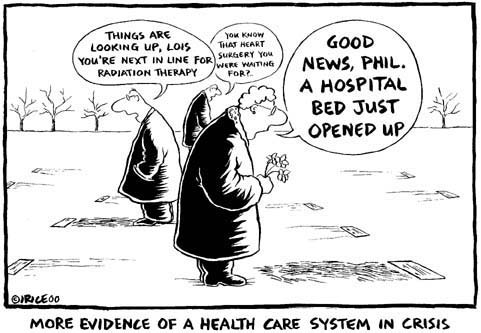
Look at it this way: as I write, we are in the midst of the coronavirus concerns, with a few thousand died from it worldwide and several in the US, where cases are rising. Now imagine you are a government-employee administrator for Medicare For All the next time such a potential pandemic arises -- and most assuredly there will be a next time. 


You have to choose between funding two heart-replacement surgeries plus rehab routines or funding the testing of 50,000 potential virus infectees for the illness. You do not have the funds to do both. 


Which do you choose? Why? And what do you respond when the untreated persons demand it anyway because it is a human right? 


There is always this question: Who pays and in what coin? One candidate this year had either the temerity (or carelessness) to tell his audience the day before the S.C. primary, "Your taxes are going to be raised" to pay for Medicare For All. How much will taxes be raised? He did not say, but presumably they will raised an amount corresponding to the cost of providing the medical care to the population. In other words, everyone will still pay an insurance premium now called taxes, and the tax rate will never go anywhere but up. Why? Because every other nation with "free" health care finds it over-utilized and under-resourced. 


Take Canada, for example, which many politicos say can be a model for us. In reality ...
... Canadians' out-of-pocket health costs are nearly identical to what Americans pay—a difference of roughly $15 per month. In return, Canadians pay up to 50% more in taxes than Americans, with government health costs alone accounting for $9,000 in additional taxes per year. This comes to roughly $50 in additional taxes per dollar saved in out-of-pocket costs.  Keep in mind these are only the beginning of the financial hit from "Medicare for All." 
Canada's public system does not cover many large health costs, from pharmaceuticals to nursing homes to dental and vision. As a result, public health spending in Canada accounts for only 70% of total health spending. In contrast, Medicare for All proposals promise 100% coverage. This suggests the financial burdens on Americans, and distortions to care, would be far greater than what Canadians already suffer. ...  
More serious than the financial burdens is what happens to quality of care in a government-run system. Canada's total health costs are about one-third cheaper than the U.S. as a percent of GDP, but this is achieved by undesirable cost-control practices. For example, care is ruthlessly rationed, with waiting lists running into months or years. The system also cuts corners by using older and cheaper drugs and skimping on modern equipment. Canada today has fewer MRI units per capita than Turkey or Latvia. 
Moreover, underinvestment in facilities and staff has reached the point where Canadians are being treated in hospital hallways. Predictably, Canada's emergency rooms are packed. In the province of Quebec, wait-times average over four hours, leading many patients to just give up, go home and hope for the best.
The piper must always be paid. And so it shall be for us, but both in currency and in other than money. Medical care is always rationed. Always. And the rationing takes place within three areas:
  1. Price to the consumer, presently mediated through 
    1. insurance premiums and co-pays, and
    2. Medicare and co-pays and Medicaid.
    3. Under MFA, those will be taxes and HHS.
       
  2. Quality of the care provided, mediated through 
    1. the training of the physicians, nurses, and other medical staff
    2. the quality and availability of medical supplies and equipment.
    3. costs of the providers as related to price to the consumers.
       
  3. Availability of the care, mediated 
    1. always through the number of practitioners and where they work, and that is almost always mediated through compensation,
    2. and by what medical specialties they practice, noting that this is heavily related to compensation also (see Megan McArdles' observation above). 
    3. by limiting or even eliminating medical for some demographics, say by age, as now-suspended presidential candidate Mike Bloomberg said explicitly.
What we are falling into in this debate is the "Do something!" fallacy: 
  1. The status quo is deficient, so something must be done!
  2. This is something.
  3. Therefore, this must be done. 
Absolutely anything can be justified by that template - and is being justified. But remember: medical care is always rationed, either by price and cost, or by quality, or by availability. When we go to the polls in November, we will not be voting for free health care for everyone. We will be voting only for how we want health care rationed in the coming years, and we will be merely hoping without any evidence anywhere in the world that it will be better than what we have now. 


Her is The New York Times in 2009: "Why We Must Ration Health Care."
Health care is a scarce resource, and all scarce resources are rationed in one way or another. In the United States, most health care is privately financed, and so most rationing is by price: you get what you, or your employer, can afford to insure you for. But our current system of employer-financed health insurance exists only because the federal government encouraged it by making the premiums tax deductible. That is, in effect, a more than $200 billion government subsidy for health care. In the public sector, primarily Medicare, Medicaid and hospital emergency rooms, health care is rationed by long waits, high patient copayment requirements, low payments to doctors that discourage some from serving public patients and limits on payments to hospitals.

The case for explicit health care rationing in the United States starts with the difficulty of thinking of any other way in which we can continue to provide adequate health care to people on Medicaid and Medicare, let alone extend coverage to those who do not now have it.


This is not where are now except for the VA. Which should tell us something.

Forbes covered the way health care works (well, doesn't work) in Britain: "Britain's Version Of 'Medicare For All' Is Struggling With Long Waits For Care."


Consider how long it takes to get care at the emergency room in Britain. Government data show that hospitals in England only saw 84.2% of patients within four hours in February. That's well below the country's goal of treating 95% of patients within four hours -- a target the NHS hasn't hit since 2015. Now, instead of cutting wait times, the NHS is looking to scrap the goal. ...  
The NHS also routinely denies patients access to treatment. More than half of NHS Clinical Commissioning Groups, which plan and commission health services within their local regions, are rationing cataract surgery. They call it a procedure of "limited clinical value." It's hard to see how a surgery that can prevent blindness is of limited clinical value. Delaying surgery can cause patients' vision to worsen -- and thus put them at risk of falls or being unable to conduct basic daily activities.  
"It's shocking that access to this life-changing surgery is being unnecessarily restricted," said Helen Lee, a health policy manager at the Royal National Institute of Blind People.  
Many Clinical Commissioning Groups are also rationing hip and knee replacements, glucose monitors for diabetes patients, and hernia surgery by placing the same "limited clinical value" label on them. Patients face long wait times and rationing of care in part because the NHS can't attract nearly enough medical professionals to meet demand. At the end of 2018, more than 39,000 nursing spots were unfilled. That's a vacancy rate of more than 10%. Among medical staff, nearly 9,000 posts were unoccupied.
But don't worry. We will be promised that it will different here. But there is zero reason to believe that American politicians and bureaucrats are magically more generous, more compassionate or smarter than Britain's. 

Or for that matter, Canada's, where the government determines medical care, and so uses that power to favor selected constituencies. In Canada, rare but expensive medical treatments go grossly underfunded while the government spends enormous sums on cheap treatments and meds that vast numbers of voters use. Like this:
A girl who died of leukemia was given a final send off after her friends signed her casket with loving messages on January 30.  
[…]Laura might have experienced a few more milestones if a Hamilton, Ontario, Canada, hospital had been able to accommodate a bone marrow transplant for the young woman. Numerous donors were a match with Laura and ready to donate, but Hamilton’s Juravinski Hospital didn’t have enough beds in high-air-pressure rooms for the procedure. Hospital staff told her they had about 30 patients with potential donors, but the means to only do about five transplants a month.  
[…]Dr. Ralph Meyer, Juravinski’s vice-president of oncology and palliative care, told Ontario’s TheStar.com there are plenty of others facing the same situation as Laura in Canada.
Free birth control immediately? Check. Free needles to inject illegal narcotics? Check. Free condoms? Check. Free abortions on demand? Check. Life-saving operation for a single leukemia patient? Not a chance. Leukemia patients are too few to form a voting block, so let 'em die. 

Then there is the Catholic-run hospice in Canada that the government is requiring closure because it refuses to kill its patients
A hospice in Canada has lost its funding and is being forced to close after refusing to offer and perform medically assisted suicides. The Irene Thomas Hospice in Delta, British Columbia, will lose $1.5 million in funding and will no longer be permitted to operate as a hospice as of February 25, 2021. 
Fraser Health Authority, one of the six public health care authorities in the province, announced on Tuesday that it would be ending its relationship with the hospice over its refusal to provide medically assisted deaths to its patients.
Anyone who thinks that none of this can happen under Medicare For All is living on a different planet than the rest of us. 

Friday, August 9, 2019

Rule Number One: Don't be stupid

One would think that in the wake of the horrific mass murders in El Paso and Dayton, that people would understand that everyone's anxiety is elevated about copycat attackers. But apparently, not everyone thinks about that.

Case number one: Panic in Springfield Walmart as man walks around with tactical rifle wearing body armor in Missouri (CBS).
Springfield, Mo. – Police here say they arrested a man who went into a Walmart store Thursday with a rifle around his neck and wearing body armor and military-style clothes, prompting terrified shoppers to flee. Springfield police tweeted that "an armed individual" was confronted and arrested. No shots were fired.

CBS Springfield affiliate KOLR-TV says Lt. Mike Lucas told reporters police got a call about an active shooter at 4:09 p.m. and arrived within three minutes. According to Lucas, a 20 year old put on body armor in the parking lot, then walked inside with a tactical rifle around his neck and a handgun on his side. He had more than 100 rounds of ammunition, according to The Springfield News-Leader.
The manager pulled the fire alarm and people headed for the exits. Smart thinking. The gunman never pointed his rifle at anyone. He did take smart-phone video of the scene (police think he was Facebook live streaming) and then walked out of the store, where he was confronted by a legally-armed former firefighter, who held him at gunpoint until police arrived about three minutes later. Police have neither released the man's name nor established his motive. The police lieutenant at the scene told reporters, "He is lucky to be alive." And he is right. The armed former firefighter who held him at gunpoint police arrived showed remarkable restraint, IMO.

Here in Tennessee there is no such thing as a "concealed" carry permit. The law requires a permit to carry at all, whether concealed or "open carry," which the term of art for carrying a firearm unconcealed.

Not a long time ago I was in a Best Buy where I saw a man - not a staffer - wearing a full-size semiauto pistol on his right hip, not tucked inside his shorts. When he turned I saw he was wearing another one in the middle of his back. And then by gosh he was wearing a third one on his left hip. Fortunately, he was turning to head for the doors and he left the store.

This is not something mentally healthy men do, regardless of having a carry permit or what the Second Amendment says. It was legal, yes (assuming he had a permit, I sure did not inquire) but it was stupid. And there are times when stupidity brings on its own penalty, as the police lieutenant in Springfield implied.

Case Number 2Florida man who asked Walmart clerk about a gun to kill people was 'making political statement'

In Port St. Lucie - at another Walmart (what is it about dumbbells and Walmarts?) - a man identified as Phil Attey, an anti-gun activist, walked into a Walmart "and asked the clerk about a gun to kill people with."
"Can you sell me anything (or a gun) that would kill 200 people?" When the worker replied, "That isn't funny," Attey said, "I know," and asked again if they could sell him anything that would kill 200 people.
Police were called, but Attey had left the store by the time they arrived, so this APB was put out.


Attey was soon apprehended but not charged since he had not made actual threats and no one was harmed.
He admitted to WPTV the remark was in poor taste, but he was trying to make an anti-gun statement because he saw someone who looked like a white nationalist purchase a gun.
If you know what "someone who looked like a white nationalist" means, then you are ahead of me on that.

Case Number 3SunTrust Park worker allegedly threatened to ‘blow up’ stadium, ‘shoot everyone there. That's the Braves' stadium.
A man who worked at SunTrust Park is behind bars after getting into an argument with
Jamar Antonio Golfin, police photo
his boss and threatening to “blow up” the stadium and “shoot everyone there,” according to his arrest warrant.

Jamar Antonio Golfin, 30, has been in jail since Saturday on a felony charge of making terroristic threats or acts, Cobb County jail records show.

Golfin, a temporary employee assigned to clean a seating area of the stadium, got in trouble Friday morning for walking off during a break and was asked to leave the ballpark, according to his warrant.  ...

As he was walked out, Golfin ... allegedly threatened to “kill them all” and told his supervisor he “would come back and shoot everyone there,” his warrant said. Golfin also allegedly said he’d be back to “blow up the place.”
Golfin has been charged with "making terroristic threats or acts," according to reports.

You know, when people do or say stuff like this, it makes me believe the reports that the human race is literally getting stupider every year.

Friday, June 7, 2019

Slavery and abortion - what's the diff?


What's the difference in the arguments offered today supporting abortion and the arguments used to support slavery until 1861?

None really: "Arguments for Abortion Mimic the Arguments for Slavery Before the Civil War."
Both the arguments for slavery in the 1800s and the arguments for abortion rely on a central claim: that a human being is less than human. The dehumanization of black people relied on pseudoscientific claims that they were inferior. The dehumanization of unborn babies relies on claims that they are "just a clump of cells" or part of a woman's body. In both cases, a growing movement of moral clarity demands that the dehumanized be granted a fundamental right long denied them: freedom and life. (Note: I am not saying abortion and slavery are the same, only that the arguments for them are similar.)
Read the whole thing.


In his debates with Stephen Douglas, Abraham Lincoln said, "If slavery is not wrong, then nothing is wrong." Slavery was the brutal exploitation of one class of human beings by another. Abortion is the actual destruction of one class of human beings by another. But that's different, we are told, because abortion is medical care.

God save us.

Update My colleague, Rev. Allan Bevere, links to a column by Frederica Mathewes-Green, whom he accurately says,
... is one of the best moral theologians alive today. She is substantive and nuanced in her arguments and is not carried away by the temptation to offer theology and ethics in quaint clichés and social media memes, which is sadly so prevalent today.

This is a must-read.
Here: "When Abortion Suddenly Stopped Making Sense"

Bookmark and Share

Sunday, February 3, 2019

How ISIS drove Muslims to Christian Faith

NBC News: Life under ISIS led these Muslims to Christianity "If heaven is made for ISIS and their belief," said one convert, "I would choose hell for myself instead of being again with them in the same place, even if it’s paradise."
While residents are still dealing with the emotional scars left by the brutality of ISIS, Omar says many people in Kobani have been open-minded about Christianity.

Image: Omar reads the Bible at the Church of the Brethren

Omar reads the Bible at the Church of the Brethren in Kobani, Syria.  NBC News
“Most of the brothers here converted or come to church as a result of what ISIS did to them and to their families,” he added. “No one is forced to convert. Our weapon is the prayer, the spreading of spirit of love, brotherhood and tolerance.”

Friday, November 2, 2018

No, rocks are not the same as rifles

As a retired US Army combat officer (I began seminary three weeks after I retired), I am disturbed by what the military's commander in chief said about use of force by the military when the "caravan" arrives at our southern border.

The president's quote, as I have heard it several times in news reports, is:
They want to throw rocks at our military, our military fights back. I told them to consider it a rifle. When they throw rocks like what they did to the Mexican military and police, I say: Consider it a rifle.
Fortunately and thankfully, we do not have a politician as secretary of defense but a retired four-star general who knows that what the president said is total idiocy. Secretary Mattis just can't say so publicly.

As someone who both wrote and received operations orders for combat operations, here is what the troops will be told. Every OPORD, as we called them, has a section entitled Rules of Engagement, or ROE (although for non-warfare operations it is usually referred to as RUF - Rules of Use of Force).

The staff proponent for ROE or RUF is the staff judge advocate, or chief military lawyer for whatever authority is issuing the order. It is the SJA's responsibility to ensure that the ROE accord with relevant federal laws (of which there are many even for overseas, active warfare), while also protecting the lives and safety of our own troops. Willful violation of the RUF is a chargeable offense.

I cannot imagine any RUF for this deployment that fails to include the following:

1. Prohibition on use of any force that extends across the border, into Mexico.

2. Prohibition of use of deadly force except actually to protect life or injury of the troops or border patrol. Does this mean that US troops (for the very few that may be near the caravan) will be authorized to shoot someone throwing rocks at them? Yes, it may mean that because thrown rocks can be grievously injuring or even lethal, but even so, troops cannot violate No. 1, above, and deadly force would have to be in extremis.

But I have no crystal ball and I hope no one gets harmed no matter who they are. No matter what one advocates I hope we can agree to unite in prayer for the grace of God to descend upon all concerned.

Tuesday, October 23, 2018

The Sheriff of Nottingham plan: rob the poor, give to the rich

The greatest financial scam ever perpetuated on the American public.
How much do Americans spend on lottery tickets?
Billions of dollars thrown away  
Americans spent $70 billion on lottery games in 2014. That's more than $300 per adult in the 43 states where lotteries are legal. In fact, Americans spent more on lottery tickets that year than they did on sporting events, movie tickets, books, video games, and recorded music.
Americans spent more than $73 billion buying lottery tickets in 2016, the latest year for which I could find figures. The odds of a ticket winning the PowerBall's jackpot is one in 292 million. Quick, how many people do you know personally who have been struck by lightning twice (even if the second time killed them)?
Your odds of being struck by lightning this year are 1 in 960,000.  In your lifetime those odds drop to about 1 in 12,000.  Your odds of being struck by lightning twice in your lifetime are 1 in 9 million, which is still a higher chance than winning the Powerball.
What about getting struck by lightning while drowning?  Those odds are 1 in 183 million which 63 percent higher than hitting the Powerball.
And the odds against winning the Mega-Millions jackpot are 302 million to one. Yeah, good luck with that. You are 159 times more likely to be killed by a falling meteorite than winning Mega-Millions. 

Who buys lottery tickets? Well, this kind of guy (men are far more likely to buy tickets than women):


But ticket buyers have been studied probably more than any other customer base in the country. Who buys? The answer reveals why for many years lottery critics have called lotteries the Sheriff of  Nottingham plan, robbing from the poor and giving to the rich. By far, lower income and net worth persons buy more lottery tickets and by far the middle and upper classes are more likely to use non-payout benefits, such as lottery-sales-funded college scholarships. Lotteries are literally a wealth-transfer program from the poor to the relatively wealthy.
An even broader look at the dynamics between demographics and lottery purchases is the subject of a 2012 study from researchers at the University of Buffalo, also published in the Journal of Gambling Studies. That study, titled  “Gambling on the Lottery: Sociodemographic Correlates Across the Lifespan,” analyzes telephone survey data from a random sampling of nearly 5,000 Americans; the data were compiled from two surveys conducted at different times, one with persons ages 14-21 (though 18 is technically the legal age to play) and the other survey with those 18 and older. The survey asked respondents about all forms of lottery play in the past 12 months, “including instant scratch tickets, daily numbers or Lotto….”

The study’s findings include:
  • “With regard to lottery play for respondents of various racial/ethnic groups, non-Hispanic whites and Native Americans had the highest proportion of gambling on the lottery (51% for each group); however, with regard to mean levels of gambling on the lottery, blacks and Native Americans had the highest averages (20.6 and 25 days, respectively).” 
  • Those in the lowest fifth in terms of socioeconomic status (SES) had the “highest rate of lottery gambling (61%) and the highest mean level of days gambled in the past year (26.1 days).” Moreover, there were “very few observed differences in lottery gambling for those in the three upper SES groups — 42–43% gambled on the lottery and the three upper groups averaged about 10 days of gambling on the lottery in the past year.” 
  • The data show that “blacks have lower rates of gambling on the lottery than whites, but blacks have a higher average number of days gambled on the lottery than whites. However, in the analysis containing all of the sociodemographic variables, including socioeconomic status and neighborhood disadvantage, black and Hispanic groups are not significantly different from the white reference group in number of days gambled on the lottery.” 
  • The tendency to play the lottery in a given year increases for people in their twenties and thirties — the proportion hovers around 70% in those age groups. It dips slightly to about two-thirds for people in their forties, fifties and sixties; and then declines to 45% for people 70 and older. 
  • Men play more frequently than women do — 18.7 days over the past year for men, versus 11.3 for females.
See also this article in The Atlantic. When the PowerBall lottery first went before the voters here in Tennessee, I was a member of the anti-lottery task force (we lost) and was cited in the post-referendum book, Lottery Wars: Case Studies in Bible Belt Politics, 1986-2005.

Lotteries are here to stay, that's for sure. But it is simply impossible to find the slightest shred of social good in them.

Monday, October 1, 2018

A pastoral reflection on last week's politics

In the beginning of Matthew 19, " Some Pharisees came to Jesus, and to test him they asked, “Is it lawful for a man to divorce his wife for any cause?”

Jesus did not respond directly, as he often didn't to such questions, but his paragraph-long answer was, "No."
They said to him, “Why then did Moses command us to give a certificate of dismissal and to divorce her?”

He said to them, “It was because you were so hard-hearted that Moses allowed you to divorce your wives, but from the beginning it was not what God intended."
But this reflection is not about divorce, but last Thursday's Senate Judiciary Committee hearing, featuring Dr. Christine Ford in the morning and Judge Brett Kavanaugh in the afternoon. This nomination generally and that day's hearing specifically have become a defining day in our country. Some commentators have said that it may become a generational "moment," much like the assassination of JFK was for Boomers or the explosion of the space shuttle Challenger was for the next generation.

"Where were you when watched the Ford-Kavanaugh hearing?" one might be asked in 2040 or 2045, to answer, "I was streaming it over my phone at work listening on my Bluetooth earpiece."

Whether you are Right or Left, no matter whom you believed or didn't, I think we surely can all agree that what we saw last week was not what our country was intended to be. And we should remember that as Jesus pointed out, we are at this point because of the hardness of our hearts -- all  our hearts, not just the hearts of those who happen to disagree with us.

This controversy is not between angels on one side and demons on the other. It is not between the Children of Light and the Children of Darkness. As Reinhold Niebuhr pointed out in a (slightly) different context, political conflicts are exclusively between sinners, not between the righteous and the unrighteous.


I am presently preaching a series on Jesus' parables, and yesterday's was the Good Samaritan, in which Jesus pointedly tells us to consider, "Who is my neighbor?" Even as hard as the politics are in our country today - and they are very hard -- even as strongly as we believe what is right in this controversy - and I do believe about it very strongly - when we lose sight that we are, in God's eyes, still neighbors with one another, especially those we may detest because of this issue, then we all stand condemned.

Nowhere do the Jewish Scriptures or the New Testament tell us, "Love your neighbor as yourself - unless they vote differently than you. Pray for one another - unless you despise their politics." The commandments of Christ are simple but also absolute:
“But I say to you that listen, Love your enemies, do good to those who hate you, bless those who curse you, pray for those who abuse you. ... If you love those who love you, what credit is that to you? For even sinners love those who love them. But love your enemies, do good, and lend, expecting nothing in return. Be merciful, just as your Father is merciful.
“Do not judge, and you will not be judged; do not condemn, and you will not be condemned. Forgive, and you will be forgiven; give, and it will be given to you. ... Can the blind guide the blind?  person? Will not both fall into a pit? ... Why do you see the speck in your neighbor’s eye, but do not notice the log in your own eye? You hypocrite, first take the log out of your own eye, and then you will see clearly to take the speck out of your neighbor’s eye." Luke 6.27-42, excerpted
"If all men were angels," said Thomas Jefferson, "no government would be necessary." We certainly are not angels. But neither are we demons.We are a fallen people who can still be redeemed by our Lord and who can still move on to perfection. But our country will not change unless we change. America cannot become different unless Americans become different.

That, I fear, is what we will not accept. We want "change for thee but not for me." Are our politics leading our culture (which means leading us personally) or following our culture? I do not know which case is worse. But this is our culture: "As another prep official quits, a call for crazy parents to dial it back."
A few days ago, a northwest Ohio man took his job and shoved it, citing the poor working conditions.

Which made us wonder: What, was he a sword-swallowing birthday party clown? A candy-coated beekeeper? A sword-swallowing beekeeper?

Turns out, it was worse. He was a high school ref.

The Northern Lakes League announced that it “lost another soccer official” because of the “constant verbal harassment from players, coaches, and spectators.”

It was a midseason walkout as unsurprising as it is alarming, and if that’s not enough of a wake-up call, consider what another official told me this week: “I wouldn’t be surprised if high school sports are a thing of the past in 20 years.”
And this is our culture:

The report is from USA Today last June, that almost a third of Americans believe the United States is heading toward another, literal, Civil War. Not a metaphorical one, but one with Americans actually killing one another.

We are all alike the blind leading the blind, and unless we do change, we will all fall into the pit. My present fear is not that we know what we have to do but simply refuse to do it, which would be bad enough. It is that we are progressively losing sight of what we have to do.

It is really quite simple, but as Carl von Clausewitz observed about simple concepts, "Even the simplest things can be very difficult."