Showing posts with label Methodism. Show all posts

Thursday, February 27, 2020

Living in Lent - how and why


The story is told of Sean O'Flannery, a lad who moved to Boston from Dublin. Coming home from school one day he went into an ice cream shop and told the jerk behind the counter (the soda jerk) "One scoop of yer best chocolate ice cream in four dishes!"

Soda jerks get strange requests, so he set four dishes with one scoop each in front of Sean. Sean took a spoon of one, held it before his face and loudly announced, "This is me beloved cousin eating ice cream back in the old country!" He ate the ice cream and took a spoonful from another scoop, "This is me dear friend Kelly eating ice cream back in me homeland!" The third dish he said was his favorite uncle, Finian, eating ice cream back home.

Sean raised the last scoop and said, "And this dish is for me!"

This practice went on for several months until one evening as the soda jerk was filling the four dishes Sean stopped him and said quietly, "Only three dishes today, please."

The soda jerk asked, "Did you suffer a loss and that is why you only want three scoops?"

"Heaven's no!" protested Sean O'Flannery. "It's Lent now, and I've given up ice cream!"

The word “Lent” comes from the Anglo-Saxon word, “lencten,” meaning Spring, the season in which Easter occurs. The forty days before Easter constitute the Lenten season, but the forty-day count does not include Sundays. All Sundays celebrate the resurrection, and so are excluded from the forty days count. The forty days duration is drawn from the length of time Jesus spent in prayer and fasting in the wilderness before he set out on his three-year ministry.

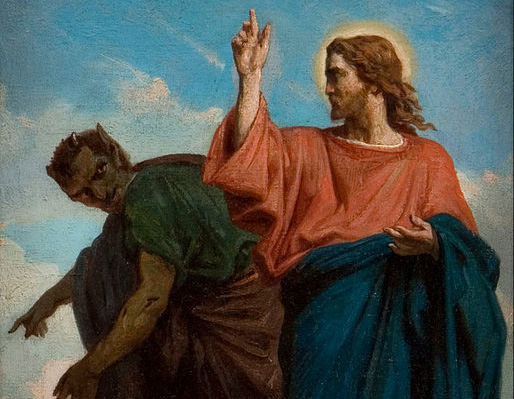
Matthew 4.1-4:

1 Then Jesus was led by the Spirit into the wilderness to be tempted by the devil. 2 After fasting forty days and forty nights, he was hungry. 3 The tempter came to him and said, “If you are the Son of God, tell these stones to become bread.”
4 Jesus answered, “It is written: ‘Man shall not live on bread alone, but on every word that comes from the mouth of God.
As originally conceived by the church long ago, the Lenten sacrifice was instituted as a “means of penitential preparation and preparation for baptism, which in the early church customarily took place on Easter Sunday.”

The tradition of fasting during Lent is an early one, originally done between Good Friday and Easter morning, the forty hours that Jesus was in the tomb. Christians would partake of no food or drink at all during that time. The fast was extended to the forty days before Easter sometime between 300 and 325, and changed so that food could be eaten only when evening had come.

The idea behind the fast was to imitate Christ. In addition to fasting, Christians would devote themselves to making prayer a faithful habit. So “prayer and fasting” have been closely linked for a long time.

And that brings me, by a rather circuitous route, to chocolate.

Chocolate is an absolutely unessential food, nutritionally speaking. We eat chocolate for no reason other than it is pleasurable. Since denial of the flesh is a prominent theme of Lent, rejection of chocolate in Lent is often offered as the Lenten sacrifice, particularly by people who wish to diet anyway.

But the Lenten season is also a time we ponder and wonder about the love of God. God’s love knows no bounds or limits and was so strong that not even the prospect of cruel death could deter Jesus from his redemptive mission. While we deny the pleasures of life during Lent, Jesus denied his life itself for the sake of his love for us.

Perhaps that fact could put a different spin on our concepts of giving something up for Lent. The Lenten sacrifice is best oriented toward that which most blocks our spiritual growth. It is each to ask ourselves, “What is it that most keeps me from Christ-likeness?” If that thing is chocolate, then it is appropriate to give up chocolate for Lent. But if something else is your greatest obstacle in being more Christlike, then giving up chocolate is a spiritually pointless exercise.

The question is this: “What is the one thing that most hinders my Christian growth into the person whom God wants me to be?” The answer may not be easy, but it will always involve self-denial. We think that following Christ is hard because to obey Christ we must first disobey ourselves, and it is disobeying ourselves that makes us think following Christ is hard.

But Jesus said his yoke is easy, his burden is light. We just have to get over ourselves to do it.

As Robert Mulholland put it, “Jesus is not talking about giving up candy for Lent. He is calling for the abandonment of our entire, pervasive, deeply entrenched matrix of self-referenced being.”

If we focus on that between now and Easter Day, then we have a chance to become more mature in Christian faith and practice. It may be a habit that is out of true with Christian character that needs to be overcome for further growth. Or it may be a thing undone which must be done for deeper development to occur. The Lenten idea is for our habits to change enough in the next few weeks so that we can continue at a higher level of discipleship after Easter. The Lenten season and the Lenten sacrifice are not the points in and of themselves, the whole life of discipleship is.

Focusing on the one big thing is not the only Lenten discipline that would be helpful for spiritual development. Methodism’s founder, John Wesley, insisted that the only thing that distinguishes the Christian from the non-Christian are how we use our time and money. So, for the period of Lent I would suggest focusing on those two things in addition to whatever one big spiritual obstacle you might have. Some suggestions:
  • Tithe all your income until Easter. 
  • Devote yourself to prayer daily and attending worship every Sunday. If you are traveling, say on business or spring break, then worship wherever you are.
  • Read the Bible each day. 
  • Call someone you love and let them know. 
  • Ask people who live alone to join you for lunch or whether you can visit them. 
  • Become involved in Christian ministries.
  • Re-establish or reinforce important relationships in your life.
Spiritually speaking, it is not enough to simply excise sin or personal vices from our lives. We have to replace vice with virtue. Thus, simply giving up something like chocolate for Lent is simply silly if we are only counting the days when we can start doing it again. That’s a game, not a spiritual discipline.


Lent should be a period of joyful, God-directed introspection into how we may be further united with Christ in godly love. If we make Lent into a severe, joyless, self-justifying exercise in self-denial, we have missed the point. Jesus sternly admonished teachers of the religious law and the Pharisees not to practice the letter of the law while neglecting “the more important matters of justice, mercy and faithfulness” (Matt 23:23).

When a lawyer asked Jesus, “which is the greatest commandment in the Law?” Jesus replied, “‘Love the Lord your God with all your heart and with all your soul and with all your mind.” And the second is like it: ‘Love your neighbor as yourself.’”

That is the whole point of spiritual growth and spiritual discipline, and hence the whole point of Lent: love. We are to be living ambassadors from God to one another and the world at large in Christ’s name. Christ was crucified, buried and raised from the dead for our sake and the sake of the whole world. Let us rededicate ourselves to being Christ’s ambassadors. It’s Lent, after all; it’s all about love, you see, Lent is all about love.

Tuesday, January 28, 2020

A note to the congregations

Greetings in the name of our Lord Jesus Christ!

As I briefly explained to Gideon and Greenbrier UMCs on Jan. 26, every year at this time, pastors and the Staff-Parish Relations Committee (SPRC) of their churches enter into a time of consultation about pastors' appointments. Appointments begin each each year at the end of June. In the Tennessee Conference, every appointment is for one year at a time, basically from the beginning of July to the end of the next June.

During the still-ongoing consultation process it became clear to the SPRC's of both Gideon and Greenbrier that I will not be returned to the Greenbrier-Gideon Charge as pastor. The two predominant reasons are:
  • Retirement of pastors in the Conference this year will likely be higher than average, which causes more moves than usual.
  • The financial condition of both congregations, especially forecasting to January 2021. 

Here is why January 2021 figures in. Starting this year, 2020, every church is fully responsible for paying all of its pastor(s)' health insurance premium and pension "match." For 2020 only, the Conference is paying half of the insurance premium and three-fourths of the pension match. Starting Jan. 1, 2021, both subsidies drop to zero. That means that in the middle of the appointment year, the direct-billing total rises very sharply -- for Greenbrier church alone more than $9,000 and for Gideon proportionately.

Both churches have been faced this year with declining offering amounts chiefly because of deaths of members whose giving has not been significantly offset by other members, and by persons moving away, either literally by moving van, or figuratively by attending another church.

(Almost every UM pastor either within our conference or outside it I have spoken with, and it has been a lot, have said their attendance has also dropped. That many, maybe most, of the departures have resulted from the ongoing turmoil in the UMC regarding actions of last February's General Conference, and the guaranteed continuation of it coming in this May's GC, there is little doubt. )

With all of this as background, in my consultation meetings with both SPRCs, we all agreed that my continuation as pastor of this charge was not financially supportable. Frankly, had the SPRCs' members not already understood that, I would have put it on the table. But we all knew this. The main task now for each church's SPRC is preparing for their own consultations with our district superintendent, the Rev. Scott Aleridge. I continue to work with both committees on that.

As for myself, Cathy and I had always planned on retiring in 2022. We frankly see little point, and have no desire, to move our home and begin new at another church, then retire after only two years there. I do not think it would be fair to that church. And, since Greenbrier is very north in the Conference, any move would almost certainly take us farther away from our new grandchild to be born in March. Add the hassle of selling our home and possibly having to buy a new one, or live in a parsonage for only two years, then move our household again, and other things like that. For these reasons, I informed Rev. Aleridge last weekend that I would retire this summer.

As I said Sunday, Cathy and I are deeply grateful to the people of Greenbrier and Gideon churches for the time we have been here, and for the five months I still have to enjoy as your pastor. It is possible that I may be asked to take a part-time appointment somewhere within driving distance, but there is no way to know now. But today, you and I serve our Lord and one another in love, thanks be to God!

Grace and peace,

Pastor Don

Thursday, January 9, 2020

The Methodists' coming punishment of God

I wrote this with non-UMC readers in mind, so I do not dwell on the minutiae of the recently-released "Protocol" document. Besides, this is long enough without that.

Just after New Year’s Day there was national and regional news coverage announcing, “United Methodist Church Announces Proposal to Split Over Gay Marriage” (NPR), or similar headlines.


Why did this become suddenly worthy of such large-scale coverage? That the church has been wrestling with homosexuality since at least 1972 is no secret. Accurate headlines would read, "United Methodist Church leaders agree to catch up to fact that the UMC is already splitting over gay rights."

The UMC is the America’s second-largest Protestant denomination with about 7.5 million US members, and about that many around the world, with the largest foreign numbers in Africa.

The massive coverage of the latest split proposal, called “Protocol of Reconciliation & Grace Through Separation,” does not really break much new ground. There were already a few breakup plans proposed and on the table several months ago.

So, what is the situation now, what comes next, and what after that?

“Status quo” is Latin for “the mess we’re in” 

In fact, nothing has been decided and no actual actions have been taken to split the UMC. That a split is nearly certain to come before this summer is not much in doubt. But what the details will be no one can predict.

The UMC’s only body that can determine policy denomination-wide is the General Conference. Presided over by bishops, who can speak to issues but may not vote, the GC convenes once per four years and does not exist in between. It will convene again on May 5. The “gay issue” will certainly be the priority matter. Voting delegates come from the church’s conferences, which is what the UMC calls dioceses. The number of delegates is fixed; how many come from each conference is based on their membership number. Delegates per conference must be both laity and clergy.

So, what will the fight be about?

The present canon law of the UMC, called the Book of Discipline, says this:
• ¶ 304.3: The practice of homosexuality is incompatible with Christian teaching. Therefore self-avowed practicing homosexuals are not to be certified as candidates, ordained as ministers, or appointed to serve in The United Methodist Church. View full statement.

• ¶ 341.6: Ceremonies that celebrate homosexual unions shall not be conducted by our ministers and shall not be conducted in our churches.
This has been the policy for many years. However, a special, called General Conference in February 2019 added mandatory penalties for violations and prohibited giving …
… United Methodist funds to any gay caucus or group, or otherwise use such funds to promote the acceptance of homosexuality or violate the expressed commitment of The UMC "not to reject or condemn lesbian and gay members and friends."
That GC also adopted means by which churches that could not abide by these provisions could withdraw from the UMC while retaining possession of their real estate and buildings. Some did, but not many.

Instead, the vast majority of progressives remained in the UMC to continue the fight. This caused two major consequences:
  1. Traditionalists rebelled against the never-ending infighting and started to leave the UMC individually, causing a significant decline in attendance and collections. This was amplified by the relatively smaller number of progressive Methodists who made the same choice. Progressive churches (in aggregate) sharply dropped paying their apportionments (denominational dues) in protest. Only two months after the special GC, The Hill reported, "Liberal Methodist churches withholding dues after denomination vote to ban LGBT-inclusive practices." Presently, the denomination and its congregations are financially tenuous.
     
  2. While traditionalists patted themselves on the back for winning, progressives redoubled to orient on the election of delegates to this May’s GC. As a result, it is generally acknowledged that the majority of American delegates elected are clearly progressive.
Long before the “Protocol” was released on Jan. 3, clergy from one end of the spectrum to the other had concluded that some sort of split of the UMC was not merely inevitable, it was desirable.

That the new changes to the Discipline formally provided for churches to withdraw was simply dismissed by UM progressives. They were determined that the UMC itself would become fully progressive, not some church splintered from it. That determination has not lessened.

The near horizon

True, the Protocol is not even on the agenda for this May’s General Conference, although there are ways it can be added. Even so, that it was released by the COB in an obviously pre-planned, coordinated national media campaign for maximum coverage, compels pulpit pastors like me to understand a sobering fact: We may not be interested in the Protocol, but the Protocol is very interested in us.

Dale M. Coulter, associate professor of historical theology at Regent University, observed in First Things, that
... the Protocol does not allow local churches or conferences to remain neutral any longer. In its current configuration, the Protocol requires that a choice be made—even if that choice is not to vote and thus remain in the post-separation UMC after the dust settles. The fight will now be taken to the local level.
The Protocol simply torpedoes whatever remained of the center. The center, or what was left of it, now no longer exists. When the president of the Council of Bishops is a Protocol signatory and its first appearance is on the COB's web site, the idea that there remains sort of centrist path is shredded. It is reasonable to assume that this is the outcome preferred by a clear majority, perhaps all, of the UM's bishops. On the date of this post the UM News Service announced that members of the team that developed the Protocol "will be interviewed in a live-streamed panel discussion on Monday, Jan. 13" for an hour at 9.30 a.m. EST on umnews.org. No other proposal for General Conference on this or any other topic has received such genuflection, which IMO speaks volumes.

So even if some bishops think there should still be a middle way, their peers have shut them down. (Remember, though, that the Council of Bishops formally endorsed a centrist plan for the UMC at the February 2019 special General Conference, and it was promptly rejected by both left and right.)

Pastors' shepherding of congregations through the coming schism will be challenging, to say the least. Each pastor will have to choose a side while still pastoring all the people of the church, and the people will be choosing their sides, too. Most congregations' members will not be unified with one another. I have known, for example, members who hold the traditionalist position but who also have homosexual close family members. For them, the issue is very personal. And that puts ministers right here:


The reason is that congregants will fall into three basic groups of response:
  1. Those who will leave the church because the pastor chose the "wrong" position,
     
  2. Those who will leave the church because the pastor would not announce his/her position,
     
  3. And those who feel so deeply rooted that they are not going to leave their church no matter what, or who simply want this whole issue to just go away - at least until a very progressive or very traditionalist pastor takes the pulpit in their church. Then, to borrow Robert Heinlein's metaphor, they will hoist the Jolly Roger.
Which is to say, we ministers (but not only us) are being presented with a Star Trek Kobayashi Maru no-win scenario, for which this Forbes article is useful in understanding in trying to maintain ethical leadership. It explains, among other things,
A crucial feature of good ethical decision-making in the real world is understanding the limits of your powers. You try to make choices that bring lots of good consequences and minimal bad ones, that fulfill your obligations to everyone to whom you have obligations (including yourself) — but you’re doing it in a complicated world where you must make your choices on the basis of imperfect information, and where other people are doing things that may impose constraints on your options. Ethics cannot require us to be omniscient or omnipotent. This means that sometimes even the most creative and optimistic ethical decision-maker has to face a situation where none of the available choices or outcomes are very good.
Even allowing for all that, the Protocol's basic premise that traditionalists and progressives must divorce one another is hardly disputed within the UMC. The Protocol likely will be added to the handful of "split up" proposals already on the General Conference's agenda. For sure, no one expects “the mess we’re in” to continue post-GC.

A safe assumption is that at least two Methodist denominations will arise from this May's GC. One will be progressive/liberal and the other orthodox/traditionalist/conservative. What the actual names will be who knows, but theologically and ideologically that’s how they will be. There could be other denominations, too.

It must be recognized that individual churches will get to choose. If My Town UMC's conference votes to be in the progressive church but MTUMC's members are mostly traditionalist, then MTUMC's members will be able to vote to join another denomination. But they will still lose some members when they do. Likewise if a progressive congregation votes to leave a traditionalist conference. Not all the sheep will follow. Shrinkage, probably dramatic at that, is inevitable.

And then what? There will be no Promised Land for either faction.

Both or all new denominations will be significantly down-funded from now. Staffs at the denominational, conference, and local-church level will diminish and there will be significant downward pressure on salaries from top to bottom. That means that most pastors and staff who can retire will do so and those who cannot yet retire but have other options will take them. The already-over bureaucratic structure of today's UMC will not collapse, exactly, but it will shrink a lot.

Even assuming there is an amicable split, or at least not an angry one, the coming few years will not be unicorns and rainbows for either progressives of traditionalists. I think both denominations will have many difficulties getting organized (which is to be expected) but also fights over their respective purity codes will erupt also. That is, what is it that marks one as a True Traditionalist or a True Progressive? Neither side can answer that right now because any answer given now is mainly influenced by the "mess we're in" and not what will pertain then.

Both denominations will find themselves bickering about a whole host of matters other than homosexuality, which as a topic will be off the table anyway. This will further cause church members to vote with their feet, accelerating the decline of Methodism in America. The Baptists or the MCC , however, will probably be very grateful. And then there was this posted by a friend I have known since before the internet:
Went to a Catholic funeral. At the supper I mentioned how beautiful their church was.
The answer was, "Beautiful yes, but it takes a lot of money for upkeep. We couldn't afford it if it were not for all the Protestants that are converting."
That will continue.

Where do we find God here?


I hope for a far finer future than I envision. But as a very senior leader observed in my prior career, "Hope is not a method and wishes are not plans." In our history since our founding in the Christmas Conference of 1784, there have been quite a number of splits. The only one approaching the scale of what is coming this year was a full-scale  schism in 1844 over slavery. But slavery was ended and the two denominations finally reunited. The coming schism will be permanent. After all, homosexuality is not going to simply be ended like slavery was.

I know that God never withdraws his grace and guidance. Jesus' resurrection never becomes less efficacious. But I also remember this:


And we will get it good and hard.

If you think I am overstating all of this I only reply, wait and see. Because you ain't seen nothing yet.

The outcome will be like this, only it will not be funny.


Bookmark and Share

Monday, December 9, 2019

10 Tough Questions


Link.

The 10th point is the toughest one:

10. Remember, the ‘wicked problem’ of the denomination far transcends sexuality 
This last point is not framed as a question because of its truth there is no question. No matter what the GC decides, decline and irrelevance will continue to accelerate unless larger issues are named and tamed. Examples are trust deficits, miscommunication, theological conflicts/contradictions, ineffective organization, inefficient structures, disjointed training and education of clergy or establishing coherent ministry career paths. Organizations facing a wicked problem either tend to ‘fail into collaboration’ among competing stakeholders…or they just fail (see above). Nurturing trust and affirming the claim of conscience for all parties sets the stage not for failure but new birth.
The author earlier posted an essay with a full explanation of what a wicked problem is, as distinguished from a simple problem or a complex one (click here). But briefly, a wicked problem is that which all parties agree exists but do not agree on how to describe it, nor on what a solution can be, nor even on how to implement a resolution or know when it has been accomplished.

I have elsewhere explained that one such wicked problem, which I think underlies all those listed just above, is Pournelle's Law, formulated by the late, great science fiction writer Jerry Pournelle. It is:

And no, I do not have a solution to it.

Tuesday, October 29, 2019

The ground beneath our feet

The United Methodist Church is committing denominational hari-kiri, which will be nearly completed before the end of May, 2020. Recently, a long-term friend and law-enforcement officer posted an article from lawofficer.com: "The End of Law Enforcement, " written by a 20-plus year active LE officer and a trainer of LE officers around the country.

He says that this is the state of law enforcement today:


1. Retirement eligible officers are retiring even though they have many years of useful service ahead of them.


2. Mid-career officers are miserably trying to make it to retirement and are "are trying to get off the streets, afraid of the next 'viral' video showing them doing nothing wrong but ruining their reputation and ability to work forever." Some are leaving LE anyway.

3. Less than 10-year officers "have now realized that they work in the only profession that can ruin you for doing nothing wrong. They have stopped working. Some call it the 'Ferguson Effect' but they just call it trying to save their [hind ends]. It’s not worth staying and the majority are looking to leave."

I responded thus:


There is a French phrase from maritime history that was adopted by some other nations' services that is usually, though inaccurately, translated as, "every man for himself." The French is, "Sauve qui peut," and don't ask me how to pronounce it.


It was the command given when a vessel's captain decided the ship was lost and was going to sink no matter what. So he would order, "May he save himself, whoever can" (literal translation) or basically, "Stop trying to save the ship and save yourselves."


ISTM that is what this writer has concluded about the profession of law enforcement.


Regarding the UMC, I had a conversation recently with a senior staffer of one the UMC's general councils. It became clear to me that sauve qui peut has already been adopted by large numbers of our laity. Both attendance and giving have plummeted at UM churches across the nation, including mine. The laity who have left because of all the intra-church fighting over the homosexuality question have absolutely abandoned ship and are not going to return.


I can only wonder how many serving clergy will decide the same between now and the end of General Conference in May 2020. Will we see a parallel with what is going on in law enforcement? Will we see retirement-eligible ministers with several more years of possible service just hang it up now? Will mid-career pastors try simply to hang on until retirement and younger ones make (covert) plans to move to another denomination or profession?


Update, Dec. 10: I attended a Mon-Wed. GCFA conference last month with pastors from across the nation present, although the majority from the southeast and eastern seaboard. Here is my takeaway summary:

Basically, retirement-eligible pastors are doing so, even if they have years left to 72. I met some who are younger than I who are retiring in 2020, including two who pastor mega-churches (neither in my conference).

Several ministers from about age 50 openly told me that when they hit 62, they're gone. Very few were there much younger than that, but if I was 44 rather than 64, I almost certainly would be covertly making contingency plans.

And the denomination is going broke. Giving across America is way down. Way. Down. This is not going to be reversed and will, if anything, accelerate. At current trend, the GCFA's episcopal fund will be at zero dollars by the end of 2024. 

One minister told me that giving is down so much in his present appointment (not only because of people leaving a strife-torn denomination, also several major donors died) that his church can no longer afford his compensation. But he wonders what the point in a new appointment will be if it will probably run out of money also within a year. May as well retire, right?


BTW, even apart from people voting on the "issue" with their feet and checkbooks, the UMC will still be in accelerated rate of decline due to increasing deaths of an aging laity and our inability (and frankly, denominational unwillingness) to evangelize, especially evangelize unconnected to politics.


Just as law enforcement, the UMC still has many strengths and still is doing great work. But we are more and more resembling Centralia, Penn. Our foundation and "solid rock" on which we stand is being destroyed from underneath us.


Centralia was a coal-mining town where the mine shafts caught fire in 1962 and 
the town was destroyed from underneath. The fire is still burning. Estimates are that 
it will burn at least 250 more years.

The ground burning beneath our feet applies to much more than the UMC or law enforcement. I would be hard-challenged to find any national-level institution not affected by this threat.


Wesley said that when we are on fire for Christ people will come for miles around to watch us burn. The UMC is on fire, all right. But decide for yourself for what we are burning.

Tuesday, September 24, 2019

Four ways the UMC may split

The deadline for submitting resolutions and other action items for consideration to next May's General Conference was Sept. 18. This is not a UM site, but the summary of the proposals for the schism of the denomination seem to be fair summaries. As of the time I am posting this, I have not finished the article, but I did want to "park" the link.


See also: GC2020: Nine Plans and What to Think about Them

See also: https://planegrace.com/gc-2020-the-plain-grace-plan-is-a-flow-chart-worth-a-thousand-words/

Rev. Shane Bishop: Know What You are Going to Do! (my advice to #UMC pastors and churches)

The real issue splitting the UMC is not homosexuality, it is the destruction of trust on all sides.

Wednesday, August 14, 2019

The latest plan to replace the UMC

It's called this:


The Indianapolis Plan envisions a Traditionalist United Methodist Church that would maintain the denomination’s current restrictions on same-sex weddings and ordination of “self-avowed practicing” gay clergy.
 
A separate Centrist/Progressive United Methodist Church would remove those restrictions, as well as church teaching that the practice of homosexuality is incompatible with Christian teaching.

The names in the plan are placeholders. Each denomination would decide what it would be called and could incorporate “United Methodist” into that name. 

The Indianapolis Plan also holds out the possibility of a third denomination, a Progressive United Methodist Church that would practice immediate full inclusion of LGBTQ persons.

Significantly, the plan avoids dissolution, suggesting that “legal continuation” and most general church agencies would remain with the Centrist/Progressive United Methodist Church. ...
 
The Indianapolis Plan’s basic provisions include:

  • Central conferences could align with either of the denominations or become autonomous affiliated denominations. Those that don’t decide would automatically be part of the Traditionalist United Methodist Church.
  • U.S. annual conferences would decide by majority vote which denomination to join. Those who don’t take a vote would by default be part of the Centrist/Progressive United Methodist Church.
  • Local churches disagreeing with their annual conference’s decision could decide by majority vote to align elsewhere, retaining their property, assets and liabilities.
  • Clergy would decide on a denomination to join, but by default would go with their annual conference’s decision. Bishops could also choose a denomination.
  • Each denomination would develop a new General Conference, as well as its own Book of Discipline, structures, polity and finances.
  • Wespath, the United Methodist Committee on Relief, United Methodist Women and the United Methodist Publishing House would be independent 501(c)3 organizations positioned to serve the two or three denominations.
  • All other agencies would be part of the Centrist/Progressive United Methodist Church.
  • The 2020 General Conference would provide funding for central conference ministries through the 2021-2024 quadrennium, and the separated denominations would share the costs.
  • A process would be devised for dividing current general church assets, including creation of an arbitration board.

Thursday, August 1, 2019

What next for us?


There is said to be a Chinese curse that simply says, “May you live in interesting times.” Whether a curse or not, I’d say we are certainly living in interesting times!

I think most of you know that the United Methodist Church is facing an uncertain future as a denomination. The General Conference (GC) is the only body that makes denomination-wide policy. It is useful to recall that the UMC is a worldwide church with several million members outside the United States.

Since the GC of 1972, the UMC has been wrestling with what shall be the denomination-wide position regarding homosexuality. Presently, the UMC's position is that homosexuals, like all other peope, "are persons of sacred worth" and are invited to become part of the body of Christ through baptism, to celebrate Holy Communion, and to serve in the church as fully as everyone else, with two exceptions:
  • "Self-confessed, practicing homosexuals" may not be ordained as ministers of the UMC, and
  • No UM minister, whether ordained or licensed, may officiate a same-sex wedding anywhere, nor may such ceremonies be conducted on the grounds of UM churches, no matter who officiates. 
By the time of the 2016 GC, the durability and mounting intensity among progressives and traditionalists had reached the point where a special General Conference was set for February 2019. It was intended that this GC would provide the definitive position of the church, for no other business was to be brought before it.

Last February, the General Conference retained the existing position and strengthened it. Some provisions of what was passed were subsequently nullified by the UM Judicial Council. But the core parts were retained. See here.

Even so, the debate is far from finished. The GC regularly meets every four years and will convene again in May 2020. There is, as of now I think, a widespread belief among all sides of that issue that no compromise-outcome is really possible. I am reminded of Abraham Lincoln’s observation in his 1858 “House Divided” speech, that every solution to the slavery question had been attempted and failed and no more compromising was possible. The nation, he said, would eventually either legalize slavery in every state or in abolish slavery in every state. What it could not do any longer was maintain the status quo.

I think that is what progressives and traditionalists alike are concluding about the UMC’s position on homosexuality. Everything that can be tried has been tried, and the subject is still not settled within the denomination. The One Church Plan, endorsed by the Council of Bishops, was rejected last February and no one today is promoting it for next May.

If I could forecast now the GC will decide next May, I could make a fortune on the stock market. I know that many influential progressive and traditionalist Methodists across the country are in ongoing conversation. I am gratified not have seen or read of spite-filled language or personal attacks by either side.

But what about us?

I echo what Bishop McAlilly told the annual conference in June. I am pastor of all the people of the church and I will not be drawn into partisan positions. Of course, I have my beliefs about this issue, but as I told the annual conference, “I could be wrong” (an admission I wish everyone progressive or traditionalist would also make).

TNAC 2019 Bishop's Remarks from TNUMC on Vimeo.

"It's tough to make predictions, especially about the future." Even so, here are my predictions:

Our calling to be disciples of Jesus Christ will not change even though our denomination is going through “interesting times.” Jesus’ Great Commandment to go make disciples shall remain before us.

We shall face the future unafraid because
  • we are still united in our baptism even if not by certain beliefs on this (or other) topics,
  • we therefore will continue to worship together and move on to Christian perfection through deeds of devotion, charity, and justice.


These "interesting times" are temporary. Christ’s church is eternal!

Regardless of the future of the United Methodist Church, we remain united in our prayers, our presence, our gifts, our service, and our witness.

The Lord is with us! Let’s remain with the Lord -- and with one another!

Tuesday, July 16, 2019

The post-2020 UMC

"For now we see through a glass, darkly ... ." 
1 Corinthians 13.12

For those who have heard that two bishops of the UMC have proposed a plan to schism the denomination while trying to maintain some level of connectionalism, here are two good analyses. The plan is the product of Bishops Scott Jones and David Bard. It is proposed for next year's general conference to enacted (or not) by a simple majority vote. The plan envisions “two or three self-governing” denominations being birthed from United Methodism.

First the United Methodist News Service release is here.

Second, "Thoughts on the Bard-Jones Plan," by Chris O'Ritter. 

Third, "The Bard-Jones Plan: 'Cooperative Separation',” by David F. Watson.

Saturday, June 15, 2019

Speaking my language

Yesterday in his closing homily of the annual conference of the Tennessee Conference, Bishop Bill McAlilly urged the people of the conference to understand that while times for the UMC today are rocky, we should, "Take a breath and carry on" with the full ministries of the church.

I turned to my wife, Cathy, and said, "That is speaking my language" since I am a retired US Army officer. So that deserves a meme!


Or as we put it in my former career:


Sunday, April 28, 2019

What the Judicial Council's rulings mean

An excellent, non-partisan summary by the rev. Katie Dawson, pastor at Immanuel United Methodist Church, which I have simply pasted below.

SUMMARY OF 2019 GENERAL CONFERENCE DECISIONS – MODIFIED AFTER JUDICIAL COUNCIL RULING

Decisions of the 2019 General Conference
Timeline for Implementation in Central Conferences
  • In general, when legislation before a GC is approved, it goes into effect on January 1 of the following year.
  • Central Conferences (outside the U.S.) have additional time because they are allowed to adapt and change the Book of Discipline to fit their context. These groups will not be meeting until after the 2020 General Conference.  This legislation gives them until May of 2021 to implement any of the legislation we approved at this special session.
 WESPATH Pension Liabilities and CRSP amendment.
  • These two pieces of legislation give guidance for if a local church leaves the UMC or if a clergy person terminates their conference relationship regarding pensions. The local church that leaves has to pay their share of unfunded pension liabilities.
  • An amendment was made that also notes that nothing in this legislation prevents the Annual Conference from collecting other obligations.
  • Clergy that terminate their relationship will have their pension benefits converted to the actuarial equivalent balance, which can continue to be invested in their personal defined contribution account through Wespath.
Traditional Plan
  • The eight petitions that will be implemented as of January 1, 2020 are:
    • 90032 #1 Update of the footnote that describes what a “self-avowed practicing homosexual” is according to recent Judicial Council decisions. This does not essentially change our Book of Discipline, rather notes current rulings.
    • 90036 #5 Expands episcopal responsibilities by adding that Bishops are prohibited from consecrating, commissioning, or ordaining people who are self-avowed homosexuals. (NOTE: Everywhere else in our Book of Discipline we use the word “practicing.”  This word was inadvertently left off of this piece of legislation, but it was never amended by the body.  This means that if someone is openly gay or lesbian, even if they are celibate, they cannot be consecrated/commissioned/ordained.)
    • 90042 #11 Mandatory Minimum Penalties for clergy who have been convicted of conducting same-sex weddings or celebrations of homosexual unions: First offense – one year suspension without pay. Second offense – termination of conference membership and revocation of credentials.  (Note: this is the ONLY mandatory penalty we have in the Book of Discipline)
    • 90043 #12 The District Committee on Ordained Ministry and Board of Ordained Ministry cannot approve/recommend for candidacy, licensing, commissioning or ordination, someone who does not meet the qualifications for ordained ministry (which include being a self-avowed practicing homosexual). The bishop shall rule unqualified candidates out of order.
    • 90044 #13 When a complaint/charge is brought to the Bishop regarding a violation, the Bishop has discretion about how to proceed. Now, the Bishop cannot dismiss the complaint, unless it has no basis in law or fact.
    • 90045 #14 One of the results of a complaint/charge is a Just Resolution. Now, Just Resolutions have to name all identified harms and how they will be addressed. The unconstitutional part is that it has to also include a commitment not to repeat the violation.  This line is removed and the rest remains.  
    • 90046 #15 One of the results of a complaint/charge is a Just Resolution. This changes the process so that the complainant has to be part of the process and has to agree with the resolution.
    • 90047 #16 One of the results of a complaint/charge is a church trial. Previously, the Church could not appeal those decisions.  This legislation allows the Church to appeal to the committee on appeals or to the Judicial Council.
Disaffiliation – Taylor/Minority Report Version
  • If a local church wants to disaffiliate over matters of human sexuality this is the process that can be used from Feb 27, 2019– Dec 31, 2023. It requires a 2/3 majority vote of professing members present at the charge conference.  Terms will be negotiated with conference Board of Trustees w/ advice of cabinet, and other conference officers. Standard terms will include: being able to leave with property with the exiting church paying for legal/transfer fees, any unpaid apportionments from the previous 12 months plus an additional 12 months of apportionments, its share of unfunded pension liabilities, and payment or assumption of all debts/loans/liabilities prior to departure.  The annual conference has to approve such an exit by a simple majority.

Thursday, April 4, 2019

Organizational maturity

First published elsewhere in 2011

Many years ago, when I was still in the Army, I was sent by my colonel to attend a dinner and meeting of the Association of the US Army in Fayetteville, NC. Normally my colonel went to these meetings as the representative of Headquarters, XVIII Airborne Corps and Fort Bragg, but for that meeting, away I went.

By the end of the meeting, I had formulated the Principle of Organizational Maturity, which is simply that in any organization, especially volunteer organizations, the point will be reached when sustaining the organization become more important than the goals of the organization.

Which is to say that keeping the institution viable as a going concern comes to supplant the purposes for which the organization was founded. It was evident to me at the AUSA meeting because the only thing on the agenda that night was signing up more members. That's it. No other topic was discussed.

As I said, the Principle of Organizational Maturity is a particular imperative for volunteer outfits because unless the organization itself can appeal to potential volunteers, the organization will wither and eventually die. An organization's founders learn the bitter truth that there is no lasting mass movement for their cause (see "Tea Party") and that new volunteers must have other primary reasons to join than the original cause.

So eventually the organization becomes oriented on keeping present members happy and inducing new members by focusing on the benefits of membership. Which is to say, the organization becomes a club in the main, although it will continue to do some of the work for which it was founded, but only to the line where members become uncomfortable or resistant, especially regarding their commitment of money and time.

Comes now renowned science-fiction writer Jerry Pournelle's "Iron Law of Bureaucracy," which states that "in any bureaucratic organization there will be two kinds of people":
First, there will be those who are devoted to the goals of the organization. Examples are dedicated classroom teachers in an educational bureaucracy, many of the engineers and launch technicians and scientists at NASA, even some agricultural scientists and advisors in the former Soviet Union collective farming administration.

Secondly, there will be those dedicated to the organization itself. Examples are many of the administrators in the education system, many professors of education, many teachers union officials, much of the NASA headquarters staff, etc.

The Iron Law states that in every case the second group will gain and keep control of the organization. It will write the rules, and control promotions within the organization.

Like I said. Hear then the parable of the lighthouse:

Saturday, March 2, 2019

Social justice and churches

WHY SOCIAL JUSTICE IS KILLING SYNAGOGUES AND CHURCHES
Data suggests that the more a religious movement is concerned with progressive causes, the more likely it is to rapidly lose members
The mainstream Protestant churches are not exactly filling the sanctuaries either. Some, like the internally conflicted Methodists have seen their number of North American congregants drop from 15 million in 1970 to barely half that today. Since 2007 alone, America’s mainstream churches have lost 5 million members, and even the once vibrant evangelical movement is losing adherents outside of the developing world. Ever more churches, particularly in urban areas, are being abandoned, turned into bars, restaurants, and luxury condos. And nothing augurs worse for the future than the fact that American millennials are leaving religious institutions at a rate four times that of their counterparts three decades ago; almost 40 percent of people 18 to 29 are not unaffiliated.
Read the whole thing.

Thursday, February 28, 2019

After General Conference


Post Conference – One More Year

One day Jesus was speaking to a large crowd. He told told a parable or two of the coming of God’s judgment, then warned the crowd to understand the signs of the times and to be faithful. Luke 13 opens this way.

Now there were some present at that time who told Jesus about the Galileans whose blood Pilate had mixed with their sacrifices. Jesus answered, “Do you think that these Galileans were worse sinners than all the other Galileans because they suffered this way? I tell you, no! But unless you repent, you too will all perish. Or those eighteen who died when the tower in Siloam fell on them—do you think they were more guilty than all the others living in Jerusalem? I tell you, no! But unless you repent, you too will all perish.”

These five verses tell of Pilate sending his soldier to kill some Galileans making sacrifices. Rather than ask the circumstances, which is what you and I would probably do, Jesus challenges his listeners to rethink their own assumptions. By the way, he adds, don’t forget the eighteen people who were just standing around, minding their own business when a tower collapsed on them. Were they guiltier of sin than the other people of Jerusalem? No! Jesus is warning those who think themselves righteous: unless you repent you will nonetheless perish.
Then Jesus told a parable:
A man had a fig tree, planted in his vineyard, and he went to look for fruit on it, but did not find any. So he said to the man who took care of the vineyard, ‘For three years now I’ve been coming to look for fruit on this fig tree and haven’t found any. Cut it down! Why should it use up the soil? "Sir," the man replied, "leave it alone for one more year, and I’ll dig around it and fertilize it. If it bears fruit next year, fine! If not, then cut it down."

There are three characters in the parable: the man who owned the vineyard, the gardener, and the fig tree. Of course, the fig tree is a character because this is not a story about trees. It’s a story about you and me and the world we live in. It’s a story about condemnation and grace, of dismissal and reconsideration. It’s a story about repentance, mercy and judgment.
There is a man who owns a vineyard and in the vineyard, he had a fig tree. For three years the owner looked for fruit to be produced by the tree but there was none. So, the owner tells his gardener, "Cut it down!"
The gardener begs the owner to let it stand. Give it one more year, the gardener pleads. He promises to turn the soil around the tree and take special care of it. Then if it doesn’t bear fruit, he says, you can cut it down.
And that’s the end of the parable. Did the owner agree or did he insist on immediate destruction? And if he agreed to the gardener’s plea, what happened after a year? Was there fruit or not? And if not, what then? More importantly, what happened during the year? Did the gardener keep his promise of care or did he just let the tree succeed or fail on its own?
Jesus doesn’t say. These are blanks he left us to fill in.
Some of you know that before General Conference began, I said that it was really just a warm-up for the regular General Conference in May of next year. 
What happened this week was not a good outcome. 
If the One Church Plan had passed, that would not have been a good outcome. 
If no plan had passed and the status quo had been maintained, that would not have been a good outcome. 
This General Conference could have been scripted by a Greek tragedian. It was a three-act play with no possible happy ending. To anyone who rejoices in the outcome, heed Jesus’ word: "unless you repent, you too will perish." And to anyone who despairs or is angered at the outcome: "unless you repent, you too will perish."
What this conference shows me more than anything was that we, as a denomination, must repent. We are more like Washington than New Jerusalem, God forbid! But we have a year, do we not, until May of 2020? Even one more year is God’s gift. While we are living, God is working with us and for us, trying to get us the bear fruit for the strengthening of his kingdom. One more year to get right with God. 

But we do not have forever to decide about forever. The ax can still fall. So, there is a particular urgency to start producing fruit pretty quick. A "lesson of the fig tree is a challenge to live each day as a gift from God. Live each day in such a way that you will have no fear of giving an account for how you have used God’s gift" (NIB).
It’s also an instruction for us to examine the way we treat one another. The parable invokes each of us to ask whether we are more eager to cut than to cultivate. It was easy to watch or listen to the Conference over the internet and announce how the delegates, the bishops, or the presiding elders were all screwing it up, and how this delegate or that one was either bigoted or godless. Then I remembered the words of Saint Augustine:


We are hopeless creatures, and the less we concentrate on our own sins, the more interested we become in the sins of others. We seek to criticize, not to correct. Unable to excuse ourselves, we are ready to accuse others.

There will be no better Methodism until there are better Methodists. One more year of care and cultivation is before us. God is merciful. Are we? If the gardener represents that God is slow to anger, abounding in love and faithfulness, how well are we doing in that department? The sad fact is we are more likely to swing the ax than cultivate one another to be fruitful.
Why is that? It’s not the example Christ gives us. Here’s a tree that isn’t producing fruit. What is the solution? Cut it down? Not at all! The solution is so unexpected – so foolish, really – that it could not occur to anyone but God. The answer is to give it more water, more nutrition, more nurturing and more care. In the coming year, this tree can bear fruit. It is the year of the Lord’s favor.
Paul wrote, “God is able to make all grace abound to you, so that in all things at all times, having all that you need, you will abound in every good work” (2 Cor 9:8). That is a gardening God. Where there is barrenness of spirit or service, barrenness of love or discipleship, there you will find God, humbly kneeling, turning the soil of our lives and cultivating with care. What else can God do with us? It’s in his interest for us to bear fruit, too.
But we cannot be passive. We have to respond to being cultivated by the Holy Spirit and by the godly people of our church. We have to accept cultivation, to listen, to learn, to serve, to pray, to repent of barrenness, and then bear righteous fruits of faith and godly works. God, like a gardener, patiently works the soil of our lives. Bad things happen and we are sinners anyway, but God’s grace abounds all the more.
One more year. What is the fruit you will produce, or I? Will we cultivate godliness and fruitfulness in one another or just swing the ax? That part of the story we will write ourselves.

Tuesday, June 12, 2018

Council of Bishops and the One Church Model

There will be a special General Conference of the UMC in February of 2019. The General Conference is the only body of the UMC that can set rules and standards and doctrine for the whole church. Only the GC can amend the church canon law, the Book of Discipline. The GC is not a standing body, it exists only when convened. That happens every four years by rule. Special General Conferences are rare and time limited. February's Conference is scheduled (and funded) for only three days.

The topic for the special Conference is to set a way forward for the church in grappling with the issue of homosexuality. Presently, there are two restrictions on this issue:
  1. "Self avowed, practicing homosexuals" may not be ordained in the UMC,
     
  2. Same-sex weddings or unions may not be conducted on any United Methodist property, nor may UM ministers officiate such ceremonies anywhere. 
That's it. And those are the two issues that the GC will address. At the last ordinary GC in 2016, a Commission on A Way Forward was founded to study and draft proposals to go before 2019's called GC. The proposals, usually referred to a models, were to be presented first to the Council of Bishops, who were empowered in 2016 to choose one to recommend to the 2019 GC. (Or the Council could reject them all and make its own recommendation, but no one expected that to happen, and it has not.) 

The Commission came up with three models, each of which were presented to the Council earlier this year. They are:
  1. Traditionalist - which would make no changes to the Discipline and would therefore maintain the status quo.
     
  2. One Church Model - in which decisions about whether to ordain LGBTQ clergy or to officiate at same-gender unions would be made closer to the congregational level. The plan would remove the restrictive language against the practice of homosexuality in the Discipline. The plan also adds assurances to pastors and conferences who in good conscience cannot perform same-sex weddings or ordain “self-avowed practicing” gay clergy that they don’t have to do so. Central conferences — church regions in Africa, Asia and Europe — could maintain current restrictions.
     
  3. The Connectional-Conference plan, which would allow conferences to choose among three connectional conferences for affiliation. The connectional conferences would align based on theology or perspective on LGBTQ ministry — be it traditionalist, progressive or allowing for a variety of approaches. This plan would require multiple amendments to the denomination’s constitution.
Last month, the Council of Bishops voted to recommend the One Church model to the 2019 Conference. However, it also voted that the other two models should remain on the table for consideration. By the way, bishops have voice but no vote at General Conferences.

For more information, read this piece from the UM News Service and see this video.

Tuesday, January 9, 2018

"Why the UMC Needs its Donald Trump"

Trump–and his avid disciples–are barbarians. They are not politicians. They don’t understand or honor the slow process of making policies. The “way we’ve always done things” cry is irrelevant to them. They are here to destroy and to rebuild the US in their image out of the ashes. And that is precisely why the UMC needs its Donald Trump.
Read more at http://www.patheos.com/blogs/thoughtfulpastor/2018/01/09/barbarians-bureaucrats-umc-donald-trump/

Thursday, May 25, 2017

The Official American Holy War Hymn

I am a retired Army artillery officer and I agree with Laurence M. Vance: "The Battle Hymn of the Republic" is blasphemous (at best) and has no place being sung in Christian worship services. It is found in The United Methodist Hymnal but let us pray it will be excised when(ever) the next hymnal is published.

Killed in action soldiers of the Battle of Antietam, near Dunker Church. Why do churches sing a hymn that celebrates wholesale killing and destruction and calls them holy and good?
Read the whole article for a detailed, line-by-line explanation why this "hymn" is best described as a satanic perversion of the Gospel of Jesus Christ. Here is the conclusion:
The “Battle Hymn of the Republic” ought to be parodied, satirized, and lampooned. It has nothing to do with God or Christianity. It is not a Christian hymn. It does not belong in a Christian hymnbook. It should not be sung in any Christian church — Northern or Southern. It should not be on the lips of any Christian — Yankee or Southerner. It is partisan political paean to bogus history and faulty theology. For much too long Christians have sung this “hymn” with religious fervor while remaining in ignorance as to its history and theology. For much too long pastors and song leaders have included this “hymn” in church services without stopping to consider whether it is an appropriate song for a Christian worship service. Disparaging the singing of this song has nothing to do with being a Confederate sympathizer, or being unpatriotic or anti-Lincoln, but it has everything to do with exercising biblical discernment. Traditions are hard to break, and especially religious ones, but the singing of the “Battle Hymn of the Republic” is one that must go.
And the sooner the better.