Today I conducted my final Sunday services under full-time appointment. The first was at Gideon UMC, the second at Greenbrier UMC, both in Greenbrier, Tennessee. After 23 years of full-time pastoring in the UMC, preceded by retiring as an artillery officer from the US Army, plus two years of employment in a BTB Information Technology compay, I will enter retired status for good this coming Wednesday. Here are some photos from this morning.
Serving Communion at Gideon. We used prepackaged, individual cups with the wafer and the wine (grape juice) wrapped together in one unit. I served with tongs so no one's hands ever touched the cups but the communicant's.
My final benediction at Gideon UMC.
When Cathy and I arrived at Greenbrier UMC, this sign awaited us near the front entrance.
Beginning my final service at Greenbrier UMC.
Consecrating the Communion elements.
My successor pastor, beginning there July 1, is the Rev. Jason Wilkerson, whom I have known since I moved to Robertson County three years ago. He is a very fine Christian gentleman and minister. I invited him and his family to attend today to introduce him to the congregation. I also asked him to assist in serving Communion.
Our Communion steward, the wonderful Donna Watkins, prepared Communion with the bread (the "chiclet" style) in trays of cups and the wine in other trays. She prepared these entirely in keeping with proper C19 protocols so that neither the bread, the liquid, nor the cups were ever touched by anyone but the recipients.
Rev. Wilkerson and I were both masked while serving and we donned new sterile nitrile gloves first. We removed each cup from the tray and handed it to the communicant so that no unprotected hands ever touched anything but their own serving.
In the photo above, I am serving Rev. Wilkerson at the end, just after he served me. This was one part of our ritual of me passing the pastoral care of the congregation to him - leaving him with the place of honor in the Methodist tradition: last. Hopefully, this helped the people understand that there is an orderly, grace-filled and indeed sacramental continuity of pastoral care of the people of God.
Then we proceeded with a litany of passing of the pastoral ministry from myself to Jason. We each led the congregation is responses and prayers for one another and the church itself.
Our closing hymn was, "Lord, You Have Come to the Lakeshore," number 344 in the UM Hymnal. This hymn was requested by a church member but coincidentally (or not!) it was also the thematic hymn of the service of Annual Conference in which I was ordained. So the hymn has always been deeply meaningful to both Cathy and me.
My final benediction to the people of Greenbrier UMC, which I basically ripped off from Paul's first letter to the church in Corinth, chapter 4. But I meant every word as if I had written them myself, although I could not have done so nearly as well as Paul did.
To the church of
God that is Greenbrier UMC, to those who are sanctified in Christ Jesus, called
to be saints, together with all those who in every place call on the name of
our Lord Jesus Christ, both their Lord and ours:
I give thanks to
God for you because of the grace of God that has been given you in Christ
Jesus, for in every way you have been enriched in him, in speech and knowledge
of every kind just as the testimony of Christ has been strengthened among you.
He will also strengthen you to the end, so that you may be blameless on the day
of our Lord Jesus Christ. God is faithful; by him you were called into the
fellowship of his Son, Jesus Christ our Lord.
The church hosted a "walk-thru" reception for Cathy and me after the service. It would have been outside had weather permitted.
A wonderful lady of the church made this for me - Wake Forest was my undergrad school. I already had a Vandy bottle. I earned my M.Div. there.
That Cathy was also in ministry with me at the churches was a real fact and the people said so! This was given to her because everyone knows (I mean really knows!) that Cathy loves to cheer for Duke basketball.
This fine family of four are special to me for two reasons. One is that I baptized all four of them when they joined the church. The other is that he is also retired from the Army and is the only other person in the church who speaks the language of acronym as I do. So we could have whole conversations without anyone else understanding a word (except probably our wives)!
The church gave us this laser-etched crystal plaque as a gift. We are deeply moved by this thoughtfulness!
The people of Greenbrier UMC very kindly made this video for Cathy and me.
Cathy and I are thankful beyond description to all the people of Greenbrier and Gideon UMCs for the past three years. A finer and more wonderful group of people with whom to come to the finish line neither of us can imagine! What is next for us? Love God, love neighbor, and leave the rest up to the Lord.
May the love of God, the mercy of Jesus Christ our Lord, and the strengthening presence of the Holy Spirit be with us all, now and always. Amen.
And a reminder, if I may: While our church can practice social distancing, we cannot practice financial distancing! The missions, ministries, and financial obligations of the church continue!
Please mail your regular tithe or offering to the church!
Greenbrier UMC only - online and smartphone giving can also be done.
The story is told of Sean O'Flannery, a lad who moved to Boston from Dublin. Coming home from school one day he went into an ice cream shop and told the jerk behind the counter (the soda jerk) "One scoop of yer best chocolate ice cream in four dishes!"
Soda jerks get strange requests, so he set four dishes with one scoop each in front of Sean. Sean took a spoon of one, held it before his face and loudly announced, "This is me beloved cousin eating ice cream back in the old country!" He ate the ice cream and took a spoonful from another scoop, "This is me dear friend Kelly eating ice cream back in me homeland!" The third dish he said was his favorite uncle, Finian, eating ice cream back home.
Sean raised the last scoop and said, "And this dish is for me!"
This practice went on for several months until one evening as the soda jerk was filling the four dishes Sean stopped him and said quietly, "Only three dishes today, please."
The soda jerk asked, "Did you suffer a loss and that is why you only want three scoops?"
"Heaven's no!" protested Sean O'Flannery. "It's Lent now, and I've given up ice cream!"
The word “Lent” comes from the Anglo-Saxon word, “lencten,” meaning Spring, the season in which Easter occurs. The forty days before Easter constitute the Lenten season, but the forty-day count does not include Sundays. All Sundays celebrate the resurrection, and so are excluded from the forty days count. The forty days duration is drawn from the length of time Jesus spent in prayer and fasting in the wilderness before he set out on his three-year ministry.
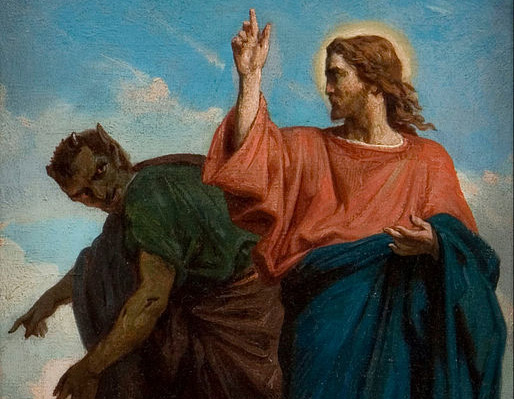
Matthew 4.1-4:
1 Then Jesus was led by the Spirit into the wilderness to be tempted by the devil. 2 After fasting forty days and forty nights, he was hungry. 3 The tempter came to him and said, “If you are the Son of God, tell these stones to become bread.”
4 Jesus answered, “It is written: ‘Man shall not live on bread alone, but on every word that comes from the mouth of God.
As originally conceived by the church long ago, the Lenten sacrifice was instituted as a “means of penitential preparation and preparation for baptism, which in the early church customarily took place on Easter Sunday.”
The tradition of fasting during Lent is an early one, originally done between Good Friday and Easter morning, the forty hours that Jesus was in the tomb. Christians would partake of no food or drink at all during that time. The fast was extended to the forty days before Easter sometime between 300 and 325, and changed so that food could be eaten only when evening had come.
The idea behind the fast was to imitate Christ. In addition to fasting, Christians would devote themselves to making prayer a faithful habit. So “prayer and fasting” have been closely linked for a long time.
And that brings me, by a rather circuitous route, to chocolate.
Chocolate is an absolutely unessential food, nutritionally speaking. We eat chocolate for no reason other than it is pleasurable. Since denial of the flesh is a prominent theme of Lent, rejection of chocolate in Lent is often offered as the Lenten sacrifice, particularly by people who wish to diet anyway.
But the Lenten season is also a time we ponder and wonder about the love of God. God’s love knows no bounds or limits and was so strong that not even the prospect of cruel death could deter Jesus from his redemptive mission. While we deny the pleasures of life during Lent, Jesus denied his life itself for the sake of his love for us.
Perhaps that fact could put a different spin on our concepts of giving something up for Lent. The Lenten sacrifice is best oriented toward that which most blocks our spiritual growth. It is each to ask ourselves, “What is it that most keeps me from Christ-likeness?” If that thing is chocolate, then it is appropriate to give up chocolate for Lent. But if something else is your greatest obstacle in being more Christlike, then giving up chocolate is a spiritually pointless exercise.
The question is this: “What is the one thing that most hinders my Christian growth into the person whom God wants me to be?” The answer may not be easy, but it will always involve self-denial. We think that following Christ is hard because to obey Christ we must first disobey ourselves, and it is disobeying ourselves that makes us think following Christ is hard.
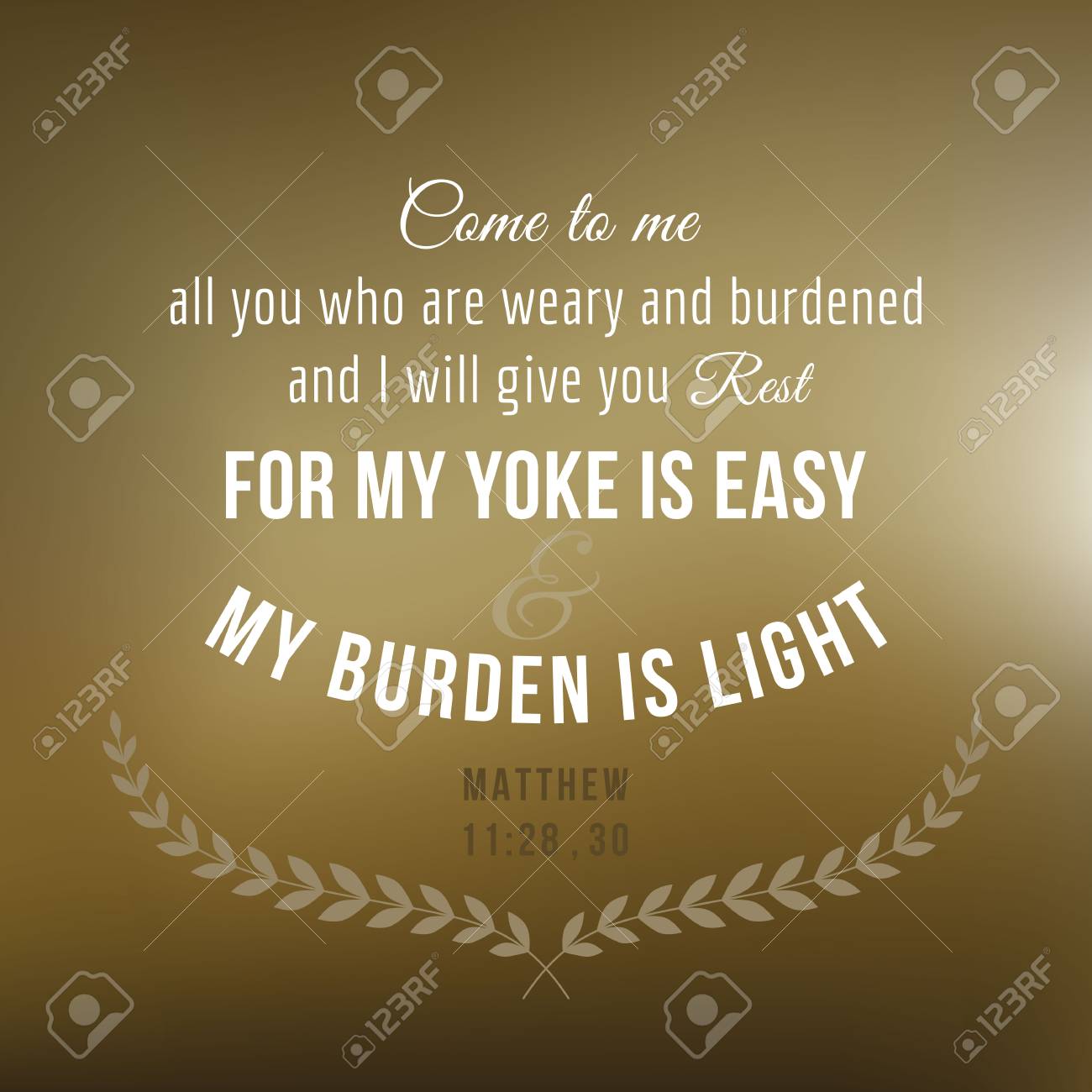
But Jesus said his yoke is easy, his burden is light. We just have to get over ourselves to do it.
As Robert Mulholland put it, “Jesus is not talking about giving up candy for Lent. He is calling for the abandonment of our entire, pervasive, deeply entrenched matrix of self-referenced being.”
If we focus on that between now and Easter Day, then we have a chance to become more mature in Christian faith and practice. It may be a habit that is out of true with Christian character that needs to be overcome for further growth. Or it may be a thing undone which must be done for deeper development to occur. The Lenten idea is for our habits to change enough in the next few weeks so that we can continue at a higher level of discipleship after Easter. The Lenten season and the Lenten sacrifice are not the points in and of themselves, the whole life of discipleship is.
Focusing on the one big thing is not the only Lenten discipline that would be helpful for spiritual development. Methodism’s founder, John Wesley, insisted that the only thing that distinguishes the Christian from the non-Christian are how we use our time and money. So, for the period of Lent I would suggest focusing on those two things in addition to whatever one big spiritual obstacle you might have. Some suggestions:
Tithe all your income until Easter.
Devote yourself to prayer daily and attending worship every Sunday. If you are traveling, say on business or spring break, then worship wherever you are.
Read the Bible each day.
Call someone you love and let them know.
Ask people who live alone to join you for lunch or whether you can visit them.
Become involved in Christian ministries.
Re-establish or reinforce important relationships in your life.
Spiritually speaking, it is not enough to simply excise sin or personal vices from our lives. We have to replace vice with virtue. Thus, simply giving up something like chocolate for Lent is simply silly if we are only counting the days when we can start doing it again. That’s a game, not a spiritual discipline.
Lent should be a period of joyful, God-directed introspection into how we may be further united with Christ in godly love. If we make Lent into a severe, joyless, self-justifying exercise in self-denial, we have missed the point. Jesus sternly admonished teachers of the religious law and the Pharisees not to practice the letter of the law while neglecting “the more important matters of justice, mercy and faithfulness” (Matt 23:23).
When a lawyer asked Jesus, “which is the greatest commandment in the Law?” Jesus replied, “‘Love the Lord your God with all your heart and with all your soul and with all your mind.” And the second is like it: ‘Love your neighbor as yourself.’”
That is the whole point of spiritual growth and spiritual discipline, and hence the whole point of Lent: love. We are to be living ambassadors from God to one another and the world at large in Christ’s name. Christ was crucified, buried and raised from the dead for our sake and the sake of the whole world. Let us rededicate ourselves to being Christ’s ambassadors. It’s Lent, after all; it’s all about love, you see, Lent is all about love.
I wrote this with non-UMC readers in mind, so I do not dwell on the minutiae of the recently-released "Protocol" document. Besides, this is long enough without that.
Just after New Year’s Day there was national and regional news coverage announcing, “United Methodist Church Announces Proposal to Split Over Gay Marriage” (NPR), or similar headlines.
Why did this become suddenly worthy of such large-scale coverage? That the church has been wrestling with homosexuality since at least 1972 is no secret. Accurate headlines would read, "United Methodist Church leaders agree to catch up to fact that the UMC is already splitting over gay rights."
The UMC is the America’s second-largest Protestant denomination with about 7.5 million US members, and about that many around the world, with the largest foreign numbers in Africa.
The massive coverage of the latest split proposal, called “Protocol of Reconciliation & Grace Through Separation,” does not really break much new ground. There were already a few breakup plans proposed and on the table several months ago.
So, what is the situation now, what comes next, and what after that?
“Status quo” is Latin for “the mess we’re in”
In fact, nothing has been decided and no actual actions have been taken to split the UMC. That a split is nearly certain to come before this summer is not much in doubt. But what the details will be no one can predict.
The UMC’s only body that can determine policy denomination-wide is the General Conference. Presided over by bishops, who can speak to issues but may not vote, the GC convenes once per four years and does not exist in between. It will convene again on May 5. The “gay issue” will certainly be the priority matter. Voting delegates come from the church’s conferences, which is what the UMC calls dioceses. The number of delegates is fixed; how many come from each conference is based on their membership number. Delegates per conference must be both laity and clergy.
So, what will the fight be about?
The present canon law of the UMC, called the Book of Discipline, says this:
• ¶ 304.3: The practice of homosexuality is incompatible with Christian teaching. Therefore self-avowed practicing homosexuals are not to be certified as candidates, ordained as ministers, or appointed to serve in The United Methodist Church. View full statement.
• ¶ 341.6: Ceremonies that celebrate homosexual unions shall not be conducted by our ministers and shall not be conducted in our churches.
This has been the policy for many years. However, a special, called General Conference in February 2019 added mandatory penalties for violations and prohibited giving …
… United Methodist funds to any gay caucus or group, or otherwise use such funds to promote the acceptance of homosexuality or violate the expressed commitment of The UMC "not to reject or condemn lesbian and gay members and friends."
That GC also adopted means by which churches that could not abide by these provisions could withdraw from the UMC while retaining possession of their real estate and buildings. Some did, but not many.
Instead, the vast majority of progressives remained in the UMC to continue the fight. This caused two major consequences:
Traditionalists rebelled against the never-ending infighting and started to leave the UMC individually, causing a significant decline in attendance and collections. This was amplified by the relatively smaller number of progressive Methodists who made the same choice. Progressive churches (in aggregate) sharply dropped paying their apportionments (denominational dues) in protest. Only two months after the special GC, The Hill reported, "Liberal Methodist churches withholding dues after denomination vote to ban LGBT-inclusive practices." Presently, the denomination and its congregations are financially tenuous.
While traditionalists patted themselves on the back for winning, progressives redoubled to orient on the election of delegates to this May’s GC. As a result, it is generally acknowledged that the majority of American delegates elected are clearly progressive.
Long before the “Protocol” was released on Jan. 3, clergy from one end of the spectrum to the other had concluded that some sort of split of the UMC was not merely inevitable, it was desirable.
That the new changes to the Discipline formally provided for churches to withdraw was simply dismissed by UM progressives. They were determined that the UMC itself would become fully progressive, not some church splintered from it. That determination has not lessened.
The near horizon
True, the Protocol is not even on the agenda for this May’s General Conference, although there are ways it can be added. Even so, that it was released by the COB in an obviously pre-planned, coordinated national media campaign for maximum coverage, compels pulpit pastors like me to understand a sobering fact: We may not be interested in the Protocol, but the Protocol is very interested in us.
Dale M. Coulter, associate professor of historical theology at Regent University, observed in First Things, that
... the Protocol does not allow local churches or conferences to remain neutral any longer. In its current configuration, the Protocol requires that a choice be made—even if that choice is not to vote and thus remain in the post-separation UMC after the dust settles. The fight will now be taken to the local level.
The Protocol simply torpedoes whatever remained of the center. The center, or what was left of it, now no longer exists. When the president of the Council of Bishops is a Protocol signatory and its first appearance is on the COB's web site, the idea that there remains sort of centrist path is shredded. It is reasonable to assume that this is the outcome preferred by a clear majority, perhaps all, of the UM's bishops. On the date of this post the UM News Service announced that members of the team that developed the Protocol "will be interviewed in a live-streamed panel discussion on Monday, Jan. 13" for an hour at 9.30 a.m. EST on umnews.org. No other proposal for General Conference on this or any other topic has received such genuflection, which IMO speaks volumes.
So even if some bishops think there should still be a middle way, their peers have shut them down. (Remember, though, that the Council of Bishops formally endorsed a centrist plan for the UMC at the February 2019 special General Conference, and it was promptly rejected by both left and right.)
Pastors' shepherding of congregations through the coming schism will be challenging, to say the least. Each pastor will have to choose a side while still pastoring all the people of the church, and the people will be choosing their sides, too. Most congregations' members will not be unified with one another. I have known, for example, members who hold the traditionalist position but who also have homosexual close family members. For them, the issue is very personal. And that puts ministers right here:
The reason is that congregants will fall into three basic groups of response:
Those who will leave the church because the pastor chose the "wrong" position,
Those who will leave the church because the pastor would not announce his/her position,
And those who feel so deeply rooted that they are not going to leave their church no matter what, or who simply want this whole issue to just go away - at least until a very progressive or very traditionalist pastor takes the pulpit in their church. Then, to borrow Robert Heinlein's metaphor, they will hoist the Jolly Roger.
Which is to say, we ministers (but not only us) are being presented with a Star Trek Kobayashi Maru no-win scenario, for which this Forbes article is useful in understanding in trying to maintain ethical leadership. It explains, among other things,
A crucial feature of good ethical decision-making in the real world is understanding the limits of your powers. You try to make choices that bring lots of good consequences and minimal bad ones, that fulfill your obligations to everyone to whom you have obligations (including yourself) — but you’re doing it in a complicated world where you must make your choices on the basis of imperfect information, and where other people are doing things that may impose constraints on your options. Ethics cannot require us to be omniscient or omnipotent. This means that sometimes even the most creative and optimistic ethical decision-maker has to face a situation where none of the available choices or outcomes are very good.
Even allowing for all that, the Protocol's basic premise that traditionalists and progressives must divorce one another is hardly disputed within the UMC. The Protocol likely will be added to the handful of "split up" proposals already on the General Conference's agenda. For sure, no one expects “the mess we’re in” to continue post-GC.
A safe assumption is that at least two Methodist denominations will arise from this May's GC. One will be progressive/liberal and the other orthodox/traditionalist/conservative. What the actual names will be who knows, but theologically and ideologically that’s how they will be. There could be other denominations, too.
It must be recognized that individual churches will get to choose. If My Town UMC's conference votes to be in the progressive church but MTUMC's members are mostly traditionalist, then MTUMC's members will be able to vote to join another denomination. But they will still lose some members when they do. Likewise if a progressive congregation votes to leave a traditionalist conference. Not all the sheep will follow. Shrinkage, probably dramatic at that, is inevitable.
And then what? There will be no Promised Land for either faction.
Both or all new denominations will be significantly down-funded from now. Staffs at the denominational, conference, and local-church level will diminish and there will be significant downward pressure on salaries from top to bottom. That means that most pastors and staff who can retire will do so and those who cannot yet retire but have other options will take them. The already-over bureaucratic structure of today's UMC will not collapse, exactly, but it will shrink a lot.
Even assuming there is an amicable split, or at least not an angry one, the coming few years will not be unicorns and rainbows for either progressives of traditionalists. I think both denominations will have many difficulties getting organized (which is to be expected) but also fights over their respective purity codes will erupt also. That is, what is it that marks one as a True Traditionalist or a True Progressive? Neither side can answer that right now because any answer given now is mainly influenced by the "mess we're in" and not what will pertain then.
Both denominations will find themselves bickering about a whole host of matters other than homosexuality, which as a topic will be off the table anyway. This will further cause church members to vote with their feet, accelerating the decline of Methodism in America. The Baptists or the MCC , however, will probably be very grateful. And then there was this posted by a friend I have known since before the internet:
Went to a Catholic funeral. At the supper I mentioned how beautiful their church was. The answer was, "Beautiful yes, but it takes a lot of money for upkeep. We couldn't afford it if it were not for all the Protestants that are converting."
That will continue.
Where do we find God here?
I hope for a far finer future than I envision. But as a very senior leader observed in my prior career, "Hope is not a method and wishes are not plans." In our history since our founding in the Christmas Conference of 1784, there have been quite a number of splits. The only one approaching the scale of what is coming this year was a full-scale schism in 1844 over slavery. But slavery was ended and the two denominations finally reunited. The coming schism will be permanent. After all, homosexuality is not going to simply be ended like slavery was.
I know that God never withdraws his grace and guidance. Jesus' resurrection never becomes less efficacious. But I also remember this:
And we will get it good and hard.
If you think I am overstating all of this I only reply, wait and see. Because you ain't seen nothing yet.
The outcome will be like this, only it will not be funny.
I subscribe to a daily newsletter by a Canadian minister, the Rev. Carey Nieuwhof. He is one of only two or three such writers that I know who are always worthy of reading because the majority of his writing applies in some way to my ministry.
He does not write merely for other pastors, but also for the people of churches. I do recommend taking a look at his site, https://careynieuwhof.com/.
Recently, his email included this nugget:
One of the most difficult things to do is self-challenge what we know. As someone once remarked, it is not what we do not know that is often the problem, it is that so much of what we think we know is not so.
The balance between retaining what have tested and found enduring, and discarding what serves us well no longer—well, that can be tough.
Just imagine what the first followers of Jesus had to discard and adopt. Start with Peter, whom Jesus told to stop fishing for fish and start fishing for people. Or much earlier, the shepherds, who had to face that the Messiah was born in the humblest of settings to undistinguished parents. Or Mary, that she was being asked to face possible social disaster in being pregnant with a child that her fiancé could not say was his. And Joseph, who is described as a honorable man who elected to do what in his day was a dishonorable thing, marrying Mary anyway.
The story of Jesus’ nativity and ministry is one of turning over tables, both literally in the Temple confronting the money changers, but also figuratively, for bringing people to confront that so much of what they knew simply was not so:
“You have heard that it was said, ‘Love your neighbor and hate your enemy.’ But I tell you, love your enemies and pray for those who persecute you, that you may be children of your Father in heaven" -- Matthew 5.43-45
If we are truly blessed, we are seriously disturbed this Advent by the implications of Jesus’ coming and nativity. May the Holy Spirit lead us to think more deeply about what we think we know and what it means for the way we live and more importantly, why we live.
The gifts of Advent and Christmas are twofold, at least:
First, that “unto us a child is born, unto us a Son is given, and he will be called Wonderful Counselor, Mighty God, Everlasting Father, Prince of Peace.”
Second, that in celebrating that Christ is born, we can embrace that we are born anew. May we discern the renewing revelation of God through our worship and giving this season!
I came across this post from 2017 by accident and am re-dating it to today. Today was the day that the US House of Representatives voted along strictly party lines to proceed with impeachment proceedings against the president. I make no comment here as to the merits or not of the proceedings. But as much as my colleague's words rang true two years ago, how much more compelling are they today. From July 2017:
From former district superintendent in the Memphis Conference of the United Methodist Church, Sky McCracken:
In my opinion, the most powerful force in Christianity - if it wants to be - is a local church who decides to be a community of faith and discipleship in the manner of Jesus for its neighborhood, instead of a chapel for members who like things "just the way they are." No law, no entity, no politician has any power against such a force. Regardless of the happenings, fear mongering, and media hype of the last few weeks, they pale against the total history of God's presence with His people - which has always been unrelenting and ever-pursuing. I'll quote Bill Hybels:
"For eight years...I went to Washington, D.C., every month to meet in the foremost centers of power with some of the highest elected officials in our country. What I discovered was not how powerful those people are, but how limited their power really is. All they can actually do is rearrange the yard markers on the playing field of life. They can't change a human heart. They can't heal a wounded soul. They can't turn hatred into love. They can't bring about repentance, forgiveness, reconciliation, peace. They can't get to the core problem....I believe that only one power exists on this sorry planet that can do that. It's the power of the love of Jesus Christ, the love that conquers sin and wipes out shame and heals wounds and reconciles enemies and patches broken dreams and ultimately changes the world, one life at a time. And what grips my heart is the knowledge that the radical message of that transforming love has been given to the church. That means that in a very real way the future of the world rests in the hands of local congregations like yours and mine." - In his book, Courageous Leadership.
There is no political solution to the severe dysfunctions of America today because our national illness is not really political. It is spiritual. There will not be a better America until there are better Americans. That is the task for the Church today: to bring more and more people into the fullness of reconciliation to God through Christ so that we can be reconciled to one another. Absent that, our congregations are just religious clubs.
There is said to be a Chinese curse that simply says, “May you live in interesting times.” Whether a curse or not, I’d say we are certainly living in interesting times!
I think most of you know that the United Methodist Church is facing an uncertain future as a denomination. The General Conference (GC) is the only body that makes denomination-wide policy. It is useful to recall that the UMC is a worldwide church with several million members outside the United States.
Since the GC of 1972, the UMC has been wrestling with what shall be the denomination-wide position regarding homosexuality. Presently, the UMC's position is that homosexuals, like all other peope, "are persons of sacred worth" and are invited to become part of the body of Christ through baptism, to celebrate Holy Communion, and to serve in the church as fully as everyone else, with two exceptions:
"Self-confessed, practicing homosexuals" may not be ordained as ministers of the UMC, and
No UM minister, whether ordained or licensed, may officiate a same-sex wedding anywhere, nor may such ceremonies be conducted on the grounds of UM churches, no matter who officiates.
By the time of the 2016 GC, the durability and mounting intensity among progressives and traditionalists had reached the point where a special General Conference was set for February 2019. It was intended that this GC would provide the definitive position of the church, for no other business was to be brought before it.
Last February, the General Conference retained the existing position and strengthened it. Some provisions of what was passed were subsequently nullified by the UM Judicial Council. But the core parts were retained. See here.
Even so, the debate is far from finished. The GC regularly meets every four years and will convene again in May 2020. There is, as of now I think, a widespread belief among all sides of that issue that no compromise-outcome is really possible. I am reminded of Abraham Lincoln’s observation in his 1858 “House Divided” speech, that every solution to the slavery question had been attempted and failed and no more compromising was possible. The nation, he said, would eventually either legalize slavery in every state or in abolish slavery in every state. What it could not do any longer was maintain the status quo.
I think that is what progressives and traditionalists alike are concluding about the UMC’s position on homosexuality. Everything that can be tried has been tried, and the subject is still not settled within the denomination. The One Church Plan, endorsed by the Council of Bishops, was rejected last February and no one today is promoting it for next May.
If I could forecast now the GC will decide next May, I could make a fortune on the stock market. I know that many influential progressive and traditionalist Methodists across the country are in ongoing conversation. I am gratified not have seen or read of spite-filled language or personal attacks by either side.
But what about us?
I echo what Bishop McAlilly told the annual conference in June. I am pastor of all the people of the church and I will not be drawn into partisan positions. Of course, I have my beliefs about this issue, but as I told the annual conference, “I could be wrong” (an admission I wish everyone progressive or traditionalist would also make).
"It's tough to make predictions, especially about the future." Even so, here are my predictions:
Our calling to be disciples of Jesus Christ will not change even though our denomination is going through “interesting times.” Jesus’ Great Commandment to go make disciples shall remain before us.
We shall face the future unafraid because
we are still united in our baptism even if not by certain beliefs on this (or other) topics,
we therefore will continue to worship together and move on to Christian perfection through deeds of devotion, charity, and justice.
These "interesting times" are temporary. Christ’s church is eternal!
Regardless of the future of the United Methodist Church, we remain united in our prayers, our presence, our gifts, our service, and our witness.
The Lord is with us! Let’s remain with the Lord -- and with one another!
There
are certain occasions when events on the secular calendar give us the
opportunity to pause and reflect on religion in America. The Fourth of July is
an obvious occasion. I want to take this day to reflect on the religious
underpinnings of our country and explain why I believe there is an actual
theology of America and what it means.
I think
that the theology of America was best summarized by Thomas Jefferson in his
1774 essay, "A Summary View of the Rights of British America." There
he stated, "The God who gave us life gave us liberty at the same time. The
hand of force may destroy but cannot disjoin them."
Editorialist
James Freeman wrote that based on the standards of our day, “Thomas Jefferson
was a religious nut.”
Jefferson was a big believer in religious
liberty, but he certainly wasn't shy about mentioning God in official
proceedings. In the final paragraph of the Declaration of Independence,
Jefferson asks twice for God's help in creating the country. And the
Declaration was not the only work of Jefferson's in which he gave credit to a
higher power. . . .
In his Notes on Virginia of 1782, Jefferson
writes: "Can the liberties of a nation be thought secure when we have
removed their only firm basis, a conviction in the minds of the people that
these liberties are of the gift of God?"
If we
disregard the Founders’ religious faith, we have no answer to the question, Where
do our rights come from? Jefferson's religious ideas, shared by representatives
from the thirteen colonies, are the reason we have a United States and the
reason that We the People are in charge.
However
much it is claimed that Jefferson and most of the other Founders were more
secular than religious, there is no escaping that Jefferson's writings are
permeated with God consciousness. It's true that Christ does not figure into
his political writings, but God does, and frequently. What gave Jefferson and
his fellow revolutionaries the right to be so, well, revolutionary? Whence came
their idea that the people should rule instead of a king or a parliament of
nobles? How could they claim that the right to life, liberty and the pursuit of
happiness was "unalienable," meaning beyond the rightful power of any
government either to grant or deny? Why did they talk about human rights to
begin with and where do rights come from?
According
to Thomas Jefferson and his fellows, the ultimate answer to all those questions
was simple: God. Only cynics say that the religious convictions of the Founders
were not central to their determination to risk their lives, their fortunes and
their sacred honor for a single claim: that all human beings are created equal
and that they are endowed by their Creator with certain rights that may not be
rightfully denied them. And yes, the Founders did exclude African-Americans
from this claim, but let us also acknowledge that Jefferson, among others, said
explicitly that God's righteous day of reckoning and judgment upon slave-owning
America would come. And it did.
The
whole justification for the American revolution was that the divine rights of
the people trumped the divine rights of kings that European monarchs claimed to
have. Human rights come from God, not government. When the British government
usurped them, it was the God‑given right of the people of America to cast off
the that government and form their own. That is what the Declaration of
Independence says, and that is what the Founders did. Freeman wrote, "If
you could sum up Jefferson's political views in one sentence, you would say: He
believed that God and reason allow people to rule themselves."
One of
the genius things our Founders did was create a civil society in which enormous
numbers of different Christian denominations and nowadays, different religions,
find a home. Our history has seen times of sectarian strife, but it never
descended to open combat as it has in, say, Northern Ireland. A lot of
Protestants were suspicious of whether Catholic John F. Kennedy would cleave to
the Vatican rather than the Constitution, but their fears were unfounded. In
2004, orthodox Jew Joe Lieberman ran for president and then was the nominated
candidate for vice president and no one worried whether he would cleave to
Jerusalem rather than the Constitution.
The
American ideas of freedom and liberty are drawn from religion. Jefferson was
saying that human liberty is inherent in the creative acts of God in bringing
forth humankind to begin with. Creation was not a static event, it is a dynamic
process of bringing forth the image of God in humankind and the world at large.
The creation stories in the book of Genesis show that the realms of the divine
and creation overlap. God is powerful, but creation has power too; a certain
degree of independence and freedom is built into creation by God's very acts of
creating.
In the
original paradise, the Garden of Eden, Adam and Eve were given the run of the
garden and meaningful work to do. They were free agents of their own will. Yet
there were limits. God commanded them that they could eat the fruit of any tree
except one. Their freedom had its limits. When they crossed that limit, they
were less free, and Genesis relates that as generations passed, humankind
became steadily even less free.
Eventually
the story leads to Egypt, where the Hebrews found themselves in chattel slavery
to Pharaoh. They had no freedom at all.
The twin
images of slavery and freedom shape the entire theology of both Jews and
Christians. Always God is a liberator. The central story of the Jews is that of
Moses leading the children of Israel from slavery in Egypt to freedom in the
Promised Land. At their start, slavery. At their ending, freedom. But neither
the slavery nor their freedom is the high point of the story. The high point is
what happened at Sinai. The high point, the defining moment, was when God gave
them the Law.
The Law
of Moses defined freedom in two ways. On the one hand, the law defined what was
forbidden. On the other, it stated what was obligatory.
There is
always a tension between the forbidden and the mandatory. But the Bible seems
clear that human freedom is found somewhere between the limits of what may not
be done and what must be done. With no limits there is no freedom because there
is no orientation on God. Without obligations there is no justice, without prohibitions
there is no community. The surest way for persons or societies to fall into
bondage is to ignore prohibitions and obligations. Falling into slavery is
easy, staying free is hard.
The
apostle Paul said that creation itself is in bondage to decay, an amazing
statement for a pre‑scientific man to make. Science today confirms that the
universe is running down and cosmologists now seem convinced that the universe
will keep expanding forever, until the time comes when energy states will be
even, and nothing will ever change.
As for
we men, women and children, we are born slaves to this decay. At the end lies
the grave. We know that. We fear death because our mortality looms over
everything we do. Human customs and culture are shaped by the end of life in
ways we cannot even uncover, to degrees we do not recognize. Such is our
slavery to the fear of death.
Christians
have tended to think of Jesus' gift of life as some sort of afterlife, but
Christ is concerned about far more of our lives than what happens after they
end. Christ frees us not only from the fear of personal death but from our
slavery to a death‑shaped culture. With death overcome, the family of God is
empowered to inaugurate a new order of living and a new kind of life.
Jesus
explained in the Gospel of John (8:34‑36), "Very truly, I tell you,
everyone who commits sin is a slave to sin. 35The slave does not have a
permanent place in the household; the son has a place there forever. 36So if
the Son makes you free, you will be free indeed."
Through
Christ, we are freed from sin and from servitude to the things of this world
which inhibit godly living: greed, jealousy, anger, resentment, racism,
selfishness – all the hundreds of things we put under the general label of sin.
We are freed from sin and the fear of death.
So
liberated, we should be able to live positively in ways not possible before.
Justice, the right ordering of things in human affairs, is the result of this
spiritual freedom. So the fuller Law of the Hebrews recognized this fact.
Deuteronomy 10:12‑13 and 17‑18 says to the nation of Israel:
12 So
now, O Israel, what does the LORD your God require of you? Only to fear the
LORD your God, to walk in all his ways, to love him, to serve the LORD your God
with all your heart and with all your soul, 13and to keep the commandments of
the LORD your God and his decrees that I am commanding you today, for your own
well‑being. 17For the LORD your God is God of God's and Lord of lords, the
great God, mighty and awesome, who is not partial and takes no bribe, 18who
executes justice for the orphan and the widow, and who loves the strangers,
providing them food and clothing.
Those
are some of the divine obligations people have as they live in community. Yet
our nation's founding documents make no mention of the obligations and
responsibilities, they seek to ensure only our rights. In fact, Jefferson wrote
that the whole purpose of government is to secure the rights that God gave us.
He ignored codifying the obligations God lays on us.
I think
that is a good thing. I shudder to think what our civil life would be like if
our Constitution required things of the people rather than limited the power of
government. It is always too easy for the law, whether civil or religious, to
cease being a guide and become a slave-master. George Washington warned that
even democratic "Government is not reason; ... it is force. Like fire, it
is a dangerous servant and a fearful master."
In both
our civil and religious life, we would do well to remember Paul's admonition to
the Corinthians, 1 Cor 10:23: "‘Everything is permissible' – but not
everything is beneficial. ‘Everything is permissible' – but not everything is
constructive.'" The absence of limits in America's founding documents is
not an oversight. The Founders expected the people to understand the limits of
libertine anarchy on the one hand and political slavery on the other.
John
Adams wrote in a letter to his wife, "We have no government armed with the
power capable of contending with human passions unbridled by morality and
religion. . . . Our Constitution was made only for a moral and religious
people. It is wholly inadequate to the government of any other."
Justice
William O. Douglas wrote in a majority opinion of a Supreme Court case,
"We are a religious people whose institutions presuppose a Supreme
Being."
The
Constitution guarantees our rights, but not our liberty. It is our religion
under the providence of the God of the Bible that secures our liberty. Liberty
is maintained by faith in powers greater than government, by living out God’s
call to know the truth of freedom in God’s way of life. When we make government
the object of our faith, when we decide that our liberty depends on government,
we will live under political bondage.
Various
commentators of the American religious scene point out that America is becoming
less and less religious. A lower percentage of Americans regularly attend
church or synagogue than in past times.
But the
fact is that Americans are still just as religious as before, it's just not
Jewish or Christian religion they are practicing. Increasing numbers of people
are turning to forms of spirituality that are private and personal, not public
and social. These forms of religion are, at their base, selfish and self‑centered.
While this is certainly their right, I fear that over time the obligations of
freedom will be ignored, and the justice of our freedom will be degraded. Self‑centered
persons do not prosper, and neither do self‑centered societies or nations. Paul
warned the Galatian Christians (Gal 5:13‑14):
13 For
you were called to freedom, brothers and sisters; only do not use your freedom
as an opportunity for self‑indulgence . . . For the whole law is summed up in a
single commandment, "You shall love your neighbor as yourself."
Freedom
is God's will. Certain rights are God‑given and cannot be rightfully denied by
human authority. God's gift of freedom carries the obligation to live godly
lives under his guidance and to love our neighbor as ourselves. Our rights and
our obligations reinforce one another, guard one another, preserve one another.
Together they comprise our freedom.
The National Study on Youth and Religion found a factor that is “nearly deterministic” in turning this around. Eight out of ten (82%) young adults ages 24-29 who were still participating in their faith after being active in high school, had one thing in common.
The secret? Their parents.
Youth leaders agree. “Parents are the critical discipler, period,” said Seth Martin, former Lead Student Pastor and now Lead Director of The Road at Faithbridge United Methodist Church in Spring, Texas. “Student ministries aren't (or shouldn't be, rather) the primary spiritual mentors of students, but should instead subsidize the discipleship already taking place in the home.”
Well, not so fast. Is this claim actually supported by Scripture?
Immediately
after the Day of Pentecost and its empowerment of the church by the Holy Spirit,
Peter and the other disciples began preaching the Gospel of Jesus Christ in
Jerusalem. Acts records that "great numbers of both men and women"
were converted to faith in Christ by their preaching. As a result, the Jewish
high priest and some allies on the Jewish high council had the apostles
arrested and locked in prison.
But
during the night an angel of the Lord opened the prison doors, brought them
out, and said, 20 'Go, stand in the temple and tell the people the whole
message about this life.' 21When they heard this, they entered the temple at
daybreak and went on with their teaching" (Acts 5:19-21).
When the
council discovered it, they had the Temple police bring Peter and the others to
stand before them.
Acts
5:27-32:
27 When they had brought them, they had them
stand before the council. The high priest questioned them, 28 saying, “We gave
you strict orders not to teach in this name, yet here you have filled Jerusalem
with your teaching and you are determined to bring this man’s blood on us.”
29 But Peter and the apostles answered, “We
must obey God rather than any human authority. 30 The God of our ancestors
raised up Jesus, whom you had killed by hanging him on a tree. 31 God exalted
him at his right hand as Leader and Savior that he might give repentance to
Israel and forgiveness of sins. 32 And we are witnesses to these things,
and so is the Holy Spirit whom God has given to those who obey him.”
“We must
obey God,” the apostles said. I have to tell you, I am not impressed by those
words. God commands it! That was what Osama bin Laden declared before 9/11, when
he said that it is the duty of every Muslim to kill infidels wherever they are
found. Since then al Qaeda, ISIS, and other such groups have made grisly work
of what they insist is divine duty, most recently a week ago in Sri Lanka.
Now, it's
easy to point fingers at Muslim terrorists. In fact, it's required, but it
doesn't get us Christians off the hook. When I was a boy, I worked a couple of
summers in the now-gone Woodlawn Market in Nashville. The owner was the
staunchest racist I ever met in person. He was absolutely ironclad in his
belief that God's will was that black people be oppressed. He was convinced
beyond persuasion otherwise that black skin was the mark of Cain. Cain was the
first murderer in the Bible, whom God sent to exile with every hand against
him. Racism was to Pappy literally a holy duty.
I am
guessing that most of us can think of someone who was convinced he or she was obeying
God in things we thought were disturbing, even shocking. So I read Peter's
retort to the high priest as potentially troubling. "There's what you want
and there's what God wants," Peter is saying. "And we obey God, not
you."
That's
real in-your-face stuff, and following verses explain that the officials there
were so vexed at Peter's defiance they wanted to kill the apostles.
I am
going to take the high priest's side here, at least for a moment. I don't
defend his desire to have Peter killed. But the high priest and I have
something in common. We're both clergy of well-established religions. When
something upsets the apple cart of proper religious order, we get our hackles
up and immediately set about trying to bring it under our control.
Of
course, this makes us no different from business managers or most parents. But
what makes the issue especially nettlesome for clergy is that we formally
recognize that the Holy Spirit is supposed to be breaking in and
upsetting our apple cart. In fact, I often think that one on the main reasons
the Holy Spirit came to enliven the church on the Day of Pentecost was to stir
things up and keep believers on their toes.
Nonetheless,
there are some issues for all of us, the church assembled, to consider.
One is
that if it is unacceptable to excuse sin by saying like Flip Wilson's character
Geraldine, "The devil made me do it," then it is equally unacceptable
to use a claim of divine mandate as an excuse for doing what oneself wants to
do. Cathy and I knew a woman in Virginia who told us that she knew it was God's
will for her to win the lottery because she would give more than a tithe of the jackpot to the church. True story.
"God
requires it" has been used to justify everything from simple murder to
mass murder to tyranny and oppression. So the claim that one is acting from
divine authority deserves to be regarded with deep suspicion at least at first.
On the
other hand there is a real chance that someone really might be acting under
God's command, and therefore we must leave the possibility open.
So how
to tell?
I think a
crucial key is found in what Peter went on to say: “We are witnesses,” he said,
to what we testify. Which is to say, God did not reveal Christ to me privately,
but publicly, with others, all of whom attest to this truth.
This is
important because the unambiguous testimony of the apostles in the New
Testament is that Christian faith and practice are not solitary ventures.
Everywhere the apostles went they did two things, never separated from one
another: they brought people to confess faith in Christ as risen Lord and
organized the new believers into churches.
The
apostle Paul explained more than once that the body of Christ present in the
world today is the aggregation of Christ's present disciples organized as the
church. I have found no evidence in the New Testament that people can live Christian
lives apart from the church belonging to Jesus Christ.
More
than thirty years ago my pastor in North Carolina put it this way: "I
won't tell you that you can't be a good Christian outside the church. I'll tell
you that you can't be any kind of Christian outside the church."
That statement struck me as pretty stark at the time. We Americans are
stiff-necked individualists. We pretty much think that whatever we want to do
we should be able to do on our own, but that's not how the New Testament sees
it.
Anyone
can be religious outside the church, but Jesus did not minister, teach,
suffer, die and rise just to make us religious. Religions are a dime a dozen.
Founding another one sure didn't require God's incarnation, or Christ's
passion, death and resurrection. We are not called to be merely religious, but
to be transformed and made anew in Christ's likeness – to be a new people, a
new kind of community. So when we think God has some special demand for us, or
someone makes that claim to us, we need to discern whether its context is
related to the present body of Christ. Whom does the command serve, Christ or
self?
And that
leads to the second way to assess a claim that “God commands it.” It is the
famous lawyers’ question, “Who benefits?” The apostles gained nothing from
preaching Christ but severe tests of their character, their faithfulness,
perseverance, and fortitude. All were killed but one for insisting that they
had to obey God rather than human authority. They might have been killed the
day of this passage had not a wise rabbi spoken against it. So, who benefited?
By the standards of the world, none of the apostles did.
The
experiences of the apostles and other devoted Christians through the centuries is
that God play his cards pretty close to the vest. God’s commands often do not
make sense to us or do not appeal to us. God generally leads us only one step
at a time. So, I am leery of visionaries with grand plans, all filled in from
start to finish, because I don't see in the Bible where God explains that he
has
God did not give Moses a plan. He gave him a command.
a plan. He gives commands, such as telling Moses, "Go tell
Pharaoh to let my people go," and that was that. When the Lord spoke to
Paul on the Damascus road, he did not lay out Paul's apostolic mission to him,
culminating in being crucified in Rome. Christ simply told him, "Now get
up and go into the city, and you will be told what you must do" (Acts
9:6). Even Peter, in today's passage, had no sense of grand mission. He didn't
tell the high priest, "God wants me to be the foremost of all his apostles
and become the first bishop of Rome, founder of what will become the worldwide
Roman Catholic Church." All he understood God wanted him to do was preach
the Gospel. He started out a street-corner preacher and there is no evidence
that on his own account that he thought God wanted him to be anything else.
God's
commands are pretty simple, at least at first. Sometimes they may not make a
lot of sense and leave one wanting to ask him, Why? But enlightenment is not
the point; we leave that to the eastern mystics. Obeying God is the point.
Speaking
of obedience, there are some basic commandments of Christ that are obligatory
of all Christian people and churches wherever found. These commandments are not
mysterious; they are clearly stated in the Scriptures: pray, give, love,
forgive, help, worship. Bear one another's burdens, esteem others more highly
than oneself. Love God, love neighbor. Be baptized. Consider our lives lost to
the world and gained in Christ. Use all that we have to the glory of God and
the building up of the kingdom of Heaven. These are the foundational commands
God give us.
The
story is told of a star college football player named Eddie. Almost every week
the school paper had a photograph of Eddie leaping across the goal line for a
touchdown or jumping high into the air catching an impossible pass. Oh, Eddie
was good! The cheerleaders loved him. Eddie loved them back. One day,
Eddie went to the coach and said, “Coach I’m not coming to practice anymore.”
The coach said, “Eddie, are you quitting?” Eddie replied, “Oh, no, I’m not
quitting. I’ll still dress for the games on Saturdays. But you know Mondays?
Mondays you make us to do wind sprints. And Tuesdays is grass drills and
strength training. Wednesdays is full contact practice. Thursdays is special
team drills. I don’t like all that. I’m not going to do any of that anymore.
But come game time, Coach, you can count on me. I’ll catch those passes, I’ll
make those touchdowns, I’ll get my picture in the paper. And after the game
I’ll go out with the prettiest cheerleader. I like all that! But man, I’m not
going to suffer through your practices anymore.”
Now ask
yourself whether come Saturday the coach sent Eddie into the game.
So,
another test of discerning whether we are given a particular command
from God is to ponder whether we have been faithful in carrying out God's general
commands. If God cannot trust me do the basics, why would he command me to
accomplish the special?
Jesus said,
"Whoever can be trusted with very little can also be trusted with much,
and whoever is dishonest with very little will also be dishonest with
much" (Luke 16:10).
But
suppose you work through all those things and conclude that God indeed is
giving you a special command or laying upon you a special obligation. What
then? Then Peter's courage is a model. Peter had to know the tempers flaring at
him and his fellow disciples. Before the council, recognizing the danger, Peter
and the disciples stood their ground precisely because they were under God's
mandate.
The
pressures and excuses the world lures us to turn from following Christ are
innumerable. They are also hard to resist because to say yes to Christ we must
say no to something, or someone, else – for example, Sunday morning league
sports (but now I’m meddling). But to obey God, staying on course is the only
faithful option. Only coincidentally will the world at large approve of our faithful
service, but that's okay. The world's applause is far more spiritually
dangerous than its jeers.
New
Testament scholar Robert Wall wrote (NIB) that Peter’s “heroic retort to the
high priest" served “missionary ends.” Peter was a “witness to God’s
salvation of Israel. He [was] not the leader of a movement of protest but a
movement of God."
And that
is what we are under God's command to do: proclaim salvation through Jesus
Christ our Lord. May we be satisfied with God's direction for each day, not for our sake, but for
the sake of those who know him not.