
Showing posts with label Faith and Practice. Show all posts
Showing posts with label Faith and Practice. Show all posts
Sunday, March 15, 2020
March 15, 2020 Online Worship!
Please click the play button to begin!
And a reminder, if I may: While our church can practice social distancing, we cannot practice financial distancing! The missions, ministries, and financial obligations of the church continue!
Please mail your regular tithe or offering to the church!
Greenbrier UMC only - online and smartphone giving can also be done.
Online, please browse to https://get.tithe.ly/
Smart phone - just scan this QR code:

Thank you!


Thursday, March 12, 2020
Going viral in faith and hope
There is an old Army saying we would joke with one another in times of stress or danger, “When everyone around you is losing their heads, and you’ve kept yours – well, then, you simply do not understand the situation!”

Perhaps the most stressful word in our language today is “Coronavirus,” also called Covid-19 (Coronavirus disease 2019). It seems to have come out of China so suddenly, and so apparently lethally, that we can almost understand how the ancient Egyptians might have felt coping with the plagues because they would not let the children of Israel go.
Fear or faith? Or fear with faith?
There are many admonishments and teachings about fear in the Bible. Some examples:
• Isaiah 41:10 – Fear not, for I am with you; be not dismayed, for I am your God; I will strengthen you, I will help you, I will uphold you with my righteous right hand.
• 2 Timothy 1:7 – For God gave us a spirit not of fear but of power and love and self-control.
• Psalm 34:4 – I sought the Lord, and he answered me and delivered me from all my fears.
So, is fear a reasonable response by Christian people to the onset of this virus? Is fear of this virus something Christian people may experience while remaining faithful to God?
I say the answer to both questions is yes.
Fear is an emotional response to uncertainty or threat. And the virus is a threat, though to what degree is still uncertain. The cautions against fear in Scripture do not tell us never to experience such reactions. They do tell us not to be governed by fear but to be self-controlled and reliant on God to sustain us mentally and emotionally. “Perfect love,” says 1 John 4.18, “drives out fear.” That does not mean that because we love God and one another, we are magically immunized from the virus. It means that through love we will govern what we do far better than through fear. After all, “God has not given us a spirit of fear, but of power and of love and of a sound mind” (2 Timothy 1.7).
But let me be clear about this, too: this virus has the real potential to be very serious in the United States. I will not repeat the estimates of possible infections that we have heard. They vary wildly and I have no credentials either to rebut or affirm them.
Instead, I want to say what I will do as your pastor regarding our life together, particularly when we gather for weekly worship.
We Gather Together - wait, can we still do that?
First, whether there is coronavirus or not, persons who are ill for any reason should stay home and tend to themselves. In the present day, though, being ill from any cause heightens vulnerability to the virus.
The virus attacks the elderly more harshly than the young and is more serious for anyone already dealing with other conditions, such as heart issues, diabetes, and medical (not physical) disorders. So, if such persons elect to suspend attending worship for awhile, I cannot argue with them.
That said, I hope everyone will understand that there is no special threat from going to church that is not found anywhere else. So, suspending church attendance for a time will do no good if one keeps a full schedule of activities the rest of the week!
At the church
 Starting this Sunday, I will not shake hands with anyone at church (or, well, anywhere else). I will instead greet you with the centuries-old hand sign of Christian benediction, with the thumb and two fingers representing the Father, Son, and Holy Spirit.
Second, I will try to minimize us handling hymnals and other objects in the sanctuary as much as we have done until now. This will likely cause abbreviated congregational singing for a time. We may simply sing hymns by request – at least the first verse or so! But weekly cleansing of hymnals is not practical.
This Saturday, I will personally go to both sanctuaries and sanitize pew backs, doorknobs, and other surfaces that are “common touch” by worshipers. I will not refuse volunteers to help for the long term!
We will stop passing the offering plates and instead place them at both ends of the sanctuary so you may leave your offering there when you enter or exit.
We will use online media such as YouTube and our Facebook page to worship "virtually," though simulcasting is probably not in the cards.
What about Communion?
We will continue to serve Communion exclusively with individual pieces of bread and separate cups, as is our usual practice. But no one will make physical contact with either the bread or the wine except you, when you consume them. Servers will use small tongs to place a Communion wafer in your hands and we will take similar precautions with the cups.
What can we all do now?
Pray.
Serve one another in love. Persons who are in the elevated risk by age or condition – please call me if you do not want to take the risk of going to the store for groceries or other essentials and I will go for you.
Take precautions to protect yourself.
Rely on God for strength not to be governed by fear.
Worship in Spirit and in truth.
Sorry, but this needs to be said, also
As I said, I will take no issue with persons not attending worship because of concerns over the virus. But there is no delicate way to put this: even if you stay home, your tithe or offering should not.
The missions, ministries, and financial obligations of the church are ongoing. You may mail your offerings to the church or use our online giving service at https://get.tithe.ly/, or just scan this QR Code on your smart phone:

I close with a note from my colleague and friend, the Rev. Jeremy Squires:

Perhaps the most stressful word in our language today is “Coronavirus,” also called Covid-19 (Coronavirus disease 2019). It seems to have come out of China so suddenly, and so apparently lethally, that we can almost understand how the ancient Egyptians might have felt coping with the plagues because they would not let the children of Israel go.
Fear or faith? Or fear with faith?
There are many admonishments and teachings about fear in the Bible. Some examples:
• Isaiah 41:10 – Fear not, for I am with you; be not dismayed, for I am your God; I will strengthen you, I will help you, I will uphold you with my righteous right hand.
• 2 Timothy 1:7 – For God gave us a spirit not of fear but of power and love and self-control.
• Psalm 34:4 – I sought the Lord, and he answered me and delivered me from all my fears.
So, is fear a reasonable response by Christian people to the onset of this virus? Is fear of this virus something Christian people may experience while remaining faithful to God?
I say the answer to both questions is yes.
Fear is an emotional response to uncertainty or threat. And the virus is a threat, though to what degree is still uncertain. The cautions against fear in Scripture do not tell us never to experience such reactions. They do tell us not to be governed by fear but to be self-controlled and reliant on God to sustain us mentally and emotionally. “Perfect love,” says 1 John 4.18, “drives out fear.” That does not mean that because we love God and one another, we are magically immunized from the virus. It means that through love we will govern what we do far better than through fear. After all, “God has not given us a spirit of fear, but of power and of love and of a sound mind” (2 Timothy 1.7).
But let me be clear about this, too: this virus has the real potential to be very serious in the United States. I will not repeat the estimates of possible infections that we have heard. They vary wildly and I have no credentials either to rebut or affirm them.
Instead, I want to say what I will do as your pastor regarding our life together, particularly when we gather for weekly worship.
We Gather Together - wait, can we still do that?
First, whether there is coronavirus or not, persons who are ill for any reason should stay home and tend to themselves. In the present day, though, being ill from any cause heightens vulnerability to the virus.
The virus attacks the elderly more harshly than the young and is more serious for anyone already dealing with other conditions, such as heart issues, diabetes, and medical (not physical) disorders. So, if such persons elect to suspend attending worship for awhile, I cannot argue with them.
That said, I hope everyone will understand that there is no special threat from going to church that is not found anywhere else. So, suspending church attendance for a time will do no good if one keeps a full schedule of activities the rest of the week!
At the church
Second, I will try to minimize us handling hymnals and other objects in the sanctuary as much as we have done until now. This will likely cause abbreviated congregational singing for a time. We may simply sing hymns by request – at least the first verse or so! But weekly cleansing of hymnals is not practical.
This Saturday, I will personally go to both sanctuaries and sanitize pew backs, doorknobs, and other surfaces that are “common touch” by worshipers. I will not refuse volunteers to help for the long term!
We will stop passing the offering plates and instead place them at both ends of the sanctuary so you may leave your offering there when you enter or exit.
We will use online media such as YouTube and our Facebook page to worship "virtually," though simulcasting is probably not in the cards.
What about Communion?
We will continue to serve Communion exclusively with individual pieces of bread and separate cups, as is our usual practice. But no one will make physical contact with either the bread or the wine except you, when you consume them. Servers will use small tongs to place a Communion wafer in your hands and we will take similar precautions with the cups.
What can we all do now?
Pray.
Serve one another in love. Persons who are in the elevated risk by age or condition – please call me if you do not want to take the risk of going to the store for groceries or other essentials and I will go for you.
Take precautions to protect yourself.
Rely on God for strength not to be governed by fear.
Worship in Spirit and in truth.
Sorry, but this needs to be said, also
As I said, I will take no issue with persons not attending worship because of concerns over the virus. But there is no delicate way to put this: even if you stay home, your tithe or offering should not.
The missions, ministries, and financial obligations of the church are ongoing. You may mail your offerings to the church or use our online giving service at https://get.tithe.ly/, or just scan this QR Code on your smart phone:

I close with a note from my colleague and friend, the Rev. Jeremy Squires:
Jesus’ message is unique because of its excessive amount of concern for the vulnerable. At its best, the Church has championed the cause of the “least of these”, as Matthew 25 has it. Christians are rarely more incarnational than when they say: society may consider you expendable, but we won’t.No matter what the future brings, God is already there. There is nothing that can separate us from the love of God in Jesus Christ!
Thursday, February 27, 2020
Living in Lent - how and why

The story is told of Sean O'Flannery, a lad who moved to Boston from Dublin. Coming home from school one day he went into an ice cream shop and told the jerk behind the counter (the soda jerk) "One scoop of yer best chocolate ice cream in four dishes!"
Soda jerks get strange requests, so he set four dishes with one scoop each in front of Sean. Sean took a spoon of one, held it before his face and loudly announced, "This is me beloved cousin eating ice cream back in the old country!" He ate the ice cream and took a spoonful from another scoop, "This is me dear friend Kelly eating ice cream back in me homeland!" The third dish he said was his favorite uncle, Finian, eating ice cream back home.
Sean raised the last scoop and said, "And this dish is for me!"
This practice went on for several months until one evening as the soda jerk was filling the four dishes Sean stopped him and said quietly, "Only three dishes today, please."
The soda jerk asked, "Did you suffer a loss and that is why you only want three scoops?"
"Heaven's no!" protested Sean O'Flannery. "It's Lent now, and I've given up ice cream!"
The word “Lent” comes from the Anglo-Saxon word, “lencten,” meaning Spring, the season in which Easter occurs. The forty days before Easter constitute the Lenten season, but the forty-day count does not include Sundays. All Sundays celebrate the resurrection, and so are excluded from the forty days count. The forty days duration is drawn from the length of time Jesus spent in prayer and fasting in the wilderness before he set out on his three-year ministry.
Matthew 4.1-4:As originally conceived by the church long ago, the Lenten sacrifice was instituted as a “means of penitential preparation and preparation for baptism, which in the early church customarily took place on Easter Sunday.”
1 Then Jesus was led by the Spirit into the wilderness to be tempted by the devil. 2 After fasting forty days and forty nights, he was hungry. 3 The tempter came to him and said, “If you are the Son of God, tell these stones to become bread.”
4 Jesus answered, “It is written: ‘Man shall not live on bread alone, but on every word that comes from the mouth of God.
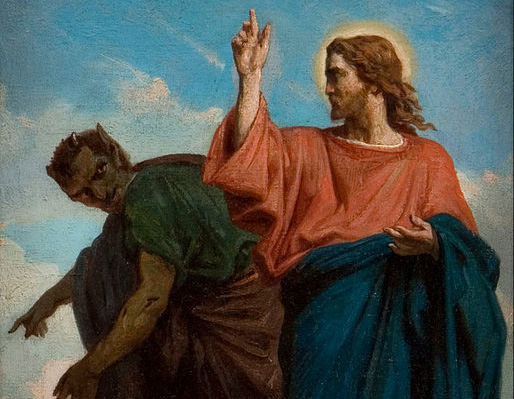
The tradition of fasting during Lent is an early one, originally done between Good Friday and Easter morning, the forty hours that Jesus was in the tomb. Christians would partake of no food or drink at all during that time. The fast was extended to the forty days before Easter sometime between 300 and 325, and changed so that food could be eaten only when evening had come.
The idea behind the fast was to imitate Christ. In addition to fasting, Christians would devote themselves to making prayer a faithful habit. So “prayer and fasting” have been closely linked for a long time.
And that brings me, by a rather circuitous route, to chocolate.

But the Lenten season is also a time we ponder and wonder about the love of God. God’s love knows no bounds or limits and was so strong that not even the prospect of cruel death could deter Jesus from his redemptive mission. While we deny the pleasures of life during Lent, Jesus denied his life itself for the sake of his love for us.
Perhaps that fact could put a different spin on our concepts of giving something up for Lent. The Lenten sacrifice is best oriented toward that which most blocks our spiritual growth. It is each to ask ourselves, “What is it that most keeps me from Christ-likeness?” If that thing is chocolate, then it is appropriate to give up chocolate for Lent. But if something else is your greatest obstacle in being more Christlike, then giving up chocolate is a spiritually pointless exercise.
The question is this: “What is the one thing that most hinders my Christian growth into the person whom God wants me to be?” The answer may not be easy, but it will always involve self-denial. We think that following Christ is hard because to obey Christ we must first disobey ourselves, and it is disobeying ourselves that makes us think following Christ is hard.
But Jesus said his yoke is easy, his burden is light. We just have to get over ourselves to do it.
As Robert Mulholland put it, “Jesus is not talking about giving up candy for Lent. He is calling for the abandonment of our entire, pervasive, deeply entrenched matrix of self-referenced being.”
If we focus on that between now and Easter Day, then we have a chance to become more mature in Christian faith and practice. It may be a habit that is out of true with Christian character that needs to be overcome for further growth. Or it may be a thing undone which must be done for deeper development to occur. The Lenten idea is for our habits to change enough in the next few weeks so that we can continue at a higher level of discipleship after Easter. The Lenten season and the Lenten sacrifice are not the points in and of themselves, the whole life of discipleship is.
Focusing on the one big thing is not the only Lenten discipline that would be helpful for spiritual development. Methodism’s founder, John Wesley, insisted that the only thing that distinguishes the Christian from the non-Christian are how we use our time and money. So, for the period of Lent I would suggest focusing on those two things in addition to whatever one big spiritual obstacle you might have. Some suggestions:
- Tithe all your income until Easter.
- Devote yourself to prayer daily and attending worship every Sunday. If you are traveling, say on business or spring break, then worship wherever you are.
- Read the Bible each day.
- Call someone you love and let them know.
- Ask people who live alone to join you for lunch or whether you can visit them.
- Become involved in Christian ministries.
- Re-establish or reinforce important relationships in your life.

Lent should be a period of joyful, God-directed introspection into how we may be further united with Christ in godly love. If we make Lent into a severe, joyless, self-justifying exercise in self-denial, we have missed the point. Jesus sternly admonished teachers of the religious law and the Pharisees not to practice the letter of the law while neglecting “the more important matters of justice, mercy and faithfulness” (Matt 23:23).
When a lawyer asked Jesus, “which is the greatest commandment in the Law?” Jesus replied, “‘Love the Lord your God with all your heart and with all your soul and with all your mind.” And the second is like it: ‘Love your neighbor as yourself.’”
That is the whole point of spiritual growth and spiritual discipline, and hence the whole point of Lent: love. We are to be living ambassadors from God to one another and the world at large in Christ’s name. Christ was crucified, buried and raised from the dead for our sake and the sake of the whole world. Let us rededicate ourselves to being Christ’s ambassadors. It’s Lent, after all; it’s all about love, you see, Lent is all about love.
Thursday, January 9, 2020
The Methodists' coming punishment of God
I wrote this with non-UMC readers in mind, so I do not dwell on the minutiae of the recently-released "Protocol" document. Besides, this is long enough without that.
Just after New Year’s Day there was national and regional news coverage announcing, “United Methodist Church Announces Proposal to Split Over Gay Marriage” (NPR), or similar headlines.

Why did this become suddenly worthy of such large-scale coverage? That the church has been wrestling with homosexuality since at least 1972 is no secret. Accurate headlines would read, "United Methodist Church leaders agree to catch up to fact that the UMC is already splitting over gay rights."
The UMC is the America’s second-largest Protestant denomination with about 7.5 million US members, and about that many around the world, with the largest foreign numbers in Africa.
The massive coverage of the latest split proposal, called “Protocol of Reconciliation & Grace Through Separation,” does not really break much new ground. There were already a few breakup plans proposed and on the table several months ago.
So, what is the situation now, what comes next, and what after that?
“Status quo” is Latin for “the mess we’re in”
In fact, nothing has been decided and no actual actions have been taken to split the UMC. That a split is nearly certain to come before this summer is not much in doubt. But what the details will be no one can predict.
The UMC’s only body that can determine policy denomination-wide is the General Conference. Presided over by bishops, who can speak to issues but may not vote, the GC convenes once per four years and does not exist in between. It will convene again on May 5. The “gay issue” will certainly be the priority matter. Voting delegates come from the church’s conferences, which is what the UMC calls dioceses. The number of delegates is fixed; how many come from each conference is based on their membership number. Delegates per conference must be both laity and clergy.
So, what will the fight be about?
The present canon law of the UMC, called the Book of Discipline, says this:
• ¶ 304.3: The practice of homosexuality is incompatible with Christian teaching. Therefore self-avowed practicing homosexuals are not to be certified as candidates, ordained as ministers, or appointed to serve in The United Methodist Church. View full statement.This has been the policy for many years. However, a special, called General Conference in February 2019 added mandatory penalties for violations and prohibited giving …
• ¶ 341.6: Ceremonies that celebrate homosexual unions shall not be conducted by our ministers and shall not be conducted in our churches.
… United Methodist funds to any gay caucus or group, or otherwise use such funds to promote the acceptance of homosexuality or violate the expressed commitment of The UMC "not to reject or condemn lesbian and gay members and friends."That GC also adopted means by which churches that could not abide by these provisions could withdraw from the UMC while retaining possession of their real estate and buildings. Some did, but not many.
Instead, the vast majority of progressives remained in the UMC to continue the fight. This caused two major consequences:
- Traditionalists rebelled against the never-ending infighting and started to leave the UMC individually, causing a significant decline in attendance and collections. This was amplified by the relatively smaller number of progressive Methodists who made the same choice. Progressive churches (in aggregate) sharply dropped paying their apportionments (denominational dues) in protest. Only two months after the special GC, The Hill reported, "Liberal Methodist churches withholding dues after denomination vote to ban LGBT-inclusive practices." Presently, the denomination and its congregations are financially tenuous.
- While traditionalists patted themselves on the back for winning, progressives redoubled to orient on the election of delegates to this May’s GC. As a result, it is generally acknowledged that the majority of American delegates elected are clearly progressive.
That the new changes to the Discipline formally provided for churches to withdraw was simply dismissed by UM progressives. They were determined that the UMC itself would become fully progressive, not some church splintered from it. That determination has not lessened.
The near horizon
True, the Protocol is not even on the agenda for this May’s General Conference, although there are ways it can be added. Even so, that it was released by the COB in an obviously pre-planned, coordinated national media campaign for maximum coverage, compels pulpit pastors like me to understand a sobering fact: We may not be interested in the Protocol, but the Protocol is very interested in us.
Dale M. Coulter, associate professor of historical theology at Regent University, observed in First Things, that
... the Protocol does not allow local churches or conferences to remain neutral any longer. In its current configuration, the Protocol requires that a choice be made—even if that choice is not to vote and thus remain in the post-separation UMC after the dust settles. The fight will now be taken to the local level.The Protocol simply torpedoes whatever remained of the center. The center, or what was left of it, now no longer exists. When the president of the Council of Bishops is a Protocol signatory and its first appearance is on the COB's web site, the idea that there remains sort of centrist path is shredded. It is reasonable to assume that this is the outcome preferred by a clear majority, perhaps all, of the UM's bishops. On the date of this post the UM News Service announced that members of the team that developed the Protocol "will be interviewed in a live-streamed panel discussion on Monday, Jan. 13" for an hour at 9.30 a.m. EST on umnews.org. No other proposal for General Conference on this or any other topic has received such genuflection, which IMO speaks volumes.
So even if some bishops think there should still be a middle way, their peers have shut them down. (Remember, though, that the Council of Bishops formally endorsed a centrist plan for the UMC at the February 2019 special General Conference, and it was promptly rejected by both left and right.)
Pastors' shepherding of congregations through the coming schism will be challenging, to say the least. Each pastor will have to choose a side while still pastoring all the people of the church, and the people will be choosing their sides, too. Most congregations' members will not be unified with one another. I have known, for example, members who hold the traditionalist position but who also have homosexual close family members. For them, the issue is very personal. And that puts ministers right here:

The reason is that congregants will fall into three basic groups of response:
- Those who will leave the church because the pastor chose the "wrong" position,
- Those who will leave the church because the pastor would not announce his/her position,
- And those who feel so deeply rooted that they are not going to leave their church no matter what, or who simply want this whole issue to just go away - at least until a very progressive or very traditionalist pastor takes the pulpit in their church. Then, to borrow Robert Heinlein's metaphor, they will hoist the Jolly Roger.
A crucial feature of good ethical decision-making in the real world is understanding the limits of your powers. You try to make choices that bring lots of good consequences and minimal bad ones, that fulfill your obligations to everyone to whom you have obligations (including yourself) — but you’re doing it in a complicated world where you must make your choices on the basis of imperfect information, and where other people are doing things that may impose constraints on your options. Ethics cannot require us to be omniscient or omnipotent. This means that sometimes even the most creative and optimistic ethical decision-maker has to face a situation where none of the available choices or outcomes are very good.Even allowing for all that, the Protocol's basic premise that traditionalists and progressives must divorce one another is hardly disputed within the UMC. The Protocol likely will be added to the handful of "split up" proposals already on the General Conference's agenda. For sure, no one expects “the mess we’re in” to continue post-GC.
A safe assumption is that at least two Methodist denominations will arise from this May's GC. One will be progressive/liberal and the other orthodox/traditionalist/conservative. What the actual names will be who knows, but theologically and ideologically that’s how they will be. There could be other denominations, too.
It must be recognized that individual churches will get to choose. If My Town UMC's conference votes to be in the progressive church but MTUMC's members are mostly traditionalist, then MTUMC's members will be able to vote to join another denomination. But they will still lose some members when they do. Likewise if a progressive congregation votes to leave a traditionalist conference. Not all the sheep will follow. Shrinkage, probably dramatic at that, is inevitable.
Both or all new denominations will be significantly down-funded from now. Staffs at the denominational, conference, and local-church level will diminish and there will be significant downward pressure on salaries from top to bottom. That means that most pastors and staff who can retire will do so and those who cannot yet retire but have other options will take them. The already-over bureaucratic structure of today's UMC will not collapse, exactly, but it will shrink a lot.
Even assuming there is an amicable split, or at least not an angry one, the coming few years will not be unicorns and rainbows for either progressives of traditionalists. I think both denominations will have many difficulties getting organized (which is to be expected) but also fights over their respective purity codes will erupt also. That is, what is it that marks one as a True Traditionalist or a True Progressive? Neither side can answer that right now because any answer given now is mainly influenced by the "mess we're in" and not what will pertain then.
Both denominations will find themselves bickering about a whole host of matters other than homosexuality, which as a topic will be off the table anyway. This will further cause church members to vote with their feet, accelerating the decline of Methodism in America. The Baptists or the MCC , however, will probably be very grateful. And then there was this posted by a friend I have known since before the internet:
Went to a Catholic funeral. At the supper I mentioned how beautiful their church was.That will continue.
The answer was, "Beautiful yes, but it takes a lot of money for upkeep. We couldn't afford it if it were not for all the Protestants that are converting."
Where do we find God here?

I know that God never withdraws his grace and guidance. Jesus' resurrection never becomes less efficacious. But I also remember this:

And we will get it good and hard.
If you think I am overstating all of this I only reply, wait and see. Because you ain't seen nothing yet.
The outcome will be like this, only it will not be funny.

Thursday, December 26, 2019
Facts are not important, politics is
This was posted by a very liberal long-time friend and fellow cleric of mine.

I commented thus:
But the facts don't matter when political hit jobs can be done even on pretense.
Update: In response to another minister's query (who is a friend and not just on FB), I wrote this:
Both Judea and Egypt were occupied and governed by Rome; of course you know this. Just as the Romans changed the name of the formerly independent country of Judah to Judea, they changed the name of Egypt to Aegyptus. But the key point is not really that they changed the name, but that they had the power (by force of arms, to be sure) to do so.
To say that Egypt and Judea were "countries" under Roman rule is about as accurate as saying that Kazakhstan was a country under Stalin. Maybe it was once, and wanted to be again, but in 1948 it was not. It was a Soviet province and nothing more.
Likewise Judea and Aegyptus. The Holy Family changed province of residence but it did not change who governed them.
Now, whether the Holy Family were refugees. Yes, Matthew is clear that they made the trek to Aegyptus because of Herod's lethal plans. But again, while they changed provincial government, there was no political difference, just as if someone moved from Virginia to North Carolina.
Which are states I use on purpose because, as I am sure you know, Virginia's Gov. Northam has publicly stated that he will call out the National Guard to enforce the state's new, draconian gun laws - laws that have caused 90 percent of the state's county commissions to declare that they will prohibit any local law officers to enforce or assist state authorities in enforcing.
Which is to say, Gov. Northam is in fact directly threatening to use actual soldiers to kill people who have committed no offense against the peace or safety of anyone at all or even can be remotely considered such a threat.
Think that cannot happen? In November of last year, Maryland police shot to death a 61-year-old man in his own home who had committed no crime but for whom a court had issued a "red flag" order.
IMO, Gov. Northam is today's Herod. So when (not if, btw) some Virginia 2nd Amendment advocates decide to leave potentially-fatal Virginia to live in North Carolina, will they be refugees? If not, why would the Holy Family have that status?
Tomorrow in my sermon I will quote the Rev. Joy Carol Wallis thus,

I commented thus:
The Holy Family were never refugees. They did not move to Egypt illegally. They moved from Roman-controlled Judea to Roman-controlled Egypt. It was literally like if you moved from Tennessee to Kentucky.Why did the Holy Family need to move to Egypt in a hurry? The answer is one word: government. Yet to my friend and others of his leanings, government is always the solution, never the problem.
But the facts don't matter when political hit jobs can be done even on pretense.
Update: In response to another minister's query (who is a friend and not just on FB), I wrote this:
Both Judea and Egypt were occupied and governed by Rome; of course you know this. Just as the Romans changed the name of the formerly independent country of Judah to Judea, they changed the name of Egypt to Aegyptus. But the key point is not really that they changed the name, but that they had the power (by force of arms, to be sure) to do so.
To say that Egypt and Judea were "countries" under Roman rule is about as accurate as saying that Kazakhstan was a country under Stalin. Maybe it was once, and wanted to be again, but in 1948 it was not. It was a Soviet province and nothing more.
Likewise Judea and Aegyptus. The Holy Family changed province of residence but it did not change who governed them.
Now, whether the Holy Family were refugees. Yes, Matthew is clear that they made the trek to Aegyptus because of Herod's lethal plans. But again, while they changed provincial government, there was no political difference, just as if someone moved from Virginia to North Carolina.
Which are states I use on purpose because, as I am sure you know, Virginia's Gov. Northam has publicly stated that he will call out the National Guard to enforce the state's new, draconian gun laws - laws that have caused 90 percent of the state's county commissions to declare that they will prohibit any local law officers to enforce or assist state authorities in enforcing.
Which is to say, Gov. Northam is in fact directly threatening to use actual soldiers to kill people who have committed no offense against the peace or safety of anyone at all or even can be remotely considered such a threat.
Think that cannot happen? In November of last year, Maryland police shot to death a 61-year-old man in his own home who had committed no crime but for whom a court had issued a "red flag" order.
IMO, Gov. Northam is today's Herod. So when (not if, btw) some Virginia 2nd Amendment advocates decide to leave potentially-fatal Virginia to live in North Carolina, will they be refugees? If not, why would the Holy Family have that status?
Tomorrow in my sermon I will quote the Rev. Joy Carol Wallis thus,
Herod represents the dark side of the gospel. He reminds us that Jesus didn't enter a world of sparkly Christmas cards or warm spiritual sentiment. Jesus enters a world of real pain, of serious dysfunction, a world of brokenness and political oppression.So far, so good. Agree 100 percent. But then:
Jesus was born an outcast, a homeless person, a refugee, and finally he becomes a victim to the powers that be. Jesus is the perfect savior for outcasts, refugees, and nobodies.I will omit the italicized part because it is simply incorrect.
- Jesus was not, in fact, born “born an outcast." He was born a Jew in a nearly-totally Jewish land to a solidly ordinary and righteous family.
- He was not "a homeless person" because his parents owned a home in Nazareth. If a Nashville woman gave birth to a child in Knoxville, would that make the baby homeless?
- And as I have said, he was never "a refugee” at all, much less born one in his father’s ancestral town.
- That “Jesus is the perfect savior for outcasts, refugees, and nobodies” is true, but then, he is also the perfect savior for absolutely everyone else.
Thursday, December 5, 2019
An Advent reflection
Grace and peace to all!
I subscribe to a daily newsletter by a Canadian minister, the Rev. Carey Nieuwhof. He is one of only two or three such writers that I know who are always worthy of reading because the majority of his writing applies in some way to my ministry. He does not write merely for other pastors, but also for the people of churches. I do recommend taking a look at his site, https://careynieuwhof.com/.
Recently, his email included this nugget:

One of the most difficult things to do is self-challenge what we know. As someone once remarked, it is not what we do not know that is often the problem, it is that so much of what we think we know is not so. The balance between retaining what have tested and found enduring, and discarding what serves us well no longer—well, that can be tough.
Just imagine what the first followers of Jesus had to discard and adopt. Start with Peter, whom Jesus told to stop fishing for fish and start fishing for people. Or much earlier, the shepherds, who had to face that the Messiah was born in the humblest of settings to undistinguished parents. Or Mary, that she was being asked to face possible social disaster in being pregnant with a child that her fiancé could not say was his. And Joseph, who is described as a honorable man who elected to do what in his day was a dishonorable thing, marrying Mary anyway.
The story of Jesus’ nativity and ministry is one of turning over tables, both literally in the Temple confronting the money changers, but also figuratively, for bringing people to confront that so much of what they knew simply was not so:
The gifts of Advent and Christmas are twofold, at least:
I subscribe to a daily newsletter by a Canadian minister, the Rev. Carey Nieuwhof. He is one of only two or three such writers that I know who are always worthy of reading because the majority of his writing applies in some way to my ministry. He does not write merely for other pastors, but also for the people of churches. I do recommend taking a look at his site, https://careynieuwhof.com/.
Recently, his email included this nugget:

One of the most difficult things to do is self-challenge what we know. As someone once remarked, it is not what we do not know that is often the problem, it is that so much of what we think we know is not so. The balance between retaining what have tested and found enduring, and discarding what serves us well no longer—well, that can be tough.
Just imagine what the first followers of Jesus had to discard and adopt. Start with Peter, whom Jesus told to stop fishing for fish and start fishing for people. Or much earlier, the shepherds, who had to face that the Messiah was born in the humblest of settings to undistinguished parents. Or Mary, that she was being asked to face possible social disaster in being pregnant with a child that her fiancé could not say was his. And Joseph, who is described as a honorable man who elected to do what in his day was a dishonorable thing, marrying Mary anyway.
The story of Jesus’ nativity and ministry is one of turning over tables, both literally in the Temple confronting the money changers, but also figuratively, for bringing people to confront that so much of what they knew simply was not so:
“You have heard that it was said, ‘Love your neighbor and hate your enemy.’ But I tell you, love your enemies and pray for those who persecute you, that you may be children of your Father in heaven" -- Matthew 5.43-45If we are truly blessed, we are seriously disturbed this Advent by the implications of Jesus’ coming and nativity. May the Holy Spirit lead us to think more deeply about what we think we know and what it means for the way we live and more importantly, why we live.
The gifts of Advent and Christmas are twofold, at least:
- First, that “unto us a child is born, unto us a Son is given, and he will be called Wonderful Counselor, Mighty God, Everlasting Father, Prince of Peace.”
- Second, that in celebrating that Christ is born, we can embrace that we are born anew. May we discern the renewing revelation of God through our worship and giving this season!
Thursday, August 15, 2019
Ban on driving while using cell phone - just a cash cow?

The Tennessee law banning hand-held cell phones went into effect July 1. Drivers can eat, drink, converse, sing, look at roadside sights, talk to their kids in the back seat, and it’s all perfectly legal. Pick up a cell phone, however, and you’re a distracted-driving lawbreaker. Law enforcement and first responders, however, are exempt from the safety measure that the legislature and governor determined is required for Tennessee drivers.The Sentinel is not a fan of the law, mainly because such bans, in effect in some other states for many years, have not once been shown to affect the accident rate at all. They cite a number of such studies.
But it does roll cash into county and state coffers.
At $50 per ticket, the Tennessee Highway Patrol’s cell phone ban enforcement netted, it would appear, a minimum of $21,200 for the 424 tickets the THP wrote in July, Knox News reported. Tickets increase up to $200 depending on the situation.And yet . . .
Yes, the ban here in Tennessee is really just another way to tax people. OTOH, the worst accident scene I ever got called by the sheriff's dept. to go work was directly caused by a young woman driving on a two-lane state highway in Franklin, Tenn. It was before smart phones were invented. She was trying to punch a number into her cell phone and wandered into the other lane. An oncoming 18-wheeler swerved to miss her, bounced back onto the road and went head on into a Chevy pickup behind the woman's car.
The impact was so violent that it completely separated the truck's body from its frame, knocking the truck body 20 or more feet away from the frame assembly, which was solely occupied by the driver, married only three weeks, on his way home from work. He had been ripped into three separate pieces. The 18-wheeler's driver was injured.
The woman phone caller was wholly uninjured but when I spoke with her she was not very coherent. She was still holding the phone in her hand, up next to her head, though of course there was no call connected, and basically just walking in a small circle at the rear of her car.
A highway patrol trooper told me that in his 26 years in the THP, this was the most violent accident he had seen. After seeing the truck driver's remains, I could see why. Before the medical examiner's team went to retrieve the remains, I held a time of prayer and Holy Communion for them (I always took my Communion kit responding to sheriff's department calls).
So I cannot argue with Tennessee's law.
Thursday, August 1, 2019
What next for us?

There is said to be a Chinese curse that simply says, “May you live in interesting times.” Whether a curse or not, I’d say we are certainly living in interesting times!
I think most of you know that the United Methodist Church is facing an uncertain future as a denomination. The General Conference (GC) is the only body that makes denomination-wide policy. It is useful to recall that the UMC is a worldwide church with several million members outside the United States.
Since the GC of 1972, the UMC has been wrestling with what shall be the denomination-wide position regarding homosexuality. Presently, the UMC's position is that homosexuals, like all other peope, "are persons of sacred worth" and are invited to become part of the body of Christ through baptism, to celebrate Holy Communion, and to serve in the church as fully as everyone else, with two exceptions:
- "Self-confessed, practicing homosexuals" may not be ordained as ministers of the UMC, and
- No UM minister, whether ordained or licensed, may officiate a same-sex wedding anywhere, nor may such ceremonies be conducted on the grounds of UM churches, no matter who officiates.
Last February, the General Conference retained the existing position and strengthened it. Some provisions of what was passed were subsequently nullified by the UM Judicial Council. But the core parts were retained. See here.
Even so, the debate is far from finished. The GC regularly meets every four years and will convene again in May 2020. There is, as of now I think, a widespread belief among all sides of that issue that no compromise-outcome is really possible. I am reminded of Abraham Lincoln’s observation in his 1858 “House Divided” speech, that every solution to the slavery question had been attempted and failed and no more compromising was possible. The nation, he said, would eventually either legalize slavery in every state or in abolish slavery in every state. What it could not do any longer was maintain the status quo.
I think that is what progressives and traditionalists alike are concluding about the UMC’s position on homosexuality. Everything that can be tried has been tried, and the subject is still not settled within the denomination. The One Church Plan, endorsed by the Council of Bishops, was rejected last February and no one today is promoting it for next May.
If I could forecast now the GC will decide next May, I could make a fortune on the stock market. I know that many influential progressive and traditionalist Methodists across the country are in ongoing conversation. I am gratified not have seen or read of spite-filled language or personal attacks by either side.
But what about us?
I echo what Bishop McAlilly told the annual conference in June. I am pastor of all the people of the church and I will not be drawn into partisan positions. Of course, I have my beliefs about this issue, but as I told the annual conference, “I could be wrong” (an admission I wish everyone progressive or traditionalist would also make).
"It's tough to make predictions, especially about the future." Even so, here are my predictions:
Our calling to be disciples of Jesus Christ will not change even though our denomination is going through “interesting times.” Jesus’ Great Commandment to go make disciples shall remain before us.
We shall face the future unafraid because
- we are still united in our baptism even if not by certain beliefs on this (or other) topics,
- we therefore will continue to worship together and move on to Christian perfection through deeds of devotion, charity, and justice.

These "interesting times" are temporary. Christ’s church is eternal!
Regardless of the future of the United Methodist Church, we remain united in our prayers, our presence, our gifts, our service, and our witness.
The Lord is with us! Let’s remain with the Lord -- and with one another!
Saturday, June 15, 2019
Speaking my language
Yesterday in his closing homily of the annual conference of the Tennessee Conference, Bishop Bill McAlilly urged the people of the conference to understand that while times for the UMC today are rocky, we should, "Take a breath and carry on" with the full ministries of the church.
I turned to my wife, Cathy, and said, "That is speaking my language" since I am a retired US Army officer. So that deserves a meme!

Or as we put it in my former career:


I turned to my wife, Cathy, and said, "That is speaking my language" since I am a retired US Army officer. So that deserves a meme!

Or as we put it in my former career:


Monday, June 3, 2019
Surprise! Parents are the key influence on children
From the United Methodist Church News Service, "The secret to faith after high school? Parents!"
And this, from Harvard University: "Kids Raised Going to Church Are Happier Adults, Study Finds"
But don't be these parents: "After 12 Years Of Quarterly Church Attendance, Parents Shocked By Daughter's Lack Of Faith"
Parents’ faith is key
The National Study on Youth and Religion found a factor that is “nearly deterministic” in turning this around. Eight out of ten (82%) young adults ages 24-29 who were still participating in their faith after being active in high school, had one thing in common.Read the whole thing.
The secret? Their parents.
Youth leaders agree. “Parents are the critical discipler, period,” said Seth Martin, former Lead Student Pastor and now Lead Director of The Road at Faithbridge United Methodist Church in Spring, Texas. “Student ministries aren't (or shouldn't be, rather) the primary spiritual mentors of students, but should instead subsidize the discipleship already taking place in the home.”
And this, from Harvard University: "Kids Raised Going to Church Are Happier Adults, Study Finds"
But don't be these parents: "After 12 Years Of Quarterly Church Attendance, Parents Shocked By Daughter's Lack Of Faith"
Thursday, April 18, 2019
What draws people to church services?
A Gallup survey reported just two years ago:


There is growing realization today that "attractional" church worship is not working in drawing people wither to long-term attendance or to personal commitment to Christ. "Worshiptainment," as we call it, is a failure in leading people to discipleship.
Commentator Jonathan Miltimore writes,
I think the real bottom line is this: What are people finding, experiencing, and learning in a church that they cannot find in secular culture?
Pew Research has a lot more, "Why Americans Go (and Don’t Go) to Religious Services."
More Gallup commentary of these trends, "Church Leaders and Declining Religious Service Attendance."

STORY HIGHLIGHTS
- Three in four worshippers say sermons a major factor in why they go
- Youth programs, outreach and volunteer opportunities also important
- Preferring to worship solo is main reason non-attenders eschew services

Belonging to a church, synagogue or mosque provides people with important social benefits that Gallup research shows improve personal well-being. While social benefits are clearly important to majorities of those who worship regularly, what most motivates them to attend is learning more about the tenets of their faith, as well as connecting that faith to their lives. Protestants, who have more control over their church leadership and flexibility in where they worship, place even greater emphasis on the quality of sermons than do Catholics, although both groups rate sermons highly.Much more at the link.
Fulfilling these expectations could be critical in order for religious organizations to survive. But to expand their ranks, reigniting the interest of lapsed members should be a priority. Converting those who say they aren't very religious or who don't like organized religion may be futile. But churches and others may find some success with the message that worshipping in communion with others has benefits that can't be achieved worshipping alone -- addressing the No. 1 reason non-attendees give for not attending.
There is growing realization today that "attractional" church worship is not working in drawing people wither to long-term attendance or to personal commitment to Christ. "Worshiptainment," as we call it, is a failure in leading people to discipleship.
Commentator Jonathan Miltimore writes,
The poll made me wonder: When and why did music became such a prominent part of evangelical services? And are these churches missing out by focusing on music at the expense of other aspects of church life?The Gallup survey corresponds to other research I have seen that reports that the fabled and much-derided Millennials are drawn to traditional or orthodox services far more than "contemporary" or attractional services.
I suspect the former question might be linked to the increasing need for people in our culture to be entertained.
“Americans no longer talk to each other, they entertain each other," Neil Postman famously wrote in his 1985 book Amusing Ourselves to Death. "They do not exchange ideas, they exchange images.”
I’m not suggesting churches need to stop playing music. I’m merely wondering if dedicating nearly half of a church service to musical performances is the most efficient use of time.
One wonders if people in pews would not receive more spiritual nourishment from other church-led activities: An extended reading of scripture? Silent prayer? A longer sermon?
I think the real bottom line is this: What are people finding, experiencing, and learning in a church that they cannot find in secular culture?
Pew Research has a lot more, "Why Americans Go (and Don’t Go) to Religious Services."
More Gallup commentary of these trends, "Church Leaders and Declining Religious Service Attendance."
Thursday, April 4, 2019
Organizational maturity
First published elsewhere in 2011
Many years ago, when I was still in the Army, I was sent by my colonel to attend a dinner and meeting of the Association of the US Army in Fayetteville, NC. Normally my colonel went to these meetings as the representative of Headquarters, XVIII Airborne Corps and Fort Bragg, but for that meeting, away I went.
By the end of the meeting, I had formulated the Principle of Organizational Maturity, which is simply that in any organization, especially volunteer organizations, the point will be reached when sustaining the organization become more important than the goals of the organization.
 Which is to say that keeping the institution viable as a going concern comes to supplant the purposes for which the organization was founded. It was evident to me at the AUSA meeting because the only thing on the agenda that night was signing up more members. That's it. No other topic was discussed.
As I said, the Principle of Organizational Maturity is a particular imperative for volunteer outfits because unless the organization itself can appeal to potential volunteers, the organization will wither and eventually die. An organization's founders learn the bitter truth that there is no lasting mass movement for their cause (see "Tea Party") and that new volunteers must have other primary reasons to join than the original cause.
So eventually the organization becomes oriented on keeping present members happy and inducing new members by focusing on the benefits of membership. Which is to say, the organization becomes a club in the main, although it will continue to do some of the work for which it was founded, but only to the line where members become uncomfortable or resistant, especially regarding their commitment of money and time.
Comes now renowned science-fiction writer Jerry Pournelle's "Iron Law of Bureaucracy," which states that "in any bureaucratic organization there will be two kinds of people":
Like I said. Hear then the parable of the lighthouse:
Many years ago, when I was still in the Army, I was sent by my colonel to attend a dinner and meeting of the Association of the US Army in Fayetteville, NC. Normally my colonel went to these meetings as the representative of Headquarters, XVIII Airborne Corps and Fort Bragg, but for that meeting, away I went.
By the end of the meeting, I had formulated the Principle of Organizational Maturity, which is simply that in any organization, especially volunteer organizations, the point will be reached when sustaining the organization become more important than the goals of the organization.

As I said, the Principle of Organizational Maturity is a particular imperative for volunteer outfits because unless the organization itself can appeal to potential volunteers, the organization will wither and eventually die. An organization's founders learn the bitter truth that there is no lasting mass movement for their cause (see "Tea Party") and that new volunteers must have other primary reasons to join than the original cause.
So eventually the organization becomes oriented on keeping present members happy and inducing new members by focusing on the benefits of membership. Which is to say, the organization becomes a club in the main, although it will continue to do some of the work for which it was founded, but only to the line where members become uncomfortable or resistant, especially regarding their commitment of money and time.
Comes now renowned science-fiction writer Jerry Pournelle's "Iron Law of Bureaucracy," which states that "in any bureaucratic organization there will be two kinds of people":
First, there will be those who are devoted to the goals of the organization. Examples are dedicated classroom teachers in an educational bureaucracy, many of the engineers and launch technicians and scientists at NASA, even some agricultural scientists and advisors in the former Soviet Union collective farming administration.
Secondly, there will be those dedicated to the organization itself. Examples are many of the administrators in the education system, many professors of education, many teachers union officials, much of the NASA headquarters staff, etc.
The Iron Law states that in every case the second group will gain and keep control of the organization. It will write the rules, and control promotions within the organization.
Like I said. Hear then the parable of the lighthouse:
Saturday, March 2, 2019
Social justice and churches
WHY SOCIAL JUSTICE IS KILLING SYNAGOGUES AND CHURCHES
Data suggests that the more a religious movement is concerned with progressive causes, the more likely it is to rapidly lose members
Data suggests that the more a religious movement is concerned with progressive causes, the more likely it is to rapidly lose members
The mainstream Protestant churches are not exactly filling the sanctuaries either. Some, like the internally conflicted Methodists have seen their number of North American congregants drop from 15 million in 1970 to barely half that today. Since 2007 alone, America’s mainstream churches have lost 5 million members, and even the once vibrant evangelical movement is losing adherents outside of the developing world. Ever more churches, particularly in urban areas, are being abandoned, turned into bars, restaurants, and luxury condos. And nothing augurs worse for the future than the fact that American millennials are leaving religious institutions at a rate four times that of their counterparts three decades ago; almost 40 percent of people 18 to 29 are not unaffiliated.Read the whole thing.
Sunday, February 3, 2019
How ISIS drove Muslims to Christian Faith
NBC News: Life under ISIS led these Muslims to Christianity "If heaven is made for ISIS and their belief," said one convert, "I would choose hell for myself instead of being again with them in the same place, even if it’s paradise."
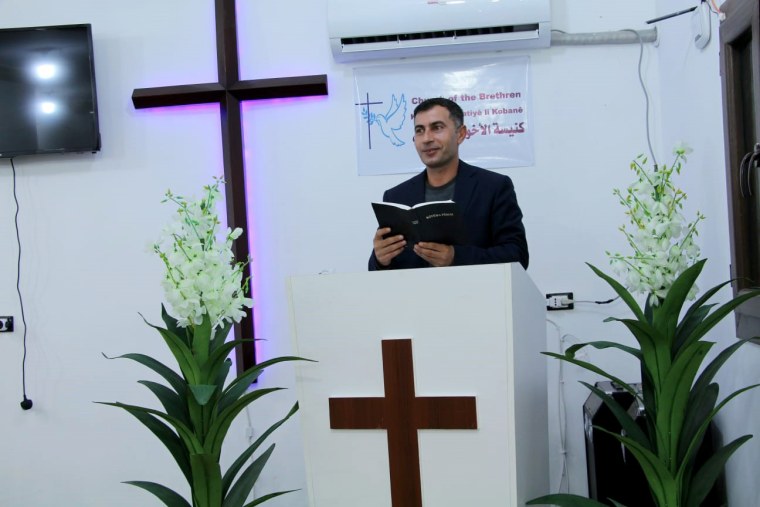
While residents are still dealing with the emotional scars left by the brutality of ISIS, Omar says many people in Kobani have been open-minded about Christianity.
Omar reads the Bible at the Church of the Brethren in Kobani, Syria. NBC News
“Most of the brothers here converted or come to church as a result of what ISIS did to them and to their families,” he added. “No one is forced to convert. Our weapon is the prayer, the spreading of spirit of love, brotherhood and tolerance.”
Saturday, December 8, 2018
Advent Downsizing

I know many readers have dealt with such transitions already. And I cannot overlook that since last Advent, some families of our church coped with transitions more severe than that as they have committed loved ones to God's eternity.
I have learned that these kinds of transitions mean “downsizing.” When mom and dad moved from their house to a Blakeford apartment in 2009, they downsized. When we moved dad from the apartment to a single room, downsizing again. But not only of things. When my mother died in 2015, it was a different, but very real, kind of downsizing also.
And you know what? Downsizing is not appealing. It is not fun. It means saying goodbye to things and sometimes persons loved.
And yet . . .
Downsizing can also make us focus on essentials. Downsizing can bring clarity. When our eldest, a U.S. Marine lance corporal, spent 2005’s Christmas in combat service in Iraq, Cathy and I had a clear picture of what Christmas meant for us. It was not the stuff. Of course, we gave and received gifts and celebrated with our other two children and family, but it was crystal clear to us — and has remained so 13 years hence — that all we really have in this life is one another, not things.
The book of Job tells of his fabulous wealth — all lost, his children killed, even his health ruined, his body wracked with pain. Yet he merely says, “Naked I came from my mother's womb, and naked I will depart.” It took me years to see that Job was only half right. Naked we are born, but we die clothed in the love we gave away.
To move on to Christian perfection in this life is to downsize. Downsize habits that block us from holiness. Downsize that which inhibits our love of God and our neighbors. Downsize our egos to make room for God. Downsize the falsehood that getting our way is all it takes to make us happy.
Thankfully, the upsizing is greater than the down. We upsize in gratitude. We upsize in meaningfulness. We upsize in patience, in peacefulness, in joyfulness, in kindness, self-control, gentleness, and so many other ways.
But first comes the downsizing, so let Advent be a time to downsize for the sake of the Gospel!
Merry Christmas to all, and God bless us, every one!

Wednesday, December 5, 2018
Can we endure the refinery?
Malachi 3.1-4, a passage for the second Sunday of Advent
And silver, while we are at it.
To move on to Christian perfection in this life, to attain holiness of life, is not painless or easy.
Malachi uses the metaphor of refining because it illustrates the process of moving on to perfection and righteousness: the dross (impurities in the raw material) must be removed, but it takes intention, planning, and effort. We have to yield to the process. And as even Jesus himself found out, some number of people will try it out and just say no -- see, for example, John 6.66, "After this many of his disciples turned back and no longer walked with him."
While the process of spiritual refinement is important, it is only a means to an end, not the end itself. As Paul said, we should keep our eyes upon the goal: "... forgetting what lies behind and straining forward to what lies ahead, I press on toward the goal for the prize of the heavenly call of God in Christ Jesus" (Philippians 3.13b-14).
Yes, it is worth it!
Can we imagine the discipleship equivalent to such a work?
See, I am sending my messenger to prepare the way before me, and the Lord whom you seek will suddenly come to his temple. The messenger of the covenant in whom you delight--indeed, he is coming, says the LORD of hosts.Are we willing to take the refining?
But who can endure the day of his coming, and who can stand when he appears? For he is like a refiner's fire and like fullers' soap; he will sit as a refiner and purifier of silver, and he will purify the descendants of Levi and refine them like gold and silver, until they present offerings to the LORD in righteousness.
Then the offering of Judah and Jerusalem will be pleasing to the LORD as in the days of old and as in former years.
And silver, while we are at it.
To move on to Christian perfection in this life, to attain holiness of life, is not painless or easy.
Malachi uses the metaphor of refining because it illustrates the process of moving on to perfection and righteousness: the dross (impurities in the raw material) must be removed, but it takes intention, planning, and effort. We have to yield to the process. And as even Jesus himself found out, some number of people will try it out and just say no -- see, for example, John 6.66, "After this many of his disciples turned back and no longer walked with him."
While the process of spiritual refinement is important, it is only a means to an end, not the end itself. As Paul said, we should keep our eyes upon the goal: "... forgetting what lies behind and straining forward to what lies ahead, I press on toward the goal for the prize of the heavenly call of God in Christ Jesus" (Philippians 3.13b-14).
Yes, it is worth it!
 |
| 2009 U.S. Mint Ultra High Relief, $20 Double Eagle, .9999 fine gold coin, Saint-Gaudens design. |
Tuesday, August 14, 2018
Taking Communion to the Sick and Home-bound
GUIDELINES FOR COMMUNION MINISTERS TO THE SICK AND HOME-BOUND
Introduction
Holy Communion is one of two a sacraments in the United Methodist Church, the other being baptism. In the UMC, communion is an act of the whole church. We do not practice private communion. It is always done within the context of the assembled community of faith. But, like almost every other Christian denomination, we recognize that not everyone can be assembled when communion is offered. Persons who are not able to come by reason of illness, disability or medical treatment or condition may be offered communion where they reside or are under treatment. In the United Methodist Church, this is known as extending the table. However, communion for these persons begins within the context of the community of faith. The communion elements of bread and wine are consecrated by the pastor before being transported to serve to the home-bound for the sick.

General information
1. Because Communion is an act of the church, it is intended for any person baptized into the body of Christ in the apostolic tradition. In Methodism, Communion may be taken by unbaptized persons if they are desirous of baptism soon. Hence, Communion should be served only by baptized persons.
2. One of the earliest sacramental issues the early church had to deal with was whether the moral character of clergy or lay persons could negate the efficacy of the sacraments. That is, were there sins that should disqualify clergy or laity from either consecrating or receiving the sacraments? The answer is no. The actor in the sacraments is God, whose power is not hindered by the human condition. Therefore, there is no personal issue of servers that makes them unworthy to take Communion to the homebound or sick. We are not worthy to receive or serve Communion to begin with!
3. Communion is to be neither consecrated, served, nor received casually. It is a means of grace by which Christ sanctifies his holy church to move us on to perfection. While a Communion visit may be light-hearted, serving and receiving Communion should be treated with respect.
4. Ideally, Communion to the sick and homebound should be taken on the same day that it is celebrated at the church, using the same Communion elements as shared by the congregation. Those who carry Holy Communion to the sick and persons otherwise confined, therefore, continue the community's act of worship. They extend the community's embrace to include those unable to be physically present. If a same-day visit is not possible, Communion should be taken as soon as possible.
5. Always call ahead to confirm the day and time to come. Observe the visitants’ condition and time your visit with them as you deem best for all. Remember, most will be very glad to see you and may want you to stay longer than you planned!
6. “Visit at full speed” right to departure. Do not take several minutes to explain why you must leave and say farewell. When the time comes that you must leave, simply stand and politely say so, make brief but cordial farewells, and go.
7. When praying with the homebound and sick, ask them first what they wish you to pray for, if they are able to answer.
8. Communion is to be offered to all persons present if they wish. So it is good to know how many persons will be there before arriving.
To continue, click on "read more":
Tuesday, June 12, 2018
Council of Bishops and the One Church Model
There will be a special General Conference of the UMC in February of 2019. The General Conference is the only body of the UMC that can set rules and standards and doctrine for the whole church. Only the GC can amend the church canon law, the Book of Discipline. The GC is not a standing body, it exists only when convened. That happens every four years by rule. Special General Conferences are rare and time limited. February's Conference is scheduled (and funded) for only three days.
The topic for the special Conference is to set a way forward for the church in grappling with the issue of homosexuality. Presently, there are two restrictions on this issue:
The topic for the special Conference is to set a way forward for the church in grappling with the issue of homosexuality. Presently, there are two restrictions on this issue:
- "Self avowed, practicing homosexuals" may not be ordained in the UMC,
- Same-sex weddings or unions may not be conducted on any United Methodist property, nor may UM ministers officiate such ceremonies anywhere.
That's it. And those are the two issues that the GC will address. At the last ordinary GC in 2016, a Commission on A Way Forward was founded to study and draft proposals to go before 2019's called GC. The proposals, usually referred to a models, were to be presented first to the Council of Bishops, who were empowered in 2016 to choose one to recommend to the 2019 GC. (Or the Council could reject them all and make its own recommendation, but no one expected that to happen, and it has not.)
The Commission came up with three models, each of which were presented to the Council earlier this year. They are:
- Traditionalist - which would make no changes to the Discipline and would therefore maintain the status quo.
- One Church Model - in which decisions about whether to ordain LGBTQ clergy or to officiate at same-gender unions would be made closer to the congregational level. The plan would remove the restrictive language against the practice of homosexuality in the Discipline. The plan also adds assurances to pastors and conferences who in good conscience cannot perform same-sex weddings or ordain “self-avowed practicing” gay clergy that they don’t have to do so. Central conferences — church regions in Africa, Asia and Europe — could maintain current restrictions.
- The Connectional-Conference plan, which would allow conferences to choose among three connectional conferences for affiliation. The connectional conferences would align based on theology or perspective on LGBTQ ministry — be it traditionalist, progressive or allowing for a variety of approaches. This plan would require multiple amendments to the denomination’s constitution.
Last month, the Council of Bishops voted to recommend the One Church model to the 2019 Conference. However, it also voted that the other two models should remain on the table for consideration. By the way, bishops have voice but no vote at General Conferences.
For more information, read this piece from the UM News Service and see this video.
For more information, read this piece from the UM News Service and see this video.
Sunday, April 29, 2018
Why you matter
Why
you matter (The Resurrection – So What? Part Two)
Do you
matter? And if so, why? I read a physicist’s answer to that question once. He
said that when the universe formed 14 billion years ago, matter and antimatter collided
and burst into energy, then reformed into matter and antimatter and then did it
all over again until, for reasons yet unknown, there was no more antimatter.
The universe, he said, is made up of all the matter that was left over after
all the antimatter had been destroyed. The difference in amounts between matter
and antimatter was no more than one percent.
You matter,
he said, because you are matter.
Well, maybe, but I doubt that answer is very consoling in the dark of the night. Here is a story, a parable if you will, of one evening on a Chicago commuter train.

It was about
10 o’clock one weeknight when three young tough guys, full of swagger and
threat, boarded a car. There were not many riders aboard at that hour – a young
woman clutching a grocery sack, a tired-looking, middle-aged laborer leaning
against a support bar, not even looking up, a few others. As a leopard sees which
gazelles are weak, the young punks scanned the car for prey.
They saw an
older man, maybe 70 or so, in a gray coat and tie, not Brooks Brothers but not
off the Goodwill rack, either. He was seated in the next section, reading a folded
newspaper. And so, laughing loudly and shuffling noisily, the punks approached.
The leader stood before the suited man and punched his newspaper.
“Hey man!”
he yelled. “You’re sitting in my seat!”
When the man
looked up, the young punkster was somewhat surprised that his face and eyes
registered alert awareness, but not fear. So the punkster glared
at him more threateningly.
The gray man
spoke. “Well, I’d better move, then.” He pulled his paper back, folded it with care,
placed it under his arms, and stood. “Pardon me,” he said kindly to the punk
leader, and placing the back of his right hand gently on the young man’s
sleeve, he pressed lightly to the side and stepped across the car. There he
turned and sat, unfolded his paper, looked at the punkster, smiled slightly and
said, “Please, have your seat.” Then he set his eyes on the newsprint and said
no more.
The young
punk stood there for a moment, slightly shrugged and sat down. The two gangster
sidekicks with him sat on either side. “Well, what a bunch of losers we wound
up with tonight!” said one, much too loudly and to no visible effect on the
dozen people in the car. Then he stared at the gray man for a long moment. “And
I think you’re the biggest loser of all.”
The gray man
returned the gaze and shortly simply said, “Very well.” Then he began reading
again.
The punk
leader leaned forward. “Hey man, I’ll give you a real reason to be afraid!”
Several people nearby glanced nervously. “You hear me?”
The gray man
folded his paper into his lap. “No,” he said, “you may give me a reason to be
concerned. But not a reason to be afraid.” Then the gray man did the most
unexpected thing. He stood, stepped to stand in front of the sidekick and said,
“Excuse me, but I’d like to sit there for a moment.” The sidekick snorted,
“Man, stuff you!” or something like that, which evoked a comment from the gray
man to the punk leader, “Would you mind, only for a moment?”
“Shee,” the
punkster said. “I ain’t afraid of you.” To the sidekick he said, “Get up.”
Wordlessly, the glaring young man arose and the gray man sat. “Well?” said the
punkster. “I ain’t got all night.”
Looking
directly at the punkster, the gray man said, “I am no match for you and I know
it. If you want to wipe up the floor with me I can’t stop you. But you don’t
know what to about me because you live with fear and I don’t.”
“What you
mean?” came the answer. “I said I ain’t afraid of you! You talking stuff,
that’s all, old man.”
“I know you
are not afraid me of me, nor should you be. You are not afraid of anything
inside this car. But I didn’t say you were afraid. I said you are full of fear.
Not of anything in here. You fear what’s out there.” He waved his hand toward
the darkness outside.
“Oh, yeah?”
the punk retorted. “What do you think is out there that I am so afraid of?”
“Nothing,”
the gray man said simply. “That nothing is all there is. That when you have
finished walking down the path of life, there will not remain even a footprint
to note your passing.” The punkster stared at the gray man, working his jaw,
his eyes flashing. The gray man continued. “Nothing fills your soul because nothing
matters. And that is your fear – buried so deep inside you that you hardly know
it’s there, the fear that you don’t matter, either, not at all.”
It is the
unique invention of Judaism, passed on to Christianity, that individual human
beings matter personally to God. No other religion in the world teaches that.
One might
think that Islam says that Allah cares for and about human beings just as Judaism
and Christianity say, but no, not even close. A Muslim author wrote, for
example, “The Quran states that Allah is as ‘near to man as the jugular vein’”
but this is not an assurance of comfort but of threat. In Islam, Allah remains
unknown, unrevealed by the Quran, which consists of admonishments and commands
but says almost nothing about Allah himself. Allah is entirely separate and
unconnected to human affairs except through the giving of strict laws. Allah remains
a mystery; he does not make personal, self-revealing approaches to mortals nor
seek fellowship with them. Muslim jurist Samuel Solomon wrote that Islam is not
a personal religion at all. Islam claims no knowledge of a self-revealing and
self-bestowing of God.[1]
Allah commands, Allah judges, but the Quran says Allah loves only those who
obey him and explicitly says he does not love non-Muslims.[2]
Allah demands not human love but submission, willing or unwilling, either will
do. As one Muslim author states, “We can know nothing about the nature of God
except through [his] commands … .”[3]
In none of
the Eastern religions is there the notion that individuals matter in any
transcendent way. The present life is
viewed as a curse from which escape is desirable but almost impossible to
achieve. Nirvana, for example, is “achieved by the extinction of desire and of
individual consciousness,” to escape the cycle of life, death and
reincarnation. If escape is achieved, all personal identity is lost and one’s
soul merges with universal consciousness. But the gods, for the eastern
religions that have them, do not care whether you achieve this, nor do they
interact with human beings.
All the rest
of the world’s religions are varieties of nature religions with hundreds of
variants from Wicca to Voodoo in which the idea of a personal deity for whom
individual persons matter is not included.
Outside of
Judaism, in the ancient world of Jesus’ day the Greek pantheon of gods and
goddesses reigned supreme except for vestiges of Babylonian and Persian
religions. However, in all of them the god's interacted with humanity in
unpredictable, often capricious ways. Mortals were tools of the gods to achieve
their own ends when the gods bothered to notice mortals at all. The gods were
not moral exemplars whose characters were spotless and pure. Murder, incest and
rape were all attributed to the Greek gods, whose main attributes were power
and immortality, not goodness. As for the ancient Greeks, as Tina Turner would
later sing, “What’s love got to do with it?” A pupil of Aristotle wrote:
"It would be eccentric for anyone to claim that he loved Zeus."[4]
Alone
against all these religions of the pointlessness of human life stood Judaism
and its daughter Christianity. Alone they made divine love for individual human beings the centerpiece
of belief. This love, though, is not the mushy, vapid sentimentalism that our
pop culture sings about. The love of God for us, and our love for God in
return, is instead a steadfast, bi-directional loyalty in covenant
relationship. It is commitment, conviction and enduring trust that no matter
what, this committed loyalty will never weaken. Isaiah explained it in God's
words in chapter 46:
I will be your God throughout your lifetime—
until your hair is
white with age.
I made you, and I will care for you.
I will carry you
along and save you.
Jesus
explained it this way in the Sermon on the Mount:
Matthew 10:29-31
Are not two sparrows sold for a
penny? Yet not one of them will fall to the ground outside your Father’s care.
And even the very hairs of your head are all numbered. So don’t be afraid; you
are worth more than many sparrows.
Jesus told a
story about a man who had two sons. One day the younger son demanded his
inheritance immediately. The father gave it to him and the young man moved far
away, where he promptly wasted all his fortune on "riotous living."
Then he
started back home, broke and hungry, determined to beg his father to accept him
as a hired hand on the farm.
But while he was still a long way
off, his father saw him and was filled with compassion for him; he ran to his
son, threw his arms around him and kissed him.
The son said to him, 'Father, I have
sinned against heaven and against you. I am no longer worthy to be called your
son.’
But the father said to his servants,
'Quick! Bring the best robe and put it on him. Put a ring on his finger and
sandals on his feet. Bring the fattened calf and kill it. Let's have a feast
and celebrate! For this son of mine was dead and is alive again; he was lost
and is found.' So they began to celebrate.
The father
is God, of course, and the son is you and me and anyone else we think doesn’t
matter. The story is especially for every person like the Chicago punkster who
fears he doesn’t matter. Paul Harvey related one day what actually happened in
Spain some years ago. A man and his son, Pablo, had a bitter falling out. Pablo
packed and left, vowing never to come back. For five years the father never
heard from his son. The ache and regret and self-reproach was more than he
could bear. Then one day a friend told him that he was sure he had seen Pablo
in Madrid one day in a market.
The father
took a train to Madrid and went straight to the newspaper office. There, he
bought a full-page ad that said simply, "Pablo, I love you with all my
heart. I forgive everything and beg you forgive me. Meet me Friday in front of
the main library at 9 a.m. Love, your father."
Friday morning
the father walked to the library with heart pounding. His son was waiting for
him there, along with seventeen other young men, all named Pablo.
Yet these stories,
as near the heart of the why we each matter to God as they are, only illustrate
rather than define why you and I matter. At the center are not heart-warming
stories but the bloody horror of the cross. That we matter to God is a
guarantee sealed literally in blood. “For God was in Christ, reconciling the
world to himself,” and no longer counts our sins against us.[5]
And if it took crucifixion to do that, then Jesus endured the cross.
If you were
the only sinner in the world, the only one ever, Jesus would still have
carried that cross to Golgotha and died upon it, just for you alone.
That is why you matter.
[1]
http://www.answering-islam.org/Books/Spencer/God/chap2.htm
[2]
http://www.answering-islam.org/Quran/Themes/love.htm
[3]
Ibid
[4]
http://faculty.gvsu.edu/websterm/Gods&men.htm
[5]
2 Corinthians 5:19
Subscribe to:
Posts (Atom)