Tuesday, November 30, 2010

Healthier, wealthier, but no wiser

Poor Richard tells us, "Early to bed, early to rise, makes a man healthy, wealthy and wise."

Well, two out of three ain't bad, I guess.

Over the past 200 years, people around the globe have grown healthier and wealthier. Sadly, we are no wiser.

A fascinating live chart:


Back to Poor Richard to close:
If what most men admire, they would despise,
’Twould look as if mankind were growing wise.

Monday, November 29, 2010

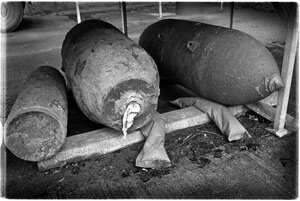
The Iron Harvest of World War One

Came across this information whilst surfing around. There is a place in Belgium called Houthulst where a lot of combat took place during the Great War. It was near there that poisonj gas was first used in warfare, April 22, 1915. German troops opened dispersant cannisters at their own lines. The wind carried the gas across Allied trenches. Before the day was out, 5,000 Allied soldiers were dead, many thousands more injured.


Still coping with munitions from World War One. Enormous numbers of duds are turned up every year. Many of them are still filled with deadly poison gas.

Today Houthulst has Belgium's largest collection area of unexploded gas munitions. The amount is staggering. There are 18,000 unexploded gas shells, totaling at least 300,000 kilos. It has been estimated that for every square meter of terrain along the old entrenchments, reaching from Belgium's coast through the country and France to the Swiss border, a metric tonne of artillery projectiles fell.

With the dud rate ranging from 25-33 percent of fired shells, Houthulst's still mostly-lethal stockpile grows daily as more ordnance comes to the surface across the region. Only a minority of duds are gas shells. Belgian farmers turn up or discover more shells so frequently that the Belgian army's collection patrol makes two trips daily through the region.

The thousands of shells at Houthulst are stacked in rows upon the ground. Many of the shells at Houthulst are leaking. They are placed in concrete bins, but there are no bunkers to enclose them. A disposal processor nearby x-rays the shells to see whether they contain explosive or gas. The ones that contain gas are drilled and vacuum evacuated into sealed containers. These are taken to Antwerp where the gas in burned at super-high temperatures.

But there is another site in Belgium that may contain a hundred times as much gas shells. It lies on the sea bed near the port of Zeebrugge, only a few hundred meters from the shoreline. This site threatens Holland also because of tidal currents. Millions of tons of munitions were dumped there after the Great War. The dumping went on for six months at a rate of about 340 tomes per day. The government classified all the details and the site was forgotten about.

The location was accidentally again brought to light in 1971 by dredging and is now well known but unmarked; the Belgian government has classified all information about the site. A researcher at the Belgian Free University has calculated that more than 1,000,000 liters of pure poison gas lies there, most of it mustard gas. Mustard gas is not degraded by seawater. If mustard shells start cracking, the hazards will be immense.

World War One, it is feared, has yet to claim its final victims.

Links:

http://www.greatwar.nl/frames/default-houthulste.html

http://en.wikipedia.org/wiki/Iron_harvest

http://forums.wildbillguarnere.com/index.php?/topic/7229-houthulst-can-anybody-verify-this/

http://www.militaryphotos.net/forums/showthread.php?94760-Legacy-of-the-Great-War

Saturday, November 27, 2010

Faith and death in North Korea

Christianity is a summary-sentence capital offense in North Korea.
"While Interviewee 17 was in the North Korean Army, his unit was dispatched to widen the highway between Pyongyang and the nearby port city of Nampo. They were demolishing a vacated house in Yongkang county, Yongkang district town, when in a basement between two bricks they found a Bible and a small notebook that contained 25 names, one identified as pastor, two as chon-do-sa (assistant pastors), two as elders, and 20 other names, apparently parishioners, identified by their occupations. The soldiers turned the Bible and notebook over to the local branch of Department 15 of the Korean Workers Party (KWP), but the Party officials said it was up to the military police unit, Bowisaryungbu gigwanwon, to investigate.

Tracked down at their place of work through the listing of occupation in the notebook, the 25 persons were picked up without formal arrest by the military bowibu. The interviewee was not aware of any judicial procedures for those seized. In November 1996, the 25 were brought to the road construction site. Four concentric rectangular rows of spectators were assembled to watch the execution. Interviewee 17 was in the first row. The five leaders to be executed - the pastor, two assistant pastors, and two elders - were bound hand and foot and made to lie down in front of a steamroller. This steamroller was a large construction vehicle imported from Japan with a heavy, huge, and wide steel roller mounted on the front to crush and level the roadway prior to pouring concrete. The other twenty persons were held just to the side.

The condemned were accused of being Kiddokyo (Protestant Christian) spies and conspiring to engage in subversive activities. Nevertheless, they were told, “If you abandon religion and serve only Kim Il Sung and Kim Jong Il, you will not be killed.” None of the five said a word. Some of the fellow parishioners assembled to watch the execution cried, screamed out, or fainted when the skulls made a popping sound as they were crushed beneath the steamroller. Interviewee 17 thought, at the time, that these church people were crazy. He thought then that religion was an “opiate,” and it was stupid for them to give up their lives for religion. He heard from the soldiers who took away the other twenty prisoners that they were being sent to a prison camp. He sketched from memory a diagram of the execution scene."
Even the appearance of Christian faith is deadly.
"A young woman, in her twenties, was washing clothes in a tributary to the Tumen River (the border between China and North Korea). When packing up the clothes, she dropped what was believed to be a small Bible. The actual words used by the North Korean authorities were “Christianity book” (kiddokyo chaek). Another washer woman reported the girl to the police. According to Interviewee 4, the informer may not have known that the book was a Bible, but all suspicious activity had to be reported to the police.
The woman and her father were tried and condemned practically in the same sentence, then immediately shot several times at close range with rifles.

Christians are hardly the only people persecuted to death in North Korea. Really, the whole country is. One presumes as well that adherents of other religions, say Islam, would likewise be killed. There is an official state religion, juche, which is not called religion, of course, but includes the deification of the late Kim Il-Sung and his psychopathic son, Kim Jong-Il.


North Koreans are obligated to make what amounts to a hajj to Pyongyang to lay flowers at the foot of Kim Il Sung's enormous statue.

Consider two of the "11 Reasons Why North Korea Is The Most Bizarre Nation On Earth."
#1 The first "Great Leader" of North Korea, Kim Il-Sung, is deeply revered in North Korea. In fact, there are over 500 statues of Kim Il-sung scattered throughout the country. Many Koreans apparently believe that Kim Il-Sung actually created the world.

#2 It is said that hanging up pictures of Kim Il-Sung is compulsory for every household in North Korea.
These are some of the reasons that trying to explain the North's recent shelling of the South Korean Yeonpyeong island is a fool's errand. There is really no basis to suppose that there was a reason for the attack at all. Of course the shelling was approved at the pinnacle of the North's government - though not necessarily by Kim John-Il personally, who just may be nutty as a fruitcake anyway - but for what reason? Well, because, that's what, which may be as good a reason as we'll ever discern.

(What does make sense, though, is that the North's disclosure of its heretofore secret uranium-enrichment plant and the shelling are a single, the message being: Yes, we have a nuke program and you don't know what else we have that's still hidden. By the way, we're shelling Yeonpyeong to make sure you understand not to assume we are being put on the defensive.)

David Warren writes, however, that saying Kim Jong-Il is crazy avails of nothing:
The conventional explanation for these and the many other incidents (including many minor ones that hardly make world news), is that the North Korean Great Leader of the moment, is crazy. I fall into this myself, sometimes -- one foot -- but then have to explain the difference between medical and moral insanity.

The "completely crazy guy" theory of history explains nothing, and is useless. Hitler was a crazy guy; Stalin was a crazy guy; Pol Pot was a crazy guy -- but mad only north-northwest. Often from a desperate position, they played brilliantly, cheated brilliantly. ...

The current North Korean position is perhaps as desperate as it has ever been. Such indications as we have are of a prison camp in which the people are quite literally starving, and the whole totalitarian infrastructure might be cracking from withdrawal of some foreign aid. The Great Leader of the moment is thought to be ill, and there could be a "succession crisis." Alternatively, this crisis is being staged, in order to sucker the West into renewing aid, in the belief that a more reasonable leadership may soon emerge.
Of which there is practically no chance.

Wednesday, November 17, 2010

Thriving and declining churches

Below are notes I took at a Tennessee Conference sponsored workshop at Gallatin 1st UMC in April 2008. These points are penetrating and thought provoking! Whether one agrees with them or not, they certainly call for some serious self examination on churches' part. They also tie in with Session 7 of my series, "Why I don't want to come to your church."


You may view the document online here.

Why I don't want to come to your church, session 7

Index at bottom of this post.

Here are the slides for the third session of this series. You can also view the slides full screen.


Thursday, October 28, 2010

"And the glory of the Lord shall be revealed"

During the last week of September, Cathy and I were shopping in the Lowes in Dickson where we saw that the store was already putting up Christmas displays. (Thankfully, as a society we have apparently have moved beyond calling them, “holiday displays.)

I don’t think I have ever seen Christmas displays go up so early. But as we all know, the Christmas season is the major revenue season for almost every business. With the economy as it is, I suppose that businesses want the shopping season the begin as early as possible.

Have you ever wanted to get a “jump” on Christmas? Do you remember being a child and thinking that Christmas Day would just never get here?

Christmas Day was not celebrated by the early church. Easter was (and remains) the foremost Christian holy day, and two millennia ago, no one really knew what time of year Jesus was born. Almost certainly it was not in December since shepherds would not have been in the fields with their flocks in that month. The Eastern Church and the Coptics celebrate Christmas on different days than we do.

The most important thing about Christmas is not when it is, but what it is and what it means.

Christmas means “Immanuel,” God With Us. This is a name ascribed to Jesus in the Gospel of Matthew. When we affirm our faith that the baby born in Bethlehem’s manger was God in the flesh, then we easily see why Jesus is truly God With Us. This is Good News, indeed!

And yet we should not rush too quickly, like the shepherds, to the manger. For while the Gospel is Good News, it is good only because of the bad news that preceded it.

Jesus came to deliver us from our bondage to sin and death. That’s Good News! But the bad news is that we needed saving to begin with. Unless we confront the gravity of the human condition into which we are born we do not grasp the life ring God casts to us in the person and work of Christ.

That is why, in the passages for Advent, getting ready for Christmas is not the point. The point of the season is to prepare for the coming of Christ, not of Christmas. The passages of Advent present the imminent presence of God in the flesh as both awful (that is, “awe-full,” not bad) and wonderful.

"For the glory of the Lord shall be revealed," promised the Scriptures, and the glory of God can hardly be beheld impassively. One either runs to embrace the Lord or runs from him. Neutrality is not even possible.

So the passages for Advent typically include reminders that, absent God’s gracing presence, we mortals are lost in our sins. We are reminded that, “Christ has come, Christ will come again.” And his next advent will not be so innocently or unthreateningly accomplished.

Yet Advent also shows that by being born the baby in the manger God was not going on the offensive against us. He joins us an our ally. In fact, God’s kingly, overwhelming power is found there literally to be defenseless, so much so that Joseph and Mary had to flee the town to save Jesus’ life.

Is there power in such weakness? No, not in weakness per se. Jesus’ Godly power, or our own, is found neither in human in weakness nor in strength, but in faithfulness. It is God who is strong, not we mortals. Compared to the God’s strength, human weakness is inevitable but it is also inconsequential. God knows this, so he did not shrink from being born of woman, just as we are, nor from enduring the travails of human life in all its triumphs and disappointments, its joys and frustrations.

And at the end, death on a cross. But death could not hold Jesus because God is stronger than death.

Manger scenes became a popular artistic motif during the Renaissance. In almost all such paintings, the artists included the cross somewhere in the scenery. Sometimes it was on the horizon outside the manger. One artist, Lorenzo Lotto (1480-1556), painted a cross on a shelf on the manger’s wall, such as many homes would have had (left, click image for larger view).

Let us take a cue from those theologically-trained artists. They knew the connection between the manger and Calvary. So did Jesus. As his last trip to Jerusalem loomed, knowing what it portended, Jesus told the disciples, “Now my heart is troubled, and what shall I say? 'Father, save me from this hour'? No, it was for this very reason I came to this hour” (Jn 12:27).

What is the meaning of Christmas? The meaning of Christmas is the cross.