An image taken by Hubble Space telescope and released on Thursday by European Space Agency showed a pair of gravitationally interacting galaxies called Arp 147, photographed on October 27-28, 2008. Arp 147 lies in the constellation of Cetus, more than 400 million light-years away from Earth. [link]The heavens are telling the glory of God; and the firmament proclaims his handiwork. -- Psalms 19:1
Wednesday, November 5, 2008
Photo of the day
Thursday, October 30, 2008
Should compassion be a basis for public policy?
When she and her fellow charity workers had started this ministry they had decided not to require means tests of the people who came to eat. Means tests - requiring the recipients offer evidence they could not afford to pay for the meals - would be degrading, they concluded. The poor were beaten down by life enough without the church adding to it.
Yet after several weeks the sister had changed her mind. The soup kitchen initially attracted diners who were clearly homeless, near-indigent or working poor. But as time went on, she observed the diners were better and better dressed. They were cleaner, obviously more healthy. At first, a large number of diners had walked to the kitchen, but now most drove, and as more time passed, older cars parked outside gave way to newer cars, then expensive cars. The kind of person who first began eating there became rarer and rarer.
The nun concluded that they should have required means testing to protect the poor. It was clear to her that they were now running a kitchen serving free food to people of substantial resources, not the poor they intended to serve.
"Which among you," asked Jesus, "when asked by your child for bread, would give him a stone?" Well, none of us, of course. And which of us, encountering someone who truly could not afford his next meal, would fail to buy it for him?
Personal charity and works of compassion are basic requirement of Christian ethics. But Christian people with best of intentions go awry when they attempt to make their personal ethics public policy. Compassion is bad public policy.
I table-talked once with several of my ministry colleagues at a seminar, some of whom insisted that health care should be free for the poor, meaning, of course, that the government will pay for it - meaning of course, the non-poor will pay for it.
As one of the seminar’s presenters pointed out, the non-poor are already paying for the poor’s health care. Heath insurance premiums are padded to cover the costs of treating the uninsured. In 2003, wrote Ezekiel J. Emanuel and Victor R. Fuchs, "the average health insurance premium for a family of four [was] about $9,000." It's $12,000 or more today. And part of that premium pays costs for the uninsured. Make no mistake, the poor don’t receive high-quality care except for emergency-room visits, but that is where they tend to get almost all their health care. Our taxes also pay health care costs. Of the $2.26 trillion the United States now spends about on health care, the government pays more than 45 percent.
Individuals exercise compassion, defined by the Oxford dictionary as "sympathetic pity and concern for the sufferings and misfortunes of others." Governments exercise justice. Justice is only accidentally compassionate because justice, to be justice, must balance the valid, competing needs of persons and groups within society. Justice attempts to answer, "What is right, what is fair?" Justice is enforced against the will of at least one of the contending parties. Hence, justice is at its foundation coercive.
Compassion, though, seeks to alleviate shortcoming, suffering or pain, to heal in body, mind or soul. Compassion cannot be enforced. I could not compel a stranded motorist I encountered one day to accept my aid, because it would have been literally criminal to do so. In offering aid, I did not have to balance competing claims for my time and money because there were no claims and could not be any. The issue of aid was not what was right or fair, but what was possible.
Compassion is self limiting; one is compassionate to whom one will to the extent of the resources one decides to donate. There are, say, 50 hungry people. You buy lunch for 15, maybe 25, 45 or all. You stop when you can afford to buy no more or simply when you decide you have spent enough and still want to have enough to buy a new DVD. There is no guilt on anyone’s part because no one has done anything wrong. You were under no legal obligation to buy anyone lunch in the first place, so choosing to feed some, not all, is your free choice. The others had no rightful claim to your money.
But justice is only roughly self limiting. An employer who cheated his employees of some of their wages for a time, totaling $25,000, cannot plead for reduced judgment because he has only $10,000 in the bank. The court will hold still him liable for all of it, plus lost interest and punitive fines and perhaps prison. The employees have a rightful claim that the employer may not rightfully deny.
Justice attempts to make right or compensate wrongs done by persons or groups against others. Compassion attempts to make more level the relationships of resources or care between persons or groups of persons.
Compassion makes a very poor guide for justice. Compassion can exist only when there is no right to receive it. A judge, for example, cannot be justly compassionate. For a judge to show compassion for one party to a case is to treat another party unjustly. Showing compassion to a burglar by an unwarranted light sentence is to rob the victim’s family of their rightful claim that the burglar will be fairly penalized. And it puts at risk larger society, which has the right to expect that burglars will not soon be turned loose to rob again.
Similarly, compassion for the victim’s family that leads to an overly harsh sentence - life in prison, for example, for a first offense when no one is injured - sets aside the rightful claim of the convict that his punishment will be consonant with the crime. Likewise, society has a rightful claim not to bear the burden of supporting him for a lifetime for commission of one, non-violent offense.
The fact that different groups have different interests that must be sometimes balanced and sometimes found to be right or wrong is what seems to escape many churches’ proclamations about public policy. The pronouncements tend to be personal compassion writ large, into state policy, then to be coercively enforced.
Case in point: a few years ago, identification cards began to be issued by the Mexican consulate in Tennessee, including at least one year in Shelbyville. Anyone care to guess how many card recipients are in the US illegally? Shelbyville is the center of Tennessee Walking Horses, a major equestrian industry. A man who was senior manager of a large Walking Horse ranch told me that the whole industry would "dry up" if its illegal-immigrant workers were taken away.
From compassion, some people say that illegal immigrants should be allowed to enter the US and work here unhindered. They come here only for economic opportunity, after all, having no prospects for personal advancement in their home country (Mexico, for most of them).
But this argument also exposes the emotional blindness of wishing to make compassion public policy. For when compassion is moved into the large-scale public arena, its focus is too narrow to promote the general welfare. Amnesty for illegal immigrants (whether by proclamation or non-enforcement, which is what we have today) means depriving others of something they to which they have a rightful claim.
I guarantee that the jobs the Walking Horse illegal aliens are working existed before they moved here. Ranchers had to mend fences, shovel barns and bale hay long before Mexicans moved here in numbers. But who was doing that labor before? Not business executives. Not otherwise idle, bon-bon-eating housewives. The American working poor made the ranches go and it was they whom the aliens displaced. But those displaced have a rightful claim to such jobs over persons who are at-large law-breakers, which is literally what illegal aliens are.
There is a long list of other groups who have rightful claims adversely affected by the issue, but that’s not the point of this essay. My point is that compassion fails as policy because it is impossible to be fairly compassionate, except with one’s own resources. Making compassion into policy or law for society compels others to conform to your idea of compassion, trampling on their freedom to be compassionate according to their own lights or to be hard-hearted as they wish. And compassion that coerces is not compassion at all; it is tyranny.
Systems of justice may be tyrannical, too, of course. That is why Western political philosophy has promoted mercy to temper justice. Mercy is not the same as compassion, though as a personal quality mercy and compassion are closely related. William Shakespeare wrote in The Merchant of Venice,
The quality of mercy is not strain'd,In terms of justice, though, "clemency" is probably a better word, indicating mercy shown toward one who has offended, but whose punishment or rehabilitation is either completed sooner than expected, or earned during the course thereof.
It droppeth as the gentle rain from heaven
Upon the place beneath. It is twice blest:
It blesseth him that gives and him that takes.
'T is mightiest in the mightiest: it becomes
The throned monarch better than his crown;
His sceptre shows the force of temporal power,
The attribute to awe and majesty,
Wherein doth sit the dread and fear of kings;
But mercy is above this sceptred sway,
It is enthroned in the hearts of kings,
It is an attribute to God himself;
And earthly power doth then show likest God’s,
When mercy seasons justice. Therefore, Jew,
Though justice be thy plea, consider this,
That in the course of justice none of us
Should see salvation: we do pray for mercy;
And that same prayer doth teach us all to render
The deeds of mercy. (Act iv, sc. 1.)
Not only mercy tempers justice. Religion has served that purpose in Western history also, as have Enlightenment philosophies of individual rights and the idea that the locus of state sovereignty lies in the people, not the state apparatus. But justice remains coercive at base, serving no one perfectly but (hopefully) all as fairly and unobtrusively as possible. However, this is what compassion cannot do.
I find, then, that I have arrived at the place theologian Reinhold Niebuhr arrived several decades ago.
Reinhold Niebuhr, a professor of Christian ethics, was one of the most influential theologians of the last century. In his work, Moral Man in Immoral Society, Niebuhr explained that while individual persons live generally moral lives, high morality is difficult, if not impossible, for human societies and social groups as a whole. Very rarely does a group of persons comport itself better than individuals do in personal relationships. When human beings engage in collective activity, Niebuhr said, they are overwhelmed by an inability to be moral. The larger the group, the greater this inability is.
Niebuhr was specifically addressing Just War theory in the works I cite here, but I think the same train of thought applies to issues of justice and compassion within societies.
Niebuhr concluded [in "Must We Do Nothing?" in The Christian Century, 3-30-1932], "The hope of attaining an ethical goal for society by purely ethical means, without coercion . . . is an illusion" of the "comfortable classes" of society. There never will be enough love and unselfishness among nations [or persons] to resolve the conflicts of history [or societies] only by ethical [or compassionate] means, even though there may be occasional successes now and then. It is part of humanity's "moral conceit" to think that human sin will not overwhelm individual morality [and compassion] when persons act collectively.
Until the return of Christ, wrote Niebuhr, human societies will never be able to conform purely to the ethic of Christian love. In the interim, we must structure our world based on justice, as best we can, even though communities of justice are inferior to communities of love or compassion. The best justice human societies can attain will only roughly correspond to divine justice. Human justice will always involve contests of power because different groups make opposing claims that they consider rightful.
Niebuhr concluded that the ethical goals of human society must not be sacrificed "simply because we are afraid to use any but purely ethical means." Nor, I think, should they be sacrificed because an ethic of love cannot serve as the fundamental ordering of society.
Yet works of compassion can indeed take on orders of magnitude that project them into the arena of justice, just not judicial justice. When acts of compassion come to affect so many persons that the order of society is changed, so is the nature of the society’s justice. Justice is, after all, only the "right ordering of things" in human affairs, as Aristotle pointed out.
I have in mind the work of Bangladeshi economist Muhammed Yunus. Banks in Bangladesh refused to loan impoverished women money to begin business independence. The average loan refused was 62 cents. Yunus reached into his own pocket and loaned 42 men and women in one village a grand total of $27.
Every borrower paid Yunus back with interest. The banks still refused to write loans. Reports "Vanderbilt Magazine," Fall 2003, p. 49:
Village by village, district by district, Yunus proved conventional bank lenders wrong. Twenty-seven years later, his pioneering approach to micro-lending has spawned nothing short of a credit revolution.His bank has been imitated by more than 7,000 other organizations around the world, including some in America. This is compassion writ large and well. It is personal; Yunus used his own money, not someone else’s. Yet its effects are transforming the social order of societies.
His Grameen Bank . . . has disbursed roughly $3 billion to more than 2 million borrowers in Bangladesh alone, allowing many thousands to lift themselves up from the most abject poverty. [italics added]
As for me, though, whenever I hear a politician tell weepy anecdotes about some unfortunates, then declare that "America is better than that," I lock up my wallet. I know he wants to make his personal sense of compassion into public policy, by coercion, using my money.
As it turns out, US Congressman David Crockett had some things to say about this topic about 171 years ago.
I should also point out that some of my Christian friends will take offense at my claim that, "Compassion can exist only when there is no right to receive it." I say again: works of compassion are a duty of Christian disciples. But they are done in gratitude for and imitation of the saving work of Christ. Hence, they are unenforceable by human agency and are voluntary. Compelling others to perform one’s own idea of compassion is the very opposite of compassion, for compassion cannot coerce others and remain compassion. Even so, the Scriptures are clear that we will be judged by Christ according to our works of compassion.
Another thought by Niebuhr: In February 1941 Niebuhr wrote,
Love must be reegarded as the final flower and fruit of justice. When it is substituted for justice it degenerates into sentimentality and may become the accomplice of tyranny. Looking at the tragic contemporary scene within this frame of reference, we feel that American Christianity is all too prone to disavow its responsibilities for the preservation of our civilization against the perils of totalitarian aggression. We are well aware of the sins of all the nations, including our own, which have contributed to the chaos of our era. We know to what degree totalitarianism represents false answers to our own unsolved problems - political, economic, spiritual. Yet we believe the task of defending the rich inheritance of our civilization to be an imperative one, however much we might desire that our social system were more worthy of defense. We believe that the possibility of correcting its faults and extending its gains may be annulled for centuries if this external peril is not resolutely faced.This is a critical point. Niebuhr was saying that if Christians refrain from maintaining justice, even by force if necessary, because they substitute love for justice, then the love they wish to promote actually becomes the handmaiden of tyranny. And of course, that is no love at all.
Monday, October 27, 2008
What has NATO ever done for us?
The Parties agree that an armed attack against one or more of them in Europe or North America shall be considered an attack against them all and consequently they agree that, if such an armed attack occurs, each of them ... will assist the Party or Parties so attacked by taking forthwith ... such action as it deems necessary, including the use of armed force, to restore and maintain the security of the North Atlantic area.So just what does this mean today? Pretty much nothing. Strictly interpreted, Article 5's provisions are not tripped by an attack on United States' interests outside North America. One must wonder whether an attack by someone against Guam, a non-North American, American territory, would trigger Article 5, but the question is actually moot since there is no imaginable threat to mount such an attack.
![]() |
| NATO's newly-delivered, $1.5-billion headquarters building, housing a hugely expensive staff who have no real work to do for an organization that has no purpose any more. |
1. Russia. The original threat for which NATO was founded, there's no chance that Russia either would or could invade western Europe now or in the far foreseeable future.
Certainly Russia's invasion of Georgia shows that Russia's militarism is alive and well, but the prospect of Russia invading western Europe is simple nitwittery. Russia, oil flush though it is, is not rich enough, militarily powerful enough, nor populous enough to extend a campaign that far or that long. Western Europe in aggregate is still more powerful (on its own soil, defending its home territories) than Russia militarily and is rich enough to outlast Russia in such a war. But the real bottom line is that Russia needs Europe peaceful and prosperous rather than wrecked and impoverished.
But what of the Baltic countries, Estonia, Latvia and Lithuania? Certainly Russia could invade them, and they are NATO members. They are also defensible by NATO to some minimal level because their sea approaches are a short trip from Germany's and Poland's northern ports.
I am trying to remember the good reasons that the Baltics were admitted into NATO, but memory fails me except to remember that there were no good reasons. (Review NATO's own assessment and see whether it's held up.) At the time, even Russia was being talked about as a potential NATO member of some kind, political membership if not part of the military alliance. See here, for example. It was then presumed membership would have a tamping effect on Russian militarism which would help ensure peace in our time. Russia has in fact been a "partner country" with NATO since 1997. (Some “partner.” As Dr. Phil would say, “How’s that worked out for us?”)
Ukraine? Not a NATO member, and Russia could easily march in. But Ukraine is hardly defensible by NATO. From the west, NATO forces would have a very long ground journey, across NATO-member Poland, then another 300 miles just to reach Ukraine's capital, Kiev. The logistics problem would be immense, especially for ammunition and spare parts.
Ukraine’s sea approach, from the Black Sea, has a natural choke point at the Bosporus straits. The sea approach to the Bosporus has its own choke points, the Dardanelles strait which empties into the Sea of Mamara, between the Aegean Sea and the Bosporus straits. Fortunately, Turkey is a NATO member whose forces have been focused for decades on keeping the sea lanes open. Of course, Russia has worked the opposite problems for decades, too. So there would almost certainly be a battle royal there between NATO and Russian air and naval forces.
Finally, Ukraine is a big country, almost 800 miles east to west, 233,000 square miles, and NATO's manpower commitment would have to be correspondingly large, probably too large for NATO's existing forces, even under mobilization, since substantial forces would need to be retained in Poland and points west to deter Russian moves in that direction.
As well, western Europe's standing forces are too few to offer substantial, long-lasting reinforcements to deployed units. Many of their regular brigades are permanently staffed by regulars at a fraction of full strength, with the rest (usually one-third or even more) of the troops being reservists whose readiness level is substantially lower. If you use your reserves to man up your regular battalions, who exactly is manning the reserves? In all, since the dissolution of the USSR, Europe's defense planning has been focused on economy rather than war readiness.
Don't count on NATO's new NATO Response Force (NRF), which consists of only 25,000 troops of all arms.
This includes a brigade-size land component with forced-entry capability; a naval task force including a carrier battle group, an amphibious task group and a surface action group; and an air component capable of 200 combat sorties a day.A brigade-size ground force (5,000-6,000 soldiers) is barely speed bump size defending Ukraine or the Baltics. And 200 combat sorties per day would be exhausted before noon in mid-intensity operations.
Sarah Palin said in her Gibson interview that the US should push to admit both Ukraine and Georgia into NATO. I have two words: In. Sane. The idea that the United States should (or can) go to war to eject Russian forces therefrom is foolish in the extreme. A return of Russian occupation of Ukraine or the Baltic countries would be dreadful for the people of those countries. But it's hard to see what US national-security interest would make warring with Russia worth it. NATO's relations with Ukraine, very extensive since 1991, are almost exclusively political-commercial rather than military, or even political-military. Even the NATO Handbook admits tacitly that its goal is development of a market economy and human rights in Ukraine, rather than strengthening of NATO as a military alliance.
It may be argued that for the US to withdraw its NATO military membership would in fact invite Russian moves against Ukraine or the Baltics. I think Putin's government is more calculating than that. Putin, et. al., surely realize that moving against Ukraine would not evoke military counter-moves from NATO, whether Ukraine is a NATO member or not. The reason is very simple: NATO nations simply do not have the military forces, nor strategic "throw," to make the counter. Simply getting tactically significant forces to the right places in Ukraine, then supplying them, would be an enormous challenge that could well be insurmountable. Only recently have Canada and the UK begun to fly strategic-range airlift, C-17s manufactured by the US. Ironically Canada also leases strategic airlift capability from Ukraine, which has a fairly extensive collection of late Soviet-era Antonov heavy lifters designed for strategic airlift. Even so, the great majority of such flying would fall to the US Air Force.
In summary: Russia is no military threat to western Europe. And though its threat to the Baltics and Ukraine is more realizable, there is not much NATO can do about it in the event, anyway.
2. Islamist terrorists. Islamo-terrorists have already attacked both North America and Europe, it hardly bears pointing out. And what was NATO's response? Except for Canada and Britain, pretty much nothing. Even worse, near surrender: al Qaeda killed 191 Spanish train commuters in March 2004, demanded Spain's withdrawal of its forces from Iraq, and Spain rolled.
We'd also wish to ask just why Islamists would attack Europe in the first place (well, yes, they're terrorists) when if they just bide their time, most of western Europe will become substantially Muslim in just a few decades, and some nations majority Muslim (Holland may be majority Muslim by 2020).
What NATO has not done, even under Article 5, is actually fight al Qaeda or the Taliban (again, except for Britain and Canada). For example, Germany sent an entire special-forces detachment to Afghanistan. They literally never left their base camp for a whole year, then Germany brought them home. Except for Canada and Britain, this is typical of the NATO troops, paltry as they are, in Afghanistan. (NATO, qua NATO, had no involvement in Iraq.)
But let us imagine that al Qaeda mounts a truly devastating attack against a NATO capital city, killing thousands. Just how can NATO respond? It can't, certainly not for any response that would require self-lifting across strategic distances. The strategic transportation of NATO has always been oriented one way: US and Canadian forces flowing into Europe to defend it from the USSR, not forces flowing out of Europe to somewhere else in the world. NATO forces cannot go anywhere in the world in substantial force without the US Air Force or Navy carrying them.
Let us then ask the pointed question: Just how does continued NATO membership actually benefit that United States? I can think of only one way - forward stationing of US forces as a deployment point to locales farther east or toward the Middle East.
That's it. Is that worth the cost of national treasure and aggravation we have with the alliance, and which show no sign of abating?
There is another point that Mark Steyn touched on when discussing Sarah Palin's bright idea to bring Georgia into NATO. I can't find a link now, but Steyn pointed out that Georgia's birth rate has tanked more than practically any other country in the world. In fact, by 2050 there will be only 100,000 Georgian women of childbearing age, if current trends continue. So, he said, if Georgians won't have children to grow up to defend Georgia, why should Americans have children to grow up to defend Georgia? I can't think of any good reason.
And the same question can be asked of every other European NATO member, except perhaps Britain and France. The birth rates of Germany, Spain, Italy and every other NATO country except Turkey are below the stable replacement rate of 2.1 average births per woman, most far below. Italy’s rate is 1.23 births per woman , for example, meaning that Italy’s population could shrink by one-third by mid-century. (Turkey’s birth rate is about twice as high as Italy's.)
Again the question for NATO’s countries: if you will not have enough children to preserve your country, why should the US make up your deficit?
I think the United States should reassess whether the NATO alliance really is serving American interests. I don't think it is, and I don't think it will do better in years to come. Though we must stay politically engaged, I think we'd be better off withdrawing from the military alliance, and work toward building an Anglosphere military alliance in its stead.
Endnote: Yes, I titled the post having in mind Monty Pythons sketch from Life of Brian, in which some ancient Judeans ask, "What have the Romans ever done for us?" Unlike them, however, we have no important, affirmative answers to the question of my post.
Thursday, September 18, 2008
Spiritual Renewal Days are upon us!
Come here the Rev. Diana DeWitt bring us the word of God nightly, Sunday thru Tuesday, at 7 p.m.
Diana is former chairperson of the Tennessee Conference Worship Team and served on the Conference Evangelism team. She earned her M.Div. From Vanderbilt and holds a doctorate from Ashland Theological Seminary. She was selected as one of 80 Pastors of Excellence in North America for the period of 2005-2007 and is a member of the World Methodism Order of the Flame.Tonight: “Expect God to Show Up” - Recognizing God’s voice and presence, looking for God in life's situations
Monday: “Expect God to Act” - Conviction, forgiveness and grace
Tuesday: “Expect God to Restore” - Restoration, healing and hope
So just for these three evenings, give a rest to your soul and let wait the cares of the world. Come, be refreshed and renewed in your spirit abide with God and with us.
Wednesday, August 13, 2008
Anniversary Sunday Aug. 17
Youth and adult classes will not meet.
The morning's schedule is:
9:30........................Snack food fellowship in Fellowship Hall
9:45-10:15 ........... Children's Sunday School.
10:30 .................... Worship service, with the Rev. Willy Lyle preaching
11:30 .................... Potluck lunch in the Christian Life Center
Everyone is invited to join us for this joyous morning!
Wednesday, August 6, 2008
Sango Holy Land Tour & Seminars!
I have set up a special web site to post the details. To learn about this exciting trip, June 15-24, 2009, please click here!
A quick look:
With my friends and contacts in Israel, I am arranging a special-itinerary tour of the Holy Land, including parts of the West Bank, for June 15-24, 2009. We will worship in Jerusalem on Sunday and have ample time for souvenir shopping. We will pass along the Via Dolorosa, starting with the historically-confirmed site of Jesus' trial and scourging. We will visit many more sites , too, both in Jerusalem, Galilee and the Dead Sea/Jericho area.
In addition to the many tourist or pilgrimage sites on the itinerary below, I have arranged for our group to visit the Golan Heights, the high land between Israel and Syria to the east of the Sea of Galilee, and receive security-related briefings from Israeli military and government officials, including the situation regarding Israel's construction of the security fence or wall that passes through Jerusalem and along most of the demarcation between Israel and the West Bank.
We also hope to visit the southern Israeli town of S'derot, which has been much in the news lately as it is located only about 1,100 yards from Gaza.
I am working with my friend Ari Marom of the Vered HaSharon agency in Israel to finalize itinerary and cost details. The great majority of the itinerary is firm now, but some elements may change between now and the travel dates.
The cost and what it includes
We need at least 30 persons to travel. The trip price, based on estimations of the airfare, is $3,425. Travelers wishing a single room in hotels will have to pay a supplementary charge of $550.
A deposit of $250 is needed to reserve your seat. Generally, this deposit is refundable until about 90 days before departure date, but that may vary depending on which airline we travel. Ari Marom is still working with airlines for the best combination of flight time and fare. With unsteady fuel costs, however, airlines will not lock in prices for June travel until about January.
Included in the cost
- seven full days of touring (17-23 June),
- lodging, two persons per room (single rooms available for extra charge)
- all entrance fees,
- breakfast and evening meal daily,
- the service of a full-time, experienced, licensed, English-speaking tour guide
- transportation in a modern, air-conditioned motor coach.
The only things not included in the price are lunches, beverages with meals and tips to the guide and driver (recommended about $7 per person per day, or $50 per person).
Cost and itinerary details on the Israel 2009 site!
Tuesday, August 5, 2008
The metrosexual Jesus


One of the main thrusts of liberal Bible scholarship over at least the last 40 years has been to devise arguments that the Bible does not really mean what it says.
A ready-to-hand case in point: sexuality. The biblical proscriptions against certain kinds of sexual acts - homosexual acts, bestiality and adultery all alike are strictly prohibited - are as clear as anything that can be found in Scripture. But modern liberal scholarship has invented ingenious arguments that the proscription of homosexuality isn’t real, that what matters most is the "authenticity" of the relationship, whether there is love and caring, and then they claim that what is really being forbidden by the texts is not homosexuality at all, but pederasty, claimed to be quite common in the ancient Mediterranean world, and that "non-exploitative" homosexual relations are actually quite in accordance with the Bible.
Now, reconstructing the Bible is nothing new. Christians have been doing it for, oh, more than a thousand years. But what is distinctive about modern scholarship is what one of my colleagues, a Ph.D. candidate at the liberal Vanderbilt Divinity School, observed: In addition to interpreting the Scriptures in ways that suit them (not a new thing at all) liberal scholars have "demythologized" the Bible in radical ways. So radical, in fact, that it is barely recognizable in many of their works as revelatory of the divine.
"Modern biblical scholarship wants to liberate people from the Bible instead of immerse them into it," he said. "The Bible is presented as oppressive, patriarchal, exclusionary and ‘privileging’ certain people at the expense of others. Therefore, scholarship is highly concerned with providing reasons to reject the teachings of the Scriptures rather than embrace them."
What got me on this post’s train of thought was an essay by Kim du Toit (no longer online) on the demasculinization of American men.
Now, little boys in grade school are suspended for playing cowboys and Indians, cops and crooks, and all the other familiar variations of "good guy vs. bad guy" that helped them learn, at an early age, what it was like to have decent men hunt you down, because you were a lawbreaker. ...Now I think that Kim is over the top in his essay, here and there, but there’s no denying that it has struck a huge chord with a lot of guys. And its basic theme, once you work through Kim’s provocative language, is really quite simple: Manhood must no longer be defined by women, but by men. Specifically, men who are self-confidently masculine and don’t regret it, who don’t want to regret it.
What I care about is the fact that since the beginning of the twentieth century, there has been a concerted campaign to denigrate men, to reduce them to figures of fun, and to render them impotent, figuratively speaking. ...
Out there, there is a huge number of men who are sick of it. We're sick of being made figures of fun and ridicule; we're sick of having girly-men like journalists, advertising agency execs and movie stars decide on "what is a man"; we're sick of women treating us like children, and we're really [deleted] sick of girly-men politicians who pander to women by passing an ever-increasing raft of Nanny laws and regulations (the legal equivalent of public-school Ritalin), which prevent us from hunting, racing our cars and motorcycles, smoking, flirting with women at the office, getting into fistfights over women, shooting criminals and doing all the fine things which being a man entails.
Since I am in a religious vocation, Kim’s essay made me think of Leon Podles’ controversial book, The Church Impotent: The Feminization of Christianity. Leon’s complaints are very similar to Kim’s, except they are more, uh, genteely stated. Amazon’s book description states thus:
After documenting the highly feminized state of Western Christianity, Dr. Podles identifies the masculine traits that once characterized the Christian life but are now commonly considered incompatible with it. ... He contends that though masculinity has been marginalized within Christianity, it cannot be expunged from human society. If detached from Christianity, it reappears as a substitute religion, with unwholesome and even horrific consequences. The church, too, is diminished by its emasculation. Its spirituality becomes individualistic and erotic, tending toward universalism and quietism. In his concluding assessment of the future of men in the church, Dr. Podles examines three aspects of Christianity-initiation, struggle, and fraternal love-through which its virility might be restored.A reader comment on the Amazon page made the following point: " If Christianity keeps appealing to "feminized men" and rejecting the masculine, we just may see a masculine spirituality go hypermasculine to the cry of "Allahu Akbar!"
As the saying goes, on Sundays women go to church and men go to NFL games, either in person or on TV. Because men darn sure are mostly absent from Christian services (not Jewish or Muslim, though).
In an essay online, Podles writes,
Something seems to be creating a barrier between Western Christianity and men. Why is it that men in the west are so little interested in religion and that the men who are interested often do not follow the general pattern of masculinity? Why doesn't religion seem to interest men much, until they reach old age? ...Clergy don’t get off Podles’ hook:
It seems that the clergy are not unhappy with the absence of men. Women are easier to deal with: even feminists can be satisfied to some extent. Hymns and the Bible are being rewritten to expunge references to men; the few men in the congregation will not protest. ...
Because Christianity is now seen as a part of the sphere of life proper to women rather than to men, it sometimes attracts men whose own masculinity is somewhat doubtful. By this I do not mean homosexuals, although a certain type of homosexual is included. Rather, religion is seen as a safe field, a refuge from the challenges of life, and therefore attracts men who are fearful of making the break with the secure world of childhood dominated by women.
The clergy have long had the reputation of not being very masculine. The main line, liberal Protestant minister in the early twentieth century had a reputation for being soft and working best with women. They were seen as exempt from masculine trials and agonies, part of the safe world of women. As one layman put it, "Life is a football game, with the men fighting it out on the gridiron, while the minister is up in the grandstand, explaining it to the ladies."Now, why is that? After all, the apostle Paul was a man’s man:
23 Are they servants of Christ? ... I am more. I have worked much harder, been in prison more frequently, been flogged more severely, and been exposed to death again and again.The Sissified Jesus
24 Five times I received from the Jews the forty lashes minus one.
25 Three times I was beaten with rods, once I was stoned, three times I was shipwrecked, I spent a night and a day in the open sea,
26 I have been constantly on the move. I have been in danger from rivers, in danger from bandits, in danger from my own countrymen, in danger from Gentiles; in danger in the city, in danger in the country, in danger at sea; and in danger from false brothers.
27 I have labored and toiled and have often gone without sleep; I have known hunger and thirst and have often gone without food; I have been cold and naked.
28 Besides everything else, I face daily the pressure of my concern for all the churches. (2 Cor 11:23-28)
But maybe the reason that many clergy seem to be not terribly manly is that the church has made sure that Jesus is presented as something of a wuss, too.
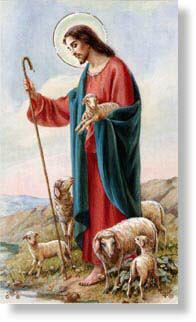
As children in Sunday School we see our first pictures of Jesus as the good shepherd (see above, for example). They are wildly inaccurate. They show a Zest-fully clean Jesus with his Breck-shampooed, blow-dried hair, in a spotless, Bill Blass robe, carrying a little lamb on his shoulders. This is an inoffensive, domesticated Jesus, a tamed Jesus who looks good. This Jesus is a poster boy for people who think that Christian faith is supposed to make them popular. But if this wimpy, smarmy, gender-confused, television-evangelist-looking Jesus ever told you, “I lay down my life for the sheep” (cf: John 10:11), you’d laugh out loud in derision. And if it ever occurred to you that your life was literally in his hands, you’d cry in despair.
A good shepherd Jesus would have grubby clothes that were torn and tattered, perhaps bloodstained. He would clip his hair short because it would be constantly dirty. Soot and sweat would be streaked across his face. His hands would be grimy. His aroma would prove he is unacquainted with Ban Roll-on. The type of fellow who can do the work that shepherding requires is not the kind of fellow any of us would invite home to meet mother. Good shepherds don’t appeal to persons of refined sensibility.
A good shepherd Jesus would look out of place in our Ethan Allen dining rooms, and probably in most churches as well. This is not a Jesus who has time to idle the day away with us. Jesus the good shepherd has countless skills and strengths, honed on this earth to rescue us from countless dangers, including ourselves. Bluntly, a good shepherd is ready for battle at any time.
“Ours is a Jesus who is powerful enough to grab us from the jaws of a hungry wolf. But at the same time Jesus is also powerful enough to grab us from the jaws of too much civility and niceness, from our need to have a pretty picture and a happy ending to the story, from our hiding from the raw, sometime coarse and smelly vitality of life itself” (Rebecca Young).In the tame, domesticated and frankly feminine images of Jesus we use, we suppress Jesus’ masculinity, of which shepherding is one example. It’s a cultural thing, you see. Boys and men find it overwhelmingly important to be seen as manly men, independent, confident and self-assured, but Christian faith is culturally seen as a sort of wimpy crutch for people who can’t handle life on their own. Such stereotypes are reinforced by artistic and verbal images of Jesus that I think would make his first apostles wonder just whom we are talking about.
When King David was just a lad, he volunteered for single combat with Goliath. David was a shepherd, a tough guy, alert to dangers. He stood before King Saul. Saul denied David the right to confront Goliath in single combat because David was so young.
But David said to Saul, "I have been keeping my father's sheep. When a lion or a bear came and carried off a sheep from the flock, I went after it, struck it and rescued the sheep from its mouth. When it turned on me, I seized it by its hair, struck it and killed it. I have killed both the lion and the bear; this uncircumcised Philistine will be like one of them. . . .That’s what good shepherds do.
There’s a lot more to this general topic, especially as relates to the feminization of culture at large (Kim’s complaint), the feminization of university curricula, which Geitner Simmons writes about without really intending to:
In short, the masculine has been driven from the curriculum. Then there is The Feminization of the American Military, which offers this pointed observation:A freshman at Bowdoin cannot take a course in Shakespeare. A freshman at Amherst isn't offered a single overview of European or American history. A freshman at Williams will find that what few courses review U.S. or European history focus on "race, ethnicity and gender," rather than the given period's main developments. A freshman at Wellesley will find that the few broad English courses offered to freshmen focus on gender and not the books' themes and styles.
Writing in the 1940’s in opposition to the ordination of women as priests, C. S. Lewis argued that the issue was not whether females could perform the caring and instructional missions of the clergy as well or better than most men, but rather that the Church was a creature of revelation, not reason, and that the Lord had chosen to place the burden of priesthood on men. But if men had become insufficiently masculine to perform their appointed duty, the solution was hardly to call upon those who were not masculine at all. We arrived at our current impasse over women in combat for the simple reason that not enough American men could be found to perform a masculine duty. And if our only solution — and it appears that it is — is to call upon those who are not masculine at all, then we may reach the point when— as Lewis wrote in The Abolition of Man: “We make men without chests and expect of them virtue and enterprise. We laugh at honor and are shocked to find traitors in our midst. We castrate and bid the geldings to be fruitful.”This essay is plenty long enough now, so I’ll let Podles have the last word. Referring again to the general absence of men in churches, he says:
Neither has the absence of men left women untouched. Unfortunately, women have been forced into the unnatural mold by Christians' misunderstandings of the feminine. Much of current feminism is an understandable reaction against the caricature of feminine roles. The breakdown of the proper relationship of masculinity and femininity, male and female, Adam and Eve, is at the root of many of the churches failures in the modern world, but this situation would not surprise the author of Genesis.Update: Glenn Reynolds refers us to a Salon essay on the Berenstain Bears syndrome, the kids books in which Papa is consistently presented as a loser, a "post-feminist Alan Alda fumbling wimp," as Charles Krauthammer put it.
Wednesday, July 23, 2008
The awfully busy God
Prayer is, in a sense, God's suggestion box; which is why many think that not all prayers are answered and why some, like the Tibetans, think that if you repeat a prayer often enough it gets noticed and answered. This irritating approach to prayer probably cost them their nation even though it hasn't shut them up. In general, it is probably not a good idea, but who am I to criticize? I'll leave that to the Dalai Lama who seems to be carrying on just fine.
But the main thrust of Gerard's piece about unanswered prayer"concerns God's work load.
He's one God who is running a very big universe. Perhaps He's got the whole thing franchised and He's running thousands of universes in a host of different dimensions, all with local variations to the main menu. We don't know. We can't know. But if you grant even one universe to this one God, you've got to admit this would be a very busy Supreme Being. Even being omnipotent and omnipresent and omniscient, You'd still have an In-Box beyond the human mind's capacity for bogglement. ...
The final upshot is that, even if God just steps away from his desk for a quick trip to heaven's free beverage machine, when He gets back he's confronted with at least 4,675,839 prayers presented as pink "While You Were Out Slips."
I submit that even the most omnipotent God cannot deal with incoming requests at this rate. ...
To me this is the most obvious reason that some prayers are answered while most are not. It's simply a question of time and resources, even for God.
Does it really happen this way? God knows.
Now, I like Gerard's writing a lot. He's a better writer than I am. I like Gerard personally, too, having corresponded with him over the years (we've never met).
All of which is an obvious preface to saying that I think he's missed the boat here. I will readily grant that prayers come to God at a rate that we can but poorly imagine - Gerard mentions the scene in Bruce Almighty where Bruce, a temporary deity, is so overwhelmed monitoring the prayer board that he freaks and hits the "yes to all" button. It causes no end of turmoil and even tragedy in the world, of course.
And I will not hide behind the old cliche that "God does answer every prayer, it's just that often the answer is no." This is true, but that's not what Gerard is getting at. He is addressing why so many prayers apparently get no answer at all. They are, as far as mere humans can tell, simply ignored.
But, "too fast, too many" is a reason I cannot accept. Here's why. The English philosopher-theologian Anselm of Canterbury, father of medieval scholasticism, postulated that God is “that than which no greater can be conceived." In philosophical inquiries that definition has withstood the test of time pretty well. (It was fiercely attacked at the time, but that's another posting.) After all, if there is a Supreme Being, then that being has to be, well, Supreme. There can be no greater.
So if God, the Creator of the universe, in unable to keep up with the workload of managing it, then I would not say that God is doing the best he can. I would say that the deity so described is not God.
Some polytheistic religions of the West did separate the Creator from the Manager and postulated that they are two distinct deities. Marcion in the second century was one of the chief intellectual figures of Gnosticism; he identified the God of Abraham as the Creator deity and the God of Jesus as a different deity. That is, the transcendent deity and the immanent deity were two deities. Gnosticism was finally overcome by the concerted efforts of early Church Fathers through strong counter-arguments.
But let us affirm here that the millennia-old traditions of the Jews and Christians is correct, that there is one deity who both created and manages the universe, and that this deity hear human prayers. For this post I'll ignore the issue that seems so important to some, whether God hears the prayers of non-Christians or non-Jews (depending on who is wondering, of course). Let me simply postulate that prayers are received by God.
Why are so many apparently unanswered? "Apparently" is a sort of dodge, of course, even though I do believe that some prayers do get answered in ways we may not recognize. But no more dodging. A couple my wife knew well a few years ago took the baby to the hospital because they found her in her crib not breathing. Life support, prayer vigils, the works. The infant died. Unanswered prayer? Definitely, and no dodging allowed that "the answer was no and God had a reason we can't comprehend." That answer lets both God and us off the hook too easily.
Besides, not all unanswered prayers are matters of life and death. I knew a Navy officer who earnestly prayed to pass her upcoming physical-training tests (maybe if she'd worked out more she wouldn't have needed to pray so much). Student pray before tests. And there is the phenomenon I've heard other pastors call the "weekly organ recital" - the Sunday listing of Aunt Erma's bad kidneys, Uncle Fred's glaucoma, and so forth.
God is not a cosmic vending machine for which prayers are the currency. The longer I spend in the praying business, the less I pray, or see the point in praying, for God to do something, darn it and the more I pray for him to lead me (us) to do something. I pray not that God will conform to my desires or needs of the moment, no matter how pressing they may be, but that I and others concerned in the prayer-situation be conformed more to God in the likeness of Christ.
Yet there is more necessary, I think. Prayer is only one part of engaging God. Remember Lieut. Dan in the movie Forest Gump? He lost both legs in Vietnam, would have preferred to have died, and finally tracks his old subordinate, Gump, to the Louisiana coast after the war. Dan joins Gump in running a shrimp boat. One day they are caught at sea by a sudden storm and Dan remains in the mast with the whipping rain and lightning all around, raising his fist to the storm and railing against God. Like Job, Lt. Dan is unable to dismiss such a God as delusion, even though it would be so much easier to do so. Finally, Dan finds his peace with God.
So many of us decline to encounter God except in storms of life or in pro-forma occasions such as a minute of silence now and then. Yet prayer is not simply some words uttered, no matter how heartfelt or sincere. Prayer is mainly a life lived out in godly ways for godly purposes. It surely can be no wonder that God refuses to acknowledge prayers seeking his miracles when we so consistently fail to acknowledge his call to us seeking our daily service. The conundrum of life-as-prayer is that we come less and less to ask God for an "answer" as for his presence come what may. Finally we realize that God with us and us with God is all the answer we really need.
Tuesday, July 22, 2008
The necessity of spiritual rebirth
In much of what passes for public discourse on religion today, “born again” is either a boast or a pejorative put-down. Who constitutes the much derided and much feared “religious right?” Ah, yes, “born again” Christians. Within their own ranks, evangelical Christians frequently sneer at any confession of faith which doesn’t include some sort of personal Damascus road experience. All in all, “born again” Christianity is heavily laden with political baggage these days in the United States.
However, Jesus made no declaration of a particular political fealty as a condition of spiritual rebirth. The discourse simply makes clear that to be born again includes a personal belief in Jesus as the one by whom the world is saved (cf. Jn. 3:15-16).Within the Wesleyan system, salvation culminates in the parousia (the end of the present age), but isn’t limited to it. Salvation is worked out here and now; the Kingdom of God is to be achieved in this life, at least in part. So “born again,” to be religiously meaningful, must include not just an assurance of heavenly life, but a reorientation in this life.
An article in the “Journal of Psychology and Theology” compared survey results between persons who said they were Christians and those who did not make that claim. It also compared attitudinal scores among professed Christians by category (born again v. ethical belief system). The study defined “born again” Christians as “those who profess a personal saving relationship with Christ,” and ethical as “those who profess to follow Christian teachings as primary” (Paloutzian, 267).
The researchers wrote they expected the ethical Christians would score higher on the Social Interest Survey, motivated primarily by Christ’s ethical teachings. It was not so.
The born again group scored higher in social interest in both age groups studied, even though they are primarily committed to the person of Christ and secondarily committed to the ethics [of Christ]. These results support the notion that born again commitment fosters greater internalization of Christian ethics.The authors claimed their study’s results were consistent with previous research. Other significant points this study uncovered were that born again commitment is more likely to mature over a person’s life than the ethical type and that “an intense, mature and personal religious commitment fosters a sense of purpose in life and a greater concern for the welfare of others.”
I believe social-justice theologies need to recover a strong notion of personal spiritual rebirth if the world is to be transformed, oppression eliminated, racism expunged, economic injustices corrected. Jesus’ teachings are powerful tools for combating these powers and principalities of the present age, but only because they are empowered by the person of the Resurrected One. Jesus is not risen because his teachings were powerful, his teachings are powerful because he is risen. There is no gospel message without an Easter morning. There is no Easter without the empty tomb.
Citation: Paloutzian, Raymond F. et. al. “Conversion Experience, Belief System, and Personal and Ethical Attitudes” Journal of Psychology and Theology, 6:266-275, Fall 1978.
Monday, July 21, 2008
Connecting with non-religious people
But here are some points worth thinking about:
- Do we present Christianity as a system of beliefs or a way of life? John Wesley said that one may affirm the truth of one, 20 or 100 creeds and yet have no saving faith at all. Faith that saves is not "believing beliefs," not the mere assent to propositions. It is, said Wesley, a conviction wrought in one's heart that in Jesus Christ, all that is necessary for our salvation has been accomplished and that there is no life apart from him.
- Don't present Jesus as the answer to problems but as the lover of souls. The deepest need of human souls is not problem solving, but the search for meaning. If you have never read Man's Search for Meaning by Viktor Frankl, I urge you to order it and read it as soon as you can.
- Do we have a passion for Christ, or a passion for the church? When we substitute passion for the church rather than for Jesus, we start to prize order, routine and predictability. Jesus said (John 3):
"The wind blows where it chooses, and you hear the sound of it, but you do not know where it comes from or where it goes. So it is with everyone who is born of the Spirit."
The Spirit-led church will often appear unpredictable! As I preached last May,We will never thrive with top-down leadership, where the pastor and committees decide what the ministries of the church will be, then nominate and elect members to carry them out. We will thrive with ministries that emerge from Spirit-led disciples who are mostly self-organizing.
Unchurched people are not looking for organizational excellence, but a church that is trying, for all its imperfections, to be "worthy of the calling to which it has been called." That means our passion must be for Jesus mlore than for one another. - We should be about attraction, not promotion. This is linked closely with communicating Jesus as a lover of souls. What is it about our faith life and practice that will attract people of our community and make them commit to it along with us, rather than simply participate in an event? Church promotion gains only participants, and very temporary ones at that. If we understand that we should attract people to commitment, not mere participation, then our own self understanding will change.
Tuesday, July 15, 2008
Let's hear it for hypocrites!
But at one point the panel and other attendees generally agreed that one of the main reasons the unchurched are well, unchurched is because church people are such hypocrites.
Alexius: Well, Paul, the reason I won't join your new church here in Corinth is because there are so many hypocrites in it.
Paul: We always have room for one more.
The hypocrisy excuse for staying away from church has got to be the oldest there is. Which only proves what Mark Twain observed, "When you don't want to do something, any excuse will do." And to borrow one of Yogi Berra's malapropisms, If people don't want to come to church, nobody's going to stop them.
But I say, "Hooray for hypocrites!" If you're a hypocrite, you're just my guy or gal.
"Hypocrite" is derived from the Greek, "hypókrisis," or "play acting." It was the description for actors in the Greek theater and refers even more specifically to the masks that certain actors wore to denote different roles, multiple roles being quite common in ancient Greek theater. Members of the chorus - a sort of on stage narrator group - also often wore masks to correspond with the mood, emotion or tome of what they were singing or narrating.
So a hypocrite is literally a "mask wearer," one who hides who s/he really is. It is, as the Greek denotes, play acting. Jesus had a lot to say about play actors, and none of it good.
That is, the men Jesus referred to made a show of praying in public so that they would gain the respect of others for being so pious. (Please note that public praying was quite normal in ancient Judea and is still done now in Israel. And it is the imperative practice in Islam. Christians pray in public, too, mainly at worship services, but also other occasions, say, the Indy 500.)The Wailing Wall in Jerusalem, part of the Western Wall of the Jewish Temple that was destroyed in 70 c.e. by the Romans. The Western Wall is all that remains of the Temple. Today, Jews of all religious convictions go there to pray. I prayed there, too, the same day I took this photo in October 2007.
One biting example,"And whenever you pray, do not be like the hypocrites; for they love to stand and pray in the synagogues and at the street corners, so that they may be seen by others."
Jesus admonished his hearers that they should pray in private, so that God would hear them privately. His meaning, I think, was that prayer should be God directed, not human intended.
But no matter how you cut it, Jesus was pretty harsh on hypocrites. So how can I be rooting for them?
Because hypocrisy requires the hypocrite to believe in something or someone outside himself. Hypocrisy requires an aspiration to something higher or better than oneself. That is the meaning of the folk saying, "Hypocrisy is the tribute vice pays to virtue." Hypocrisy is an imperfect, deficient attempt to be better.
Thankfully I have known very few non-hypocritical people. They were insufferable. They were entirely self centered, self directed, self oriented, self focused and just plain purely selfish. They recognized no cause, entity or belief higher than themselves, their own desires, wants or needs. You can see, I'm sure, that it is impossible for such people to act hypocritically because they are always looking out for No. 1 in every situation. They never pretend they are acting in someone else's interests. They don't seek others' approval because they don't fundamentally care about others or what they think.
Very, very rarely is this kind of person to be found in a church (or a synagogue, either, I would imagine). The church-attending hypocrites over which the seminar attendees clucked-clucked so sadly are not actually hypocritical in the usual meaning of the word: "a pretense of having a virtuous character, moral or religious beliefs or principles, etc., that one does not really possess." Yes, they fall short of what they intend, but their striving is real, not phony, and they try to do better. If they are hypocrites, then so was St. Paul.
It is deceit that makes hypocrisy what it is. The true hypocrite wants others to think better of him/her than is actually justified. Absent this deceit, there is no hypocrisy, just error or human frailty. That's what the hypocrisy-excuse people don't understand - or pretend not to understand - about church people. What may appear to be church people's hypocrisy is almost always just simple failure to meet the standards of our faith rather than deceit. Why? Because the standard is so high:
But I say to you that everyone who looks at a woman with lust has already committed adultery with her in his heart (Matthew 5:28).There are many such examples. So I say that if our churches are filled with such "hypocrites," then let's have many more. Vice is easy, virtue is hard. It's no hypocrisy to fall short of a very high standard and such an excellent goal. And I would suggest that the hypocrisy-excuse people have largely chosen the easy way over the hard way, and choose to call that virtue. So who are the hypocrites? Well, we always have room for one more.
You have heard that it was said, "You shall love your neighbor and hate your enemy." But I say to you, Love your enemies and pray for those who persecute you... (Matthew 5:43-44).
So however we fall short of the standards of our faith, and fall short we certainly often do, we nonetheless seek a "more excellent way" and strain forward to what lies ahead, pressing on towards the goal.
Monday, July 7, 2008
Does an ancient stone cast doubt on Jesus' resurrection?
The source of this quotation is an ancient stone tablet upon which is written (not engraved) 87 lines of text.
JERUSALEM: A three-foot-tall tablet with 87 lines of Hebrew that scholars believe dates from the decades just before the birth of Jesus is causing a quiet stir in biblical and archaeological circles, especially because it may speak of a messiah who will rise from the dead after three days.There is no reason to believe that the stone is a fake. Despite the fact that sections of the text are obscure, the pile-on to prove that the stone somehow disproves Jesus' resurrection has already begun. I got an email just this evening from a PR guy asking me to interview two novelists who think the stone buttresses their claims that not only is the story of Jesus resurrection a fraud, the Church has known it all along. Sound familiar? It should, since that premise is one of the hoariest of religious fiction. Quite literally, "nothing to see here, move along" when it comes to this unoriginal attempt to knock over orthodox Christianity. This is, in fact, the exact premise of Robert Ludlum's 1976 novel, The Gemini Contenders:
If such a messianic description really is there, it will contribute to a developing re-evaluation of both popular and scholarly views of Jesus, since it suggests that the story of his death and resurrection was not unique but part of a recognized Jewish tradition at the time.
The tablet, probably found near the Dead Sea in Jordan according to some scholars who have studied it, is a rare example of a stone with ink writings from that era in essence, a Dead Sea Scroll on stone.
It is written, not engraved, across two neat columns, similar to columns in a Torah. But the stone is broken, and some of the text is faded, meaning that much of what it says is open to debate.
A train winds through Italy towards the Alps with a precious cargo on board. The cargo is a box containing papers that could destroy the Christian world.Ho hum. But back to the stone. Time Mag quotes Israel Knohl, an expert in Talmudic and biblical language at Jerusalem's Hebrew University:
But, as Knohl told TIME, maybe the Christians had a model to work from. The idea of a "dying and rising messiah appears in some Jewish texts, but until now, everyone thought that was the impact of Christianity on Judaism," he says. "But for the first time, we have proof that it was the other way around. The concept was there before Jesus." If so, he goes on, "this should shake our basic view of Christianity. ... What happens in the New Testament [could have been] adopted by Jesus and his followers based on an earlier messiah story."Okay, so? Now, to be fair to Knohl, he does not say that the stone's presumed text (there is more than one way to translate it than Knohl's way) disproves Jesus' resurrection, only that the idea of a messianic resurrection existed before Jesus was even born. And the idea of a suffering messiah is found in the Isaiah 53.
Bible Archaeology Review has posted both the Hebrew text and an English translation online. It's mighty thin gruel to make such as grand a banquet as Knohl and some others are cooking up. Here are the lines in question, as presented by BAR:
7. Who am I(?), I (am?) Gabri’el the …(=angel?)… […]All the rest - that the presumed angelic prophecy was given to or in description of a Jewish rebel against Rome named Simon, whom the Romans killed in 4 BCE, and that the unintelligible gaps refer to Simon's resurrection - all that is simply speculation and interpolation. However, Knohl will have a news-covered presentation later today in Jerusalem to explain his hypothesis.
78. You(?) will save them, …[…]…
79. from before You, the three si[gn]s(?), three …[….]
80. In three days …, I, Gabri’el …[?],
81. the Prince of Princes, …, narrow holes(?) …[…]…
82. to/for … […]… and the …
83. to me(?), out of three - the small one, whom(?) I took, I, Gabri’el.
84. yhwh of Hosts, the Lord of(?)[ Israel …]…[….]
85. Then you will stand …[…]…
86. …\
87. in(?) … eternity(?)/… \
Furthermore, as practically any Christian who has attended Sunday School for more than a month can tell you, the Jews' belief in the resurrection of the dead was deeply rooted by the time of Jesus. Not all Jews believed this, notably the Sadducees did not, but most did, notably the Pharisees.
To the apostle Paul - a "Pharisee's Pharisee," by his own description - it was the general resurrection of the dead that was of primary importance. Jesus' resurrection was important, for Paul, only as it related to the general resurrection yet to come. Hence, Jesus is the "first fruit" of the general resurrection, the pathfinder and the proof that God's promises are true. if someone had said to Paul that there was already a concept of a dying and rising messiah before Jesus came along, Paul would have almost certainly have answered that God was no doubt preparing the people for the message of the resurrection of Jesus so that they could more quickly embrace his rising as God's seal of promise.
Knohl does make a very important point, related at the bottom of the IHT run of the story.
Knohl said that it was less important whether Simon was the messiah of the stone than the fact that it strongly suggested that a savior who died and rose after three days was an established concept at the time of Jesus. He notes that in the Gospels, Jesus makes numerous predictions of his suffering and New Testament scholars say such predictions must have been written in by later followers because there was no such idea present in his day.This is a crucial point. As New Testament scholar Ben Witherington puts it,
But there was, he said, and "Gabriel's Revelation" shows it.
Most radical Jesus scholars have argued that the passion and resurrection predictions by Jesus found in the Gospels were not actually made by Jesus-- they reflect the later notions and theologizing of the Evangelists.Knohl continues,
But now, if this stone is genuine there is no reason to argue this way. One can show that Jesus, just as well as the author of this stone, could have spoken about a dying and rising messiah.
"His mission is that he has to be put to death by the Romans to suffer so his blood will be the sign for redemption to come," Knohl said. "This is the sign of the son of Joseph. This is the conscious view of Jesus himself. This gives the Last Supper an absolutely different meaning. To shed blood is not for the sins of people but to bring redemption to Israel."Where does Knohl seem to get the idea that Jesus' passion and rising are unconnected to the redemption of Israel? Not from the Gospels, which present Jesus as weeping precisely because he realizes he will not bring about Israel's redemption. Furthermore, more than anything else, the long line of Jewish prophets had excoriated Israel for the sinfulness of the people, which they usually describe in graphic detail. That the redemption of Israel can be somehow unconnected with the forgiveness of the sins of the people is simply unsupportable by the Jewish Scriptures. Furthermore, Jeremiah's prophecy to which Jesus specifically related his suffering and resurrection says, at the end, "I will forgive their iniquity, and remember their sin no more."
In short, I agree with Dr. Witherington (and implicit in Knohl's words) that the stone's (disputable) text reinforces that the quotes of Jesus in the Gospel in which he speaks of his own death and resurrection are true quotes rather later retrojections. The stone seems to confirm, rather than rebut, the Gospel accounts.