Thursday, June 26, 2008

Wordling

I've been experimenting with Wordle, which makes word patterns that are pretty interesting. Here's the first example that I decided to save (lclick on images for full-size view):


And here is another:


Wordles are certainly eye catching. One more:

Thursday, June 19, 2008

Science and John's Gospel converge?

Discover magazine online reports on a cosmologist who says that the universe is actually made of math.
Cosmologists are not your run-of-the-mill thinkers, and [M.I.T Professor] Max Tegmark is not your run-of-the-mill cosmologist. Throughout his career, Tegmark has made important contributions to problems such as measuring dark matter in the cosmos and understanding how light from the early universe informs models of the Big Bang. But unlike most other physicists, who stay within the confines of the latest theories and measurements, the Swedish-born Tegmark has a night job. In a series of papers that have caught the attention of physicists and philosophers around the world, he explores not what the laws of nature say but why there are any laws at all.

According to Tegmark, “there is only mathematics; that is all that exists.” In his theory, the mathematical universe hypothesis, he updates quantum physics and cosmology with the concept of many parallel universes inhabiting multiple levels of space and time. By posing his hypothesis at the crossroads of philosophy and physics, Tegmark is harking back to the ancient Greeks with the oldest of the old questions: What is real?
If you read the whole interview, you might discern that Tegmark's hypothesis is not far from the theory of the logos in ancient Greek philosophy. The logos was thought to be the ordering structure of the universe, so first described by Heraclitus.The Stoics later picked up the concept, associating it with reason and that which gave animation to the universe.

The author of the Gospel of John used the concept of logos to describe the place of Christ in the creation and ordering of the universe, and to explain how the logos had become human in the person of Jesus of Nazareth. The Gospel opens,
In the beginning was the Word [logos], and the Word was with God, and the Word was God. 2He was in the beginning with God. 3All things came into being through him, and without him not one thing came into being. What has come into being 4in him was life, and the life was the light of all people.
Now, Prof. Tegmark certainly did not set out to show that a theory of the universe, founded in 21st-century science, was only an elaboration of early Christian theology or ancient Greek philosophy. But it's kind of interesting that there is a philosophical convergence between them.

Tuesday, June 17, 2008

The problem of evil


Compendium of home-video from the 2004 Indian Ocean tsunami

I think that the most vexing obstacle in bringing the Gospel to people is the problem of evil. Classically stated, the problem of evil is this:
  • God is omnibenevolent, that is, wholly good.
  • God is omnipotent, that is, of unlimited power.
  • God is omniscient, that is, he knows everything past, present and future.
  • But evil exists in the world, both the evil that human beings do to one another and the tragedies that befall us because of the natural world, which is God's own creation.

So if God is as the premises of the problem describe him, than how can either kind of evil exist? This problem is one of the most-frequently cited reasons that people say they can't accept Christian teaching. (The theological name of this problem is theodicy, derived from the Greek for the "justice of God.")

I will start a sermon series on this problem on July 27. As well, beginning July 15 I'll lead a daytime Bible study called, "Job, Jonah, Jesus and the Problem of Good and Evil," that will meet at 9 a.m.

Folks, pat answers don't work for this problem. It's a hard one.

Wednesday, June 11, 2008

Was Jesus anti-Jewish?

Prof. Amy-Jill Levine is a Jewish woman who attends an orthodox synagogue in Nashville and who occupies an endowed chair of New Testament studies at Vanderbilt Divinity School. If you make a habit of watching the various Jesus TV shows that appear around Christmastime and Easter, you've probably seen her on camera. A-J, as her students call her (I was her student, and still consider myself such) is an engaging lecturer with an appealing sense of humor and a simply awesome command of the various themes, facts and passages of the New Testament. And she treats the New Testament a lot better than many Christian professors, clergy and laity treat the Old Testament.

Which brings me to her latest book, The Misunderstood Jew: The Church and the Scandal of the Jewish Jesus. It is precisely, I think, because of A-J's deep appreciation of Jesus as a specifically Jewish man, and the plainly Jewish character of the New Testament, that leads her to describe and rebut Christians' historic and ongoing habit of thinking of Jesus as some kind of "counter-Jew" who sought to radically change his own religious traditions and teachings or even overturn them. Even worse has been the use of the New Testament by Christians to justify anti-Judaism, which is a very short step from anti-Jew; neither position is simply tenable with the identity and life of Jesus.


This book is not another bewailing of how Christian Germany came to commit the Holocaust. In fact, the Shoah gets only a very brief mention in her book. A-J isn't writing to point the finger at Christians for our sins. She simply wishes to introduce the reader to the Jewish ordinariness of Jesus himself and of his place and time. Just as importantly, A-J explains simply and thoroughly the errors of both the Church and the Academy in drawing conclusions about presumed monolithic Judaism; both blocs have generally supposed that whatever Jesus seemed to oppose must have been normative in Judaism of his day. That is, clergy and scholars alike haven't studied Judaica to speak of, but nonetheless think that the New Testament describes Judaism both accurately and exhaustively. It just is not so.

As well, A-J exposes how modern theological fads (liberationism, feminism and many others), have so idealized Jesus away from his personal Jewishness that he becomes a heroic figure exemplifying whatever the faddists a priori wish him to be. Jesus' own people then become the paradigm for whomever the faddists wish to oppose in the present day, and the dysfunctions and injustices of today - whether patriarchy, colonialism, or various exploitations - are retrojected as the norm of first-century Judaism. Jews are then portrayed, sometimes explicitly, as domineering oppressors of class, gender, the outcast and the marginalized. Hence, in seeking to identify Jesus with the Palestinian cause today, one liberationist makes explicit an identity across two millennia between the Israeli "occupiers" of the West Bank and the Jews who (presumably) killed Jesus.

Finally, the book appeals to Jews not dismiss the Christian testament as wholly antithetical to Judaism's history and current practice. A-J explains, for example, how the Lord's Prayer (called, the "Our Father" in Catholicism) is a Jewish prayer through and through. (I remember this explanation from my first New Testament class with her, too.) Noting that after two thousand years of history it is too much to expect that Jews today will feel comfortable in praying it, she uses it to point out how Christian faith and practice is still pervaded by Jewish traditions and that there are many positive points of contact that adherents of either faith would be better off to appreciate.

I recommend the book without reservation. It's the best religious-topic book I have read in several years.

Saturday, June 7, 2008

Sunni sheik says pray less, work more

AFP:

For Egyptian-born Muslim cleric and television host, Sheikh Yusuf al-Qaradawi, there is a simple answer to Egypt's productivity problem -- pray less, work more.

"Praying is a good thing ... 10 minutes should be enough," Al-Jazeera television personality Qaradawi says in a religious edict, or fatwa, published on his website.

...

"He's right. I cannot say the contrary. One must not waste time at work and use prayer as the pretext," Sheikh Fawzi al-Zifzaf, of the centre of Islamic studies at Al-Azhar, Sunni Islam's main seat of learning, told AFP.

As for Mohammed al-Shahhat al-Gendi, secretary general of the Council of Supreme Islamic affairs, "10 minutes are absolutely suitable for one prayer."

"Improving productivity is not at all contrary to Islam," he told AFP.
So the Sunni authorities want Muslims to limit their prayers to 10 minutes each, at least for the two mandatory daily prayers that occur during the workday. Meanwhile, back in the USA, Christian ministers wish their people would pray for 10 minutes once per day.

Friday, June 6, 2008

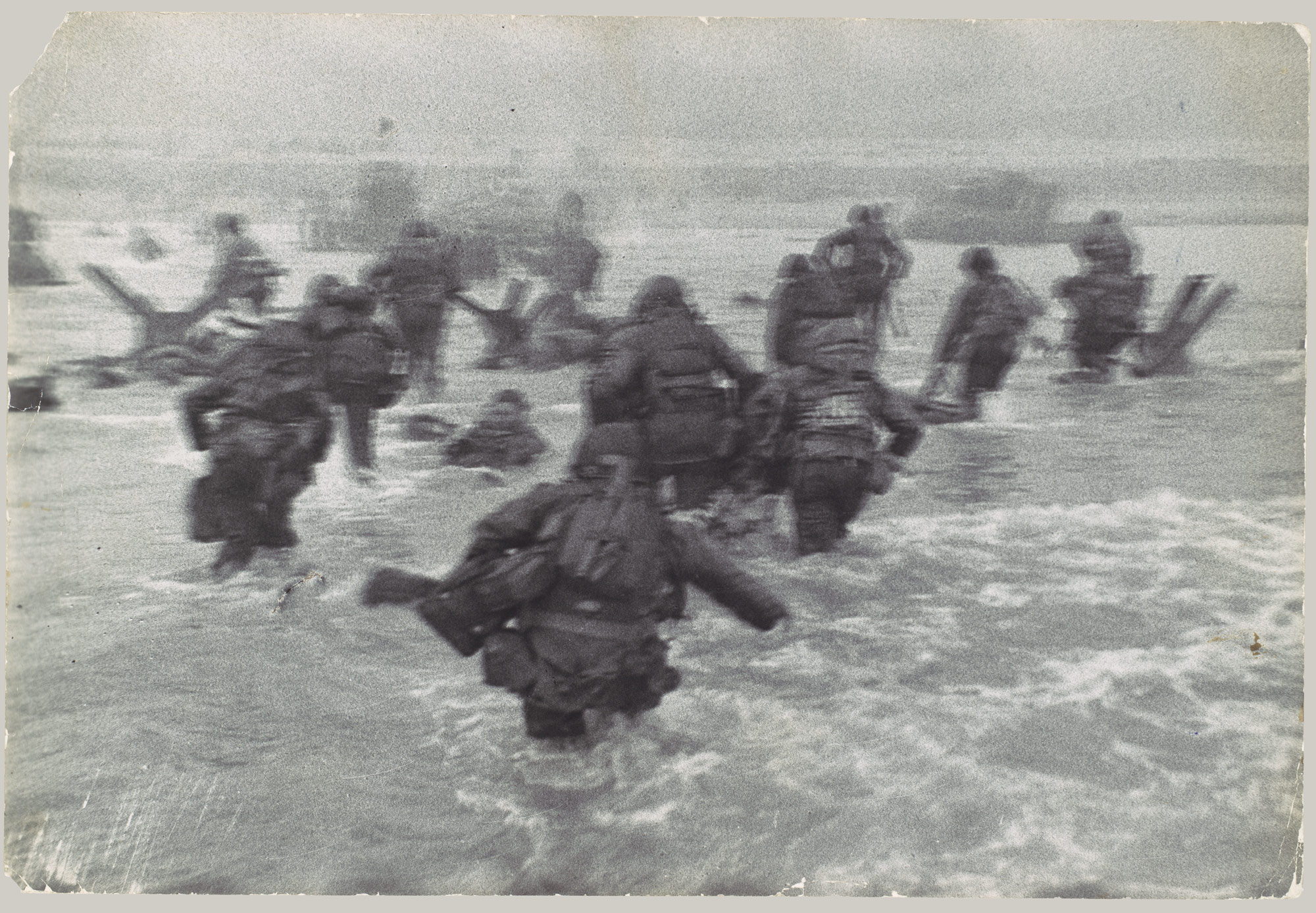
The awful stakes of D-Day

The alternate history of June 6, 1944 is too terrible to contemplate

There is an old preacher story, so old it is a cliche of bad sermons now, that goes like this: An angel awoke who had slept through the first two centuries after Jesus had gone down to earth and ascended back to heaven. The angel went to the Lord and asked, “Where did you go?”

Jesus replied, “I've been down on earth.”
Omaha Beach, Normandy, 6 June 1944

The angel asked, "How did it go?"

Jesus said, "They crucified me."

The angel protested, "You must have had a wide influence."

Jesus said, "I had twelve followers, and one betrayed me to my death."

The angel asked, "What will become of your work?"

Jesus said, "I left it in the hands of my friends."

"And if they fail?" asked the angel.

Jesus said, "I have no other plans."

That punchline, I think, is why D-Day remains so compelling. The specter of defeat on June 6, 1944 was overwhelmingly dreadful. The Allies had no other plans. There was no Plan B in case the landings were repulsed.

There are many "pivot" days in human history, when the course of human events swung in a new direction because of discrete actions. It is hard to find another moment in all history when so much rested on an outcome of one day as rested on the success of the Allies' landings on Normandy.

The Soviets, pushing toward Nazi Germany from the east in 1944, had clamored for years for America and Britain to open a second front against Germany from the west. A second front would compel Germany to draw soldiers and materiel away from the Russian front. Allied claims that operations in North Africa, southern Europe and indeed, the UK-US bombing campaign constituted a second front were scorned by Stalin.

Placating Stalin was one reason the Allies had to invade Germany through France. All the military and political leaders remembered early 1918, when the newly-in-power Soviet government under Lenin had made a separate peace with Imperial Germany. Even though all the Allies had agreed early in WW II that no separate peace agreements would be made, the nag was always there.

Moreover, neither Roosevelt nor Churchill had any desire at all to see all Germany overrun from the east and fall under the hammer and sickle. The only way to prevent that was to place American and British soldiers on the ground inside Germany.

Invasion through northern Europe was the only way to do that (Churchill's claim that an invasion from the south, through Europe's "soft underbelly," proved fantastical in rolling up the Italian peninsula. Whatever Europe's underbelly was, it wasn't soft.)

The Allies could afford to succeed by a mere whisker on the Normandy beaches. Indeed, the planned American and British timetable for operations commencing June 7 proved wildly optimistic. But they did succeed, rather handily most places, as it turned out, and that was enough.

But any failure could have been only catastrophic. As in all major military operations, logistics was the central issue. The moon and tide conditions were acceptable on only some days in May, June and July; in fact, May 19 was seriously discussed as the invasion date for some time. But the Allies' supreme commander, Gen. Dwight D. Eisenhower, postponed the invasion to June 5 because doing so would yield him an additional 100 landing craft, mostly LSTs, used to land tracked and wheeled vehicles directly onto the beach. (Bad weather caused the invasion to be postponed again until June 6.)

A little-known fact is that America was continually shuttling landing craft, both for vehicles and personnel, back and forth from Europe to the Pacific. The availability of landing craft was almost always the key point in setting landing dates for both areas.

A German victory at Normandy would probably have destroyed stocks of American landing craft by two or three years production. Not only could there not possibly been another landing even attempted in Europe for a very long time, Pacific operations would have been dramatically slowed. America was set to take the Philippines back from the Japanese beginning in October 1944. The invasions of Iwo Jima and Okinawa, both in the first half of 1945, were to follow. Significant loss of landing craft at Normandy would have thrown that timetable badly off.

Allied failure on the French coast would have meant enormous American and British casualties. Both the 82d and 101st Airborne Divisions would have been entirely destroyed because they could not have been relieved, having dropped inland. All their soldiers would have been killed or captured. The loss of life that defeat on the beaches would have entailed would have degraded the Allies' capability to try again soon almost as much as the loss of landing craft.

The Soviets certainly would not have slacked their offensives had Normandy failed. If anything, they would have pressed all the harder, but would have pressed equally hard for a much larger share of American war production, insisting that they were making better use of it than we were. As they would have been the only dog in the fight, the demands would have been hard for Roosevelt to resist. Not only would all Germany have become communist, so would France, whose communist cells were very active and which would have benefited greatly from having the Soviet army literally next door. Imagine the Iron Curtain falling at the English Channel. The Soviet bear would have easily swallowed countries like Denmark, The Netherlands and Belgium. Likewise, Greece's postwar communist insurgency would have succeeded. Italy might easily have turned communist also.

(Alternatively, the Nazis might well have shifted hundreds of thousands of soldiers from France to the eastern front. If so, they almost certainly would have shredded Soviet formations because, battalion for battalion, the German army was greatly superior and better led. The Soviets would still have won out, but it would have taken longer and at much greater cost all around.)

European Jews, of course, would have been wiped out since the "final solution" would have proceeded apace. Israel would not exist today. The Soviet Union might have become dominant in the Middle East and there's no point in even trying to speculate on what the next decades would have held for the Arabs (or Persians, since the Russians had long cast a covetous eye on Iran's year-round warm-water ports).

Roosevelt, of course, would not have been reelected that fall. He certainly would have sacked Eisenhower and Eisenhower's boss, Army Chief of Staff George C. Marshall. (Eisenhower would certainly have tendered his resignation. Marshall had survived the post-Pearl Harbor headrolling, but could not have survived failure at Normandy.) There's no point speculating what Republican President Thomas E. Dewey would have done with the office, but it is fair to say he would not have pushed for the creation of the United Nations, which was mainly Roosevelt's brainchild (for good or ill, take your pick), nor would there have been any reason for Stalin to cooperate with its formation, anyway.

Britain's people were incredibly war weary by mid-1944. Success in Normandy emboldened them to see the war to its bitter, bloody end. They remembered all too well the defeat of Dunkirk, when the British army had been evacuated from the French coast at the war's beginning, leaving behind its dead, almost all its vehicles and most of its weapons. Failure at Normandy would have caused Prime Minister Churchill's unemployment faster than Roosevelt's.

I have little doubt that some form of British peace party would have gained the Parliamentary majority and the PM's office. Might the Brits have sued Hitler for a separate peace? Maybe. Already strongly tended toward socialism, it's not hard reasonably to imagine that the UK itself would have turned communist by the 1950s had the Soviets dominated all western Europe.

Without Britain (and I'm treading very speculative ground here, I admit), America could not have continued to oppose Hitler, nor have offered any resistance to Soviet dominion of practically all Europe after they had cleaned up the Nazis. We would have continued to make war against Japan, of course. But consider that with sea-land operations slowed greatly by loss of materiel at Normandy, Japan would probably have been bombed into true oblivion; the Pacific War's end would have been greatly postponed at terrible cost of human life - American, Japanese and persons under Japanese occupation, who were dying in 1945 at the rate of 500,000 per month. Whatever Japan's postwar history would have been, it would not have resembled what it actually was.

All these things lay in the hands of fewer than 200,000 American, Canadian and British soldiers stepping onto French soil on one day. It was a burden that we should pray will never rest on human shoulders again.


End note: What of the atom bomb? It was originally envisioned for use against Naxi Germany, but Germany surrendered before the bomb was ready. With a lengthened war in Europe, could the atom bomb have restored US-UK fortunes there? I would argue that an expanded use the A-bomb from the two that actually were used is no victory. However it might have reestablished US power on the continent, such cannot be considered positively by any stretch of the imagination.


Wednesday, June 4, 2008

Politics and redemption

Wherever politics tries to be redemptive, it is promising too much. Where it wishes to do the work of God, it becomes, not divine, but demonic. - Pope Benedict XVI, Truth and Tolerance; p. 116.

Hat tip: Kyle-Anne Shiver.

Monday, June 2, 2008

Landing in Honduras

Rescue workers surround a passenger plane which skidded off a runway at Tegucigalpa airport in Honduras, May 30, 2008.

I've landed a few times at Tegucigalpa, Honduras' airport, and let me tell, you, it can be a hairy ride. There is one runway. From the south, Runway 20, the front end of the runway sits atop a high, steep bluff. It's like landing an airliner on an aircraft carrier, minus the arresting cables. Undershoot and you hit the mountain. Overshoot, and you hit the mountain at the other end of the runway. Approaching from that direction means your glide path pretty much has to match the descending slope of the mountains as you approach on final, like this:


I made that approach in a Tennessee Air Guard C-130, having hitched a ride from Panama to return to Joint Task Force Bravo, based in Honduras' Comayagua Valley, in 1989. Since I was a native Nashvillian, I was invited to make the whole flight sitting atop an upturned tool box on the flight deck.

The pilots, two airline captains back in the States, had decided to tease the air defense batteries of then-Communist Nicaragua by flying three miles plus one hundred yards off its west coast. "There's another one," one would say whenever the panel warning light lit to signify that yet another missile-targeting radar had illuminated the plane. Didn't seem to bother them much, but I spent several minutes peering out the right window, looking for rocket contrails.

Over Tiger Island, at the juncture of Nicaragua, Honduras and El Salvador, we banked into a very steep right turn to avoid overflying either of the other two countries. We spent several minutes trying to find a gap in the cloud deck below us. But the deck was solid, so "into the weather" we went. The cloud was thick. We didn't drop below it until we were already on long final to Teguc ("tuh-goose" as we called it). I was looking at the dense gray inside of clouds one moment, and the next I was staring at treetops just a couple of hundred feet below. We tracked the mountainside all the way down, descending probably 3,000 feet while remaining only a couple of hundred feet above the ground all the while.

Last Friday, five were killed when an El Salvador airliner, pictured above, skidded off the runway in bad weather. The wonder is not that crashes happen there, but that so few happen. No doubt the airports' reputation "as one of the most treacherous airports in Latin America due to a difficult approach" puts pilots on the keen, making them treat the landing as less routine than elsewhere. Sort of like the airport at St. Maarten, which ends barely off the beach.

Sunday, June 1, 2008

Smuggling

"They can figure out how to smuggle anti-aircraft missiles and hand grenades into Gaza, but not sugar and flour. Some 'blockade.'"

Friday, May 30, 2008

Arabs think Israeli PM Olmert is a fool

But not because he's Jewish, Zionist or anything like that. It's because Olmert is only a little corrupt. Israeli-Arab journalist Khaled Abu Toameh writes in the Jeruslaem Post of some of the reactions across the Arab world to the intensifying pressures on Prime Minister Ehud Olmert to resign because of corruption charges.

Among other things, Olmert is accused of accepting $150,000 in bribes from an American over a 14-year period, which Mr. Toameh said evoked this response from foreign Arabs.
"They say he received something like $3,000 a year," said Abu Atab from Morocco inaccurately. "This shows that Olmert is a decent man. This is a small sum that any Arab government official would receive on a daily basis as a bribe. Our leaders steal millions of dollars and no one dares to hold them accountable."

Touching on the same issue, a reader from Algeria posted this comment: "In the Arab world, our leaders don't accept less than $1 million in bribes; the money must be deposited in secret bank accounts in Switzerland. Olmert is a fool if he took only a small sum."

Another comment, this time from Ahmed in Jordan, also referred to the alleged amount: "Only a few thousand dollars? What a fool! This is what an Egyptian minister gets in a day or what a Saudi CEO gets in 45 minutes, or a Kuwaiti government official in five minutes. This is what the physician of the emir of Qatar gets every 30 seconds."
However, there was strong praise for Israel from Arabs who admitted they hated the Jewish state and all it stands for, except this:
A Saudi national named Abdel Karim urged his Arab brethren to stop criticizing Israel and learn something about its democracy. "Before we curse Israel, we must learn from the democratic and judicial system in Israel, where no one is above the law," he wrote.

Khaled, another Saudi national, chimed in: "Although we are talking about Israel, which I have always hated very much, there is still no one above the law there."

Mahmoud al-Bakili of Yemen posted the following response on one of the Web sites: "We want this kind of accountability and transparency in the Arab and Islamic world."

And there was this comment from an Arab who described himself as a Syrian Voice: "Despite my strong hatred for the Zionist regime, I have a lot of admiration and respect for this entity because there is no one above the law. In the Arab world, laws are broken every day and no one seems to care."
One Arab reader offered some advice to Olmert:
One Arab commentator who identified himself as Jasser Abdel Hamid advised Olmert to seek citizenship of one of the Arab countries. "Why don't you seek Arab citizenship?" he asked sarcastically. "There you can take as much money as you want. Even if they discover the theft, they will erect a statue for you in a public square."
Finally, Rashid Bohairi in Kuwait asked a very good question: "What about the millions of dollars that Mahmoud Abbas and the Palestinian Authority stole? How come the Palestinian people are still hungry?"

Well, yes. Even the Palestinian Authority admitted that Yasir Arafat stole them blind, but then its post-Arafat leaders went right on doing the same thing.

BTW, along with 11 others in my group, I met and talked with journalist Toameh in Israel last October.

Wednesday, May 28, 2008

Environmentalist Religion Explained

Freeman Dyson:
There is a worldwide secular religion which we may call environmentalism, holding that we are stewards of the earth, that despoiling the planet with waste products of our luxurious living is a sin, and that the path of righteousness is to live as frugally as possible. [From, "The Question of Global Warming."]
Freeman Dyson is one of the most highly-regarded physicists in the world. Wikipedia introduces its entry on him thus
Freeman John Dyson FRS (born December 15, 1923) is an English-born American theoretical physicist and mathematician, famous for his work in quantum mechanics, solid-state physics, and nuclear engineering. He is a lifelong opponent of nationalism and a proponent of nuclear disarmament and international cooperation. Dyson is a member of the Board of Sponsors of The Bulletin of the Atomic Scientists.
A true intellectual heavyweight, his essay in the New York Review of Books this month is a very important analysis that I urge you to read in full. Dyson is not the first to point out that environmentalism has morphed into an actual religion in its own right. Michael Crichton and J.R. Dunn have written highly insightful essays about how environmentalism is a religion in its own right. See “Environmentalism as Religion” by Crichton and Dunn’s piece, “A Necessary Apocalypse," in which he shows how global-warming environmentalism is not merely a religion, it is an apocalyptic religion. Its deity is Mother Earth (Gaia), for whom human beings are mortal enemies. NBC’s Matt Lauer inadvertently gave away Gaiaism’s central article of faith thus:
Earth’s intricate web of ecosystems thrived for millions of years as natural paradises, until we came along, paved paradise, and put up a parking lot. Our assault on nature is killing off the very things we depend on for our own lives … The stark reality is that there are simply too many of us, and we consume way too much, especially here at home.
My second son was required to take ecology his junior year in high school; he related to me that the curriculum basically said there was nothing wrong with earth that the disappearance of humanity wouldn’t cure. Jonah Goldberg wrote recently of the "Church of Green."
"At its core, environmentalism is a kind of nature worship. It’s a holistic ideology, shot through with religious sentiment. ...

Environmentalism’s most renewable resources are fear, guilt, and moral bullying. Its worldview casts man as a sinful creature who, through the pursuit of forbidden knowledge, abandoned our Edenic past. John Muir, who laid the philosophical foundations of modern environmentalism, described humans as “selfish, conceited creatures.” Salvation comes from shedding our sins, rejecting our addictions (to oil, consumerism, etc.) and demonstrating an all-encompassing love of Mother Earth. Quoth Al Gore: “The climate crisis is not a political issue; it is a moral and spiritual challenge to all of humanity.”


I heard Gore on NPR recently. He was asked about evangelical pastor Joseph Hagee’s absurd comment that Hurricane Katrina was God’s wrath for New Orleans’s sexual depravity. Naturally, Gore chuckled at such backwardness. But then the Nobel laureate went on to blame Katrina on man’s energy sinfulness. It struck me that the two men are not so different.
As Crichton pointed out, "environmentalism is in fact a perfect 21st century remapping of traditional Judeo-Christian beliefs and myths." Let me elucidate.


There are other religions than Judaism and Christianity, of course, but modern environmentalism was born in the West, whose cultural heritage and common languages are steeped through and through in Christian tradition, which was itself a daughter of Judaism.


The common themes of both scriptural Judaism and Christianity deal with deity, the natural world (existing first in a purity state), a corruption of the purity state (Augustine: "fall from grace,"), redemption and liberation/salvation. Then follows paradise. A prominent, though not universal, strain in both Judaism and Christianity is a looming apocalypse that in potential or in fact destroys enormous swaths of humanity.


Modern environmentalism has all these elements, with an emphasis on apocalypticism. I'll examine these religious elements in turn.


Deity: That would be the earth itself. "Mother Earth" is a term tossed about among the religion's adherents, thus personalizing what is really only a gazillion-ton hunk of rock. Personalization of the planet is necessary to deify it. Adherents often call this new deity, “Gaia,” the name of an ancient Greek earth goddess. The Gaia hypothesis was first proposed by NASA scientist James Lovelock, who introduced it thus:

What is the hypothesis of Gaia ? Stated simply, the idea is that we may have discovered a living being bigger, more ancient, and more complex than anything from our wildest dreams. That being, called Gaia, is the Earth.
The most important tenet of Gaiaism is that the earth is itself alive and is a being in its own right.

Creation: Environmentalism offerns no real theory of how the earth came to be, it focuses on the biosphere. In that manner it does echo the Jewish Scriptures, once removed. The Scriptures do inquire how the earth came to be, but not how God came to be. But since Gaia is god(dess), she simply is in the same way God simply is.


As for the appearance of life, environmentalism drops the Bible's creation stories and substitutes evolution. Now, I am not arguing here against the theory of evolution. I am simply pointing out that evolution theory is environmentalism's explanation of life on earth and its diversity. The earth's biodiversity is extremely important for environmentalism, since evolution-driven biodiversity undergirds the apocalypticism of religious environmentalism. The apocalypse of "climate change" is predicted to destroy the evolutionary niches of various species. They won't be able to adapt.


The Purity State: Take your pick:

  • Gaia before the appearance of human beings or,
  • Gaia after we showed up, but before we invented civilization. (The anti-civilization theme is present in the Hebrew Scriptures, too.) This aspect romanticizes pre-civilizational peoples, often portraying them as gentle souls "living in harmony" with nature and imagining that they worshiped the earth, too, which in fact some did. (However, this notion is rebutted by contemporary researchers.)
The Corruption of (or Fall from) Purity: This is easily defined. It was the invention of the internal-combustion engine and the use of fossil fuels that followed. Burning coal also. More broadly, though, the Fall is consumerism and international industry, especially chemical industries.

Redemption: There is no savior per se in environmentalism. We have to save ourselves. Environmentalism relies on cultic leaders to guide the masses and give enlightenment to them. Like the Law of Moses, their commandments are to be obeyed from faith rather than inquiry: recycle, drive less, eat organics, drive hybrids, etc.


Paradise: Sorry, environmentalism offers not. There is no longing for "life more abundant," since abundancy is exactly what environmentalism uses for original sin. Instead of paradise, environmentalism promotes stasis. Folks my age and maybe a little younger can remember when the Environmental Apocaplypse was not global warming but global cooling. So let us suppose two things: first that global warming really is occurring and human attention to it can reverse it, and second, that we do reverse it. Are we then to agree that a cooler earth really is in our best interests? Why? I’ve always kind of suspected that underlying much of environmentalism is a desire for the impossible: stasis.


Moreover, environmental stasis can be accomplished only by human austerity. Environmentalism's New Jerusalem is not prosperity, but decline, presented as a return to humanity's purity state: the simple life arranged around a village-type lifestyle where everything is within walking distance of everything else. Who else but George Monbiot to explain? 
Everything we thought was good turns out also to be bad. It is an act of kindness to travel to your cousin's wedding. Now it is also an act of cruelty. It is a good thing to light the streets at night. Climate change tells us it kills more people than it saves. We are killing people by the most innocent means: turning on the lights, taking a bath, driving to work, going on holiday. Climate change demands a reversal of our moral compass, for which we are plainly unprepared.
Apocalypticism: Like religious apocalypticism, environmental apocalypticism - in fact, the whole movement - is predicated on the imminent, substantial destruction of the natural world and its inhabitants. This from no less a personage than United Nations Secretary-General Ban Ki-moon, who just five months ago said that "humanity faces oblivion if it fails to confront global warming." Oblivion, he said. Rising seas, expanding droughts, melting sea ice, increased desertification, scorched crops, mass human suffering and death - all inhabit the same enviro-religious space as Revelation's horsemen of the apocalypse.

Important in Jewish and Christian apocalypticism was the concept of "children of light" versus the "children of darkness." The children of darkness were those who rebelled against God, who turned away from righteousness and embodied evil. Children of light were those who apprehended the truth of God and cleaved toward spiritual purity. This notion has been adopted wholesale by environmentalism. Dyson again: 

Scientists and economists can agree with Buddhist monks and Christian activists that ruthless destruction of natural habitats is evil and careful preservation of birds and butterflies is good. The worldwide community of environmentalists—most of whom are not scientists—holds the moral high ground, and is guiding human societies toward a hopeful future.
Catch that? This is a clear delineation of the realm of light and of darkness, and whom inhabits each. "The worldwide community of environmentalists ... holds the moral high ground," and thus are the children of light. Who are the children of darkness? They are the "evil" ones who conduct or permit the "ruthless destruction of natural habitats." Dyson continues,
Unfortunately, some members of the environmental movement have also adopted as an article of faith the belief that global warming is the greatest threat to the ecology of our planet. ... Much of the public has come to believe that anyone who is skeptical about the dangers of global warming is an enemy of the environment.
(Italics added.) "Enemy of the environment" = child of darkness. (Dyson does not himself promote such a belief, but certainly it is out there.)

Another tenet of religious apocalypticism is that things will get worse before they get better. And so it is with environmentalist apocalypticism. No matter what we do now, greenhouse gases, and therefore climate change, will intensify until at least mid-century, and only then might be abated.


Still skeptical that environmentalism is a religion in its own right? In The Beast in the Garden, David Baron tells of a young man named Scott Lancaster, 18, who was killed and eaten by a mountain lion.

Scott’s friends and family consoled themselves that his death, sad and untimely though it was, had somehow been kind of fitting for him. As James Valdez put it, "He was a real outdoorsy guy."

"It felt natural," said Abby Heller. "It felt like it was part of nature, and part of the way the cycle happens. It seemed kind of pure."
It was "natural," part of the pure cycle of life for a young man to suffer a gruesome, horrifying, massively painful death by means of the "red in tooth and claw" of one of Gaia's creatures. And so the case that environmentalism is a religion in its own right is hereby closed.


But there is more than mere religiousity at work in religious environmentalism. H.L. Mencken observed, "The urge to save humanity is almost always a false front for the urge to rule it." And that is the true foundation of environmentalism today: the desire of its gurus to regulate the way others live. Monbiot again:

We can deal with climate change only with the help of governments, restraining the exertions of our natural liberties.
Dyson wrote that, "Environmentalism has replaced socialism as the leading secular religion." I demur. Environmentalism has not replaced socialism at all. Instead, the old-line socialists, faced with decades of the failure of political socialism, have jumped on the environmentalist bandwagon to keep socialism alive. Environmentalism has become a much better vehicle to achieve a rigid regulation of people's lives than political socialism ever was. After all, the fate of the entire planet is at stake! Environmentalism has already led some British members of Parliament to propose that the government regulate almost every aspect of buying and selling by private individuals. If this is not socialism, it is a distinction without a difference. 

(A correspondent of mine observed that environmentalist religion is attractive to people who define who they are by their habits and patterns of consumption and spending. The rituals of environmentalism -- recycling, using low-wattage lights and all the rest -- are the way they buy indulgences to offset their sins of conspicuous consumption, which they do not in fact lessen. They've just found a way to feel less guilty.) 


At bottom, modern environmentalism has discarded scientific rigor to embrace something not much different than Leninism, the desire to control the major components of the way individuals live. From there it is a short step for environmentalism to Leninism's successor: Stalinism, the desire to control every aspect of the way we live. That's our future, minus the gulags. We hope.


This seems an apt time to quote the old liberals' bumper sticker: "If you're not outraged, you are not paying attention."

Sunday, May 25, 2008

Read and read again

I still think that Christopher Hitchens' 2006 Memorial Day essay is one of the finest I have ever read. Read the whole thing.