Monday, February 19, 2018

Mass shootings: "Hope is not a method and wishes are not plans"

First of a series

If things proceed according to pattern, there will be energetic debate after the Parkland high school massacre about stopping such a horror from happening again, then the news media will move on to other topics. And the American people, who have generally been trained over the last 50-plus years not to think something is important unless it's on TV, will move on also.

And in a few months or next year, when it happens again, lather, rinse, repeat.

This inability to take meaningful action is due to several factors, one of which is the existing (and strengthening) political divide in the country. But the main reasons, I think, are pretty simple:
  • both sides firmly believe that the other side alone is responsible for the deadlock, 
  • both sides' most prominent voices insist that there is a "silver bullet" solution that by itself will completely resolve the issue, and
  • neither side will admit that its own broader political core beliefs are already part of the cause for these shootings. As I said, all of the surrendering must be done by the other side.
So I proceed on the basis of this post's title: "Hope is not a method and wishes are not plans." I learned this very well when I was assigned to the Army Operations Center in the early 1990s at the Pentagon. The Army's chief of staff was Gen. Carl Vuono. He sometimes found occasion during our briefings to him about current and planned operations to hammer home a point: "Hope is not a method and wishes are not plans." 

Don't tell me what you hope will happen, don't tell me what you wish you could do, he repeated. "Give me a plan that makes it happen."

Stop offering "Bell the cat" solutions

... concerns a group of mice who debate plans to nullify the threat of a marauding cat. One of them proposes placing a bell around its neck, so that they are warned of its approach. The plan is applauded by the others, until one mouse asks who will volunteer to place the bell on the cat. All of them make excuses. The story is used to teach the wisdom of evaluating a plan not only on how desirable the outcome would be, but also on how it can be executed. It provides a moral lesson about the fundamental difference between ideas and their feasibility, and how this affects the value of a given plan.
Anyone who thinks that there is one thing that, if done, will stop mass shootings (whether at schools or elsewhere) is actually not thinking at all. They are making political statements, not relevant statements, and are so convinced of the moral purity of their own side that they think that a wish is a plan and that their wish, if fulfilled, will automatically result in zeroing out mass shootings. 

Here are two examples, one from each side. On the Left: 
  • "We must ban AR-15s and similar weapons."
In fact, we cannot ban these weapons. I am not saying we should not ban them, or must not ban them. I am saying we cannot ban them. It is impossible. The same with "high-capacity" magazines. 

Yes, we could legislate that they may not be manufactured or imported into the country. So? There are still tens of millions already here (no one knows how many). Will you ban them also? If so, as The Beatles sang long ago, "We'd all love to see the plan." 

Don't even utter the word, "Australia." Their 1996 ban was mandatory, requiring residents to hand over their firearms to the government, but the government paid for them, which would be mandatory here (that pesky Constitution's "takings clause"). Where will the the US government get $30 billion (at minimum) to do that? Do not even dare to suggest cutting only spending beloved by the Right, such as defense. If you are not willing to pare Left-loved spending, then you are not serious about stopping school shootings at all. You're just trying to score political points. 

Are you willing to zero out payouts and tax-money support, for example, of Planned Parenthood, the NEA, NPR, etc. to diminish the number of AR weapons in America? No? Then you will understand why I am completely ignoring you. 

That said, in Australia's ban, only 20 percent of Australian gun owners complied. One out of five. The ban, btw, had little effect on crime rates or suicides there, but it did create a thriving black market in firearms, including black-market importation. See here and here, for example. 

Ban AR-type weapons? Well, show me your plan. If in your plan no one's ox gets gored but your political opponents', you have not got a plan to save kids' lives, you have a platform for fund raising and campaigning. 

On the Right:
  • "The only thing that stops a bad guy with a gun is a good guy with a gun." 
If I hear that one more time I will not know whether to throw up or just laugh out loud. Okay, good guys with guns do stop bad guys with guns countless times per year (that's why we arm police, after all),  and yes, schools by law are "gun free zones," and yes, "gun free zone" really is a euphemism for "defenseless people here."

Fine. But then your advocates post stupid stuff like this:

This meme has been around since at least 2012 and is simply false. False as in "untrue," as Israelis on social media have attempted to refute. Here is Israel Today:
There is a picture going around the Internet that I have seen about a dozen times today that claims that Israeli teachers are packing heat. Well, are they? The answer is “NO.” There may be some exceptions in dangerous areas like the West Bank (where five percent of Israelis live), but in general, Israeli teachers are not walking around like it’s the Wild Wild West, strapped with a six shooter. No, our teachers are not focused on shooting, but educating. That doesn’t mean, however, that we don’t protect young students.

In the picture, the students are on an outing. While it appears that the teacher is holding a rifle, I have never seen such a thing in ten years of living here. Rest assured however, they are under armed protection. In most cases it is an armed guard or a soldier that will accompany a class, not the teacher. And my guess is that the woman with the gun is a security guard, not a teacher.

Secondly, they are not armed in the classroom. Is that really the image you want to imprint on the minds of six-year-olds? (That would be Hamas.)
Even so, suppose that it was made legal for faculty and staff to volunteer to go armed in schools. What's your plan to implement? Just let them get a carry license and go for it? Will they be required also to take shoot-or-no-shoot training, repeated at intervals? Will they be paid extra for carrying? Will they wear distinctive identifying clothing so they don't shoot each other by mistake? Will their local governments accept the financial liability for using their weapons when the shooter, if he lives, or his family, if he doesn't, sue the teacher who shoots him and the rest of the district? (and they will sue.) All of these factors also apply to other categories of potential guards, such as veterans or retired police.

In the wake of the Aurora, Colo., mass murder in a movie theater, I wrote elsewhere about the ignore-reality advocates of the "good guy with a gun" argument as applying to crowded venues of panicked people, which is what Parkland's high school became when the shooting started.
But let's assume you do unmistakably locate the shooter and decide to engage him. You have a 9mm compact-sized, semi-auto pistol with the typical 7-10 round magazine (though the Beretta PX4 compact holds up to 15). The killer is firing madly, apparently about 25 feet away. You shoot at him.

You will miss. Your heart rate is through the roof. So is your respiration rate. You are sweating like a marathon runner. Your hands are shaking. These are involuntary physiological responses and you can do pretty much nothing about them. They badly affect shooting accuracy. Also, you are being jostled by panicked people trying to get away. And firearms trainers know that even on a range, firing under stress makes people fire high unless they are collected enough to correct for it intentionally. However, being a typical permit holder, the only actual pistol training you ever got was when you went to the class to certify the permit application. When you shoot again, you will miss then, too. And the next time.

But now you have identified yourself as a threat to the killer, assuming his state of mind lets him notice your fire (which he might not, to be fair). So he turns his semi-auto AR-15 on you and starts pulling the trigger. Now you are dead or badly wounded. The shooter is unharmed and still shooting.
In 2011, not even the very pro-gun site, The Truth About Guns could endorse the idea that more people going armed would do anything to stop public-venue mass shootings. Even so, as I have said, show me your comprehensive plan and I will listen. Not until then. See here, too. (However, it is probably appropriate here for me to explain why I am an armed pastor.) 

Stop proposing to bell the cat, all of you. There are zero steps to end school shootings or make them much more difficult that are not going to press hard on what all of us hold dear.

What can we do now?

Let's start with what can be done fairly quickly, which is make carrying out such a shooting more difficult, perhaps so difficult that that fact alone will deter an attempt.

The Saturday after Parkland, Nashville's Tennessean newspaper printed an article about such measures. Online it is only on video.


URL here. Not everything he says translates cleanly to civilian schools. For example, just getting onto a military installation is highly restricted and requires vetting at the entrance gate. But we can and should start with physical security measures for three reasons.

  1. First, they will be effective.
  2. Second, they don't tread on either sides' core values.
  3. Third, they are local-government initiatives, hence do not depend on the federal behemoth to rouse itself, and these initiatives would be poor federal ones anyway. 
The basic principal is simple: Make school shootings hard to do

Making school shootings difficult to carry out consists of two main things: First, it must become very difficult for a shooter to enter a school or its ground with weapons. Second, the schools' designs must inhibit successfully carrying out attempts.

The same Israeli site that refuted the notion that Israeli teachers go armed also says this:
On the other hand. I have never seen a school in Israel that was not fenced in. You must go through a locked gate that is guarded by an armed shomer, a security guard. He or she, on the other hand, is not concerned with educating, but protecting. He or she will ask you why you are there? “What is your child’s name?” “Show me your I.D. card.” And he or she would not let you bring a weapon inside.
Entry security and simple access to school grounds must become more arduous than now, all the time. Every active doorway into a school must become guarded, and not by teachers or staff. Metal detectors and backpack inspections, all intrusive, yes, must become the routine. Arrival times for grades, not just for schools, must become staggered to avoid large clusters of students standing outside the school, presenting mass targets, and to avoid large numbers enduring bad weather awaiting entry. End-of-day exits must likewise be staggered.

Interior reinforcements must be made - bullet-resistant glass in all windows, for example, and strong locks with backups on doors. Classrooms in newly-built schools should have very quick and easy exits to the outside (I believe this has actually been designed in for a number of years).

Shooter drills need to be rehearsed by all, teachers and students alike. They can be age appropriate, but trust me, high-school students already know what's happening in America, and will not be traumatized by rehearsing what to do in case of gunfire.

We will have to "do school" differently to reduce the likelihood of shooters attempting the deed or succeeding if they do. It will not look like what we are doing now.

TANSTAAFL - There Ain't No Such Thing As A Free Lunch

None of this will happen overnight - nothing can - but they are all doable and can happen relatively quickly compared to the federal leviathan. And yes, they will cost money, but that can be raised far more quickly at local levels than federal.

So to the Right side of this issue, are you willing to pay higher taxes to implement such measures to protect the children? If not, then you don't have a student-safety agenda, you have a low-tax political agenda. But I would hope that the fact that new taxes will stay local, and not disappear into the black hole of the US Treasury, would make this more palatable.

Besides, there is no reason that significant federal funds cannot be reallocated to states for this purpose without raising expenditures or the deficit. As I have said, anyone who is not willing to take unpalatable actions, or who in convinced that all the pain must be borne on only the other side, is not serious about this. Federal expenditures dear to both the Left and Right need to be identified for deletion and reassignment.

Coming:

Don't talk about the "gun culture" unless you also want to talk about the general culture

Are school shootings really a mental-health matter?

Is gun fetishization in America real? Yes, on both Right and Left

Bookmark and Share

Wednesday, January 17, 2018

God or "Great Politics"?

A long essay by Edward T. Oakes, "Atheism and Violence," discusses and refutes the recent books of Richard Dawkins, Chris Hitchen, et. al., that if all humanity would only renounce religious belief,
Friedrich Nietzsche
then violence would cease and permanent peace would result. 


Curiously enough, the rant-filled Friedrich Nietzsche, who claimed that "God is dead" and originated the Germanic idea of the Superman, offers the best argument against these arguments, claims Oakes. 
The point, rather, is that Nietzsche saw. However much he (usually) advocated what ought to be most abhorred, he at least recognized that true morality and Christian belief are siblings. Moreover, in tones redolent of Jeremiah he saw the consequences to civilization as a whole when its citizens lose their faith in God. For what will take the place of God will be only a passionate—and largely empty—politics:
For when truth enters the lists against the lies of millennia, we shall have convulsions, a spasm of earthquakes . . . the likes of which have never been dreamed. Then the concept of politics will be completely dissolved in a war between spirits, all authority structures of the old order will be blown into the air—one and all, they rest upon a lie; there will be wars the likes of which have never existed on earth. From my time forward earth will see Great Politics.
Such are the contradictions of atheism. With hope in progress gone, with the lessons of the twentieth century still unlearned in the twenty-first, with technology progressing, in Adorno’s words, from the slingshot to the atom bomb (a remark cited in Spe Salvi), with a resurgence of religiously motivated violence filling the headlines, all that the new atheists can manage is to hearken back to an Enlightenment-based critique of religion. But they find their way blocked, not so much by Nietzsche (whom, as we saw, they largely ignore) but by the ineluctable realities he so ruthlessly exposed. Not Nietzsche, but the history of the twentieth century has shown that godless culture is incapable of making men happier. All Nietzsche did was to point out that no civilization, however “progressive,” can dispel the terrifying character of nature; and once progress is called into question, the human condition appears in all its forsaken nakedness.

Sunday, January 14, 2018

Retirement planning for long living

Are retirees living too long?


Well, no. But are they planning to live as long as they are living? Also no. More and more, late-middle-age men and women like me, and financial planners, are realizing that the old rules for financial retirement planning don't work any more. We need to do retirement planning for long living after retirement.


Click image for large, clear view
My grandfathers were both born in 1900. They both died of natural causes, the first in 1971 and the other in 1972. No one, including their wives and children, thought that they had died prematurely. I was a senior in high school for the latter's death and I remember one of his friends observing, "Well, he got his three score and ten," a reference to Psalm 19.10, which says in the King James, "The days of our years are threescore years and ten... ."

My maternal grandfather, Harry Burkitt,
1900-1972 -- a good, long life back then.
One grandfather had been retired no more than 18 months, the other less than seven years.

Saving or investing for retirement was fairly simple then. You had a pension plan, you had Social Security. You saved money in a bank account. Maybe you invested on your own in one of the relatively few mutual funds that existed then. IRAs did not exist and almost all company pension plans were defined benefit.

But no one planned to retire at 65 and fund retirement until age 90 or longer. Extremely few men or women lived that long (although one of my great-grandfathers did live to 96, 1870-1966).

Today, however, if you hear someone died at age 71 or 72, you ask, "What happened?" That is nowadays barely out of middle age. So retirement planning has to change so that people can afford to live decently well for 20 years or more of retirement.

Just two months ago, Business Insider explained, 

America's next retirement crisis could be that baby boomers are living too long


Therefore, a short reading list:

If you're expecting a long life, take time to adjust your financial plan on CNBC.com, which states:
"About one out of every four 65-year-olds today will live past age 90, and one out of 10 will live past age 95," according to the Social Security Administration.

43 percent of retirees underestimate by at least five years, the life expectancy for someone of their age and gender, the Society of Actuaries reports.

Planning for longevity might include working longer, adjusting investment strategies, and planning for incapacitating health problems.
How long will you live? See the Actuaries Longevity Illustrator, which, to be fair, offers a very basic calculation, but can be eye opening nonetheless.

And from Seeking Alpha, How To Retire At 62 On A Meager Million. Believe it or not, $1,000,000 on hand at the first day of retirement is not a lot if it provides your only income stream, even added to Social Security. Number one priority no matter your age: get to zero credit card debt as fast as you can. Zero, as in $0.00 balance.

If you are married or will have financial dependents after you retire, remember that funding your retirement means also funding your spouse or dependents after you die. 

How to estimate how long you will live? Family history is a big part. My wife's family, for example, has darn near achieved immortality on earth. Her father is nearing 99. His cousin is going on 105. His mother lived until 96 (his father died young from surgery complications in 1927). My wife's mother lived until 86. Many of my father-in-law's family lived to advanced ages. My own mother died at 87 and my dad is 90. 

The actuary site linked above does not take family history into account but even absent that, it tells me that I have a greater-than-50-percent chance to live to 85 and a one-in-three chance to make it to 90. My wife, though, has more than a 50 percent chance to make 90; her age-expectancy does not drop to one-third until age 95 and she has a 15 percent chance of living to triple digits. That's what I have to plan for.

What this all means is this: the question of whether we can afford to live at our same standard if we retire at age 65, only year after next for me, is less important than whether we still afford to live about as well 25 years from now, and for my wife 10 years after that. If inflation averages only 2.5 percent per year (below historical average!), a $100,000 income today will have purchasing power of only $53,100 in 25 years. Which means that to retire today on, say, 100 large per year means that you'd have to bring in $185,400 in 2043 just to stay even. 


That is a complex problem but one that we boomers have to face.

An online estimator for how long your retirement funds and savings will last is at The  Motley Fool.

End note: Even worse, "Many older Americans are living a desperate, nomadic life" -- They live in RVs and drive from one low-wage job to another. 

Tuesday, January 9, 2018

"Why the UMC Needs its Donald Trump"

Trump–and his avid disciples–are barbarians. They are not politicians. They don’t understand or honor the slow process of making policies. The “way we’ve always done things” cry is irrelevant to them. They are here to destroy and to rebuild the US in their image out of the ashes. And that is precisely why the UMC needs its Donald Trump.
Read more at http://www.patheos.com/blogs/thoughtfulpastor/2018/01/09/barbarians-bureaucrats-umc-donald-trump/

Monday, December 18, 2017

Seven days out: Why is there Christmas?

 “Why is there Christmas at all?”
This question makes it clear that we are not speaking of a holiday or the layers of secular commercialism that lie atop it. It is to ask, Why was God born into flesh and blood and all that those things entail? It is what we call Jesus’ Incarnation – the deity of God being born as human.
We can say what this did rather easily: it brought the sacred and eternal being of God into the carnal and temporal sphere of human life. God had done this before, though not in flesh and blood. He did so in Sinai in the giving of his Law to the chosen of Israel and in bringing them to the Promised Land. The Jews understood that God was made personally present in every aspect of their lives by the giving of his commandments even when they did not understand all of them.
The Jews call the commandments specifically and the Scriptures generally the Torah, the Word of God. Torah is the main way that Jews understand God to be present with them. The great Jewish theologian Michael Wyschogrod explained the meaning of the Torah. Instead of becoming present in the Word, wrote Wyschogrod,
    God could have played a godly role, interested in certain features of human existence, the spiritual, but not in others, the material. He could even have assigned [to] man the task of wrenching himself out of the material so as to assume his spiritual identity, which is just what so many [religions] believe he did. Instead, the God of Israel confirms man as he created him to live in the material cosmos ... There is a requirement for the sanctification of human existence in all of its aspects. And that is why God's election is of a carnal people. By electing the seed of Abraham, God creates a people that is in his service in the totality of its human being and not just in its moral and spiritual existence.[1]
Of course, we Christians have a different understanding of what forms the greatest manifestation and revelation of God on earth. We agree with the Jews that God’s Word is the purest manifestation and revelation of God that we have on earth. However, we don’t say “what” is God’s actual presence with us, we say, “who.” John’s Gospel tells us:
In the beginning was the Word, and the Word was with God, and the Word was God. 2 He was with God in the beginning. 3 Through him all things were made; without him nothing was made that has been made. 4 In him was life, and that life was the light of all humankind. 14 The Word became flesh and made his dwelling among us.
The Word of God, the Torah of God, the revelation of God, the Word become flesh – and so Christmas, of which Charles Wesley wrote:
Veiled in flesh the Godhead see;
Hail th’incarnate Deity,
Pleased with us in flesh to dwell,
Jesus our Emmanuel.
The Jews are exactly right: “that God and the Torah are one.” Because Jesus is the Word made flesh, the actual, living embodiment of the Torah, when Jesus said, “I and my Father are One,” his Jewish hearers understood him more deeply than the typical Christian hearing those words today.
 Jesus of Nazareth is God’s proof that we can become what we should most desire: to be holy in our own flesh, in this life. God sanctifies us in this life, for he took on this life in his own person. We cannot be gods. But we can be godly. The birth of the Son of God into humanity shows us that.
Our daily headlines show us a world not much different from the one Jesus was born into. It was and remains a world of death, of tragedy, of evil, of pain and of suffering, though thankfully leavened with beauty and joy and goodness. God wages war against everything that resists or opposes God’s intentions for his creation. But God does not war against flesh and blood. Instead, God sanctifies flesh and blood. Paul knew this, so he wrote,
For our battle is not against flesh and blood, but against the rulers, against the authorities, against the world powers of this darkness, against the spiritual forces of evil in the heavens.[2]
Yet why does this godly battle require God’s presence in human form? John’s most famous passage explains it quite simply: “For God so loved the world that he gave his only begotten Son ... .” And John later also quotes Jesus, “There is no greater love than to give up one’s life for one’s friends.”
We see on our nightly news the horrors visited by terrorists and other random violent acts of no apparent purpose. There are other sufferings we can hardly imagine. Evil is powerful in our world. Father Dwight Longenecker, a pastor in Greenville, South Carolina, wrote,[3]
   The true answer to the absurdity of evil is the supernatural rationality of love, for love is the outgoing goodness that counters evil. By "love," I do not mean merely sentimental or erotic love. I mean a power that is positive and creative and dynamic and pro-active in the world—the power which Dante said, "moved the Sun and the other stars." … Love is the light in the darkness ... .
All who are baptized into the body of Christ cease to be subject to the powers of this world and are transformed and transferred to a new and different kind of life, with different powers and possibilities for life, with new eyes to see the world, with a new family and a new Lord.
That is why to celebrate Advent and Christmas are not simply acts of worship. They are acts of defiance, for in singing carols and reading of relevant passages we announce that we do not submit to the principalities and powers of darkness or the spiritual forces of evil at loose in the world. To sing, “What child is this, who laid to rest, on Mary’s lap is sleeping?” is to speak more importantly than all the other voices in the world and to proclaim that we, God’s people,
... do not lose heart because we are being renewed every day. The promises of God far outweigh all the terrors of this world. We live not according to the fallen standards of this world because we are only here temporarily. We live in Christ’s Kingdom because it is eternal.[4]
The Reverend Nadia Bolz Weber put it this way, [5]
   Amongst the sounds of sirens and fear and isolation and uncertainty and loss we hear a sound that muffles all the rest: that still, small voice of Christ speaking our names.  … the very reason we can do these things is not because we happen to be the people with the best set of skills for this work.  Trust me, we are not. ...  – the reason we can stand and we can weep and we can listen is because finally we are bearers of resurrection. We do not need to be afraid. Because to sing to God amidst all of this is to defiantly proclaim ... that death is simply not the final word. To defiantly say that a light shines in the darkness and the darkness cannot, will not, shall not overcome it.
Consider this painting, not a contemporary work. Look immediately to the right of Joseph, at the wall behind him. What do you see? 


When we celebrate Christmas, we are celebrating the birth of someone who was born to die, as this artist recognized. To consider the life and death of Jesus, what possible expectation could we mortals have that the God who created the universe could be required, much less expected, to put on flesh and blood, be born as we are and die as we do, to take upon himself the sin of the whole world? Faced with this fact, what do we do in return?
That is the central question for us who celebrate the birth of Jesus because he put his own body between us and eternal destruction. Jesus died to bring us into everlasting life. The mystery of the Incarnation is conjoined by the shock of crucifixion. Both are resolved by Resurrection. "God With Us" did not start in Bethlehem two thousand years ago, nor was it ended at Calvary. God With Us happens today among those who follow the One who had “no crib for a bed,” the One who died on a cross and then ascended to the right hand of God.
 To celebrate Christmas, therefore, is not simply to sing carols in December in a church garlanded in greens. It is to become holy in this life each day of the year, to emerge victorious over sin, evil and death, to do the work of Christ in the world, to live knowing that Jesus is God with Us, and so we can, and must, be with God.

Every Thanksgiving my family and I join my parents at the home of my younger brother, Will, and his wife, Janice. Usually there are 17-20 there, but this year there were only nine gathered around the table. My older brother and his wife came a long distance to be there, but only one of their children could come. Our eldest child was not able to be here, nor child two or his wife. My brothers and I have a running joke one of us always announces whenever we gather for such celebrations. Sometime during Thanksgiving one of us will say to Dad, “Of course, you know that everyone who truly loves you came home for Thanksgiving.” And Dad responds, “Oh, sure, I know that.” We all laugh because we know it's just a joke.
But if you had been there this year, you would have seen fleeting sorrow flicker across our faces and a wisp of wistfulness in our eyes. For the breath of a sentence, our hearts were in Delaware or Wisconsin or Ohio or Florida because while the table was crowded, it was not full. Not everyone was there who belongs there.
That moment came to my mind when I read something author Bob Benson wrote in Come Share the Being. He and his wife had three children and he told of how they grew up and went away to college and then got married and made their own homes. They were proud of their children, he wrote, but after their youngest son moved away, “our minds were filled with memories from tricycles to commencements [and] deep down inside we just ached with loneliness and pain.
“And I was thinking about God,” Benson wrote. “He sure has plenty of children – plenty of artists, plenty of singers, and carpenters and candlestick makers, and preachers, plenty of everybody . . . except he only has one of you, and all rest together can never take your place. And there will always be an empty spot in his heart and a vacant chair at his table when you’re not home.
“And if once in a while it seems he’s crowding you a bit, try to forgive him. It may be one of those nights when he misses you so much he can hardly stand it.”
Maybe that is why Christ was born, lived, died and was raised from the tomb – because that’s what God does when he just can’t stand it anymore, when he just can’t stand the gulf of separation between us.
In Jesus’ day there was no occasion more festive or joyous than weddings. The best parties were wedding parties and feasts. The New Testament says that when Christ returns he will be reunited with his church in a celebration so magnificent that the Scriptures describe it as the grandest wedding celebration ever held. 
Are we preparing ourselves spiritually for this banquet? Do we understand how the reward of eternal life with God places a burden on us today? Methodist professor David Watson wrote,
When even a cursory thought is given to the countless millions in the world who are hungry, who are suffering, who languish under injustice, or are ravaged by war, the prospect of anyone celebrating personal salvation . . . borders on the obscene. There are still too many of Christ’s little ones who are hungry, too many who lack clothes, too many who are sick or in prison. There are too many empty places [at God’s banquet table]. The appropriate attitude for guests who have already arrived is to nibble on the appetizers and anticipate the feast which is to come. To sit down and begin to [feast] would be unpardonable . . . especially since the host is out looking for the missing guests, and could certainly use some help.
When we deeply consider what Christmas really means and what it obligates us to be and to do, we can only admit that we have surrendered all our rights to everything except humility.


Why is there Christmas? Because there is a place for every person at God’s table, but not everyone has come. Because God cannot stand the separation between himself and his children.
This day of celebration should also evoke is us an equally unbearable sorrow that we are not doing all we are able to do to close the separation. The best way to celebrate Christmas is to carry out the commandments of Christ all the year long.


[1]Quoted by David Goldman, “Banning circumcision is dangerous to your health,” http://www.atimes.com/atimes/Global_Economy/NG03Dj02.html
[2]Ephesians 6.12
[3]http://www.patheos.com/Catholic/Aurora-Murders-Demonic-Possession-Dwight-Longenecker-07-24-2012
[4]See 2 Cor 4.16-18
[5]http://www.patheos.com/blogs/nadiabolzweber/2012/07/sermon-about-mary-magdalen-the-masacre-in-our-town-and-defiant-alleluias/
Bookmark and Share

Saturday, December 9, 2017

Pope Francis and changing the Lord's Prayer


Pope Francis has announced to the Roman Catholic Church that they have been praying the Lord's Prayer wrong. (Catholics call the prayer the "Our Father," after the first two words of the prayer.)

Francis wants to re-word the phrase, "And lead us not into temptation," because it implies that God might lead us into temptation if God wanted. And as we all know, temptation is bad. Francis suggests that Catholics pray instead, "Do not let us enter into temptation".

Actually, both the traditional phrasing and Francis' rewording miss the point.

Matthew and Luke to do not agree exactly on the words of the prayer. In Matthew 6, the prayer is thus (New Revised Standard Version):
9  Our Father in heaven,
    hallowed be your name.
10     Your kingdom come.
    Your will be done,
        on earth as it is in heaven.
11     Give us this day our daily bread.[c]
12     And forgive us our debts,
        as we also have forgiven our debtors.
13   And do not bring us to the time of trial,[d]
        but rescue us from the evil one.[e]
The brackets are footnotes:
c. Or our bread for tomorrow 
d. Or us into temptation. 
e. Or from evil. Other ancient authorities add, in some form, For the kingdom and the power and the glory are yours forever. Amen.
Luke puts it this way, a somewhat shorter prayer:
Father,[a] hallowed be your name.
    Your kingdom come.[b]
3     Give us each day our daily bread.[c]
4     And forgive us our sins,
        for we ourselves forgive everyone indebted to us.
    And do not bring us to the time of trial.”[d]
The footnotes are:
a. Other ancient authorities read Our Father in heaven 
b. A few ancient authorities read Your Holy Spirit come upon us and cleanse us. Other ancient authorities add Your will be done, on earth as in heaven 
c Or our bread for tomorrow 
d. Or us into temptation. Other ancient authorities add but rescue us from the evil one (or from evil)
Note that the NRSV, a very recent translation (as translations go) does not use "temptation" at all. Why?

In Greek, the expression is καὶ mē μὴ εἰσενέγκῃς εἰς πειρασμόν, pronounced kye mē eisenenkēs hēmas eis peirasmon. The last word, peirasmon, does mean temptation and is used to mean that elsewhere in the Gospels. But the NRSV is correct not to use it here. 

In Matthew and Luke, Jesus is teaching his disciples what to expect for the rest of their lives as they follow his will: opposition, including lethal opposition. Jesus has already used peirasmon to mean "trial" in the prarable of the sower who went out to sow in Luke 8: the seeds that fall on the rock are those who “have no root; they believe for a while, and in time of testing (peirasmou) fall away.”

In teaching the disciples the Lord's prayer, Jesus is instructing them what to rely on as the build the Kingdom of God from its inception:

  • God is as close as a father. God is a person, not an impersonal influence.
  • God will provide for their essential needs
  • God will forgive their missteps and sins along the way, but they must be forgiving of others, too.
  • Pray for your work to be done before the time of trial.
  • But trust God to protect them from the demonic powers opposing them.
What is the time of trial?

Luke 4 relates that just after Jesus was baptized by John, he "was led by the Spirit in the wilderness, 2 where for forty days he was tempted by the devil." There, for "tempted," is that pesky word peirasmon again. This time in the desert was a defining time for Jesus, for the nrtemptations show that at stake was whether Jesus would be faithful to his identity, which Luke has just explained was announced by God, "You are my Son, the Beloved; with you I am well pleased" (Luke 3.22). 

In the desert, Jesus cannot both affirm his co-identity with God and yield to Satan's three lures, to care for himself, Jesus, first; to worship him, not God; and to test God's ability to save. These are not mere temptations. They are very serious trials for a famished and fatigued Jesus to endure. At stake here is whether Jesus will stay the course, or not.

This is probably the kind of forecast Jesus is warning his disciples about. True, Jesus may be referring in saying "the time of trial" to the end of the age, when he will return to place everything under his feet. But I don't think so. I think Jesus is saying, if I may paraphrase, "Pray that the work God places before you will be done before you face the ultimate temptation, which will be a great trial for you: whether to denounce me and leave the calling I will place before you, to go into the world and make disciples." 

This is not a certain reading, of course. But it's worth noting that Jesus also told his disciples that while they were accepting even death for following him ("Take up your cross and follow me"), even death was not the ultimate trial. Persecution, torture, execution are not trials in themselves, they are admittedly-horrific potential consequences of following Christ. No, the trial in the Our Father prayer is that which leads to abandonment of the Way, to exit the path that Jesus has already trod. The trial is spiritual, not physical-temporal, and Jesus promises elsewhere (i.e., Matt. 24.9-14; Mk. 13.9-13) that those who endure the time of trial without falling away will be saved. 

The apostle James reinforced this point, writing "Blessed are those who remain steadfast under trial (peirasmon), for when they have stood the test they will receive the crown of life, which God has promised to those who love him." Peter wrote, "Beloved, do not be surprised at the fiery trial (peirasmon) when it comes upon you to test you…. But rejoice insofar as you share Christ’s sufferings ..." (James 1.12, 1 Peter 12.13). 

So how to render this troublesome phrase, "lead us not into temptation"? By folding it into the greater theme of the whole prayer. If I were Pope, I'd offer this:

Our Father in heaven,
    your name is holy always. 
Bring forth your kingdom.
Your will be done on earth as it is in heaven.
Give us each day what we need. 
And forgive us our sins,
    as we also have forgiven those have sinned against us.
And do not bring us to the time of defining trial,
    but rescue us from those who oppose you.

This is more paraphrased than I would like. The challenge in translating biblical texts (or any foreign-language texts) is always to translate as succinctly as possible, to stay as true to the original text as one can. But that does risk losing nuance and context, which the author simply assumed the readers would already know. 

By the way, Holy Father, I am available for consultation for a very reasonable fee!

Sunday, November 19, 2017

A brief dive into the doctrine of Original Sin


“Nothing is more difficult to understand," Augustine once wrote, "than the nature of ‘the ancient sin." A discussion of original sin is confused since there seems to be no consensus on specifically how to define “original sin.” After all, the New Testament, early church writers, the Greek fathers and Augustine all concurred that Adam’s sin somehow established sinfulness in present humankind.

“Somehow” is the sticking point. If “In Adam’s fall we sinned all” is true, the question is, “How?” The subject of agency – exactly how Adam’s sin is transmitted to subsequent generations - is therefore central to what “original sin” means. The agency question was not considered in the New Testament. It was barely implicit in the early church. Eastern and western thinkers, Pelagius and Augustine looked at the question, Augustine very closely. (No one after Augustine could ignore his development of agency.) Pelagius examined original sin to reject it. Thus, original sin is a doctrinal development of several writers in the east and west, brought to full flower by Augustine.

New Testament: Paul wrote that “sin entered the world” through Adam and that because all persons sin, all persons come to death (Rom 5:12). To Paul, human sinfulness is the direct result of Adam’s original rebellion. Yet Paul developed no theory of participation in or transmission of Adam’s sin. That “all have sinned and fall short of the glory of God” (Rom 3:23), was to Paul so self-evident as barely to need further exposition. For NT writers, sin was violating the Law: “For whoever keeps the whole law and yet stumbles at just one point is guilty of breaking all of it” (James 2:10). The main thing was grace and redemption rather than sin’s origins. (In fact, God’s grace lies at the heart of the later debate about sin.) On the agency by which Adam’s sin is present in living persons, the NT writers were silent.

The Early Church:  Early church apologists were compelled to formulate fuller answers than the evangelical apostles to the Christological question, “Who is Christ?” and the soteriological question, “How does Christ save?” From what does Christ save Gentiles, who were never yoked with the Law? How does he do it? Their answer was that Adam’s sin was archetypal. Justin held that “we have been trained up in wicked ways by our environment.” Because the world was evil when we were born, we could not prevent being tainted thereby. Both Tatian and Theophilus saw Adam’s act as “a type of disobedience of the race.” To Irenaeus, Adam’s disobedience resulted in the loss of humanity’s likeness of God and enslavement to Satan, from which Christ reclaimed persons when they accepted him as Lord. Human participation in Adam’s deed is both inevitable and therefore so is participation in his guilt. However, these writers mostly ducked the question of agency. Irenaeus simply presupposed “some kind of mystical . . . identity” between Adam and all his descendants. Pseudo-Ambrose later wrote that “an inheritance of guilt has been transmitted” from Adam to all, but while this implied agency, it did not describe it.

The axiom until this point was that men and women were simply inherently sinful, slaves to sin (re. Rom. 7:25). Even though they desire the good, they do otherwise (Rom. 7:15). Jesus, being both God and human (the Christological question) saves by his superior power over Satan (the soteriological question). The focus remained a doctrine of Christ rather than a doctrine of humankind.

The Greek Fathers:  Gregory of Nyssa and other eastern thinkers presented an outline of a real theory of original sin, specifically linking natural propagation with the agency of transmission. Basil  used the term, “transmission” of Adam’s sin, as did Ps.-Didymus, who wrote that people are held under sin “by transmission,” with the parents’ sexual union being the agency. Persons are inherently sinful from birth, although this original sin is “involuntary” and therefore purification is called for more than condemnation.

Pelagian Radical Free Will:  To Pelagius, the assumption that human beings cannot prevent thier sinning was insulting to God. He held that people were not “puppets wholly determined by the movements of divine grace.” Human will, he thought, was not inevitably prejudiced toward the bad because of the Fall. There is no “congenital defect in man as he is born,” and people can observe God’s commandments without sinning. Thus, grace is not absolutely required for salvation since grace overcomes sin and it is at least theoretically possible not to sin. Pelagianism was anathematized in 431, but its propagation helped bring about Augustine’s long-term delineation of a doctrine of man, often called the “full-blown Latin” theory.

Augustine:  Before Augustine, Ambrose envisaged “the inherited corruption as a congenital propensity to sin,” conveyed by sexual union, but which “need cause us no anxiety at the day of judgment,” which is concerned only with personal sins. To Augustine, though, Adam’s sin was so grievous that it “resulted in the ruin of the entire race, which became . . . sinful itself, propagating sinners.” Augustine was satisfied that the Church’s traditions, i.e., baptizing infants, supported the reality of original sin. The agency was the “carnal excitement” which accompanied the physical act of generation. Yet, “the essence of original sin consists in our participation in, and co-responsibility for, Adam’s perverse choice,” as J.N.D. Kelly explains it. To Augustine, present persons are completely complicit with Adam. But Augustine used Greek Platonic philosophy, not the theology of revelation of the Bible, to formulate his theory. In a real sense, Augustine’s doctrine of Original Sin is not “biblical,” it is a very imaginative extrapolation of a brief biblical teaching. There is no biblical reason to adhere to Augustine’s theory to the rejection of all others.

In Platonic terms, Adam was the Idea of humankind. His fallen state, occurring as it did before he had children, is the Idea in which all subsequent persons participate. Guilty Adam represents all humanity; thus all humans are guilty, all merit punishment, all require grace to be saved. Augustine, unlike the Greek fathers, saw no incongruity in seeing humanity’s (even infants’) participation in Adam’s sin as voluntary.

Process theology: Process theology is a very new development in Christian history, being a discipline less than a hundred years old. It rejects reliance on ancient Greek philosophy, mainly Plato and Aristotle, as templates to use interpreting the Bible, and also rejects the theologies of John Calvin and Martin Luther, both of whom affirmed that free will is a delusion and that all events, including human (apparent) choices, are already known to God and since God cannot know anything false, what God knows must be real, therefore predetermined. 

To the contrary, process theology posits that the fundamental reality in the universe is discrete events, and that God's will is always present in shaping events, but not pre-determining them. God produced the universe, but did not reproduce himself in so doing. God created humanity but did not procreate humanity -- both of which is to say that while human beings reflect the nature of God, we do not encompass it altogether. 

The account of Adam and Eve is not seen a literally-true human history, but an inquiry into why is the human condition the way that it is, especially in relation to God. (This view of the biblical story from creation to the end of the Noah story is not original with process theologians but has been mainline Christian interpretation for almost 200 years). 

Human sin is therefore both inevitable and volitional, both at the same time. Particular sinful deeds may be individually volitional, but we are not, contra Pelagius, inherently able to make no sinful decisions and commit no sinful deeds. 

Psalm 51.5 is a good summary: "Surely I was sinful at birth, sinful from the time my mother conceived me." Each one of us is conceived by and born to sinful parents and we literally inherit this sinfulness from them. Sin is a genetic condition because human beings are created beings who are mentally, physically, and spiritually incapable in our very being of avoiding sinful thoughts and deeds. It is impossible not to sin because of the nature of our creation and this concept is called "original sin." 

Conclusion:  Orthodoxy affirms that Jesus really lived, really died and was resurrected to save people from their sins. What does this mean and why and how are people sinful? Ultimately, some sort of “original sin” is necessary to cohere Christian doctrine. At the end of the day, no one theory of original sin answers every question or satisfies every quandary. Love, grace, justice and mercy—all are God’s qualities and all apparently conflict in some way in the considerations of sin and redemption. Ultimately, the choice seems clear: Adam’s sin either decisively affects all humans or it does not. Pelagius and Augustine represent the poles of the argument but their one-sidedness prevents a lengthy stay there. Middle positions (e.g., Ambrose’s) try to have it both ways, which has its own problems. “Original sin” conceptually certainly predates Augustine and was present in several early traditions of doctrine.

Recent paths of Christian theology take a different view, seeing the old-Orthodox view as too heavily reliant on (a) a somewhat literal-historic view of Genesis and (b) Platonic or Aristotelian philosophy. Instead, it sees human sinfulness as simply inherent in the human being to begin with because we are not God. 

Related: Christian theologian Steven Shippee compares the orthodox Christian view of original sin with the Buddhist teachings of the nature of the human being and concludes it's a lot closer than Buddhists generally think. I take no stand on Buddhism's doctrines but Shippee's explication of original sin makes some good points, even though I think he is off target in a couple of important ways. But still a good read. 

Saturday, November 11, 2017

Four Veterans

Today I recognize and give thanks for the service of four special veterans in my life. My father, Thurman Sensing, now 90, was a Seabee sailor in and after World War 2 aboard the battleship USS Texas and the escort carrier USS Bougainville, both in the Pacific.


Today, Cathy and  I will take Dad to lunch, an annual tradition for us.


Below is my father-in-law, Col. (ret.) George D. Stephens, now 98, who entered the US Army as a private six months before Pearl Harbor. He fought throughout the Pacific campaigns and served during the Korean War as well.


This is our eldest, Lance Cpl. S. M. Sensing, USMC, who deployed to Iraq on the date shown in the photo, shown at Camp Lejeune, NC, with Cathy.


Dr. (Capt.) Thomas Sensing is in surgical residency at Wright-Patterson AFB, Ohio, in the US Air Force Medical Corps. As a retired officer, I administered his oath of commissioning upon his graduation from medical school in 2016, one of the most memorable and fulfilling things in my life.


This is Thomas with his wonderful wife, Dr. Wendy Sensing.


God bless them and all our veterans and their families.

  Bookmark and Share

Saturday, October 7, 2017

God and Las Vegas

Out of the whirlwind:

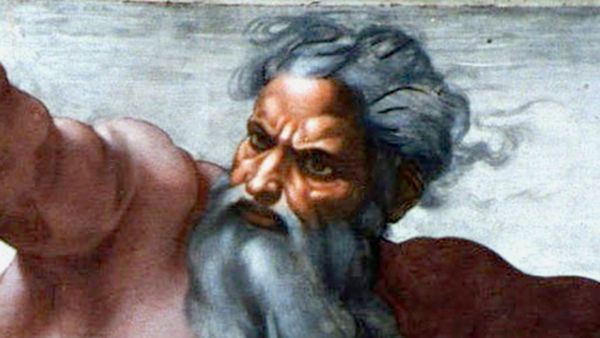
Some people have been asking how, in a world they say is governed wholly by me, Stephen Paddock was able to shoot hundreds of people this week, killing dozens. They seem to think I was AWOL. Some accused me of actual dereliction of duty, saying that yes, I was present, but simply didn't bother to intervene. I saw everything that happened as it happened, they say. In fact, I knew what would happen even before it happened. When Paddock bought the first rifle of dozens, I already knew what he would do with them.

And yet I did nothing but watch, uninterested.

This is far from the first time such accusations have been made against me. You sing in praise of me that I sit on the throne of heaven, yet you seem to call me to the dock more often than you approach me on the throne. I get indicted every day. I have known church people who accused me in their hearts of unfaithfulness to them because I didn't fix the Powerball lottery so they'd win tens of millions of dollars. I have had high school seniors accuse me of uncaring dereliction when they didn't get accepted to their first college choice. Or grown men when they get fired from their job or even when they don't get a coveted promotion.

Let me get something straight with you: I am not your fixer. Yes, I want to have a personal relationship with you but I want it to go both ways. I already have such a relationship with you on my end, but believe me, I know what being kept at arm's length is like. 

You need to understand something: I am not your buddy, I am not your pal. I am your God, your Creator, your redeemer, your savior and your judge. As I have said before, my ways are not your ways, my thoughts are not your thoughts.

Let me put this bluntly: I operate on a different level than you do. I have a longer view of the horizon than you. I have been around a lot longer than you. So: what have I done to you? How exactly, have I wearied you? I would like an answer.

I don't recall that you were around when I big-banged the universe into existence. Nor were you there to advise me when I set the earth on its course, set the limits of the sea and the moon in your sky. I gave the hawks and eagles their flight. I gave the lion his power and invented how nature renews and reproduces itself. The seasons come, the seasons go because that is the way I set it up. Where were you when I did that? Your world supports your life and the lives of innumerable creatures. Do you think I had nothing to do with that? I set up life itself. It is in me that you live and breathe and have your very being.

But you tell me that I do not know what I am doing.

Very well, let us reason together. Get a backbone and listen. You want to know why I did not intervene in Las Vegas. And my answer is: I did. I did intervene, countless times and in countless years.

I have told you, O mortal, what is good and what I require of you. It is very simple: do justice, love kindness, and walk humbly with me. You seem to scoff at my moral commandments. You think you can order your lives and societies better than I can. You acknowledge me with your lips, but your hearts are far from me. You worship me on your holy days and the next day treat your workers, or customers, or partners, or family members - the list is endless - with scorn or dishonesty. You divide yourselves into tribes or identity groups or political parties, all of them at war with one another. You reject my rules but you cannot live rule-free, so you make up your own.

How has that worked out for you?

Listen closely. Memorize this. Take it to heart, make it your daily ethic. An expert in my commandments once asked my Son what the greatest of all my commandments is. And my Son, being my begotten one, of course knew the answer. He didn't make it up on the spot. I had revealed it centuries before. My Son said, "Love the Lord your God with all your heart and with all your soul and with all your mind. And love your neighbor as yourself."

Is that complicated? No. Is it obscure? No. It is simple. It is direct. Why is it so difficult for you? I know the answer of course. It is because to obey me you must disobey yourselves, and it is in disobeying yourselves that you think obeying me is hard. But believe me, it's not hard to obey me. My yoke is easy. My burden is light. I liberate, not confine. I bring peace, not turmoil.

My teachings have been in your hands for millennia. Millennia! And yet today you ask why I was not on the job in Las Vegas. Where have you been for the last few thousand years?

Oh, believe me, I was at Las Vegas. It was a bitter night for me. But I was there.

There were a man and a woman listening to the concert when the shooting started. They did not know one another. They dived under a table. He was hit, yet he lay across the woman, shielding her with his wounded body.

A young man led 30 people to safety. He was shot doing so. There are many, many other examples. And thousands of people waited for hours on end to give blood.

Oh, you say, that's just human nature. We do not know whether those heroes and heroines even believe in a God. So? Where do you think human nature comes from? Why do you think my grace cannot operate preveniently even in the hearts of those who know me not? I am always leading every event of the world toward the good. But there are many other influences, too, such as the hardness of your hearts and the will to evil, the imperfection of your understanding, the finitude of possibilities in a world of limited resources and capabilities. Yet my will wins through more often than you know.

But why does Las Vegas prove my dereliction? Funny how no one accuses me of indifference over the murder toll in Chicago. But even that is not necessary. Just one child dying of hunger in any remote corner of the world serves just as well. (Although I might argue that it proves your dereliction more than mine.)

So before you interrogate me in the dock for not managing the world the way you think I should, I will suggest you are not actually thinking about it at all.

Shall I answer affirmatively to every prayer? Should everyone who ask me to give them the lottery win? Should every person who prays for me to heal a loved one of auto-accident injuries be granted?

Shall I prevent every illness? Every injury? Why stop there? So much of the harm you suffer comes from your own vanity, your own injustices, your own incapabilities and frankly, your own stupidities. Where do you want me to intervene?

Not long ago a young man atop a tourist center in the Alps was walking and texting. He walked right off the side of the mountain, fell 250 meters and of course did not survive. Could I have intervened? I suppose so; I could have suspended gravity and floated him gently through the air back to the platform. Or I could have made him just bounce at the bottom with no ill effect. Or I could have made it impossible for human beings to walk while texting. One or the other, never both. Or I could have just made sure that smart phones were never invented to begin with.

Here's the thing: You do not get to choose. You are not God. You have no power for miracles so you don't get to tell me how to work them or when or how.

Imagine, really try to imagine, a world in which no one ever makes a bad decision, no one ever gets a cold, no one ever suffers want or need, no relationships are ever broken or even unhappy, no woman ever turns down a marriage proposal, or no man as the case may be, no employee is ever denied a raise or promotion, no business ever fails, no inventions with potential harmful effects are ever conceived, no student ever fails, no one ever suffers harm, injury or for that matter death - or if they do die, no one mourns or grieves or feels devastated by the loss. So there are no hospitals, doctors, no medical science, no funeral homes. There are no criminals, no aggressions, no evil. But there are no doers of good deeds, either, and no charity, no compassion, no kindnesses. There is no despair but no triumph. There are no losers so there are no winners. No one has too little money in retirement because I compel everyone to invest in retirement funds from the first dollar they earn - and the market never falls, unemployment never rises, wages never fall, and I decide what everyone's occupation is, not you. After all, I am the only actually-capable central planner that there ever can be. And that means there are no dictators, no monarchs, no oligarchies, and no democracy, no elections and no politicians to elect anyway because you have no self government. I make all your decisions because I know you cannot possibly decide anything - Any. Thing. - better than I can.

What kind of world is that? That world is Hell, all of humanity living in The Truman Show. If you sometimes don't see the point of this present world, you would never see the point of that one. And neither would I, because the fundamental reality of the universe is love, and love is an act of free will and decision, not robot programming.

More than anything right now, I urge you to understand this: You and all your have constructed is under my judgment. But that has always been so. Two thousand years ago I begot the Second Person of my Trinity as a baby in a manger in Bethlehem. Sure, celebrate it with parties and cantatas and gifts, fine. But remember that his birth was an act of judgment upon the world. Why would a Savior be born if the world did not need saving?

Here is my judgment: that I so loved the world that I gave my only Son, and that anyone who accepts and follows him as the guarantor of life now and for eternity, will never perish. That is my judgment, that my Light has come into your world of darkness, but you love the darkness rather than the Light.

Even so, I will never stop loving you, never stop reaching to you, never stop being who I am. I am your Creator, your Sustainer, your Redeemer, your Savior. And all of these things are my judgment upon you, for I adjudge you in love to be in my image, I adjudge you in love to be adopted as my sons and daughters, I adjudge you to be able to spend eternity in my company, I adjudge you to be able to love me and one another both in this life and the next, I adjudge that you can do all things good and holy through my strength. I adjudge that you are both loved and love-worthy, and I adjudge that you can live with a peace that you will always enjoy even if never fully understand.

I will never redact this, never revoke it, never turn my back on you, never change my mind. And remember, I have a fuller knowledge of what "never" means than you do.

But when necessary to drive a point home, remember this, too: The severest judgment I ever lay upon you is simply to let you have what you want. That never works out well for you.

I have told you, O mortal, what is good and what I require of you: Do justice, love kindness, and walk humbly with me. Love the Lord your God with all your heart and with all your soul and with all your mind. And love your neighbor as yourself.

The triumph of human life is that it really is so simple as that. The tragedy of human life is that even the simple things can be very difficult.

Bookmark and Share