Thursday, June 16, 2016

After Orlando: The No Fly List and firearm purchases

I am writing this in response to the aftermath of the horrific mass shooting of the Pulse nightclub on June 12. Since then, many political leaders in America and many of my colleagues in ministry have offered various commentary, but the topic for this post is the insistence of many of them that persons listed on the TSA's "No Fly List" (NFL henceforth) should be prohibited from buying firearms.

That they should be so prohibited, by the way, was a specific point Preisdent Obama made during his Oval Office address to the nation after the Islamist mass murders in San Bernadino, Calif. in 2015.  The quote is:
To begin with, Congress should act to make sure no one on a no-fly list is able to buy a gun. What could possibly be the argument for allowing a terrorist suspect to buy a semiautomatic weapon? This is a matter of national security.
If we are going to debate this and other topics, it is necessary that we all understand what the terms are we are debating and what they mean. So what exactly is the No Fly List?

The NFL is nothing but a list of names that is used to prevent persons with a matching name - or even a similar name - from boarding an aircraft inside the United States. That is to say, the NFL is itself only names and nothing else - no secondary identification such as date of birth, place of residence, color of hair, height, etc.

When you make an airline reservation, either online or on the phone, the reservation system compares your name to the names on the list. If there is a match or if your name is merely similar to a name on the list, your reservation will succeed and you will be sold a ticket, but you will not be permitted to board the aircraft when you go to the airport. In fact, you will not even know your name, or a similar one, is on the NFL until you attempt to check in.

And you may not ever fly again until you prove - to the government's satisfaction, not yours - that you are not the person whose name is the real subject of the listing.

The ACLU has long been highly critical of the No Fly List and some of its chapters have challenged the law and its processes in court. The ACLU explains:


In 2004, The Washington Post reported,
U.S. Sen. Edward M. "Ted" Kennedy said yesterday that he was stopped and questioned at airports on the East Coast five times in March because his name appeared on the government's secret "no-fly" list. 
Federal air security officials said the initial error that led to scrutiny of the Massachusetts Democrat should not have happened even though they recognize that the no-fly list is imperfect. But privately they acknowledged being embarrassed that it took the senator and his staff more than three weeks to get his name removed. 
A senior administration official, who spoke on condition he not be identified, said Kennedy was stopped because the name "T. Kennedy" has been used as an alias by someone on the list of terrorist suspects. ...
"That a clerical error could lend one of the most powerful people in Washington to the list -- it makes one wonder just how many others who are not terrorists are on the list," said Reginald T. Shuford, senior ACLU counsel. "Someone of Senator Kennedy's stature can simply call a friend to have his name removed but a regular American citizen does not have that ability. He had to call three times himself."
In fact, Sen. Kennedy publicly made the same point as ACLU Counsel Shuford. But note that even though Kennedy picked up a phone and called DHS Secretary Tom Ridge to get his name removed, it still took three weeks. In fact, though, "T Kennedy" was not removed from the list, the DHS just issued instructions that Sen. Kennedy would not be delayed. I would submit that us peons will not enjoy that advantage of present DHS Secretary Jeh Johnson answering the phone personally when you or I call him.

The ACLU explains their continuing, serious concerns and legal actions regarding the No Fly List at some length here. And in 2014, Reuters reported, "Federal judge rules U.S. no-fly list violates Constitution."
The U.S. government's no-fly list banning people accused of links to terrorism from commercial flights violates their constitutional rights because it gives them no meaningful way to contest that decision, a federal judge ruled on Tuesday.

U.S. District Judge Anna Brown, ruling on a lawsuit filed in federal court in Oregon by 13 Muslim Americans who were branded with the no-fly status, ordered the government to come up with new procedures that allow people on the no-fly list to challenge that designation.
And speaking of the DHS,
Rep. Stephen Lynch (D., Mass.) disclosed that a congressional investigation recently found that at least 72 people working at DHS also “were on the terrorist watch list.”

“Back in August, we did an investigation—the inspector general did—of the Department of Homeland Security, and they had 72 individuals that were on the terrorist watch list that were actually working at the Department of Homeland Security,” Lynch told Boston Public Radio.
It should be noted that the No Fly List and the Terror Watch List (TWL) are two distinct lists that have different purposes. Being placed on the TWL does not automatically place that name on the NFL and FBI Director James Comey is on record saying that it should not do so.

There is a long list of "false positives" on the No Fly List at Wikipedia article on the topic. A few examples:
  • U.S. Representative, former Freedom Rider, and Chairman of SNCC John Lewis (politician) (D-GA) has been stopped many times.
  • David Nelson, the actor best known for his role on The Adventures of Ozzie and Harriet, is among various persons named David Nelson who have been stopped at airports because their name appears on the list.
  • In February 2006, U.S. Senator Ted Stevens (R-AK) stated in a committee hearing that his wife Catherine had been subjected to questioning at an airport as to whether she was Cat Stevens due to the similarity of their names. [Cat Stevens was a pop singer who converted to Islam and changed his name to Yusuf Islam in 1978, and that name was placed on the NFL.]
  • After frequent harassment at airport terminals, a Canadian businessman changed his name to avoid being delayed every time he took a flight.
  • Abe Mashal, a 31-year-old Muslim and United States Marine Veteran, found himself on the No Fly List in April 2010 while attempting to board a plane out of Midway Airport. He was questioned by the TSA, FBI and Chicago Police at the airport and was told they had no clue why he was on the No Fly List. Once he arrived at home that day two other FBI agents came to his home and used a Do Not Fly question-and-answer sheet to question him. They informed him they had no idea why he was on the No Fly List.
There are many other such examples. So secretive are the NFL's processes that last year the left-of-center Huffington Post published,
Earlier this week, The Intercept published a 166-page document outlining the government's guidelines for placing people on an expansive network of terror watch lists, including the no-fly list. In their report, Jeremy Scahill and Ryan Devereaux highlighted the extremely vague and loosely defined criteria developed by 19 federal agencies, supposedly to fight terrorism.

Using these criteria, government officials have secretly characterized an unknown number of individuals as threats or potential threats to national security. In 2013 alone, 468,749 watch-list nominations were submitted to the National Counterterrorism Center. It rejected only 1 percent of the recommendations.

Critics say the system is bloated and imprecise, needlessly sweeping up thousands of people while simultaneously failing to catch legitimate threats, like Boston Marathon bomber Tamerlan Tsarnaev.
HuffPo went on to explain seven ways you can wind up on the list:
  1. You could raise "reasonable suspicion" that you're involved in terrorism. "Irrefutable evidence or concrete facts" are not required.
  2. You could post something on Facebook or Twitter that raises "reasonable suspicion."
  3. Or somebody else could just think you're a potential terror threat.The guidelines also consider the use of "walk-in" or "write-in" information about potential candidates for the watch list. 
  4. You could be a little terrorist-ish, at least according to someone.
  5. Or you could just know someone terrorist-y, maybe.
  6. And if you're in a "category" of people determined to be a threat, your threat status could be "upgraded" at the snap of a finger.
  7. Finally, you could just be unlucky.
UCLA Constitutional Law Prof. Eugene Volokh wrote in The Washington Post,
"... wouldn’t the argument [against the proposal] be that these are just “suspect[s],” and we don’t deny constitutional rights based just on suspicion? If you think you can prove someone is a terrorist, lock him up. If you have probable cause to think he’s a terrorist, and think you can develop proof beyond a reasonable doubt, arrest him. Even if you have only suspicion, follow him, ask people about him, and so on. But if you don’t have enough to prosecute or even arrest someone, you can’t take away his constitutional rights, even if you suspect he’s a terrorist (or if you suspect he’s a drug dealer or a gang member or whatever else).
In another article, Prof. Volokh points out that while many people say that the Second Amendment does not secure the right of individual persons to keep and bear arms, President Obama has himself said that it does. According to Whitehouse.gov, on January 16, 2013, President Obama said:
Let me be absolutely clear.  Like most Americans, I believe the Second Amendment guarantees an individual right to bear arms.
Another point: I think the question is reasonable that if someone is threatening enough to bar from flying and from buying a gun, shouldn't they be arrested? If not, why not? As the ACLU says,
Until the government fixes its unconstitutional new [as of 2014] process, people on the No Fly List are barred from commercial air travel with no meaningful chance to clear their names, resulting in a vast and growing group of individuals whom the government deems too dangerous to fly but too harmless to arrest.
And the solution apparently is to change that to, "too dangerous to fly, too dangerous to buy a gun, but still too harmless to arrest."

Finally, let's revisit the president's quote from his 2015 Oval Office address, specifically these sentences:
To begin with, Congress should act to make sure no one on a no-fly list is able to buy a gun. What could possibly be the argument for allowing a terrorist suspect to buy a semiautomatic weapon? 
By now I hope the reader can see that imprecision of language is one of the greatest obstacles we have in coming not merely to agreement, but in even speaking cogently to one another. And the president's language here was inexcusably imprecise because the No Fly List is not a list of terrorist suspects, which should be abundantly clear from the sources I have cited above. There is such a thing as a federal terrorist watch list, but that is not the list the president was referring to. Or was it? We really do not know.

Update: The 8-year old.

Update: The Knoxville, Tenn., veterinarian:
Dr. Patrick Stephen Hackett is a veterinarian — not a terrorist.

Try explaining that in the airport security line.

Hackett, a lifelong resident of the Knoxville-Oak Ridge area, was named Outstanding Practitioner of the Year in 1992 by the Tennessee Veterinary Medical Association. He serves as president of the Humane Society of the Tennessee Valley.

He’s on the no-fly list.

Hackett has never been arrested and never traveled to the Middle East or other centers of terrorist activity, but he found out more than a decade ago he’s on the federal watch list because he shares the same name as notorious Irish Republican Army terrorist Patrick Joseph Hackett, who was jailed in the 1970s for planting bombs in Britain.

The difference should be easy to spot. The terrorist is missing an arm and a leg — blown off when a bomb exploded prematurely — while the Knoxville veterinarian has all his limbs intact.

“I don’t know how I got on the list, and I don’t know how to get off the list,” Hackett said.
And note that the actual terrorist and the veterinarian do not in fact have the same name.

Update: Huffington Post writer Chris Weigant argues
But I have to say, while all this seems laudable at first glance, the underlying (and bipartisan) disdain for the United States Constitution is extremely worrisome. Just to be clear, I’m not talking about the Second Amendment here, but rather the Fifth and Fourteenth Amendments. Here are the relevant clauses: “No person shall... be deprived of life, liberty, or property, without due process of law....” (Fifth Amendment); and “...nor shall any State deprive any person of life, liberty, or property, without due process of law....” (Fourteenth Amendment). ...

If we’re going to have a No-Fly List and a Terrorist Watch List to provide security for American citizens, then we need to codify such programs by passing a constitutional amendment which clearly spells out the limits and scope of such programs. To me, there is simply no other constitutional way to achieve this goal.

Now, don’t get me wrong. I’m not arguing that such pre-emptive security measures are inherently a bad thing. And I’m certainly not arguing that suspected terrorists should be able to easily acquire high-powered weapons. I’m not “pro-terrorist” in any way, shape, or form. Just to be clear.

But I am arguing that what we’ve got now is blatantly unconstitutional. And it appears nobody else is even willing to make such an argument, at the moment. 
Well, I am.

See also, "America's terrorist watch list, explained."

Sunday, May 29, 2016

Courage

On Memorial Day we remember the men and women who gave their lives in the service of our country or who have died since their time of service. We should be careful to distinguish between this day and Veterans Day, a day set aside to pay tribute to those serving now or who have served and are still living.

While giving honor to more than one million, one hundred thousand American men and women who died in battle, we draw up short of honoring war itself or glorifying it. General William Tecumseh Sherman, the Union commander who devastated vast swaths of Georgia and both Carolinas during the Civil War, wrote to his wife at war’s end,
I confess, without shame, that I am sick and tired of fighting — its glory is all moonshine; even the most brilliant success is over dead and mangled bodies, with the anguish and lamentations of distant families ... it is only those who have never heard a shot, never heard the shriek and groans of the wounded and lacerated ... that cry aloud for more blood, more vengeance, more desolation.
Yet while the dead whom we honor today would almost certainly agree with General Sherman's sentiments, they also knew that it is untrue that nothing is worth fighting for. Teddy Roosevelt earned wartime honors in the Spanish-American war and then received the Nobel Peace Prize for brokering the end of the Russo-Japanese war. Roosevelt put the tension between our desire for peace and the sometime necessity of war this way:
[M]y disagreement with the peace-at-any-price men, the ultra-pacifists, is not in the least because they favor peace. I object to them, first, because they have proved themselves futile and impotent in working for peace, and second, because they commit ... the crime against morality of failing to uphold righteousness as the all-important end toward which we should strive ... To condemn equally might which backs right and might which overthrows right is to render positive service to wrong-doers. . . . To denounce the nation that wages war in self-defense, or from a generous desire to relieve the oppressed, in the same terms in which we denounce war waged in a spirit of greed or wanton folly stands on a par with denouncing equally a murderer and the policeman who, at peril of his life and by force of arms, arrests the murderer. In each case the denunciation denotes not loftiness of soul but weakness both of mind and morals. – America and the World War
But I am not exploring today the topic of just or unjust wars. This post is about courage.

Every member of the service who faces battle knows about fear. But there are ample opportunities in the military to be in fear in either peace or war.

One fearful day for me was on Sicily drop zone at Fort Bragg, North Carolina, on July 1, 1987. A C-130 approached to drop off a Sheridan armored reconnaisance vehicle, flying about five feet above the ground. The chutes deployed but the C-130 hit the ground flat on its underside. It was about 75 feet away from me. The pilot gave the engines full throttle, trying to get back into the air, but the landing gear was buried in the sand and the tail assembly had almost been severed by the impact. The plane ran into a wooded ravine where it blew up.

My friend, Maj. Baxter Ennis, was with me. Like many of the other soldiers present, we ran into the flames because in the military you never abandon your comrades. There was fire and smoke everywhere, not only from the burning jet fuel; the forest was on fire, too. The heat was extremely intense. We finally left, having accomplished nothing. This is that crash:


Two flight officers in the cockpit were severely burned but lived. Four crewmen and a soldier were killed. I had never met them. I didn’t even know their names until the news media broadcast them. But I don’t think two weeks at a time has gone by since then that I don’t think of them, and think of that day.

The pilot’s was Captain Garry Bardo, Jr..
The navigator’s was First Lieutenant John B. Keiser, III.
The loadmaster’s was Technical Sergeant Timothy J. Matar.
The assistant loadmaster’s was Airman First Class Albert G. Dunse.
The soldier’s was Staff Sergeant Douglas Hunter.

These are some names I am remembering for Memorial Day.

William Manchester won the Pulitzer Prize for his biography of John. F. Kennedy. Manchester fought on Okinawa as a Marine sergeant. He wrote of single-handedly entering a building to take out an enemy sniper: “There was a door which meant there was another room and the sniper was in that—and I just broke down. I was absolutely gripped by fear that this man would expect me and would shoot me.”

Fear in danger hardly needs justification. It is not fear that needs explanation, but courage. As one veteran wrote, the reasonable thing in battle would be to run away. Whence comes the courage to stay, much less courage to heroics? Were they truly willing to die for their country? I don't think so. There's an old story that goes back probably to the Civil War of the young soldier whose commander asked him, "Are you willing to die for your country?" The young man answered, "Certainly not. But I am ready to die, unwilling."

What is courage? Courage is not simply the absence of fear. Indeed, many men who have been awarded the highest decorations for bravery in battle admit they were frightened the entire time.

No, courage is not the lack of fear. One facing real danger without fear is either a fool or ignorant. As someone once wisecracked, "When everyone around you is losing their head and you’ve kept yours, then you don’t understand the situation."

So, then, is courage the mastery of fear? The will to act despite danger and the fear of it is necessary for courage to come forth. But even that falls short as a workable definition. Courage, like fear, is mostly an emotional response to the danger. Courage is not unthinking, but it is usually uncritical. Courage is an act of will but more than that. Courage is an act of being.

Many soldiers have done heroic acts and later said they were hardly in control of themselves. The ancient Greeks called this state katalepsis, "possession," and even the Spartans tried to train their soldiers never to fall under this condition. Audie Murphy was awarded the Distinguished Service Cross for action in this condition after his best friend was killed. In this state there is no conscious fear and heroic deeds seem reckless more than courageous.

Without fear there is no courage, but fear and courage are not opposites. Courage is the opposite of cowardice, not of fear. Courage and cowardice are opposite sides of the same coin, but what is the obverse side of the coin of fear?

Again we consult ones who have seen both sides of the coin. William Manchester suffered a non-life-threatening wound on Okinawa that sent him to the honorable safety of a field hospital. There he learned that his unit would make an amphibious assault further up the island. Manchester explained in his book, Goodbye, Darkness, that the thought of his friends facing danger without him to help them “was just intolerable.”
Those men on the line were my family, my home. They were closer to me than I can say. I had to be with them, rather than let them die and me live with the knowledge that I might have saved them.
He went AWOL from the hospital, joined his unit was blown nearly to bits by Japanese artillery in the ensuing battle.

Military service, especially in battle, is steeped with the convictions of deepest emotion. In battle there is fear and courage, anger and compassion. There is resignation and determination. There is hope and despair. The chief emotion of the battlefield, unlikely as it may be, is love. When patrolling deserts of Iraq or the mountains of Afghanistan, soldiers stay where flies the angry iron not for country or flag or other abstractions. In the final sense they fight for their friends. One Iraq veteran wrote,
I've found the hard way that war is not glamorous. You quickly lose the idea of being a man fighting for his country when you have to carry your comrade who has been wounded in a gun fight. That nobility is lost quickly. ... It's not about fighting for the flag, it's about fighting for my life and fighting for my buddies' lives. These men I am lucky enough to serve with, I have become so attached to it's like they are my brothers.
The opposite of fear is not courage. It is love. The apostle John wrote (1 John 4:16-18),
And so we know and rely on the love God has for us. God is love. Whoever lives in love lives in God, and God in him. In this way, love is made complete among us so that we will have confidence on the Day of Judgment, because in this world we are like him. There is no fear in love. But perfect love drives out fear, because fear has to do with punishment. The one who fears is not made perfect in love.
John was not writing of the battlefield, of course, but of why disciples of Jesus Christ should have no fear of the judgment of God because God loves us and we love God. God's love is perfect to begin with. It's our love of God that must be perfected. The more perfectly one loves God the less one fears God.

In the Old Testament, the admonition to "fear God" mostly means to hold in reverential awe rather than to be actually afraid. The New Testament uses fear that way, too. But Jesus warns us that God is to be feared in the usual sense of the word. In Luke 12:5, Jesus said, "But I will show you whom you should fear: Fear him who, after the killing of the body, has power to throw you into hell. Yes, I tell you, fear him."

He's talking about God and the judgment of God. What insures us against the judgment of God and therefore against the fear of hell's punishment is love. A misconception among church people is that it is God's love for us that removes this fear. To the contrary, it is our love for God. "There is no fear in love. But perfect love drives out fear."

Love displaces fear just as oil displaces water. It is not just the fear of God that is banished by love for God. It is the fear of most anything life can throw at us. I am not confusing fear with concern or caution. It is reasonable to maximize one’s chances for good outcomes in danger or times of uncertainty. That is one thing, but to be gripped by fear is another. Love drives out fear as long as we remember that there is nothing in this life or after it that can separate us from the love of God in Jesus Christ, and that, as Paul put it, the sufferings of this world do not compare with the glory that God has in store for us (Rom 8.18).

The opposite of fear is not courage. It is love. "Perfect love drives out fear." Love displaces fear just as oil displaces water. Yet there is a paradox here. If love drives out fear, then is love the only source of courage? “Among men who fight together there is an intense love,” Manchester explained. His story of leaving the field hospital is a love story. Yet it was a fear story, too. His fear, as he also admitted, was that his friends would be in danger and unless he was with them he would not be able to do anything about it. Here his fear for his friends’ safety was not driven out by his love for them, his fear for them and love for them combined to evoke courage. Love and fear, two sides of the same coin. Manchester’s courage was born of both fear and love to place himself in danger to protect his comrades.

Former Marine and author Steven Pressfield put it this way in Gates of Fire:
What can be more noble than to slay oneself? Not literally. ... But to extinguish the selfish self within, that part which looks only to its own preservation, to save its own skin. ... 
When a warrior fights not for himself, but for his brothers, when his most passionately sought goal is neither glory nor his own life’s preservation, but to spend his substance for them, his comrades, not to abandon them, not to prove unworthy of them, then his heart truly has achieved contempt for death, and with that he transcends himself and his actions touch the sublime. That is why the true warrior cannot speak of battle save to his brothers who have been there with him. The truth is too holy, too sacred for words.
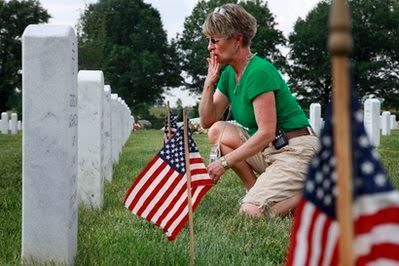
Anita Dixon, of Wichita, Kan., whose son Army Sgt. Evan Parker was killed while serving in Iraq in 2005, kisses the graves in section 60, where many of the casualties from Iraq and Afghanistan are buried, among flags placed in preparation of Memorial Day at Arlington National Cemetery in Arlington, Va. on Thursday May 27, 2010. 'I'm putting a kiss on the graves because they're all brothers,' says Dixon, ' the military is a family.' says Dixon. (AP Photo/Jacquelyn Martin)

Whether they served in peace or war, the men and women we memorialize today were not so impoverished of spirit that they were unable to surrender the pleasures of life. They deemed that their love of country and duty to freedom were of greater value and more important imperative, so they reckoned that if dangers must be faced, they would face them in the most desirable way, by placing their own mortal bodies "between their loved homes and the war's desolation."

Because of their sacrifice we go safely to our homes. Henceforth we should stand in humility when their names are read. This date should never go by but that on it our fallen shall be remembered.

The prophet Micah wrote that the time will come when God will judge between all the peoples and will settle disputes between strong nations far and wide. They will beat their swords into plowshares and their spears into pruning hooks. Nation will not take up sword against nation, nor will they train for war anymore. All people will be at peace, and no one will make them afraid (Micah 4:3-4).

Let us pray that day comes quickly. Until then may the Lord watch over those who serve today, to make them instruments of justice, enablers of peace, and finally to see them safely home.

Bookmark and Share

Thursday, May 26, 2016

Enslaved by The Crowd?

You do not know it, but you are a slave. You are not enslaved by a central authority, but by the Crowd. Their opinions determine what you can say; their product-buying choices determine what’s on the market; their government preferences create a “window” of acceptable ideas and anything else is excluded. This is tyranny by the Crowd…

Jonathan Peter Wilkinson

"JPW works as an Operations Research Analyst. This line of work has trained him to view the world in a systemic fashion. In solving the System Identification Problem of modern society, he discovered that the system was not truly designed to make us happier or more successful. Secondly, an unflinching evaluation of the ongoing outputs of the current system show its marked decline in quality and success."
(From "Upward Exit," mild language alert)

And this by Roger Simon:
As far back as 1979, Christopher Lasch published a now famous book The Culture of Narcissism that described the American behavioral patterns as largely narcissistic. According to Lasch, our family structure had produced a personality type consistent with “pathological narcissism.” We were constantly seeking attention from the outside world, making us a nation of insecure weaklings forever in search of validation to tell us we were alive, to give us a raison d’ĂȘtre.
(From "Moral Narcissism and the Least-Great Generation")

But none of this, not The Crowd nor the "attention of the outside world" can bring us happiness or meaning and purpose in life. Happiness is a false goal, anyway. As Buddha is supposed to have said, "There is no path to happiness: happiness is the path."

And modern psychologists agree with the saying attributed to Lao Tzu, "If you are depressed you are living in the past. If you are anxious you are living in the future. If you are at peace you are living in the present."

Compare to Jesus, Gospel of Matthew 25:
“Therefore I tell you, do not worry about your life, what you will eat or what you will drink, or about your body, what you will wear. Is not life more than food, and the body more than clothing? ... And can any of you by worrying add a single hour to your span of life? ... Therefore do not worry, saying, ‘What will we eat?’ or ‘What will we drink?’ or ‘What will we wear?’ But strive first for the kingdom of God and his righteousness, and all these things will be given to you as well.

“So do not worry about tomorrow, for tomorrow will bring worries of its own. Today’s trouble is enough for today."
Jesus proclaimed that he brought freedom. And so he did, but not the freedom to do anything we want. The freedom he gives is freedom from the chains that bind us from seeking holiness: sin, The Crowd, the seeking of approval from the world.

Christian writer Owen Strachan pout it this way: "Whatever else Christian freedom means, it fundamentally means that we are free to be holy. There is no barrier to godliness. We have all we need for it through the Word and the Spirit (2 Peter 1:3)."

Freedom is also a choice. But Christian freedom is not merely about making choices, it is focused on making the right choices. Choosing rightly is more important than merely having the ability to choose at all. As colleague of mine emailed me this morning, when each day begins he knows that,
For the next twelve hours I will be exposed to the day’s demands. It is now that I must make a choice.

Because of Calvary, I’m free to choose. And so I choose.

I choose love. No occasion justifies hatred; no injustice warrants bitterness. I choose love. Today I will love God and what God loves.

I choose joy. I will invite my God to be the God of circumstance. I will refuse the temptation to be cynical… the tool of the lazy thinker. I will refuse to see people as anything less than human beings, created by God. I will refuse to see any problem as anything less than an opportunity to see God.
I choose peace. I will live forgiven. I will forgive so that I may live.

I choose patience. I will overlook the inconveniences of the world. Instead of cursing the one who takes my place, I’ll invite Him to do so. Rather than complain that the wait is too long, I will thank God for a moment to pray. Instead of clinching my fist at new assignments, I will face them with joy and courage.

I choose kindness. I will be kind to the poor, for they are alone. Kind to the rich, for they are afraid. And kind to the unkind, for such is how God has treated me.

I choose goodness. I will go without a dollar before I take a dishonest one. I will be overlooked before I will boast. I will confess before I will accuse. I choose goodness.

I choose faithfulness. Today I will keep my promises. My debtors will not regret their trust. My associates will not question my word. My wife will not question my love. And my children will never fear that their father will not come home.

I choose gentleness. Nothing is won by force. I choose to be gentle. If I raise my voice, may it be only in praise. If I clench my fist, may it be only in prayer. If I make a demand, may it be only of myself.

I choose self-control. I am a spiritual being. After this body is dead, my spirit will soar. I refuse to let what will rot, rule the eternal. I choose self-control. I will be drunk only by joy. I will be impassioned only by my faith. I will be influenced only by God. I will be taught only by Christ. I choose self-control.

Love, joy, peace, patience, kindness, goodness, faithful-ness, gentleness, and self-control. To these I commit my day. If I succeed, I will give thanks. If I fail, I will seek His grace. And then, when this day is done, I will place my head on my pillow and rest.
And that rest will be easy.

Thursday, May 12, 2016

Organizational maturity is a death sentence

When I was an artillery officer on the staff of XVIII Airborne Corps at Fort Bragg, NC, in the latter 1980s, it fell to me to be assigned as the escort officer for Miss North Carolina to the anniversary dinner of the Fayetteville chapter of the Association of the US Army, or AUSA. It was a community-relations gig.

Tough duty, I know, but it had to be done so I just rubbed my artillery insignia, tossed down a cup of coffee and headed off to the trenches.

I'll say not a word about the truly stunning woman at my arm as we entered and dined (for I was and still am married to one) but will relate what led me in the next few days to develop my theory or Organizational Maturity.

After the meal came the business part of the dinner meeting. Then as now, AUSA says it's purpose is "to support all aspects of national security while advancing the interests of America's Army and
the men and women who serve. AUSA is a private, non-profit educational organization that supports America's Army - Active, National Guard, Reserve, Civilians, Retirees, Government Civilians, Wounded Warriors, Veterans, and family members."

Um, not that night.

The entire discussion of the post-prandial meeting was taken up by devoted talk that chapter was threatened with losing its status as the largest chapter of AUSA in membership numbers.

"How to get more members? What do we do with members who are enrolled but don't pay their dues? How do we replace lapsed or deceased members? How do we reach the young people?"

Etc, etc, etc.

Not one word about the troops. Not. One. Word.

And so here is Don's Theorem of Organizational Maturity:

Every organization that does not directly depend on profit-loss models to stay operating eventually abandons its founding purposes and focuses inward, concerned first with keeping itself going and then with sustaining its membership's comfortableness.

This is the special threat to volunteer organizations. It is always a sign of the organization's decline.

It works like this:

Wednesday, March 30, 2016

"10 Things You Should Know about the Resurrection"

10 Things You Should Know about the Resurrection

I would quibble a little with number 2 on the list, "Belief in Jesus's physical resurrection is the defining doctrine of Christianity." I mean, he is definitely on target here, as I insisted in seminary class one day.

My quibble is certainly not with the assertion that resurrection is at the very core of Christian faith - and not just the resurrection of Jesus! - but with his words, "physical resurrection."

That is not how the New Testament describes what happened, for its strong implication is that Jesus's physically dead body of Friday evening was reanimated or resuscitated in the tomb and departed from it.

But there are no passages in the New Testament that say that. In fact, distinctly from it. In 1 Corinthians 15, the apostle Paul says carefully,
But someone may ask, “How are the dead raised up? And with what body do they come?” ... The body that is sown is perishable, it is raised imperishable; it is sown a natural body, it is raised a spiritual body. If there is a natural body, there is also a spiritual body.
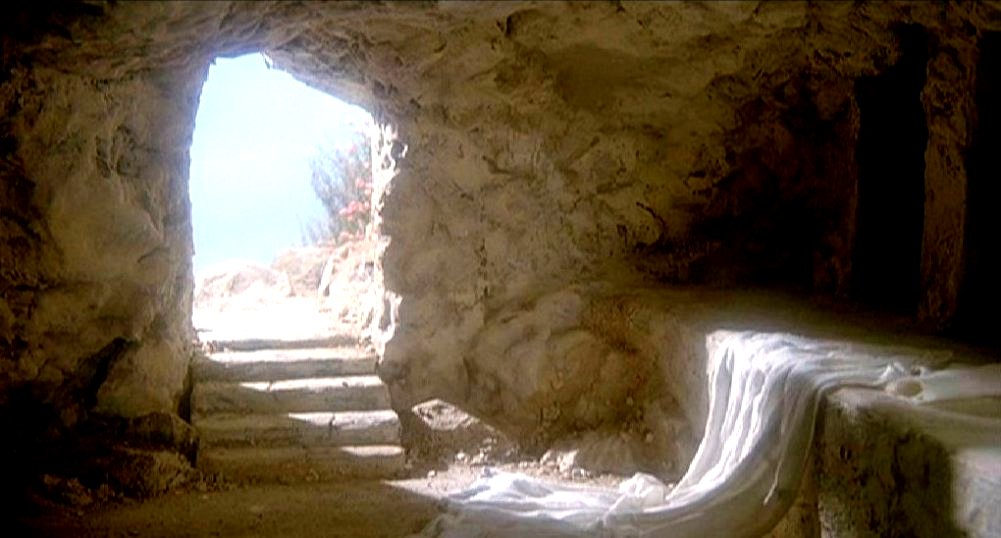
The women on that first Easter morning encountered the empty tomb, had no idea what happened to the body. To this day we still cannot explain what happened to the corpse. Jesus was raised bodily from death, but it seems that the same fleshly body that went into the tomb was not the very same body of the risen Lord.

After all, when Mary Magdalene saw Jesus, he had been transformed from a broken, bloody, ravaged and shattered corpse into glorified Risen Lord. Yet she did recognize him, though it took some prompting on his part.

When Mary talked with the risen Lord, she knew he was still Jesus. His identity continued from his life into his resurrection. But the embodiment of his resurrection, the Christ, was not the same as his embodiment as Jesus.

So resurrection is not simply the reanimation of a lifeless body. What happens to our earthly body seems to be unimportant. It would seem that identity, but not materiality carries over from this life to the resurrected life, but that is not easily grasped, as even Paul saw.

Bookmark and Share

Saturday, March 5, 2016

War and the reshaping of societies

I first published this essay in 2002 but is no longer online. I republish it now because of the prominence in the 2016 presidential campaigns of the how to confront and defeat ISIS and one candidate's assertion that he would order the intentional deaths of family members of enemy combatants, and other candidates' assertions of large-scale bombing raids against ISIS. 

Various commentators have pointed out that during the early 1990s Persian Gulf War, only about 10 percent of the bombs US air forces dropped were precision guided. But during the Afghan campaign, so far, two-thirds or more have been precision guided.


There are many military and political advantages of using precision guided munitions, or PGMs. But may be some long-term drawbacks as well. Crudely put, our reliance on PGMs make it possible for a foreign power to fight us and lose, yet not suffer many of the consequences of war.

World War II "precision" bombing

The primary advantage of PGMs is simple: hitting the target. During World War II, when there were no PGMs, the allied air forces sent up to 1,000 heavy bombers over German targets at a time. Yet the number of bombs that actually had militarily significant target effects was small in comparison to the number dropped. The British knew this would be the case from the beginning, and didn't even try to hit their targets except by using the law of averages. "Area bombing" was their tactic. They hoped that if they dropped as many bombs as they could, enough would happen to hit the target to make the mission worthwhile.

Area bombing of a German city
American commanders believed that intentionally accurate bombing was possible; they even misnamed their technique "precision" bombing. Yet long before the end of the war, American bomb wings were really conducting area bombing tactics; they just pretended it was "precision" bombing. In all, according to the US Strategic Bombing Survey completed after the war, "2,700,000 tons of bombs were dropped [on Germany], more than 1,440,000 bomber sorties" were flown. Yet the Survey reports that "only about 20% of the bombs aimed at precision targets fell within [the] target area."

That this was "precision bombing" was simply propaganda. US Air Corps bombing raids' accuracy was severely affected by German weather, which was almost never suitable for accurate bombing. An enormous number of US bomb missions were conducted by radar, which in that day was very inexact. There was no such thing as precision-guided bombs for these raids.
The destruction achieved was enormous. Almost 60 years later we can scarcely comprehend what the Germans and Japanese endured. In Germany, "3,600,000 dwelling units, approximately 20% of the total, were destroyed or heavily damaged. Survey estimates show some 300,000 civilians killed and 780,000 wounded. The number made homeless aggregates 7,500,000. The principal German cities have been largely reduced to hollow walls and piles of rubble."

Hamburg, Germany, 1943. Destruction of this magnitude across the whole of Germany was the deliberate war aim of both Britain and the United States.
Most of this destruction was what we now term, "collateral damage." With an average of 80 percent of the bombs falling outside the target area, it was inevitable that non-target areas would suffer heavy damage. The British intended from the beginning to inflict massive destruction on civilian populations and facilities. Partly, this desire was revenge based, since the German Luftwaffe had terror-bombed England. But it was mostly based on the mistaken notion that heavy bombing of civilian centers would reduce civilian morale to the point where they would not support the war any longer. (Why the British thought that German morale was more frail than their own is an unanswered question.)

The Americans rejected terror bombing, but not for long. As the war went on and on, and German and Japanese resistance failed to slacken, President Roosevelt decided that the German and Japanese peoples must realize after the war that not only had their armed forces been defeated: the entire nation, as a nation, had been beaten. He and Churchill were well aware that German militarism had survived World War I because its apologists had successfully propagated the myth that the Kaiser's army had not really been defeated, it had been "stabbed in the back" by disloyal factions at home.

Hence, wrote Roosevelt in a letter to Secretary of War Henry Stimson,
It is of utmost importance that every person in Germany should realize that this time Germany is a defeated nation. . . . The fact that they are a defeated nation, collectively and individually, must be so impressed upon them that they will hesitate to start any new war.
(Roosevelt's policy seems not far from Civil War Gen. William T. Sherman's observation of the Confederate States, "War, and war alone, can inspire our enemy with respect, and they will have their belly full of that very soon.") So, according to historian Richard B. Frank in his award-winning book, Downfall, the End of the Imperial Japanese Empire:
Viewed in this light, massive urban bombing complemented the aim of unconditional surrender. It was not just a handful of vile men who flaunted vile ideologies; whole populations imbibed these beliefs and acted as willing acolytes. Unconditional surrender and vast physical destruction would sear the price of aggression into the minds of the German and Japanese peoples. No soil would be left from which myths might later sprout that Germany and Japan had not really been defeated. These policies would assure that there would be no third world war with Germany, nor would Japan get a second opportunity.
One notes that Japan and Germany have been well behaved since 1945. But we also have to note that massive, destructive bombing was alone not the reason. It was simply impossible for either country's armed forces to claim that they had prevailed, or at least held their own, on the field of battle. German and Japanese orphans, widows and grieving parents were in almost every other household, and a lie that their armed forces had not really lost could not possibly have found legs to stand on.

Most importantly, US forces occupied both countries for several years after the war. In Germany, the division of the country into free and communist states imbued it and Europe with a forced stability that they might not otherwise had. This gave time for democratic institutions to take serious root, and today German democracy is as strong as any in the world. It helped that Germany had no ages-long tradition of centralized authority in monarchs; it had been unified into a single nation only a few decades before.

But in Japan, the situation was quite different. Militarism was deeply rooted; in fact, the entire culture of the country was oriented on producing warriors. The imperial throne had been intact for 2,400 years, although its present polity dated only to the 1860s. Women were politically and socially powerless. And in 1945, its army, navy and air forces virtually eliminated, General of the Army Douglas MacArthur arrived as the first successful invader ever to set foot on the soil of Japan. In Japan, MacArthur eliminated Japanese militarism first by emplacing a democratically-based constitution and second by liberating Japanese women from centuries of patriarchal oppression. He gave women the rights to vote and to serve in democratic assemblies and government offices, steps MacArthur saw as essential to ending Japanese military aggressiveness. America also bore the brunt of rebuilding Japan's economy and infrastructure.

The result: today Japan may fairly be characterized as a Western country. It bears all the hallmarks of Western culture ands tradition: a capitalist economic system, a representative parliament, a toothless monarchy, a vibrant university system and the rule of law.

 A comparison to America's present enemies is therefore apt. What made Japan's transition from a medieval culture to a modern one so successful so quickly was the fact that the Japanese people, from top to bottom, realized that the way they had been doing things, in every arena of their society, was no longer tenable and had to be abandoned. This realization was profound and wrenching, but it had been brought about through great violence and enormous cost to their nation.

I have noted before that there is no inherent contradiction between the religion of Islam and democratic institutions. On the contrary, I am convinced that state Islam, as practiced in the Arab countries today, serves mostly to amplify rather than create political and cultural oppression.

The real problem with Islam is not actually Islam; it is how Islam is practiced in Arab lands. Saudi Arabia is a paradigm. According to Prof. Fouad Ajami of The Johns Hopkins University, Islam has been "the handmaiden of the state" since the beginning of the modern Saudi realm, resulting from
... an alliance between a desert chieftan, Muhammed bin Saud, and a religious reformer named Muhammed ibn Abd al-Wahhab. This partnership anchored the kingdom. The House of Saud defended the country and struck bargains with world powers, while the descendants of the Wahhab family dominated the judiciary and an educational system suffused with religion.
The real enemy of Western civilization today is not Islam. It is arabism: a system of political and social authoritarianism in Arab lands using Islam as a handmaiden, as Prof. Ajami put it. (Remember, most Muslims are not Arabs.)

Our task is therefore over the long term to bring home to these nations, at every level of their societies, the fact that Japan had to face: the times, they are a-changing. These nations must come to realize at every level that they cannot successfully continue with business as before. They must transition into democratically based institutions with free-market systems and individual freedoms. The question is, can these reforms be brought about non-violently or do they require profound suffering by their peoples?

Bookmark and Share

Friday, February 12, 2016

Where will you run to?

The Cleansing of the Temple statue at a Liverpool art gallery
The Rev. Richard Hall explains this photo:
Visitors to a Liverpool art gallery are being shaken by the sight of a new statue of Jesus. Called ‘The Cleansing of the Temple’, I don’t suppose it is meant to represent ‘Gentle Jesus meek and mild’, but reactions have been even more extreme than the artist intended. Some are convinced the statue is evil and recoil in terror. Others fall to their knees in prayer. Some say they see sparks coming from the statues eyes.
Gerard Van Der Leun quotes the lyrics of 16 Horepowers’ song, “Sinnerman.”
 o sinnerman where will you run to
sinnerman where will you run to
All on that day
Run to the mountain
The mountain wont hide you
Run to the sea
The sea will not have you
And run to your grave
Your grave will not hold you.
All on that day.
Gerard explains,
Many years ago, I was flipping through the pages of a newsmagazine and came upon a photograph of the machete-hacked corpse of a child floating like some half-chewed chunk of jetsam in a backwater of Lake Victoria. This was during what we now think of, because we have to think of it as something distinct from our normal run-of-the-mill massacres, as the Rwanda genocide.

It was a crystal clear photograph showcasing an act of genocide like any other, only the meaningless details changed: children, machetes, an African lake. As a professional in the pornography of violence, the photographer had gotten in close. The child’s eyes could be seen. They were without pupils, a dead fish-belly white; the white of clotted milk. …

The child was long since buried or left to dissolve as mere carrion. What had disturbed me was only the abstraction of a child snagged out of the world with photographic film, transmitted across the oceans via orbiting satellites. printed up on sheets of flimsy paper, and delivered to me and millions of others on a weekly basis…. to what purpose? To. What. Purpose.

Because I needed to know? What did I know? That we are, each and every one of us, capable of the darkest evil? This much I’d known long before I’d known it. Did I see it because I needed more confirmation? I’d long been confirmed. And yet the image stuck in my mind, not as an obsession, but as an unbidden harbinger. And in time, I came to know it’s purpose.

It’s purpose was to teach me to hate God. …
Ah, holy Jesus, how hast thou offended,
that we to judge thee have in hate pretended?
By foes derided, by thine own rejected,
O most afflicted! 

(Johann Heermann)


Gerard continues,
Childhood leukemia? God’s on the job. A close friend is shot-gunned on 14th street in a mugging? God’s there pulling the trigger. Yet another mass grave in yet another subdivision of Hell in Europe, Africa, the Middle East? God’s working the back-hoe. It’s all a tough and dirty job and nobody but God has the moral clarity to do it. He’s the original Bastard. A real Professional. To top it all off He had billions of fools convinced of His mercy and His goodness. They were ready to tell you that “God so loved the world. …
But,

O sinnerman where will you run to

All on that day

Then one day,
It was a jester that stopped my hate of God. Not a great jester, I'll grant you, but a jester just the same. He used to caper for donations in the Central Park Zoo. Perhaps he capers there today. I wouldn't know.
Since this jester's act was pitched towards humans with no more than five or six years of experience in the world, the only people that ever stopped and listened and watched him were little children with their parents or nannies. And on one particular day, for no clear reason, myself. ...

Maybe it was because I was tired of hating God at every turn. Maybe it was because I'd simply come to the end of wanting to take the woes of the world onto my shoulders. Maybe it was because I just happened, at that moment, to be ready to snap out of it. Or maybe it was because of the childish message of the song. Urban sophisticates can, after all, be some of the densest matter in the universe, and sometimes need to be spoken to in very simple ways. 
For me, the voice said something like, "Oh, come off it and cop to your own shortcomings. I gave you everything there is and now you want Me to fix it? Be glad I made it fixable. And, if I hadn't made it the way it is, there'd be no you hanging around to hate Me, would there?"
And my hatred of God left me. 
There wasn't any kind of great switcheroo where my hatred was replaced with love and the peace that passeth all understanding. It wasn't a replacement. It was a departure. And nobody waved goodbye. Least of all me.
I did not forget the photograph. I would never forget the photograph. But I did let go of the idea that the evil it embodied was an Act of God. It took me a long time, a lot of hate, and a very simple song before I came to understand that every act of evil is an Act of Man. 
Lo, the Good Shepherd for the sheep is offered;
the slave hath sinned, and the Son hath suffered.
For our atonement, while we nothing heeded,
God interceded.

There was a day when Jesus was teaching in the synagogue at Capernaum, where he said,
“This is indeed the will of my Father, that all who see the Son and believe in him may have eternal life; and I will raise them up on the last day.” … And he said, “For this reason I have told you that no one can come to me unless it is granted by the Father.” Because of this many of his disciples turned back and no longer went about with him.
O sinnerman where will you run to …
Run to the mountain
The mountain wont hide you
Run to the sea
The sea will not have you
And run to your grave
Your grave will not hold you.

So Jesus asked the twelve, “Do you also wish to go away?” Simon Peter answered him, “Lord, to whom can we go? You have the words of eternal life.”

Your grave will not hold you
all on that day
run to the lord

The Hebrew Scriptures say that the word of the LORD came to Jonah son of Amittai: “Go to the great city of Nineveh and preach against it, because its wickedness has come up before me.” But Jonah ran away from the LORD and headed for Tarshish. He went down to Joppa, where he found a ship bound for that port. After paying the fare, he went aboard and sailed for Tarshish to flee from the LORD. Then the LORD sent a great wind on the sea, and such a violent storm arose that the ship threatened to break up.

O sinnerman where will you run to
O sinnerman where will you run to?

Then the sailors said to each other, “Come, let us cast lots to find out who is responsible for this calamity.” They cast lots and the lot fell on Jonah. … The sea was getting rougher and rougher. So they asked him, “What should we do to you to make the sea calm down for us?”

“Pick me up and throw me into the sea,” he replied, “and it will become calm. I know that it is my fault that this great storm has come upon you.”

Instead, the men did their best to row back to land. But they could not, for the sea grew even wilder than before. Then they cried to the LORD, “O LORD, please do not let us die for taking this man’s life. Do not hold us accountable for killing an innocent man, for you, O LORD, have done as you pleased.” Then they took Jonah and threw him overboard … .

O sinnerman where will you run to?
Run to the sea
The sea will not have you
And run to your grave
Your grave will not hold you
all on that day.

Where can we run to? The Psalmist asked that question: “Where can I go from your spirit? Where can I flee from your presence?” Jonah surely did not think he could escape God. He instead sought to disqualify himself from carrying out God’s command by running away from what God wanted him to do.

Is that the escape we try to make, too? To run away from our God-commanded responsibilities? Why on earth do we think we can succeed? Not even the grave can hide us when the Lord comes again. The prophet Malachi had words to say about that:
But who may abide the day of his coming? and who shall stand when he appeareth? for he is like a refiner’s fire … And he shall sit as a refiner and purifier of silver: and he shall purify the children of Levi, and refine them like gold and silver, that they may give offerings to the LORD in righteousness.
O sinnerman where will you run to?
Run to the mountain
The mountain won’t hide you
Run to the sea
The sea will not have you
And run to your grave
Your grave will not hold you
all on that day.
Run to the Lord.
When you gonna stop running?
When you gonna cease fleeing?
When you gonna stop hiding?
When you gonna start heeding?
O sinnerman, Jesus is calling!
O sinnerman, Jesus does see you!
O sinnerman, Jesus is coming,
all on that day!
O sinnerman where will you run to?
Run to the Lord!

For me, kind Jesus, was thy incarnation,
thy mortal sorrow, and thy life’s oblation;
thy death of anguish and thy bitter passion,
for my salvation.
Therefore, kind Jesus, since I cannot pay thee,
I do adore thee, and will ever pray thee,
think on thy pity and thy love unswerving,
not my deserving.


Thursday, February 11, 2016

Commitment

It is interesting, I think, that the Bible doesn't talk about commitment very much - hardly any, in fact. But consider Luke 9.51:  
When the days drew near for him to be taken up, he set his face to go to Jerusalem.
John Piper wrote,
To set his face towards Jerusalem meant something very different for Jesus than it did for the disciples. ... Jerusalem meant one thing for Jesus: certain death. Nor was he under any illusions of a quick and heroic death. He predicted in Luke 18:31f., "Behold, we are going up to Jerusalem, and everything that is written of the Son of man by the prophets will be accomplished. For he will be delivered to the Gentiles, and will be mocked and shamefully treated and spit upon; they will scourge him and kill him." When Jesus set his face to go to Jerusalem, he set his face to die. 
That's commitment. 

The Jewish prophets, Jesus and the apostles did talk a lot about obeying God and his commandments. For Jesus, commitment to him meant obeying his commandments: "If you love me, you will keep my commandments,” John 14.15. 

What that means is that Christian commitment is a matter of love, not mere duty. Nor, more importantly, does God demand obedience from his position power over us mortals. God, being infinitely more powerful than we can even imagine, surely could compel obedience if he wanted to. 

But he does not want to. God invites obedience from love rather than forces it from power. Do you wish to know how the the power of God and love of God are the same? Here is a hint:


And here it is fully known and displayed: 


Jesus explained this while he lived: "For God so loved the world that he gave his only Son, and whoever believes in him shall not perish but have everlasting life." 

One of the central spiritual disciplines for Lent is commitment to shed habits of ungodliness and sin and to adopt habits of virtue and holiness. This is the real intention of Lenten sacrifice - to use the 40 days of Lent to kickstart enduring progress toward Christlikeness.

However, in some ways Christian discipleship is a zero-sum game. That is, if we are to grow in discipleship we have to shrink in whatever hinders us from it. If we are to add holiness to our lives, we have to give up ungodliness. In his book I Surrender, Patrick Morley writes that the church’s main misconception is “that we can add Christ to our lives, but not subtract sin.” We think we can change what we believe without changing what we do. We want revival without reformation, says Morley, and rebirth without repentance.

That is why this Sunday, the first Sunday of Lent, is commitment Sunday at our church. Everyone will have the opportunity to make a personal, and private, commitment to God for this Lenten period. We distributed a from last week, and will again this Sunday, a form that may used as a template for Lenten commitment. Of course, you may make Lenten commitments as you wish; the form is merely a suggestion, not a requirement.

Everyone this Sunday will be handed an envelope. After completing your Lenten commitment, fold it and place it inside the envelope, the write your name and address on the front and seal it. Bring the envelope when you come forward to receive the bread and wine of Communion, and leave it at the altar area. After the service, a team of volunteers will gather to pray for each person individually. Then we will mail your envelope back to you, unopened.

Methodists have understood that the fullness of Christian faith and practice is found in four main areas:

  • Acts of worship - the public, communal praise of God and renewal by the Holy Spirit to be in discipleship throughout the week.
  • Acts of devotion - prayer, Scripture study, meditation, or journaling that opens the heart to the indwelling of the Spirit and asks God’s intercession for those in need. 
  • Acts of justice - those done in Christian concern, in cooperation with other people, which help affairs of the world or the church come more closely to the ideals of God as explained in the Scriptures
  • Acts of charity - personal acts of love or care that are individual rather than communal. 
No one is required to make resolutions according to these areas; they are one way to think about personal spiritual growth and religious life. Your resolutions are private. Please prayerfully consider ways that God is leading you to grow in Christian love, devotion, and service, and then bring your resolutions to worship on February 14.

Here is a link to download the form in PDF format: http://1drv.ms/1QaTWBu

God bless you for a holy Lent, and may the grace of our Lord rest upon you all!


Why we should not do Jewish Passover meals in church

There is a habit that waxes and wanes in churches over time, that of holding Jewish Passover during Holy Week, sometimes during the Holy Thursday service itself. Sometimes you may hear the Passover referred to as a Seder meal, but Seder simply means "order," not Passover. That is, any Jewish meal that follows a liturgical or ritualistic order can be a Seder, Passover or not.

A modern Passover meal setting. This is not how Jesus celebrated Passover.
In fact, we have no idea how Jesus celebrated Passover
But there are several problems with Christian churches co-opting this distinctly Jewish religious practice. One is that the Gospels are not unanimous that Jesus celebrated Passover on Thursday night. Passover is in the synoptic Gospels but not in John, which says that the Last Supper was the night before Passover. Also, even in the synoptic Gospels it is pretty clear that the Lord's Supper, on which we model Holy Communion, is not the same as a Passover meal; after all, it was after the supper was over that Jesus took the cup to offer it to his disciples as his blood shed for them and "for many for the forgiveness of sins." These differing accounts in the Gospels should make it clear that trying to press any specific actions into any particulars of Jewish Passover ritual of that or any time is problematic at best.

Practicing a Passover in a Christian church, especially on Holy Thursday, risks conflating a Passover meal with Holy Communion and confusing the two in the understanding of what either is. They cannot, and so should not, be co-identified with one another.

This is what Taylor Watson Burton-Edwards, director of UM worship resources, has written on the topic:
The United Methodist Book of Worship has this to say about Seder practices. "United Methodists are encouraged to celebrate the Seder as invited guests in a Jewish home or in consultation with representatives of the Jewish community, thus respecting the integrity of what is a Jewish tradition and continuing the worthy practice of Jews and Christians sharing at table together. Celebrating the modern meal without a Jewish family as host is an affront to Jewish tradition and sometimes creates misunderstanding about the meaning of the Lord's Supper.
But there is more. Most of what follows is derived from UM sources and discussion and historical studies of the subject.

First, any specific connections between the Last Supper and Passover ritual in the time of Jesus are actually impossible to establish. There are no reliable texts describing Jewish Passover practices at all until the third century, and there is no way to demonstrate that these texts, which are themselves rather sketchy on some points, reflect what first century practice would have been. Thus, trying to recreate a first-century order for Passover or imagine what it may have been is just that—an act of imaginative speculation, not an act of responsible historical interpretation. It should also be noted that Jewish Passover Seder practice today is also not based on these third century texts, nor does it claim nor try to be. Instead, it consciously embraces the later history of the development of this rite beginning in the late middle ages and into current times.

So if there was a Seder for Passover in the first century at all, literally no one today knows or can claim to know what it looked like.

Second, Jesus chose perhaps the most non-distinctive elements of the Passover meal -- bread and wine, common to all meals -- as the signs and bearers of his body and blood in all the biblical accounts of the last supper in the gospels and I Corinthians. Given conflicting accounts between Luke and the others about which cup of wine Jesus used to designate his blood, there is no way to conclude decisively, on biblical grounds, what the meaning of that cup would have been related to a first century Seder, even if we had access to a definitive text.

Third, the earliest forms of Christian Eucharistic prayers bear far more resemblance to Jewish thanksgivings for meals (Q’iddush) or for Sabbath than to anything we see from the third century or even later medieval Jewish Seder texts.

This is not a problem nor seen as a problem by Judaism. Judaism understands itself to be a developing religion. Not everything for them was settled in the biblical period. There is always more to be understood.

But it is a serious problem for 21st century Christians trying to read much, much later Jewish liturgical practices onto whatever Jesus was doing with his disciples in the first century.

Monday, January 25, 2016

Why we should make all the money we can

Three Money Rules and Modern Life – Jan. 24, 2016


We ought not to forbid people to be diligent and frugal: We must exhort all Christians to gain all they can, and to save all they can; that is, in effect, to grow rich!
John Wesley, "Thoughts Upon Methodism," 1786 

One of the doctrines of the United Methodist Church that is Methodists should make all the money we can as part of our Christian duty and obligation. This is not a popular view these days, either within the church or society at large. Nonetheless, it is our doctrine. 

The reason it is doctrine rather than advice is that the doctrinal standards of the UMC include the sermons of John Wesley.

In his sermon entitled, "The Use of Money," John Wesley pointed out that “poets, orators, and philosophers … rail at” money “as the grand corrupter of the world .. the pest of human society.”
Then he said that all such statements were merely empty rantings, lacking solid reasons. Money is not to blame for the corruption of the world. “The love of money,” says the New Testament “is the root of all evil.” Wesley added,
The fault does not lie in the money, but in them that use it. It may be used ill: and what may not? But it may likewise be used well: It is full as applicable to the best, as to the worst uses. … It is therefore of the highest concern that all who fear God know how to employ this valuable talent … [which] may be reduced to three plain rules… . The first of these is, "Gain all you can.”

Money Rule No. One: We ought to make all the money all we can.

But it must be done morally, ethically, not at the expense of one’s life in Christ nor at the expense of our health. The apostle Paul put it this way in 1 Timothy 6:9, 
But those who desire to be rich [he means rich for its own sake] fall into temptation, into a snare, into many senseless and harmful desires that plunge people into ruin and destruction.
Not everyone is going to become wealthy. But Wesley went on to say if not wealthy, then aim for prosperity and if not that at least self-supporting. There is strong biblical support for this, for example, 1 Thessalonians 2, in which Paul reminded the church in Thessaly: 
We were not idle when we were with you, nor did we eat anyone’s food without paying for it. On the contrary, we worked night and day, laboring and toiling so that we would not be a burden to any of you. We did this, not because we do not have the right to such help, but in order to offer ourselves as a model for you to imitate. For even when we were with you, we gave you this rule: “The one who is unwilling to work shall not eat.”
So we should make all the money we can with the strong admonition that the point of making all we can is not to make all we can. That is, in the Christian perspective, accumulating wealth is not the goal of making money. That is where the other two rules for money come in.

The second rule of money is to save all we can.

Money is a tool for other ends, not an end in itself. So, Wesley said, don’t spend money 
  • on trivial pursuits or on what we would call bling, 
  • do not spend money simply to impress others 
  • or to signal status. 
  • Do not spend money just to claim a place in social standing.
Business Insider adds that spending money to assuage emotions is always a bad idea and so is debt. In fact, 10 percent of Americans owe more money than they have on hand and more than a third of Americans have credit card debt that exceeds their savings balance.

Live simply and justly. Save money to meet unforeseen needs, to pay for planned expenses and to be self-sufficient in retirement. That’s pretty much the whole goal of savings and investment.

The capstone of Methodist rules of money: Give all you can.

To an outside observer, Christians can be distinguished from non-Christians by only two things: how we spend our money and how we spend our time. Because really, that is all we have. 

And that is the hardest part. Surveys show that about seven of ten Americans describe themselves as Christians but almost two-thirds of Americans agree that the purpose of life is enjoyment and personal fulfillment and that each person's main responsibility is to oneself. 

Robert Wuthnow wrote in his book, God and Mammon in America that most of those who described themselves as committed churchgoers admitted they live no differently than non-Christians in any significant respect.


John Wesley wrote in 1786 that the Methodist movement would "dead sect" with having the form but not the power of Christian religion if holiness lost its place as Methodists’ guiding principle. The late Christian philosopher Henri Nouwen observed,
One of the temptations of upper-middle class life is to create sharp edges of our moral sensitivities that allows comfortable confusions about sin and virtue. The difference between rich and poor is not that the rich sin more than the poor, it is that the rich find it easier to call sin a virtue. When the poor sin, they call it sin; when they see holiness, they identify it as such. This intuitive clarity is often absent from the wealthy, and that absence easily leads to the atrophy of the moral sense.
That is why the third doctrine of money of the UMC is so important, to give all you can. It is through generosity that an unrighteous love of money is blocked and that money is used as a tool for good. Methodist Bishop Gary Mueller of Arkansas wrote recently,
It’s easy to get fixated on what’s missing in your life – the right job, house, car or money in the bank. Soon, however, you become angry, which can lead to an attitude of entitlement, which inevitably makes you more and more self-centered, which takes you away from God,
and which leaves you feeling isolated, bitter and negative. But something quite different occurs when you focus on what you do have - even when you don’t have everything you think you would like. You begin to experience overwhelming gratitude, which makes you more and more God-centered, which always takes you into an ever-deeper relationship with God, and which results in more joy, freedom and hope than you ever imagined. 
Ironic, isn’t it? The more you make it all about you, the more you struggle; while the more you make it about God, the more you thrive. It may be a hard lesson to learn, but it’s one that will last an eternity.
It is impossible to give oneself into poverty. The point of earning all we can and saving all we can is to release ourselves from the golden manacles of concern, anxiety and worry about money in order to use our money to carry out the work of Christ in the world. Everything about discipleship takes either time or money, and usually both.

There is, however, good news on the giving front. Americans are the most generous people in the world in terms of total monies given. CNN reported that in 2014 Americans donated a record $358 billion. By another measure – the percentage of individuals who personally helped a stranger, volunteered their time or gave money to a charity in the past year – we are second, just behind Burma.

Earning and saving require planning and discernment and so does giving. The New Testament actually sets priorities for giving that are easier to say than to carry out. In 1 Timothy 5, Paul writes that anyone who fails to provide for one’s own relatives, “especially for family members, has denied the faith and is worse than an unbeliever.” But he is referring to relatives in actual need, not those who merely earn less money.

After family members come the members of one’s church and then everyone else. Now, these priorities do not translate very neatly to 21st-century America since in Paul’s day there were no social-welfare agencies or bureaucracies and society itself, including families, was organized differently than we are. Nonetheless, as a general rule, it is a good place to start: family first, then other members of the church, then everyone else. If that sequence makes you uneasy, well, it does me, too.

All that being said, we are unmistakably obligated by Christ to assist people in need, to provide for the poor and those in crisis. In fact, Paul wrote in Ephesians 4 that the primary objective of work is “to have something to share with those in need” and in 2 Cor 9: “And God is able to bless you abundantly, so that in all things at all times, having all that you need, you will abound in every good work.”

Honest work, honestly done is the biblical standard. Gains must be honorably achieved. There are many admonitions to be honest in business. Deuteronomy 25, for example, requires merchants to give honest weights and measures in their trade: 
A full and fair weight you shall have, a full and fair measure you shall have, that your days may be long in the land that the Lord your God is giving you. For all who do such things, all who act dishonestly, are an abomination to the Lord your God.
1 Timothy 5 instructs employers not to cheat their employees: “For the Scripture says, ‘You shall not muzzle an ox when it treads out the grain,’ and, ‘The laborer deserves his wages.’”

So what we have learned about work and money?
  1. Making all the money that we can does not overrule our primary duty of religious devotion and holy living. Jesus said, “Seek first the Kingdom of God” and the things that money buys will be properly prioritized.
  2. A Christian is obligated to create wealth, but wealth is not the point of life. Our calling in life is to be a holy people who spread scriptural holiness across the land.
  3. Wealth without righteousness is more eternally lethal than poverty with holiness.
  4. We give from our wealth in emulation of Jesus’s ministry and to deny ourselves as Christ commanded, for as he told us, we cannot serve both God and wealth if we make wealth an idol of our loyalty rather than God.
And so we should live as 2 Philippians teaches:

Do nothing from selfish ambition or conceit, but in humility regard others as better than yourselves. Let each of you look not to your own interests, but to the interests of others. Let the same mind be in you that was in Christ Jesus,
who, though he was in the form of God,
    did not regard equality with God
    as something to be exploited,
but emptied himself,
    taking the form of a slave,
    being born in human likeness.
And being found in human form,
   he humbled himself
    and became obedient to the point of death—
    even death on a cross.

“Gain all you can. Save all you can. Give all you can.” They are a unity. All done together they assist personal holiness by enabling us to be the body of Christ in the world.

Click image to enlarge