
Words fail me now. Let's go to the tape.
Is the American Church immune from such travesties? Not on your tintype!
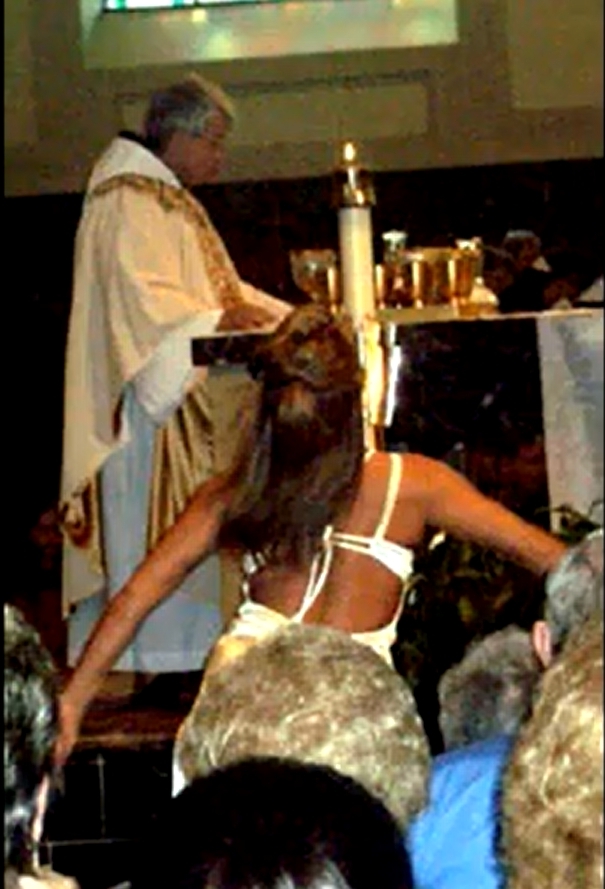 |
| "Nymphette Mass" - I kid you not. |

|
| "Nymphette Mass" - I kid you not. |




Bureau of Labor Statistics data show that as many as one out of three college graduates today are in jobs that previously or historically have been filled by people with lesser educations or none.
The U.S. now has 115,000 janitors with college degrees, along with 83,000 bartenders, 80,000 heavy-duty truck drivers, and 323,000 waiters and waitresses. Employers, because they realize that many college graduates aren’t really educated, now routinely quiz job seekers on what they majored in and what courses they took, a practice virtually unknown a generation ago.
Good luck if you majored in gender studies, communications, art history, pop culture, or (really) the history of dancing in Montana in the 1850s.The problem is that high school grads - as many as three-fourths! -are increasingly unprepared for even the ever-lowering standards of undergraduate work. Most college graduates are similarly unprepared for "the real world" and so half of college grads are unemployed or underemployed, a figure no doubt amplified by the very bad economy.

The War on Poverty is the unofficial name for legislation first introduced by United States President Lyndon B. Johnson during his State of the Union address on January 8, 1964. This legislation was proposed by Johnson in response to a national poverty rate of around nineteen percent. The speech led the United States Congress to pass the Economic Opportunity Act, which established the Office of Economic Opportunity (OEO) to administer the local application of federal funds targeted against poverty.But we lost that war.
WASHINGTON (AP) — The ranks of America's poor are on track to climb to levels unseen in nearly half a century, erasing gains from the war on poverty in the 1960s amid a weak economy and fraying government safety net.It was the most expensive war America has ever fought:
Fifteen trillion dollars: That’s how much American taxpayers have forked over in the name of helping the poor since 1964. And what do we have to show for it? A poverty rate that has barely budged, an entrenched bureaucracy, and a population — like that of Greece and Portugal, two welfare-state basket cases — increasingly dependent on government handouts.So who lost the war? The poor, obviously, whose numbers are on track this year to exceed the highest number ever. But also the taxpayers.
Needless to say, taxpayers have been the big losers in the war. Federal welfare spending has risen 375 percent (in constant 2011 dollars) since 1965. Total welfare spending has climbed almost as much: Governments are now disbursing $908 billion a year to alleviate poverty, up from $256 billion (also in constant dollars) in 1965. Moreover, notes Tanner:The entire US government operates on the principle enunciated by British Prime Minister Benjamin Disraeili: "Never complain, never explain." Here's a quote from a speech made almost 50 years ago asking a very good question and giving the same answer we get now. The more things change, the more they stay the same:
Over the last decade the increase has been even more rapid. Federal welfare spending increased significantly under the Bush administration, but President Obama has thrown money at anti-poverty programs at an unprecedented rate. Since taking office, the Obama administration has increased spending on welfare programs by more than $193 billion.While some of the spending hikes under Obama can be attributed to the recession, Tanner writes, “part of the program’s growth is due to conscious policy choices by this administration to ease eligibility rules and expand caseloads.” This, he points out, “undid many of the incentives contained in the 1996 Clinton welfare reform, which helped states to reduce welfare rolls.” As a result, the administration projects that “combined federal and state welfare spending will not drop significantly once the economy fully recovers,” with the annual tab reaching $1 trillion in 2014 and the 10-year total hitting $10.3 trillion — an amount that, Tanner calculates, comes to “$250,000 for every American currently living in poverty, or $1 million for every poor family of four.”
Well, now, if government planning and welfare had the answer -- and they've had almost 30 years of it -- shouldn't we expect government to read the score to us once in a while? Shouldn't they be telling us about the decline each year in the number of people needing help? The reduction in the need for public housing? But the reverse is true. Each year the need grows greater; the program grows greater.The actual purpose of the federal government's anti-poverty programs is not to decrease poverty. "Federal anti-poverty programs" are a prime example of Newspeak. Because the very last thing they want to do is actually decrease the number of poor people. The purpose is to grow the government and enhance its power and budget.
New research funded by the National Science Foundation has scientists warning consumers about the potentially harmful effects energy-saving CFL light bulbs can have on skin.Making it quite literally true that if you get skin cancer because of CFL bulbs, you didn't get there on your own. The government made it happen.

Every Monday night, Uncle Charlie’s bar in Cheyenne, Wyo., hosts “Bibles and Beer,” a discussion that routinely pulls in people of all faiths — and an atheist.
As many as 45 people have shown up, some toting Bibles. Some might have a drink; others stick to water. Some talk; others mostly listen. There are only a few ground rules: Avoid debate and stick to the text to be discussed that week.
“There really is not a focus on drinking,” insists the Rev. Rodger McDaniel, a Presbyterian minister who organized the weekly gathering more than a year ago. “But at the same time, it is a much more relaxed atmosphere than in a church basement. If I put this on in my church, I don’t think we would have five or six people.”
Across the country, faith is becoming bar talk. The trend combines the traditional religious charge to go where the people are with the reality that a lot of them are in bars. Organizers include those from mainline churches, those building churches and bar owners and brewers. Some are trying to push the model nationally, taking an ageless yearning for meaning and purpose to places where people often go to try to wash their worries away.
“It is good to bring the word to wherever God is, and God is everywhere, and people are everywhere, too,” says Joe Beene, owner of the Drunk Monkey Tavern in the Tulsa suburb of Glenpool, Okla. Last year, Beene began live streaming Sunday morning services from Tulsa’s Celebration Church into his bar. “The people who come in here on Sunday mornings are people who want to hear the word but won’t go to church.”More at the link. The last thing Jesus told his apostles to do before he returned to the Father was, "Go!" And the apostles went - over almost all of the Roman-ruled world at the time. They did not hang a sign outside the Upper Room saying, "Holy Spirit comes here weekly, join us."

Its numbers and coffers shrinking, the church votes for pet funerals but offers little to the traditional faithful.Far be it from this United Methodist to point out a speck in the Anglicans' eyes while ignoring the plank in our own. But it just goes to show how widespread the problem is.
I sat with a table of clergy and laity leaders talking about reaching “young people.” In frustration, I asked them to define for me who these “young people” are and what they are like. It became apparent that the “young people” we want to reach are a generic, bland hash of upper-middle-class, calm, well-behaved “newer” versions of ourselves. The expectation is that “young people” will either share, or quickly adopt, our values, that they will enjoy what we enjoy, think what we think, and not question or challenge the way things are. Oh, and they will all nicely and cleanly fit simple categories — easy to label and control. This conversation is a glimpse into a huge problem we face — trying to reach and relate to people we don’t know or understand at all.There's more - read the whole thing.