Tuesday, June 19, 2012
Jesus drove people away
Timothy Dalrymple:
... Surely Jesus gave “the FULL gospel,” right? And yet Jesus “lost” followers by droves. I agree with Kierkegaard on this: when you give the full gospel, you will drive people away. Narrow is the way and few will walk upon it. When confronted with the full gospel, not only in its attractiveness but also in its offensiveness and its challenge, in the way it calls us to die to ourselves and then take up the cross daily, we’re more likely to thin the flock than to fill it. Thousands followed Jesus when they thought he might serve their worldly interests; when the teaching grew hard, and the sacrifice he required became clear, only the twelve remained — “and one of you is a devil.” Jesus was not exactly concerned with dwindling numbers. He wanted true followers. Consider that. The greatest preacher in the history of Christianity drove them away by the thousands.John chapter 6:
61 Aware that his disciples were grumbling about this, Jesus said to them, “Does this offend you? 62 Then what if you see the Son of Man ascend to where he was before! 63 The Spirit gives life; the flesh counts for nothing. The words I have spoken to you—they are full of the Spirit[e] and life. 64 Yet there are some of you who do not believe.” For Jesus had known from the beginning which of them did not believe and who would betray him. 65 He went on to say, “This is why I told you that no one can come to me unless the Father has enabled them.”
66 From this time many of his disciples turned back and no longer followed him.
67 “You do not want to leave too, do you?” Jesus asked the Twelve.
68 Simon Peter answered him, “Lord, to whom shall we go? You have the words of eternal life. 69 We have come to believe and to know that you are the Holy One of God.”
70 Then Jesus replied, “Have I not chosen you, the Twelve? Yet one of you is a devil!” 71 (He meant Judas, the son of Simon Iscariot, who, though one of the Twelve, was later to betray him.)Do you see the "dog that did not bark?" When " many of his disciples turned back and no longer followed him," Jesus did not go running after them to beg them to reconsider or offer to tone things down if they'd come back. Instead, he turned to the Twelve and basically asked them what they were still doing here! I have a nagging suspicion that when we try to make following Jesus appealing to the masses, we are not being faithful to Jesus' example. But I don't like that, either.
Monday, June 18, 2012
Syria rebellion is not about freedom
As usual, Walter Russell Mead cuts to the heart of the matter about The Real News From Syria:
[R]adical and Salafist sheikhs and organizations in the Gulf are getting into the weapons delivery act. For many jihadis, the fight against Assad is first and foremost a struggle against Alawite “heretics”, and the goal is to build a radical Islamic state on the ruins of Ba’athist, secular Syria.If the rebels win, expect a bloodbath of non-Sunnis, especially the Alawites and Christians.
The end of the doofus family man?
The scorn and disdain of which Hollywood and the entertainment industry had held the family man may be finally coming to an end. Though the trope still has a long way to do before it's buried, as Glenn points out,
... with the number of stay-at-home dads doubling over the last decade, their purchasing power will influence advertisers. When women did all the shopping, it was easy to diss men.We can see this evolution even in the ads of the same company - pcmatic.com. Exhibit A - remember this ad of the helpless, frustrated husband whose independent, assertive wife saves him from his own stupidity? Whether the company got a lot of protests I don't know, but the present ad featuring the same character morphs him into a wise, mentoring dad who patiently helps his daughter. Is this the harbinger of a new trend? Slate thinks so.
Tuesday, May 29, 2012
Is college worth the price?
Not worth the debt - NYPOST.com
Wake Forest offered us $46,000 per year in scholarships and grants. Sound like a lot? It is a lot - but it still would have left us with almost $13,000 to come up with. Sorry, I am too old to take on that kind of debt times four years.
Wake Forest (my alma mater, btw) underscores the real reason there is a higher-education bubble: I cannot see how a baccalaureate degree from the school could possibly be worth almost a quarter-million dollars. Not all bachelor degrees are created equal. Wake is very much a liberal-arts school, probably one of the best such schools in the world.
And good luck getting a job to pay off the commensurate student debt with that degree in medieval German literature.
Wake's law school and business school have proven excellent investments for later return - but as even law professor Glenn Reynolds points out in the Post piece, law schools have been fudging their criteria for post-graduation success for some time and a JD degree pretty much guarantees nothing any more. As one partner-track attorney told me recently, a job-seeking, newly-minted attorney needs to have a diploma from one of the top ten (not ten percent, ten) law schools in the country, and (not or) have graduated in the top fourth of his/her class, to even be considered for interview by most law firms. Don't have that? So sorry.
College payments have to be evaluated the same way as any other spending, by present value and eventual worth. Fewer and fewer top-tier schools can pass that test.
For students, piece of advice No. 1 is: Don’t go into debt. When I went to law school, back in the ’80s, I turned down free rides at a couple of excellent schools to go to Yale Law School, even though it meant taking on a lot of student-loan debt. I’m not sure I’d advise anyone to do the same thing today, even to go to Yale Law, the undisputed king of the law-school rankings — and I’m positive I wouldn’t make a similar tradeoff for many other places, even Harvard Law.True for undergrad schools, too. As anyone who has helped son or daughter with a college search recently, as I have in the last year (daughter graduated from high school last Friday), sticker shock is endemic.Georgia Tech runs more than $40,000 for non-Georgia residents; their idea of financial aid was for me to borrow $37,400 of it. When I called the financial-aid office to plead, the nice lady I talked to said that they do not give financial aid to non-Georgia applicants (though she did not put it quite so baldly).
Wake Forest offered us $46,000 per year in scholarships and grants. Sound like a lot? It is a lot - but it still would have left us with almost $13,000 to come up with. Sorry, I am too old to take on that kind of debt times four years.
Wake Forest (my alma mater, btw) underscores the real reason there is a higher-education bubble: I cannot see how a baccalaureate degree from the school could possibly be worth almost a quarter-million dollars. Not all bachelor degrees are created equal. Wake is very much a liberal-arts school, probably one of the best such schools in the world.
And good luck getting a job to pay off the commensurate student debt with that degree in medieval German literature.
Wake's law school and business school have proven excellent investments for later return - but as even law professor Glenn Reynolds points out in the Post piece, law schools have been fudging their criteria for post-graduation success for some time and a JD degree pretty much guarantees nothing any more. As one partner-track attorney told me recently, a job-seeking, newly-minted attorney needs to have a diploma from one of the top ten (not ten percent, ten) law schools in the country, and (not or) have graduated in the top fourth of his/her class, to even be considered for interview by most law firms. Don't have that? So sorry.
College payments have to be evaluated the same way as any other spending, by present value and eventual worth. Fewer and fewer top-tier schools can pass that test.
Labels:
Education
Friday, May 25, 2012
Hymn for Memorial Day
The traditional hymn of both the Royal Navy and the US Navy was originally penned as, "Eternal Father, Strong to Save." I posted the history of the hymn and its subsequent versions here. Here is the version we will use this Sunday. Verse 2 and 5 are my authorship.
| USS Arizona Memorial, Pearl Harbor, photo by Donald Sensing |
| Arlington National Cemetery, Memorial Day 2007. A young woman weeps for her slain fiance. |
| The U.S. Marine Memorial, Washington D.C. |
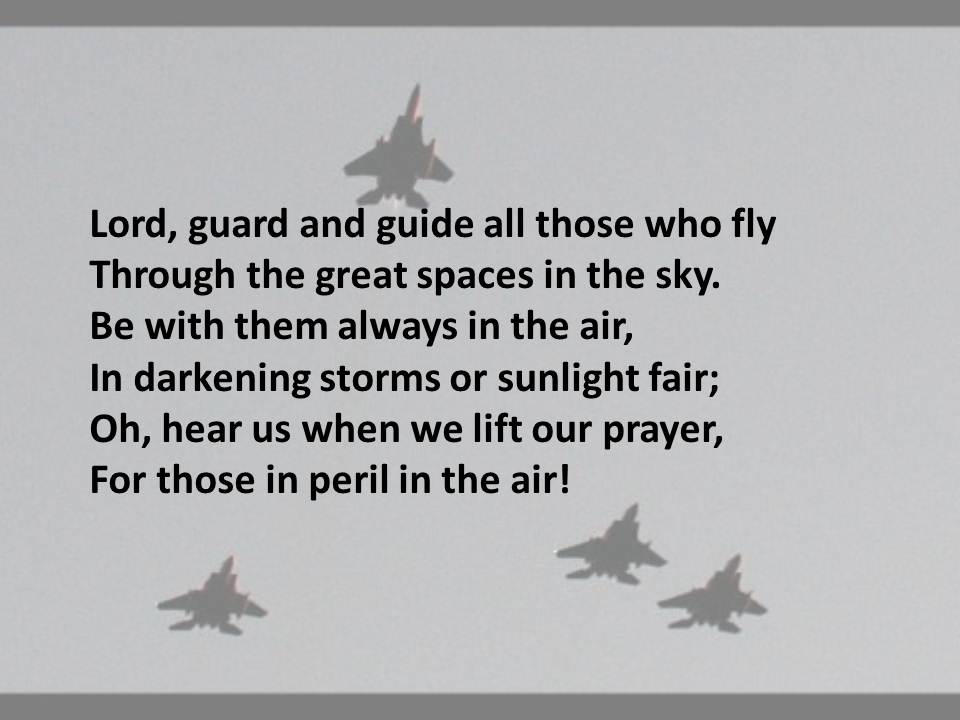
| US Air Force F-15 fighters' "missing man" formation, in which the lead pilot ascends heavenward to memorialize comrades who died. |
| The Gateway Arch, St. Louis, Miss., noontime Memorial Day 2009, photo by Donald Sensing |
Litany for Memorial Day
These are Power Point slides saved as JPGs. Each background image was set at 50 percent transparency. The text is from The Book of Worship for United States Forces (1974).
| Arlington National Cemetery |
| National Cemetery of the Pacific (the Punchbowl), photo by Donald Sensing |
Here is a blank slide.
| Tomb of the Unknowns, Arlington National Cemetery |
Friday, May 18, 2012
Death throes of the Blue Model church
If you want to see a microcosm of the decaying and death of Blue Model organizations, California is a good example for government and The United Methodist Church for religious bodies.
Every four years the United Methodist Church convenes its General Conference, the only body that can set the denomination's doctrines and denomination-wide legislation. The GC meets for two weeks and adjourned last week in Tampa, Fla. Methodist Bishop Will Willimon, who attended, sums up the two-week fiasco rather well:
Probably a review of what the Blue Model is would be useful here. Scholar Walter Russell Mead describes the Blue Model as "The core institutions, ideas and expectations that shaped American life for the sixty years after the New Deal." The problem is that these things,
One
The focal point of dissension within Blue Model organizations is money - who gets it and how much. Beside this question, all others pale. The problem for the UMC is that the General Conference is delegated by a huge majority by men and women who grew up under the Blue Model in its heyday and whose personal influence is derived from expertise in navigating Blue Model sub-institutions.
More than anything else, what brings down Blue Model organizations is that the money stream starts drying up. This is what has happened in the UMC. Personal giving among Methodist church members has declined markedly. Much of the decline can be attributed to the ongoing recession, yes, but not all. Besides, charitable giving is as much a matter of habit as devotion. Even households that have recuperated from the recession have not, on the whole, returned to the prior level of giving, mainly because it is no longer a habit.
And so it was that the General Conference was a two-week scramble by the countless special-interest groups of the church to protect their slice of the pie, without, apparently, much caring that the pie is getting ever smaller. If it is true, as Charles de Gaulle observed, that graveyards are full of indispensable men, it is truer that the UMC is more full of boards and agencies whose special-interest constituents would count it as the Apocalypse come in power if they were more than token downsized. As Bishop Willimon puts it, " The Methodist Federation for Social Action received new life, the [General] Board of Church and Society went home unscathed by reform" and pretty much every other entity of the church maintained an even strain.
What all this means is that the main activity of the two weeks of Conferencing was lobbying by countless entities large and small to protect their share of the general budget. This is exactly why Southern Methodist University Prof. Maria Dixon Hall, a delegate to the Conference, wrote that the UMC is "facing slow, agonizing, organizational death."
A second mark of a Blue Model organization in its death throes is that the Old Guard tries to tighten its grip on its power while the Young Turks demand they relinquish.
In the UMC, the Old Guard are the boards and agencies and the spin-off movements and various constituencies of the church. These are 100 percent American and almost all white. The Young Turks are non-U.S. Methodists, mainly Africans, whose numbers are growing rapidly at the same time that domestic American Methodists continue to dwindle. In 2008, 30 percent of delegates came from outside the United States; this year it was 41 percent. No one doubts that in 2020, foreign Methodist delegates will be the majority and that may well happen only four years from now.
Yet U.S. Methodists paid for 99 percent of the Conference's costs despite insistence from foreign delegations that they pay a larger share. To these requests, the US-based UMC said no, even to the Norwegian delegation!
Money is power, they say, and so we see the real meaning of the Golden Rule:
The American wing of the UMC has passed its peak of influence. Money will not buy it back. As Mark Tooley, president of the Institute on Religion and Democracy, puts it, "United Methodists Transition from Liberal to Global."
I do not mean that the UMC will disappear, although there is still significant shrinkage of the domestic American church yet to come. I mean that the main indicator of the Blue Model Church's demise is plain: The inability of existing organization to help the UMC prosper.
Like other Blue Model entities, the UMC is organized vertically, itself a consequence of America's victory in World War II, which taught the country that organizations with clear boundaries of authority and defined responsibilities are the keys to success. The defining characteristic of Blue Model organizations is a vertical chain of command and layers of supervision. And so the UMC is organized to the hilt: Bishops preside over Conferences (which is what Methodists call dioceses; each year every Conference has a convention, called an Annual Conference, and every four years the general church holds the General Conference. It took me years to understand all this.) Geographical conferences are further divided into districts, each with a superintendent, who exercises supervision of individual pastors. In turn, Conferences (dioceses) are organized into several Jurisdictions, each with its own set of jurisdictional agencies, and the denomination operates 13 general (churchwide) boards and agencies.
The result is practically a textbook example of a vertically-integrated organization, "An organization whose members look up to bosses instead of out to customers. Loyalty and commitment is given to functional fiefdoms, not the overall corporation and its goals." The Old Guard's loyalty, as Mr. Tooley, Bishop Willimon and Prof. Hall point out, is mainly to the "functional fiefdoms" of the Blue Model church and not to either the structures or goals of the emerging UMC in Africa and elsewhere. Yet, once again, the emerging UMC is really emerging while the Blue Model UMC is declining.
This situation is aggravated by an ecclesial equivalent of the dysfunction of government's Blue Model. Prof. Mead puts it thus: "they are poorly equipped to respond nimbly to the fast-changing conditions of America today." And so with the vertical, Blue Model structure of the UMC. American society is rapidly moving to a new model (of sorts) of horizontal organizations, often of self-organized networks that arise as needed as can pass away just as quickly. This is multi-modal and multi-nodal - flexible of purpose and structure and oriented toward purpose and process more than place or personnel. This is 180 degrees out from the way the UMC works now.
Conclusion
Yogi Berra is supposed to have said, "It's easy for forecast the future, especially in retrospect." One thing is for sure: there are many more tears to be shed and agonies to be endured before the nature of UMC of the 21st century is evident. For the next three or four General Conferences (extending to 2028), the Blue Model devotees will try to hang on. Mead:
Beyond that my crystal ball is cloudy. One thing is for sure - Bob Dylan had it right: "The times, they are a-changing."
Update: Rev. Andy Langford's assessments are similar to mine: "Rearranging the deckchairs of a sinking ship, General Conference tossed the paying passengers overboard and saved the lives of the crew."
General Conference in Tampa made history as the most expensive ($1,500 per minute!), least productive, most fatuous assemblage in the history of Methodism. Sunday evening’s “A Celebration of Ministry” fiasco was a metaphor for our nearly two weeks at church expense: four hours of belabored supplication by the General Commission on Status and Role of Women, five Ethnic National Plans, Strengthening the Black Church for the 21st Century, United Methodist Men, Girl Scouts, Africa University and a number of other agencies I can’t remember. A subtheme of that long night: even though we can’t cite specific fruit, please don’t force us to change or to expend less on ourselves.
Even after suffering this abuse, General Conference succumbed to the agencies’ pleadings. In a post-GC blog, Mike Slaughter (who with Adam Hamilton eloquently—and futilely—warned GC that we must change or face certain death) told the truth: “Our denominational systems continue to resist change by protecting archaic structures. From our seminaries to boards and agencies, institutional preservation was a strong resistant influence throughout GC. Entrenched organizational bureaucracies resist accountability …”I did not attend myself, but one delegate, whom I know, said that more than anything else, this General Conference was about money. That is practically the hallmark of the death paroxysms of Blue Model organizations: who gets how much of a shrinking monetary base. And whatever else it may be, the UMC is one of the bluest of the Blue Model organizations out there.
Probably a review of what the Blue Model is would be useful here. Scholar Walter Russell Mead describes the Blue Model as "The core institutions, ideas and expectations that shaped American life for the sixty years after the New Deal." The problem is that these things,
... don’t work anymore, and the gaps between the social system we’ve inherited and the system we need today are becoming so wide that we can no longer paper them over or ignore them.
In the old system, both blue collar and white collar workers hold stable jobs, a professional career civil service administers a growing state, with living standards for all social classes steadily rising while the gaps between the classes remain fairly stable, and with an increasing ‘social dividend’ being paid out in various forms: longer vacations, more and cheaper state-supported education, earlier retirement, shorter work weeks and so on. Graduate from high school and you were pretty much guaranteed lifetime employment in a job that gave you a comfortable lower middle class lifestyle; graduate from college and you would be better paid and equally secure.
Life would just go on getting better. From generation to generation we would live a life of incremental improvements — the details of life would keep getting better but the broad outlines of our society would stay the same. The advanced industrial democracies of had in fact reached the ‘end of history’: this is what ‘developed’ human society looked like and there would be no more radical changes because the picture had fully developed. The blue model rested on the post-Second World War industrial and economic system. The ‘commanding heights’ of American business were controlled by a small number of monopolistic and oligopolistic firms. ...
The stable economic structure allowed a stable division of the pie. Workers (much more heavily unionized then than now) got steady raises and stable jobs. The government got a stable flow of tax revenues. Shareholders got reasonably steady dividends.Peter Skurkiss of The Buckeye Institute assesses that the Blue Model is in its death throes:
Simply put, the blue model is unsustainable. The compensation, the benefits, and privileges that were afforded to government workers was possible only with an unusually healthy and robust private sector which itself was made possible by the lack of serious foreign competition. That world no longer exists, nor is it ever likely to again. Governors like John Kasich (Ohio) and Scott Walker (Wisconsin) recognize this fact faster than others, but in the end, all states will have to conform to the new reality.And not just states and governments or corporations at every level. Blue Model institutional churches are going to be swept away by the new reality as well. And so with the United Methodist Church. Here are the portents that bode ill for the UMC, but these portents are true for most any Blue Model organization.
One
The focal point of dissension within Blue Model organizations is money - who gets it and how much. Beside this question, all others pale. The problem for the UMC is that the General Conference is delegated by a huge majority by men and women who grew up under the Blue Model in its heyday and whose personal influence is derived from expertise in navigating Blue Model sub-institutions.
More than anything else, what brings down Blue Model organizations is that the money stream starts drying up. This is what has happened in the UMC. Personal giving among Methodist church members has declined markedly. Much of the decline can be attributed to the ongoing recession, yes, but not all. Besides, charitable giving is as much a matter of habit as devotion. Even households that have recuperated from the recession have not, on the whole, returned to the prior level of giving, mainly because it is no longer a habit.
And so it was that the General Conference was a two-week scramble by the countless special-interest groups of the church to protect their slice of the pie, without, apparently, much caring that the pie is getting ever smaller. If it is true, as Charles de Gaulle observed, that graveyards are full of indispensable men, it is truer that the UMC is more full of boards and agencies whose special-interest constituents would count it as the Apocalypse come in power if they were more than token downsized. As Bishop Willimon puts it, " The Methodist Federation for Social Action received new life, the [General] Board of Church and Society went home unscathed by reform" and pretty much every other entity of the church maintained an even strain.
What all this means is that the main activity of the two weeks of Conferencing was lobbying by countless entities large and small to protect their share of the general budget. This is exactly why Southern Methodist University Prof. Maria Dixon Hall, a delegate to the Conference, wrote that the UMC is "facing slow, agonizing, organizational death."
Again, winning the battle and losing the war became the strategy of the day. The minority point was clear: if we don’t like what you do or we don’t feel like you gave us enough deference, we will shut it down regardless of whom it hurts. Funny, whether it’s Grover Norquist and the Tea Party or the Methodist Federation for Social Action, the rhetoric of organizational hostage-taking has the same effect—polarization, distrust and, in the end, slow, agonizing, organizational death.
One of my students in Organizational Communication could look at this mess called GC2012 and diagnose the problem immediately: An 18th Century structure cannot sustain a 21st century global organization. We must be willing to let go of the non-essentials to get back to the first fruits and ideals of why we are a People called Methodist.Two
A second mark of a Blue Model organization in its death throes is that the Old Guard tries to tighten its grip on its power while the Young Turks demand they relinquish.
In the UMC, the Old Guard are the boards and agencies and the spin-off movements and various constituencies of the church. These are 100 percent American and almost all white. The Young Turks are non-U.S. Methodists, mainly Africans, whose numbers are growing rapidly at the same time that domestic American Methodists continue to dwindle. In 2008, 30 percent of delegates came from outside the United States; this year it was 41 percent. No one doubts that in 2020, foreign Methodist delegates will be the majority and that may well happen only four years from now.
Yet U.S. Methodists paid for 99 percent of the Conference's costs despite insistence from foreign delegations that they pay a larger share. To these requests, the US-based UMC said no, even to the Norwegian delegation!
Money is power, they say, and so we see the real meaning of the Golden Rule:
The American wing of the UMC has passed its peak of influence. Money will not buy it back. As Mark Tooley, president of the Institute on Religion and Democracy, puts it, "United Methodists Transition from Liberal to Global."
Unlike the other traditionally liberal-led Mainline denominations, United Methodism is fully global in membership. ... There are 7.5 million United Methodists in the U.S. and 4.5 million overseas, almost all in Africa, mostly in the Congo. With the U.S. church losing about 100,000 members a year (down from 11 million 44 years ago) and the African church gaining over 200,000 a year, the denomination likely will become a majority non-U.S. church in about 10 years or less. ...
With over 4 million and soon to be 5 million members, the African churches are now too large to ignore. A few liberal activists, in their blogs, complained about Africans from impoverished countries who don't contribute dollars into the denomination now having so much power. But disenfranchising the poor is not a successful battle cry for progressives. Some U.S. liberals quietly try to paint the Africans as primitives who reject enlightened Western liberalism. ...
Inevitably the growing African membership will alter these preoccupations with American leftist themes. They believe the church's role is primarily evangelistic, not political.This is the same type of competition and foreign pressure that led to the decay of the political Blue Model. Back to Prof. Mead:
The blue model began to decay in the seventies. Foreign producers began to erode the market share of lazy, sclerotic American firms – like the Big Three automakers. The growth of offshore financial markets forced the financial services industry to become more flexible as both borrowers and lenders were increasingly able to work around the regulations and the oligopolies of the domestic market. ... These days, private sector blue companies can only survive with vast and continuing government support.But there is no such equivalent entity to prop up the Blue Model UMC. And so the structure will crash. As economist Herbert Stein said 40-plus years ago, "When something can't go on forever, it won't."
I do not mean that the UMC will disappear, although there is still significant shrinkage of the domestic American church yet to come. I mean that the main indicator of the Blue Model Church's demise is plain: The inability of existing organization to help the UMC prosper.
Like other Blue Model entities, the UMC is organized vertically, itself a consequence of America's victory in World War II, which taught the country that organizations with clear boundaries of authority and defined responsibilities are the keys to success. The defining characteristic of Blue Model organizations is a vertical chain of command and layers of supervision. And so the UMC is organized to the hilt: Bishops preside over Conferences (which is what Methodists call dioceses; each year every Conference has a convention, called an Annual Conference, and every four years the general church holds the General Conference. It took me years to understand all this.) Geographical conferences are further divided into districts, each with a superintendent, who exercises supervision of individual pastors. In turn, Conferences (dioceses) are organized into several Jurisdictions, each with its own set of jurisdictional agencies, and the denomination operates 13 general (churchwide) boards and agencies.
The result is practically a textbook example of a vertically-integrated organization, "An organization whose members look up to bosses instead of out to customers. Loyalty and commitment is given to functional fiefdoms, not the overall corporation and its goals." The Old Guard's loyalty, as Mr. Tooley, Bishop Willimon and Prof. Hall point out, is mainly to the "functional fiefdoms" of the Blue Model church and not to either the structures or goals of the emerging UMC in Africa and elsewhere. Yet, once again, the emerging UMC is really emerging while the Blue Model UMC is declining.
This situation is aggravated by an ecclesial equivalent of the dysfunction of government's Blue Model. Prof. Mead puts it thus: "they are poorly equipped to respond nimbly to the fast-changing conditions of America today." And so with the vertical, Blue Model structure of the UMC. American society is rapidly moving to a new model (of sorts) of horizontal organizations, often of self-organized networks that arise as needed as can pass away just as quickly. This is multi-modal and multi-nodal - flexible of purpose and structure and oriented toward purpose and process more than place or personnel. This is 180 degrees out from the way the UMC works now.
Conclusion
Yogi Berra is supposed to have said, "It's easy for forecast the future, especially in retrospect." One thing is for sure: there are many more tears to be shed and agonies to be endured before the nature of UMC of the 21st century is evident. For the next three or four General Conferences (extending to 2028), the Blue Model devotees will try to hang on. Mead:
[C]ulturally and intellectually, bureaucrats and politicians [read: the UMC's general boards and agencies] often remain blue. That is, they think instinctively in the old ways, come up with blue solutions to non-blue problems, and often fail to grasp either the constraints or the opportunities of the new era.But this will fail because the Blue Model's center is the American branch of the church. And the center cannot hold. Here are some consequences of the breakdown of the Blue Model UMC that are already evident and will become stronger in the coming years:
- The great majority of the shrinking domestic base of Methodist lay people are not personally invested in propping up the Blue Model Methodist Establishment -- and so they won't. Their own Blue Model organizations (unions, job security and guaranteed pensions, etc.) have already gone a-glimmering. Lay people increasingly will see no benefit to themselves from maintaining a Blue Model church. Their concerns are almost exclusively related to the local church and its mission and ministries and not to the activities of general boards, denominational ministries or even the "connectional system," a term that not one lay person in 20 can define.
- Lay people and pastors more and more will not accept the bureaucratic inertia and plodding deliberatism of the Blue Model -- and again, will not pay for it. The hierarchical structures of the church must rediscover what servant ministry means and devote themselves to helping local churches and pastors succeed rather than, in usual Blue Model style, issue edicts from Sinai's peak that must be obeyed. Flexibility and responsiveness by church leaders and agencies to the needs of local churches will be key. From bishops down through Conference offices and superintendents, it must become an embedded value that their purpose is to empower, assist and support local churches. The line of support's direction must run down, not up the chain of command, but this is, frankly, exactly opposite of what we have today.
- Church leaders at all levels will become increasingly frustrated by the glacial inability of the General Conference to accomplish anything meaningful regarding to structure and revisions of UMC's Book of Discipline (the canon law of the church). This will strengthen the already-evident movement among lay people toward congregationalism in the church instead of traditional Methodist connectionalism. Churches will increasingly see themselves as franchise operators rather than subordinate offices, and will begin to take increasing liberties with the directive documents of the Church.
- We are long past the day when Methodism as a “brand” was uniquely attractive. It is very naive to expect that the laity or pastors will somehow become more devoted to the Church's connectional system and the work of general boards and agencies than they are now. The great majority of our people attend our churches because of personal relationships and the particular church’s programs and internal ministries, not because the sign says Methodist.
- The growing influence of the foreign Methodists will become the focal point of dissent among American Methodists over the future of the general church. Largely because of Africa's delegations, the routine quadrennial attempt by the gay lobby (eleventh in a row) at the General Conference to liberalize the church's stance on homosexuality was crushed by 61-39 percent, a larger margin than four years ago. Already there is a move by the liberal wing of the church to form a domestic-church-only Conference, but this would essentially schism the Church and leave the General Conference even more directionless than it is now.
Beyond that my crystal ball is cloudy. One thing is for sure - Bob Dylan had it right: "The times, they are a-changing."
Update: Rev. Andy Langford's assessments are similar to mine: "Rearranging the deckchairs of a sinking ship, General Conference tossed the paying passengers overboard and saved the lives of the crew."
Thursday, May 17, 2012
New policy of the Tennessee Conference on Pastoral Appointments
This is the text of the email I sent to everyone of our congregation on May 16.
I received a document this week via email from the Columbia District Superintendent with instructions to "familiarize your administrative boards and SPRC committees" with it. There seems little point, in my opinion, of sending it to those folks and not to the congregation at large. I have pasted the text below. If you have questions, I will be glad to receive them and pass them to the district superintendent, but I personally do not want to try to interpret this policy on his behalf. I am informed that this policy is in effect now.
As Kevin Carroll announced a couple of Sundays ago, I have been officially notified that I will be reappointed to serve as Westview's pastor for the coming year. Cathy, Elizabeth and I are blessed to be here and are very grateful for continuing service among you all. Thank you all for your support and friendship of the past two years; we hope to enjoy a long tenure of service here to God and our church.
Here is the verbatim text of the policy:
---------------------------------------------------------------------
Guidelines for Right-Sizing Church Appointments
The history and doctrine of The United Methodist Church give evidence to our connectional ministries. Every local church is related to every other local church in the connection. From the earliest days of our existence we have sought to work together in mission and ministry around the world.
In order to help churches that are struggling to pay their pastor’s salary, their apportionments, and other obligations, the Bishop and Cabinet of the Tennessee Conference have instituted the following guidelines for the appointment of pastors to churches and for realigning churches.
1) Churches that are financially able to pay 100% of their apportionments, pay their pastor(s) a salary and benefits that meets or exceeds the conference equitable compensation guidelines and support their local ministry will be considered for a full-time pastor(s).
2) Churches that request more than one pastor (an Associate Pastor or Deacon) but have not paid their apportionments or paid the Pastor’s Salary and benefits in full in the current or preceding year will not be considered for multiple pastors until the church has shown at least three years of full payment of apportionments and pastor’s salary and benefits.
3) Churches that have paid less than 100% of apportionments in at least one year of the previous ten years may be subject to a reconfiguration of pastoral appointment.
5) In a few cases (to be approved by the Cabinet) a church may be approved for missional support for a given period of time to enable ministry in a setting that is greatly needed but would otherwise be impossible to provide.
6) In a church in which the apportionments or salary(ies) were not paid in full for the current year, the pastor(s) shall not receive nor accept a salary raise for the ensuing year. It is imperative that the salaries of the connectional church and the missional efforts of the denomination be met as well as the salary of the local pastor and the ministry and missions in the local setting.
The cooperation of everyone will assure that the ministry of the local church, the annual conference, and The United Methodist Church remains strong and faithful to the gospel of our Lord Jesus Christ. It is our intent to respond to the Call to Action by the Council of Bishops in a way that fosters a new path of accountability and faithfulness. This accountability will also strengthen our ability to “make disciples of Jesus Christ for the transformation of the world.”
I received a document this week via email from the Columbia District Superintendent with instructions to "familiarize your administrative boards and SPRC committees" with it. There seems little point, in my opinion, of sending it to those folks and not to the congregation at large. I have pasted the text below. If you have questions, I will be glad to receive them and pass them to the district superintendent, but I personally do not want to try to interpret this policy on his behalf. I am informed that this policy is in effect now.
As Kevin Carroll announced a couple of Sundays ago, I have been officially notified that I will be reappointed to serve as Westview's pastor for the coming year. Cathy, Elizabeth and I are blessed to be here and are very grateful for continuing service among you all. Thank you all for your support and friendship of the past two years; we hope to enjoy a long tenure of service here to God and our church.
Here is the verbatim text of the policy:
---------------------------------------------------------------------
The history and doctrine of The United Methodist Church give evidence to our connectional ministries. Every local church is related to every other local church in the connection. From the earliest days of our existence we have sought to work together in mission and ministry around the world.
In order to help churches that are struggling to pay their pastor’s salary, their apportionments, and other obligations, the Bishop and Cabinet of the Tennessee Conference have instituted the following guidelines for the appointment of pastors to churches and for realigning churches.
1) Churches that are financially able to pay 100% of their apportionments, pay their pastor(s) a salary and benefits that meets or exceeds the conference equitable compensation guidelines and support their local ministry will be considered for a full-time pastor(s).
2) Churches that request more than one pastor (an Associate Pastor or Deacon) but have not paid their apportionments or paid the Pastor’s Salary and benefits in full in the current or preceding year will not be considered for multiple pastors until the church has shown at least three years of full payment of apportionments and pastor’s salary and benefits.
3) Churches that have paid less than 100% of apportionments in at least one year of the previous ten years may be subject to a reconfiguration of pastoral appointment.
a) In consultation with the District Superintendent, the church may reduce its salary and benefits for the pastor and be appointed a pastor who will serve two or more churches. This will give the pastor a bigger responsibility, more people to serve, and hopefully a more stable ministry setting. It will give the church less salary obligations, less of the pastor’s time, and a higher expectation to pay its apportionments in full. It will also require the laity of the congregation to assume more responsibility for the ministry of the church.
b) In some cases an ordained elder may be appointed to a charge or parish ministry consisting of several churches and multiple clergy. They may consist of some combination of the following: ordained elder, commissioned elder, deacon, local pastor, supply pastor, lay speaker. The ordained elder in charge will make assignments for pastoral care, preaching, and administration of the sacraments, and will give supervision to the clergy and the churches in the parish ministry.4) In a select number of cases (to be approved by the Cabinet and the Commission on Equitable Compensation) churches or charges will be considered for equitable compensation with a portion of the salary paid by the Annual Conference. But in every case the expectation will be that the church will pay its apportionments in full each year that it is on equitable compensation. If it fails to do so, it is subject to losing its salary supplement by the conference, and the church being in a reconfigured mode (see 3a and 3b above).
5) In a few cases (to be approved by the Cabinet) a church may be approved for missional support for a given period of time to enable ministry in a setting that is greatly needed but would otherwise be impossible to provide.
6) In a church in which the apportionments or salary(ies) were not paid in full for the current year, the pastor(s) shall not receive nor accept a salary raise for the ensuing year. It is imperative that the salaries of the connectional church and the missional efforts of the denomination be met as well as the salary of the local pastor and the ministry and missions in the local setting.
The cooperation of everyone will assure that the ministry of the local church, the annual conference, and The United Methodist Church remains strong and faithful to the gospel of our Lord Jesus Christ. It is our intent to respond to the Call to Action by the Council of Bishops in a way that fosters a new path of accountability and faithfulness. This accountability will also strengthen our ability to “make disciples of Jesus Christ for the transformation of the world.”
Sunday, April 29, 2012
Grave threat to religious freedom being mounted
Summary:
Certain members of the Congress have proposed an amendment to the United States Constitution that, if ratified, will strip incorporated churches of their Constitutional rights. And not just churches -- any kind of corporation, whether for profit or not for profit, would be stripped of its rights as well.
The amendment does this by specifically defining "people, person, or citizen" to mean only individual human beings and specifically excluding from that definition, "corporations, limited liability companies or other corporate entities."
Background:
The presumptive rationale for the amendment is a Supreme Court decision (Citizens United v. Federal Election Comission) that invalidated the part of the Bipartisan Campaign Reform Act (known as BCRA or “McCain-Feingold”) that restricted corporate expenditures in elections. The amendment's sponsors say that the only way to reverse the Supreme Court's decision is to amend the Constitution. Since the Court held that corporations have Constitutional status as persons before the law (in fact, a longstanding legal principle, not a novel ruling), the amendment therefore dismisses such entities from personhood as Constitutionally defined.
The Amendment
The proposed amendment is called the "People's Rights Amendment," sponsored by US Rep. Jim McGovern (D.-3rd District, Mass.) and is supported by US House minority leader Rep. Nancy Pelosi (D.-8th District, Calif.) and others. The PRA would amend our Constitution so as to define "person" or any part of "the people," as the Constitution uses the term, to mean only individual human beings. The PRA reads in entirety:
Section 1. We the people who ordain and establish this Constitution intend the rights protected by this Constitution to be the rights of natural persons.
Section 2. The words people, person, or citizen as used in this Constitution do not include corporations, limited liability companies or other corporate entities established by the laws of any State, the United States, or any foreign state, and such corporate entities are subject to such regulations as the people, through their elected State and Federal representatives, deem reasonable and are otherwise consistent with the powers of Congress and the States under this Constitution.
Section 3. Nothing contained herein shall be construed to limit the people's rights of freedom of speech, freedom of the press, free exercise of religion, freedom of association and all such other rights of the people, which rights are inalienable.Rep. McGovern explains it this way:
And Rep. Pelosi says,
What this means for America and its churches
UCLA Law School Prof. Eugene Volokh is one of the forty most cited law-faculty members in the country.
These citation counts refer to citations in law review articles, but his works have also been cited by courts. Six of his law review articles have been cited by opinions of the Supreme Court Justices; twenty-one of his works (mostly articles but also a textbook, an op-ed, and a blog post) have been cited by federal circuit courts; and several others have been cited by district courts or state courts.According to Prof. Volokh, the PRA would "Strip Most Newspapers, Churches, Nonprofits, and Other Corporations of All Constitutional Rights."
So just as Congress could therefore ban the speech of nonmedia business corporations, it could ban publications by corporate-run newspapers and magazines — which I think includes nearly all such newspapers and magazines in the country (and for good reason, since organizing a major publications as a partnership or sole proprietorship would make it much harder for it to get investors and to operate). Nor does this proposal leave room for the possibility, in my view dubious, that the Free Press Clause would protect newspapers organized by corporations but not other corporations that want to use mass communications technology. Section 3 makes clear that the preservation of the “freedom of the press” applies only to “the people,” and section 2 expressly provides that corporations aren’t protected as “the people.”
Congress could also ban the speech and religious practice of most churches [boldface added], which are generally organized as corporation. It could ban the speech of nonprofit organizations that are organized as corporations. (Congressman McGovern confirms this: “My ‘People’s Rights Amendment’ is simple and straightforward. It would make clear that all corporate entities — for-profit and non-profit alike — are not people with constitutional rights. It treats all corporations, including incorporated unions and non-profits, in the same way: as artificial creatures of the state that we the people govern, not the other way around.”) Congress could ban speech about elections and any other speech, whether about religion, politics, or anything else. It could also ban speech in viewpoint-based ways.
State legislatures and local governments could do the same. All of them could seize corporate property without providing compensation, and without providing due process. All corporate entities would be stripped of all constitutional rights. Quite a proposal; I blogged more generally about this issue here, but it seems to me that simply listing the consequences of Congressman McGovern’s proposal largely suffices to explain its flaws.As a clergyman, I will speak (while I can, I suppose) about the effect the PRA would have on churches or other religious assemblies. Prof. Volokh is correct that it is commonplace for a church to be incorporated as a not-for-profit corporation. One big reason is because of tort liability. As a tort lawyer explained at a meeting I attended, if a church is not incorporated and someone is injured on the property, that person can sue the entire membership of the church, each member being named individually in the suit. Because of the established principle of joint and several liability, all members of unincorporated churches can be held financially liable for damages awarded. Each member can be ordered by the court to pay a pro-rata share of the damages. Not only that, every individual church member is potentially liable for the entire amount of the damages. This has happened, said this trial lawyer, and the only way to prevent it it to make the church a legal entity, or "person," under the law.
The PRA would remove the protection completely that incorporation affords because, as Rep. McGovern says explicitly, "corporate entities" would not have Constitutional rights -- at all.
Prof. Volokh also points out that the only present arrangement that would escape the PRA's tentacles is a partnership. After noting that any corporation would be stripped of Constitutional rights, including, say, media conglomerates (are you paying attention, CNN?), he goes on to say,
Now this would have two effects. First, any media organization that wants to be free would thus have to give up the benefits of the corporate form, and will have to organized as a partnership. This will make it much harder for those media organizations to raise operating capital, dealing with changes in ownership as partners die or leave, and the like.Prof. Volohk's coblogger, Ilya Somin, Associate Professor at George Mason University School of Law, explains the tyrannical nature of the PRA thus:
Thus, the PRA would deny all constitutional rights to all entities organized as corporations. If the Amendment passes, government would be free to search corporate-owned premises at will, restrict freedom of religion at houses of worship owned by corporate entities (which includes most churches), condemn corporate-owned property for private uses and without paying compensation, and so on.
Understand what this means!
The effects of the PRA, if ratified, are almost too innumerable to imagine. But here are three examples.
1. Incorporated churches would have no right of redress or access to the courts if their property is claimed by local, state or federal government under eminent domain. In fact, churches' real property could be seized by governments with no notice or reason given and with no payment made. Why? Because the Fifth Amendment to the Constitution states that
No person shall ... be deprived of life, liberty, or property, without due process of law; nor shall private property be taken for public use, without just compensation.But an incorporated church (and any incorporated business, no matter how small) will not be a "person" under the terms of the PRA, and therefore shall not be entitled to any of these rights or protections.
2. Incorporated entities of churches, such as the United Methodist Printing House, could find themselves with no First Amendment rights of freedom of the press. Here is why:
a. The First Amendment states in part, "Congress shall make no law respecting an establishment of religion, or prohibiting the free exercise thereof; or abridging the freedom of speech, or of the press; ..."
b. However, Section 2 of the PRA excludes the UM Publishing House as being included in the definition of "the people."
c. Section 3 of the PRA specifies exactly that "Nothing contained herein shall be construed to limit the people's rights of freedom of speech, freedom of the press, ..." but the PRA has already defined the UM Publishing House outside the boundaries of "the people."
3. The First Amendment also protects, "the right of the people peaceably to assemble," but the PRA would utterly separate this right of church members from the church itself because an incorporated church has no rights. Governments from local level to federal could padlock a church's property (or simply seize it entirely). Note that the PRA's Section 3 does not reinforce freedom of assembly, only "freedom of association." While assembly is definitionally personal presence with one another, "association" has no such meaning. We would have only the "right" to call ourselves United Methodists, but not the right personally to assemble together on any property owned by our incorporated church.
A word to skeptics
I would say to readers who are skeptical of the conclusions that Professors Volokh and Somin draw, or of the implications I identify, please just consider the record of the federal government over the past half-century (or more) and ask yourself exactly why you are skeptical:
Self restraint on the part of government officials or bureaucrats? Based on what empirical or historical evidence do you think that future governments will be more restrained than those of the last several decades?
Good will on the part of government agencies? Again, based on what historical record and what reasons?
Try to think of a single time when government, having been granted (or having seized) the power to exercise more control or regulation of citizens' lives has failed to use that authority beyond what was ever envisioned -- regardless of which party has controlled the Congress or the White House at the time. We would do well to heed George Washington's warning, "Government is not reason; it is not eloquent; it is force. Like fire, it is a dangerous servant and a fearful master."
Next steps
I am presently working to draft a resolution to be presented to the annual conference of the Tennessee Conference in June that, if adopted by the annual conference, will put the annual conference on record as opposing ratification of the People's Rights Amendment and urging Tennessee's two senators and the US Representatives of the Tennessee Conference are to vote against it if/when the time comes.
Presently, I am seeking co-sponsors of this resolution which I will post on this site when I have finished it. I also will seek sponsorship of the resolution by the Tennessee Conference's General Commission on Church and Society.
Please feel free to distribute this post using the social-media button immediately below. You may also leave a comment below.
Thursday, April 12, 2012
Do human beings really have free will?
Do human beings really have free will - the ability to make genuinely unforced choices? We believe we do. Our entire legal system, in fact, is predicated on willful obedience (or not) to the law or to freely entering into binding contracts. A neuroscientist says that the question, "Do human beings have free will?" is actually a meaningless one because,
There seems to be a common thread among materialists: they do not seem to understand that their entire world view sits atop nothing but fog. I am currently reading God and Stephen Hawking, by John Lennox, Oxford mathematician, who coincidentally states on the page I am at, "… it is only belief in a Creator that gives us a satisfactory ground for believing in the uniformity of nature (the inductive principle) in the first place!"
Neuroscientist Lieberman's piece is refreshing though because he understands that even if materialism is true, there is no way for us to know. The problem is that he does not take the obvious and unavoidable next steps: that if materialism is true then there is no way for us to know anything at all. We may as well assume we are living in a Matrix world.
This is just a scientific-sounding version of solipsism and if you think about it (heh!) is just a gussied up variety of Hinduism's teaching of maya, that nothing is real but illusion itself. And yet if, as Lieberman says, the answer won’t affect the way we act – nor even what we think we know – then the smart move is to do what Robert Heinlein advised: even if the deck is crooked, cut the cards. So we’d better live as if free will is real because betting that it is not has potentially devastating, eternal consequences.
Free Will: Weighing Truth and Experience | Psychology Today
Hat tip: Wintery Knight
Given a materialist view of the universe, it makes no sense to talk about consciousness or experience at all. We have absolutely no idea what it is about the three pounds of mush between our ears that allows it to perform this trick of being conscious.In fact, he concludes, it does not matter the slightest whether we really have free will because (1) we cannot ever know that to begin with and (2) whether the answer is yes or no nothing about human behavior will change, anyway.
There seems to be a common thread among materialists: they do not seem to understand that their entire world view sits atop nothing but fog. I am currently reading God and Stephen Hawking, by John Lennox, Oxford mathematician, who coincidentally states on the page I am at, "… it is only belief in a Creator that gives us a satisfactory ground for believing in the uniformity of nature (the inductive principle) in the first place!"
Neuroscientist Lieberman's piece is refreshing though because he understands that even if materialism is true, there is no way for us to know. The problem is that he does not take the obvious and unavoidable next steps: that if materialism is true then there is no way for us to know anything at all. We may as well assume we are living in a Matrix world.
This is just a scientific-sounding version of solipsism and if you think about it (heh!) is just a gussied up variety of Hinduism's teaching of maya, that nothing is real but illusion itself. And yet if, as Lieberman says, the answer won’t affect the way we act – nor even what we think we know – then the smart move is to do what Robert Heinlein advised: even if the deck is crooked, cut the cards. So we’d better live as if free will is real because betting that it is not has potentially devastating, eternal consequences.
Free Will: Weighing Truth and Experience | Psychology Today
Hat tip: Wintery Knight
Labels:
Religion,
Religion-Culture,
Theology
Subscribe to:
Posts (Atom)