Tuesday, August 5, 2008

The metrosexual Jesus

Would you trust your eternity to this guy? Neither would I.


One of the main thrusts of liberal Bible scholarship over at least the last 40 years has been to devise arguments that the Bible does not really mean what it says.

A ready-to-hand case in point: sexuality. The biblical proscriptions against certain kinds of sexual acts - homosexual acts, bestiality and adultery all alike are strictly prohibited - are as clear as anything that can be found in Scripture. But modern liberal scholarship has invented ingenious arguments that the proscription of homosexuality isn’t real, that what matters most is the "authenticity" of the relationship, whether there is love and caring, and then they claim that what is really being forbidden by the texts is not homosexuality at all, but pederasty, claimed to be quite common in the ancient Mediterranean world, and that "non-exploitative" homosexual relations are actually quite in accordance with the Bible.

Now, reconstructing the Bible is nothing new. Christians have been doing it for, oh, more than a thousand years. But what is distinctive about modern scholarship is what one of my colleagues, a Ph.D. candidate at the liberal Vanderbilt Divinity School, observed: In addition to interpreting the Scriptures in ways that suit them (not a new thing at all) liberal scholars have "demythologized" the Bible in radical ways. So radical, in fact, that it is barely recognizable in many of their works as revelatory of the divine.

"Modern biblical scholarship wants to liberate people from the Bible instead of immerse them into it," he said. "The Bible is presented as oppressive, patriarchal, exclusionary and ‘privileging’ certain people at the expense of others. Therefore, scholarship is highly concerned with providing reasons to reject the teachings of the Scriptures rather than embrace them."

What got me on this post’s train of thought was an essay by Kim du Toit (no longer online) on the demasculinization of American men.
Now, little boys in grade school are suspended for playing cowboys and Indians, cops and crooks, and all the other familiar variations of "good guy vs. bad guy" that helped them learn, at an early age, what it was like to have decent men hunt you down, because you were a lawbreaker. ...

What I care about is the fact that since the beginning of the twentieth century, there has been a concerted campaign to denigrate men, to reduce them to figures of fun, and to render them impotent, figuratively speaking. ...

Out there, there is a huge number of men who are sick of it. We're sick of being made figures of fun and ridicule; we're sick of having girly-men like journalists, advertising agency execs and movie stars decide on "what is a man"; we're sick of women treating us like children, and we're really [deleted] sick of girly-men politicians who pander to women by passing an ever-increasing raft of Nanny laws and regulations (the legal equivalent of public-school Ritalin), which prevent us from hunting, racing our cars and motorcycles, smoking, flirting with women at the office, getting into fistfights over women, shooting criminals and doing all the fine things which being a man entails.
Now I think that Kim is over the top in his essay, here and there, but there’s no denying that it has struck a huge chord with a lot of guys. And its basic theme, once you work through Kim’s provocative language, is really quite simple: Manhood must no longer be defined by women, but by men. Specifically, men who are self-confidently masculine and don’t regret it, who don’t want to regret it.

Since I am in a religious vocation, Kim’s essay made me think of Leon Podles’ controversial book, The Church Impotent: The Feminization of Christianity. Leon’s complaints are very similar to Kim’s, except they are more, uh, genteely stated. Amazon’s book description states thus:
After documenting the highly feminized state of Western Christianity, Dr. Podles identifies the masculine traits that once characterized the Christian life but are now commonly considered incompatible with it. ... He contends that though masculinity has been marginalized within Christianity, it cannot be expunged from human society. If detached from Christianity, it reappears as a substitute religion, with unwholesome and even horrific consequences. The church, too, is diminished by its emasculation. Its spirituality becomes individualistic and erotic, tending toward universalism and quietism. In his concluding assessment of the future of men in the church, Dr. Podles examines three aspects of Christianity-initiation, struggle, and fraternal love-through which its virility might be restored.
A reader comment on the Amazon page made the following point: " If Christianity keeps appealing to "feminized men" and rejecting the masculine, we just may see a masculine spirituality go hypermasculine to the cry of "Allahu Akbar!"

As the saying goes, on Sundays women go to church and men go to NFL games, either in person or on TV. Because men darn sure are mostly absent from Christian services (not Jewish or Muslim, though).

In an essay online, Podles writes,
Something seems to be creating a barrier between Western Christianity and men. Why is it that men in the west are so little interested in religion and that the men who are interested often do not follow the general pattern of masculinity? Why doesn't religion seem to interest men much, until they reach old age? ...

It seems that the clergy are not unhappy with the absence of men. Women are easier to deal with: even feminists can be satisfied to some extent. Hymns and the Bible are being rewritten to expunge references to men; the few men in the congregation will not protest. ...

Because Christianity is now seen as a part of the sphere of life proper to women rather than to men, it sometimes attracts men whose own masculinity is somewhat doubtful. By this I do not mean homosexuals, although a certain type of homosexual is included. Rather, religion is seen as a safe field, a refuge from the challenges of life, and therefore attracts men who are fearful of making the break with the secure world of childhood dominated by women.
Clergy don’t get off Podles’ hook:
The clergy have long had the reputation of not being very masculine. The main line, liberal Protestant minister in the early twentieth century had a reputation for being soft and working best with women. They were seen as exempt from masculine trials and agonies, part of the safe world of women. As one layman put it, "Life is a football game, with the men fighting it out on the gridiron, while the minister is up in the grandstand, explaining it to the ladies."
Now, why is that? After all, the apostle Paul was a man’s man:
23 Are they servants of Christ? ... I am more. I have worked much harder, been in prison more frequently, been flogged more severely, and been exposed to death again and again.
24 Five times I received from the Jews the forty lashes minus one.
25 Three times I was beaten with rods, once I was stoned, three times I was shipwrecked, I spent a night and a day in the open sea,
26 I have been constantly on the move. I have been in danger from rivers, in danger from bandits, in danger from my own countrymen, in danger from Gentiles; in danger in the city, in danger in the country, in danger at sea; and in danger from false brothers.
27 I have labored and toiled and have often gone without sleep; I have known hunger and thirst and have often gone without food; I have been cold and naked.
28 Besides everything else, I face daily the pressure of my concern for all the churches. (2 Cor 11:23-28)
The Sissified Jesus
But maybe the reason that many clergy seem to be not terribly manly is that the church has made sure that Jesus is presented as something of a wuss, too.

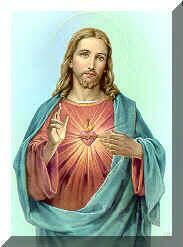
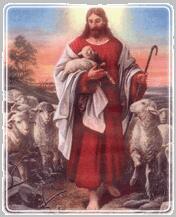
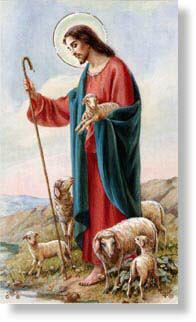
As children in Sunday School we see our first pictures of Jesus as the good shepherd (see above, for example). They are wildly inaccurate. They show a Zest-fully clean Jesus with his Breck-shampooed, blow-dried hair, in a spotless, Bill Blass robe, carrying a little lamb on his shoulders. This is an inoffensive, domesticated Jesus, a tamed Jesus who looks good. This Jesus is a poster boy for people who think that Christian faith is supposed to make them popular. But if this wimpy, smarmy, gender-confused, television-evangelist-looking Jesus ever told you, “I lay down my life for the sheep” (cf: John 10:11), you’d laugh out loud in derision. And if it ever occurred to you that your life was literally in his hands, you’d cry in despair.

A good shepherd Jesus would have grubby clothes that were torn and tattered, perhaps bloodstained. He would clip his hair short because it would be constantly dirty. Soot and sweat would be streaked across his face. His hands would be grimy. His aroma would prove he is unacquainted with Ban Roll-on. The type of fellow who can do the work that shepherding requires is not the kind of fellow any of us would invite home to meet mother. Good shepherds don’t appeal to persons of refined sensibility.

A good shepherd Jesus would look out of place in our Ethan Allen dining rooms, and probably in most churches as well. This is not a Jesus who has time to idle the day away with us. Jesus the good shepherd has countless skills and strengths, honed on this earth to rescue us from countless dangers, including ourselves. Bluntly, a good shepherd is ready for battle at any time.
“Ours is a Jesus who is powerful enough to grab us from the jaws of a hungry wolf. But at the same time Jesus is also powerful enough to grab us from the jaws of too much civility and niceness, from our need to have a pretty picture and a happy ending to the story, from our hiding from the raw, sometime coarse and smelly vitality of life itself” (Rebecca Young).
In the tame, domesticated and frankly feminine images of Jesus we use, we suppress Jesus’ masculinity, of which shepherding is one example. It’s a cultural thing, you see. Boys and men find it overwhelmingly important to be seen as manly men, independent, confident and self-assured, but Christian faith is culturally seen as a sort of wimpy crutch for people who can’t handle life on their own. Such stereotypes are reinforced by artistic and verbal images of Jesus that I think would make his first apostles wonder just whom we are talking about.

When King David was just a lad, he volunteered for single combat with Goliath. David was a shepherd, a tough guy, alert to dangers. He stood before King Saul. Saul denied David the right to confront Goliath in single combat because David was so young.
But David said to Saul, "I have been keeping my father's sheep. When a lion or a bear came and carried off a sheep from the flock, I went after it, struck it and rescued the sheep from its mouth. When it turned on me, I seized it by its hair, struck it and killed it. I have killed both the lion and the bear; this uncircumcised Philistine will be like one of them. . . .
That’s what good shepherds do.

There’s a lot more to this general topic, especially as relates to the feminization of culture at large (Kim’s complaint), the feminization of university curricula, which Geitner Simmons writes about without really intending to:
  • A freshman at Bowdoin cannot take a course in Shakespeare.

  • A freshman at Amherst isn't offered a single overview of European or American history.

  • A freshman at Williams will find that what few courses review U.S. or European history focus on "race, ethnicity and gender," rather than the given period's main developments.

  • A freshman at Wellesley will find that the few broad English courses offered to freshmen focus on gender and not the books' themes and styles.
  • In short, the masculine has been driven from the curriculum. Then there is The Feminization of the American Military, which offers this pointed observation:
    Writing in the 1940’s in opposition to the ordination of women as priests, C. S. Lewis argued that the issue was not whether females could perform the caring and instructional missions of the clergy as well or better than most men, but rather that the Church was a creature of revelation, not reason, and that the Lord had chosen to place the burden of priesthood on men. But if men had become insufficiently masculine to perform their appointed duty, the solution was hardly to call upon those who were not masculine at all. We arrived at our current impasse over women in combat for the simple reason that not enough American men could be found to perform a masculine duty. And if our only solution — and it appears that it is — is to call upon those who are not masculine at all, then we may reach the point when— as Lewis wrote in The Abolition of Man: “We make men without chests and expect of them virtue and enterprise. We laugh at honor and are shocked to find traitors in our midst. We castrate and bid the geldings to be fruitful.”
    This essay is plenty long enough now, so I’ll let Podles have the last word. Referring again to the general absence of men in churches, he says:
    Neither has the absence of men left women untouched. Unfortunately, women have been forced into the unnatural mold by Christians' misunderstandings of the feminine. Much of current feminism is an understandable reaction against the caricature of feminine roles. The breakdown of the proper relationship of masculinity and femininity, male and female, Adam and Eve, is at the root of many of the churches failures in the modern world, but this situation would not surprise the author of Genesis.
    Update: Glenn Reynolds refers us to a Salon essay on the Berenstain Bears syndrome, the kids books in which Papa is consistently presented as a loser, a "post-feminist Alan Alda fumbling wimp," as Charles Krauthammer put it.

    Wednesday, July 23, 2008

    The awfully busy God

    Gerard Van Der Leun has a long and thoughtful post about why prayers are answered - or aren’t, as the case may be. Wisely admitting up front that, "We don't know much about God," Gerard basically says that God has free will as do we humans, and that,

    Prayer is, in a sense, God's suggestion box; which is why many think that not all prayers are answered and why some, like the Tibetans, think that if you repeat a prayer often enough it gets noticed and answered. This irritating approach to prayer probably cost them their nation even though it hasn't shut them up. In general, it is probably not a good idea, but who am I to criticize? I'll leave that to the Dalai Lama who seems to be carrying on just fine.

    But the main thrust of Gerard's piece about unanswered prayer"concerns God's work load.

    He's one God who is running a very big universe. Perhaps He's got the whole thing franchised and He's running thousands of universes in a host of different dimensions, all with local variations to the main menu. We don't know. We can't know. But if you grant even one universe to this one God, you've got to admit this would be a very busy Supreme Being. Even being omnipotent and omnipresent and omniscient, You'd still have an In-Box beyond the human mind's capacity for bogglement. ...

    The final upshot is that, even if God just steps away from his desk for a quick trip to heaven's free beverage machine, when He gets back he's confronted with at least 4,675,839 prayers presented as pink "While You Were Out Slips."

    I submit that even the most omnipotent God cannot deal with incoming requests at this rate. ...

    To me this is the most obvious reason that some prayers are answered while most are not. It's simply a question of time and resources, even for God.

    Does it really happen this way? God knows.

    Now, I like Gerard's writing a lot. He's a better writer than I am. I like Gerard personally, too, having corresponded with him over the years (we've never met).

    All of which is an obvious preface to saying that I think he's missed the boat here. I will readily grant that prayers come to God at a rate that we can but poorly imagine - Gerard mentions the scene in Bruce Almighty where Bruce, a temporary deity, is so overwhelmed monitoring the prayer board that he freaks and hits the "yes to all" button. It causes no end of turmoil and even tragedy in the world, of course.

    And I will not hide behind the old cliche that "God does answer every prayer, it's just that often the answer is no." This is true, but that's not what Gerard is getting at. He is addressing why so many prayers apparently get no answer at all. They are, as far as mere humans can tell, simply ignored.

    But, "too fast, too many" is a reason I cannot accept. Here's why. The English philosopher-theologian Anselm of Canterbury, father of medieval scholasticism, postulated that God is “that than which no greater can be conceived." In philosophical inquiries that definition has withstood the test of time pretty well. (It was fiercely attacked at the time, but that's another posting.) After all, if there is a Supreme Being, then that being has to be, well, Supreme. There can be no greater.

    So if God, the Creator of the universe, in unable to keep up with the workload of managing it, then I would not say that God is doing the best he can. I would say that the deity so described is not God.

    Some polytheistic religions of the West did separate the Creator from the Manager and postulated that they are two distinct deities. Marcion in the second century was one of the chief intellectual figures of Gnosticism; he identified the God of Abraham as the Creator deity and the God of Jesus as a different deity. That is, the transcendent deity and the immanent deity were two deities. Gnosticism was finally overcome by the concerted efforts of early Church Fathers through strong counter-arguments.

    But let us affirm here that the millennia-old traditions of the Jews and Christians is correct, that there is one deity who both created and manages the universe, and that this deity hear human prayers. For this post I'll ignore the issue that seems so important to some, whether God hears the prayers of non-Christians or non-Jews (depending on who is wondering, of course). Let me simply postulate that prayers are received by God.

    Why are so many apparently unanswered? "Apparently" is a sort of dodge, of course, even though I do believe that some prayers do get answered in ways we may not recognize. But no more dodging. A couple my wife knew well a few years ago took the baby to the hospital because they found her in her crib not breathing. Life support, prayer vigils, the works. The infant died. Unanswered prayer? Definitely, and no dodging allowed that "the answer was no and God had a reason we can't comprehend." That answer lets both God and us off the hook too easily.

    Besides, not all unanswered prayers are matters of life and death. I knew a Navy officer who earnestly prayed to pass her upcoming physical-training tests (maybe if she'd worked out more she wouldn't have needed to pray so much). Student pray before tests. And there is the phenomenon I've heard other pastors call the "weekly organ recital" - the Sunday listing of Aunt Erma's bad kidneys, Uncle Fred's glaucoma, and so forth.

    God is not a cosmic vending machine for which prayers are the currency. The longer I spend in the praying business, the less I pray, or see the point in praying, for God to do something, darn it and the more I pray for him to lead me (us) to do something. I pray not that God will conform to my desires or needs of the moment, no matter how pressing they may be, but that I and others concerned in the prayer-situation be conformed more to God in the likeness of Christ.

    Yet there is more necessary, I think. Prayer is only one part of engaging God. Remember Lieut. Dan in the movie Forest Gump? He lost both legs in Vietnam, would have preferred to have died, and finally tracks his old subordinate, Gump, to the Louisiana coast after the war. Dan joins Gump in running a shrimp boat. One day they are caught at sea by a sudden storm and Dan remains in the mast with the whipping rain and lightning all around, raising his fist to the storm and railing against God. Like Job, Lt. Dan is unable to dismiss such a God as delusion, even though it would be so much easier to do so. Finally, Dan finds his peace with God.

    So many of us decline to encounter God except in storms of life or in pro-forma occasions such as a minute of silence now and then. Yet prayer is not simply some words uttered, no matter how heartfelt or sincere. Prayer is mainly a life lived out in godly ways for godly purposes. It surely can be no wonder that God refuses to acknowledge prayers seeking his miracles when we so consistently fail to acknowledge his call to us seeking our daily service. The conundrum of life-as-prayer is that we come less and less to ask God for an "answer" as for his presence come what may. Finally we realize that God with us and us with God is all the answer we really need.

    Tuesday, July 22, 2008

    The necessity of spiritual rebirth

    In the third chapter of the gospel of John, Jesus holds forth his famous discourse with Nicodemus about being born, in the Greek, anothen. Does Jesus mean being born again or from above? Nicodemus interprets the former, Jesus means the latter or he means both. Nicodemus would have understood Jesus’ observation that one must be born of water to mean physical birth. It was a common term in Jesus’ day. But Jesus means more than physical birth; he means spiritual rebirth.

    In much of what passes for public discourse on religion today, “born again” is either a boast or a pejorative put-down. Who constitutes the much derided and much feared “religious right?” Ah, yes, “born again” Christians. Within their own ranks, evangelical Christians frequently sneer at any confession of faith which doesn’t include some sort of personal Damascus road experience. All in all, “born again” Christianity is heavily laden with political baggage these days in the United States.

    However, Jesus made no declaration of a particular political fealty as a condition of spiritual rebirth. The discourse simply makes clear that to be born again includes a personal belief in Jesus as the one by whom the world is saved (cf. Jn. 3:15-16).Within the Wesleyan system, salvation culminates in the parousia (the end of the present age), but isn’t limited to it. Salvation is worked out here and now; the Kingdom of God is to be achieved in this life, at least in part. So “born again,” to be religiously meaningful, must include not just an assurance of heavenly life, but a reorientation in this life.

    An article in the “Journal of Psychology and Theology” compared survey results between persons who said they were Christians and those who did not make that claim. It also compared attitudinal scores among professed Christians by category (born again v. ethical belief system). The study defined “born again” Christians as “those who profess a personal saving relationship with Christ,” and ethical as “those who profess to follow Christian teachings as primary” (Paloutzian, 267).

    The researchers wrote they expected the ethical Christians would score higher on the Social Interest Survey, motivated primarily by Christ’s ethical teachings. It was not so.
    The born again group scored higher in social interest in both age groups studied, even though they are primarily committed to the person of Christ and secondarily committed to the ethics [of Christ]. These results support the notion that born again commitment fosters greater internalization of Christian ethics.
    The authors claimed their study’s results were consistent with previous research. Other significant points this study uncovered were that born again commitment is more likely to mature over a person’s life than the ethical type and that “an intense, mature and personal religious commitment fosters a sense of purpose in life and a greater concern for the welfare of others.”

    I believe social-justice theologies need to recover a strong notion of personal spiritual rebirth if the world is to be transformed, oppression eliminated, racism expunged, economic injustices corrected. Jesus’ teachings are powerful tools for combating these powers and principalities of the present age, but only because they are empowered by the person of the Resurrected One. Jesus is not risen because his teachings were powerful, his teachings are powerful because he is risen. There is no gospel message without an Easter morning. There is no Easter without the empty tomb.

    Citation: Paloutzian, Raymond F. et. al. “Conversion Experience, Belief System, and Personal and Ethical Attitudes” Journal of Psychology and Theology, 6:266-275, Fall 1978.

    Monday, July 21, 2008

    Connecting with non-religious people

    Not long ago I attended a seminar at Hendersonville 1st UMC on connecting with non-religious people. Some of the points made I found somewhat dubious, such as the claim that "Jesus broke away from his religious tradition for a higher good," which I addressed in more detail here.

    But here are some points worth thinking about:

    • Do we present Christianity as a system of beliefs or a way of life? John Wesley said that one may affirm the truth of one, 20 or 100 creeds and yet have no saving faith at all. Faith that saves is not "believing beliefs," not the mere assent to propositions. It is, said Wesley, a conviction wrought in one's heart that in Jesus Christ, all that is necessary for our salvation has been accomplished and that there is no life apart from him.
    • Don't present Jesus as the answer to problems but as the lover of souls. The deepest need of human souls is not problem solving, but the search for meaning. If you have never read Man's Search for Meaning by Viktor Frankl, I urge you to order it and read it as soon as you can.
    • Do we have a passion for Christ, or a passion for the church? When we substitute passion for the church rather than for Jesus, we start to prize order, routine and predictability. Jesus said (John 3):
      "The wind blows where it chooses, and you hear the sound of it, but you do not know where it comes from or where it goes. So it is with everyone who is born of the Spirit."
      The Spirit-led church will often appear unpredictable! As I preached last May,
      We will never thrive with top-down leadership, where the pastor and committees decide what the ministries of the church will be, then nominate and elect members to carry them out. We will thrive with ministries that emerge from Spirit-led disciples who are mostly self-organizing.
      Unchurched people are not looking for organizational excellence, but a church that is trying, for all its imperfections, to be "worthy of the calling to which it has been called." That means our passion must be for Jesus mlore than for one another.
    • We should be about attraction, not promotion. This is linked closely with communicating Jesus as a lover of souls. What is it about our faith life and practice that will attract people of our community and make them commit to it along with us, rather than simply participate in an event? Church promotion gains only participants, and very temporary ones at that. If we understand that we should attract people to commitment, not mere participation, then our own self understanding will change.

    Tuesday, July 15, 2008

    Let's hear it for hypocrites!

    A few weeks ago I attended a seminar on how to connect with non-religious people. That's the new term for describing the folks we used to refer to as the unchurched. The presenter had arranged for four self-described non-religious people to form a panel for us. Curiously, to be called "non-religious," all but one attended a Christian church and the fourth followed Buddhism. In the Q&A they tried to clarify that what they meant, by calling themselves non-religious, was that they rejected the in institutions of religion, the formally-organized structures of denominationalism, and by strong implication, the basic tenets of historic Christian religion as well. Jesus, it seems, is whomever you wish him to be, rather than a first-century Jew of a particular context and religious heritage. (I wrote about that issue here.)

    But at one point the panel and other attendees generally agreed that one of the main reasons the unchurched are well, unchurched is because church people are such hypocrites.

    Alexius: Well, Paul, the reason I won't join your new church here in Corinth is because there are so many hypocrites in it.

    Paul: We always have room for one more.


    The hypocrisy excuse for staying away from church has got to be the oldest there is. Which only proves what Mark Twain observed, "When you don't want to do something, any excuse will do." And to borrow one of Yogi Berra's malapropisms, If people don't want to come to church, nobody's going to stop them.

    But I say, "Hooray for hypocrites!" If you're a hypocrite, you're just my guy or gal.

    "Hypocrite" is derived from the Greek, "hypókrisis," or "play acting." It was the description for actors in the Greek theater and refers even more specifically to the masks that certain actors wore to denote different roles, multiple roles being quite common in ancient Greek theater. Members of the chorus - a sort of on stage narrator group - also often wore masks to correspond with the mood, emotion or tome of what they were singing or narrating.

    So a hypocrite is literally a "mask wearer," one who hides who s/he really is. It is, as the Greek denotes, play acting. Jesus had a lot to say about play actors, and none of it good.

    The Wailing Wall in Jerusalem, part of the Western Wall of the Jewish Temple that was destroyed in 70 c.e. by the Romans. The Western Wall is all that remains of the Temple. Today, Jews of all religious convictions go there to pray. I prayed there, too, the same day I took this photo in October 2007.

    One biting example,

    "And whenever you pray, do not be like the hypocrites; for they love to stand and pray in the synagogues and at the street corners, so that they may be seen by others."
    That is, the men Jesus referred to made a show of praying in public so that they would gain the respect of others for being so pious. (Please note that public praying was quite normal in ancient Judea and is still done now in Israel. And it is the imperative practice in Islam. Christians pray in public, too, mainly at worship services, but also other occasions, say, the Indy 500.)

    Jesus admonished his hearers that they should pray in private, so that God would hear them privately. His meaning, I think, was that prayer should be God directed, not human intended.

    But no matter how you cut it, Jesus was pretty harsh on hypocrites. So how can I be rooting for them?

    Because hypocrisy requires the hypocrite to believe in something or someone outside himself. Hypocrisy requires an aspiration to something higher or better than oneself. That is the meaning of the folk saying, "Hypocrisy is the tribute vice pays to virtue." Hypocrisy is an imperfect, deficient attempt to be better.

    Thankfully I have known very few non-hypocritical people. They were insufferable. They were entirely self centered, self directed, self oriented, self focused and just plain purely selfish. They recognized no cause, entity or belief higher than themselves, their own desires, wants or needs. You can see, I'm sure, that it is impossible for such people to act hypocritically because they are always looking out for No. 1 in every situation. They never pretend they are acting in someone else's interests. They don't seek others' approval because they don't fundamentally care about others or what they think.

    Very, very rarely is this kind of person to be found in a church (or a synagogue, either, I would imagine). The church-attending hypocrites over which the seminar attendees clucked-clucked so sadly are not actually hypocritical in the usual meaning of the word: "a pretense of having a virtuous character, moral or religious beliefs or principles, etc., that one does not really possess." Yes, they fall short of what they intend, but their striving is real, not phony, and they try to do better. If they are hypocrites, then so was St. Paul.

    It is deceit that makes hypocrisy what it is. The true hypocrite wants others to think better of him/her than is actually justified. Absent this deceit, there is no hypocrisy, just error or human frailty. That's what the hypocrisy-excuse people don't understand - or pretend not to understand - about church people. What may appear to be church people's hypocrisy is almost always just simple failure to meet the standards of our faith rather than deceit. Why? Because the standard is so high:
    But I say to you that everyone who looks at a woman with lust has already committed adultery with her in his heart (Matthew 5:28).

    You have heard that it was said, "You shall love your neighbor and hate your enemy." But I say to you, Love your enemies and pray for those who persecute you... (Matthew 5:43-44).
    There are many such examples. So I say that if our churches are filled with such "hypocrites," then let's have many more. Vice is easy, virtue is hard. It's no hypocrisy to fall short of a very high standard and such an excellent goal. And I would suggest that the hypocrisy-excuse people have largely chosen the easy way over the hard way, and choose to call that virtue. So who are the hypocrites? Well, we always have room for one more.

    So however we fall short of the standards of our faith, and fall short we certainly often do, we nonetheless seek a "more excellent way" and strain forward to what lies ahead, pressing on towards the goal.

    Monday, July 7, 2008

    Does an ancient stone cast doubt on Jesus' resurrection?

    Should I call my bishop and lay down my ordination orders? Some are now claiming that Jesus' disciples just made up the whole Easter-resurrection story by appropriating a century-old legend that the angel Gabriel was supposed to have said rebel named Simon, who was killed by the Romans in 4 BCE.

    The source of this quotation is an ancient stone tablet upon which is written (not engraved) 87 lines of text.
    JERUSALEM: A three-foot-tall tablet with 87 lines of Hebrew that scholars believe dates from the decades just before the birth of Jesus is causing a quiet stir in biblical and archaeological circles, especially because it may speak of a messiah who will rise from the dead after three days.

    If such a messianic description really is there, it will contribute to a developing re-evaluation of both popular and scholarly views of Jesus, since it suggests that the story of his death and resurrection was not unique but part of a recognized Jewish tradition at the time.

    The tablet, probably found near the Dead Sea in Jordan according to some scholars who have studied it, is a rare example of a stone with ink writings from that era in essence, a Dead Sea Scroll on stone.

    It is written, not engraved, across two neat columns, similar to columns in a Torah. But the stone is broken, and some of the text is faded, meaning that much of what it says is open to debate.
    There is no reason to believe that the stone is a fake. Despite the fact that sections of the text are obscure, the pile-on to prove that the stone somehow disproves Jesus' resurrection has already begun. I got an email just this evening from a PR guy asking me to interview two novelists who think the stone buttresses their claims that not only is the story of Jesus resurrection a fraud, the Church has known it all along. Sound familiar? It should, since that premise is one of the hoariest of religious fiction. Quite literally, "nothing to see here, move along" when it comes to this unoriginal attempt to knock over orthodox Christianity. This is, in fact, the exact premise of Robert Ludlum's 1976 novel, The Gemini Contenders:
    A train winds through Italy towards the Alps with a precious cargo on board. The cargo is a box containing papers that could destroy the Christian world.
    Ho hum. But back to the stone. Time Mag quotes Israel Knohl, an expert in Talmudic and biblical language at Jerusalem's Hebrew University:
    But, as Knohl told TIME, maybe the Christians had a model to work from. The idea of a "dying and rising messiah appears in some Jewish texts, but until now, everyone thought that was the impact of Christianity on Judaism," he says. "But for the first time, we have proof that it was the other way around. The concept was there before Jesus." If so, he goes on, "this should shake our basic view of Christianity. ... What happens in the New Testament [could have been] adopted by Jesus and his followers based on an earlier messiah story."
    Okay, so? Now, to be fair to Knohl, he does not say that the stone's presumed text (there is more than one way to translate it than Knohl's way) disproves Jesus' resurrection, only that the idea of a messianic resurrection existed before Jesus was even born. And the idea of a suffering messiah is found in the Isaiah 53.

    Bible Archaeology Review has posted both the Hebrew text and an English translation online. It's mighty thin gruel to make such as grand a banquet as Knohl and some others are cooking up. Here are the lines in question, as presented by BAR:
    7. Who am I(?), I (am?) Gabri’el the …(=angel?)… […]
    78. You(?) will save them, …[…]…
    79. from before You, the three si[gn]s(?), three …[….]
    80. In three days …, I, Gabri’el …[?],
    81. the Prince of Princes, …, narrow holes(?) …[…]…
    82. to/for … […]… and the …
    83. to me(?), out of three - the small one, whom(?) I took, I, Gabri’el.
    84. yhwh of Hosts, the Lord of(?)[ Israel …]…[….]
    85. Then you will stand …[…]…
    86. …\
    87. in(?) … eternity(?)/… \
    All the rest - that the presumed angelic prophecy was given to or in description of a Jewish rebel against Rome named Simon, whom the Romans killed in 4 BCE, and that the unintelligible gaps refer to Simon's resurrection - all that is simply speculation and interpolation. However, Knohl will have a news-covered presentation later today in Jerusalem to explain his hypothesis.

    Furthermore, as practically any Christian who has attended Sunday School for more than a month can tell you, the Jews' belief in the resurrection of the dead was deeply rooted by the time of Jesus. Not all Jews believed this, notably the Sadducees did not, but most did, notably the Pharisees.

    To the apostle Paul - a "Pharisee's Pharisee," by his own description - it was the general resurrection of the dead that was of primary importance. Jesus' resurrection was important, for Paul, only as it related to the general resurrection yet to come. Hence, Jesus is the "first fruit" of the general resurrection, the pathfinder and the proof that God's promises are true. if someone had said to Paul that there was already a concept of a dying and rising messiah before Jesus came along, Paul would have almost certainly have answered that God was no doubt preparing the people for the message of the resurrection of Jesus so that they could more quickly embrace his rising as God's seal of promise.

    Knohl does make a very important point, related at the bottom of the IHT run of the story.
    Knohl said that it was less important whether Simon was the messiah of the stone than the fact that it strongly suggested that a savior who died and rose after three days was an established concept at the time of Jesus. He notes that in the Gospels, Jesus makes numerous predictions of his suffering and New Testament scholars say such predictions must have been written in by later followers because there was no such idea present in his day.

    But there was, he said, and "Gabriel's Revelation" shows it.
    This is a crucial point. As New Testament scholar Ben Witherington puts it,
    Most radical Jesus scholars have argued that the passion and resurrection predictions by Jesus found in the Gospels were not actually made by Jesus-- they reflect the later notions and theologizing of the Evangelists.

    But now, if this stone is genuine there is no reason to argue this way. One can show that Jesus, just as well as the author of this stone, could have spoken about a dying and rising messiah.
    Knohl continues,
    "His mission is that he has to be put to death by the Romans to suffer so his blood will be the sign for redemption to come," Knohl said. "This is the sign of the son of Joseph. This is the conscious view of Jesus himself. This gives the Last Supper an absolutely different meaning. To shed blood is not for the sins of people but to bring redemption to Israel."
    Where does Knohl seem to get the idea that Jesus' passion and rising are unconnected to the redemption of Israel? Not from the Gospels, which present Jesus as weeping precisely because he realizes he will not bring about Israel's redemption. Furthermore, more than anything else, the long line of Jewish prophets had excoriated Israel for the sinfulness of the people, which they usually describe in graphic detail. That the redemption of Israel can be somehow unconnected with the forgiveness of the sins of the people is simply unsupportable by the Jewish Scriptures. Furthermore, Jeremiah's prophecy to which Jesus specifically related his suffering and resurrection says, at the end, "I will forgive their iniquity, and remember their sin no more."

    In short, I agree with Dr. Witherington (and implicit in Knohl's words) that the stone's (disputable) text reinforces that the quotes of Jesus in the Gospel in which he speaks of his own death and resurrection are true quotes rather later retrojections. The stone seems to confirm, rather than rebut, the Gospel accounts.

    Thursday, June 26, 2008

    Wordling

    I've been experimenting with Wordle, which makes word patterns that are pretty interesting. Here's the first example that I decided to save (lclick on images for full-size view):


    And here is another:


    Wordles are certainly eye catching. One more:

    Thursday, June 19, 2008

    Science and John's Gospel converge?

    Discover magazine online reports on a cosmologist who says that the universe is actually made of math.
    Cosmologists are not your run-of-the-mill thinkers, and [M.I.T Professor] Max Tegmark is not your run-of-the-mill cosmologist. Throughout his career, Tegmark has made important contributions to problems such as measuring dark matter in the cosmos and understanding how light from the early universe informs models of the Big Bang. But unlike most other physicists, who stay within the confines of the latest theories and measurements, the Swedish-born Tegmark has a night job. In a series of papers that have caught the attention of physicists and philosophers around the world, he explores not what the laws of nature say but why there are any laws at all.

    According to Tegmark, “there is only mathematics; that is all that exists.” In his theory, the mathematical universe hypothesis, he updates quantum physics and cosmology with the concept of many parallel universes inhabiting multiple levels of space and time. By posing his hypothesis at the crossroads of philosophy and physics, Tegmark is harking back to the ancient Greeks with the oldest of the old questions: What is real?
    If you read the whole interview, you might discern that Tegmark's hypothesis is not far from the theory of the logos in ancient Greek philosophy. The logos was thought to be the ordering structure of the universe, so first described by Heraclitus.The Stoics later picked up the concept, associating it with reason and that which gave animation to the universe.

    The author of the Gospel of John used the concept of logos to describe the place of Christ in the creation and ordering of the universe, and to explain how the logos had become human in the person of Jesus of Nazareth. The Gospel opens,
    In the beginning was the Word [logos], and the Word was with God, and the Word was God. 2He was in the beginning with God. 3All things came into being through him, and without him not one thing came into being. What has come into being 4in him was life, and the life was the light of all people.
    Now, Prof. Tegmark certainly did not set out to show that a theory of the universe, founded in 21st-century science, was only an elaboration of early Christian theology or ancient Greek philosophy. But it's kind of interesting that there is a philosophical convergence between them.

    Tuesday, June 17, 2008

    The problem of evil


    Compendium of home-video from the 2004 Indian Ocean tsunami

    I think that the most vexing obstacle in bringing the Gospel to people is the problem of evil. Classically stated, the problem of evil is this:
    • God is omnibenevolent, that is, wholly good.
    • God is omnipotent, that is, of unlimited power.
    • God is omniscient, that is, he knows everything past, present and future.
    • But evil exists in the world, both the evil that human beings do to one another and the tragedies that befall us because of the natural world, which is God's own creation.

    So if God is as the premises of the problem describe him, than how can either kind of evil exist? This problem is one of the most-frequently cited reasons that people say they can't accept Christian teaching. (The theological name of this problem is theodicy, derived from the Greek for the "justice of God.")

    I will start a sermon series on this problem on July 27. As well, beginning July 15 I'll lead a daytime Bible study called, "Job, Jonah, Jesus and the Problem of Good and Evil," that will meet at 9 a.m.

    Folks, pat answers don't work for this problem. It's a hard one.

    Wednesday, June 11, 2008

    Was Jesus anti-Jewish?

    Prof. Amy-Jill Levine is a Jewish woman who attends an orthodox synagogue in Nashville and who occupies an endowed chair of New Testament studies at Vanderbilt Divinity School. If you make a habit of watching the various Jesus TV shows that appear around Christmastime and Easter, you've probably seen her on camera. A-J, as her students call her (I was her student, and still consider myself such) is an engaging lecturer with an appealing sense of humor and a simply awesome command of the various themes, facts and passages of the New Testament. And she treats the New Testament a lot better than many Christian professors, clergy and laity treat the Old Testament.

    Which brings me to her latest book, The Misunderstood Jew: The Church and the Scandal of the Jewish Jesus. It is precisely, I think, because of A-J's deep appreciation of Jesus as a specifically Jewish man, and the plainly Jewish character of the New Testament, that leads her to describe and rebut Christians' historic and ongoing habit of thinking of Jesus as some kind of "counter-Jew" who sought to radically change his own religious traditions and teachings or even overturn them. Even worse has been the use of the New Testament by Christians to justify anti-Judaism, which is a very short step from anti-Jew; neither position is simply tenable with the identity and life of Jesus.


    This book is not another bewailing of how Christian Germany came to commit the Holocaust. In fact, the Shoah gets only a very brief mention in her book. A-J isn't writing to point the finger at Christians for our sins. She simply wishes to introduce the reader to the Jewish ordinariness of Jesus himself and of his place and time. Just as importantly, A-J explains simply and thoroughly the errors of both the Church and the Academy in drawing conclusions about presumed monolithic Judaism; both blocs have generally supposed that whatever Jesus seemed to oppose must have been normative in Judaism of his day. That is, clergy and scholars alike haven't studied Judaica to speak of, but nonetheless think that the New Testament describes Judaism both accurately and exhaustively. It just is not so.

    As well, A-J exposes how modern theological fads (liberationism, feminism and many others), have so idealized Jesus away from his personal Jewishness that he becomes a heroic figure exemplifying whatever the faddists a priori wish him to be. Jesus' own people then become the paradigm for whomever the faddists wish to oppose in the present day, and the dysfunctions and injustices of today - whether patriarchy, colonialism, or various exploitations - are retrojected as the norm of first-century Judaism. Jews are then portrayed, sometimes explicitly, as domineering oppressors of class, gender, the outcast and the marginalized. Hence, in seeking to identify Jesus with the Palestinian cause today, one liberationist makes explicit an identity across two millennia between the Israeli "occupiers" of the West Bank and the Jews who (presumably) killed Jesus.

    Finally, the book appeals to Jews not dismiss the Christian testament as wholly antithetical to Judaism's history and current practice. A-J explains, for example, how the Lord's Prayer (called, the "Our Father" in Catholicism) is a Jewish prayer through and through. (I remember this explanation from my first New Testament class with her, too.) Noting that after two thousand years of history it is too much to expect that Jews today will feel comfortable in praying it, she uses it to point out how Christian faith and practice is still pervaded by Jewish traditions and that there are many positive points of contact that adherents of either faith would be better off to appreciate.

    I recommend the book without reservation. It's the best religious-topic book I have read in several years.

    Saturday, June 7, 2008

    Sunni sheik says pray less, work more

    AFP:

    For Egyptian-born Muslim cleric and television host, Sheikh Yusuf al-Qaradawi, there is a simple answer to Egypt's productivity problem -- pray less, work more.

    "Praying is a good thing ... 10 minutes should be enough," Al-Jazeera television personality Qaradawi says in a religious edict, or fatwa, published on his website.

    ...

    "He's right. I cannot say the contrary. One must not waste time at work and use prayer as the pretext," Sheikh Fawzi al-Zifzaf, of the centre of Islamic studies at Al-Azhar, Sunni Islam's main seat of learning, told AFP.

    As for Mohammed al-Shahhat al-Gendi, secretary general of the Council of Supreme Islamic affairs, "10 minutes are absolutely suitable for one prayer."

    "Improving productivity is not at all contrary to Islam," he told AFP.

    So the Sunni authorities want Muslims to limit their prayers to 10 minutes each, at least for the two mandatory daily prayers that occur during the workday. Meanwhile, back in the USA, Christian ministers wish their people would pray for 10 minutes once per day.

    Friday, June 6, 2008

    The awful stakes of D-Day

    The alternate history of June 6, 1944 is too terrible to contemplate

    There is an old preacher story, so old it is a cliche of bad sermons now, that goes like this: An angel awoke who had slept through the first two centuries after Jesus had gone down to earth and ascended back to heaven. The angel went to the Lord and asked, “Where did you go?”

    Jesus replied, “I've been down on earth.”
    Omaha Beach, Normandy, 6 June 1944

    The angel asked, "How did it go?"

    Jesus said, "They crucified me."

    The angel protested, "You must have had a wide influence."

    Jesus said, "I had twelve followers, and one betrayed me to my death."

    The angel asked, "What will become of your work?"

    Jesus said, "I left it in the hands of my friends."

    "And if they fail?" asked the angel.

    Jesus said, "I have no other plans."

    That punchline, I think, is why D-Day remains so compelling. The specter of defeat on June 6, 1944 was overwhelmingly dreadful. The Allies had no other plans. There was no Plan B in case the landings were repulsed.

    There are many "pivot" days in human history, when the course of human events swung in a new direction because of discrete actions. It is hard to find another moment in all history when so much rested on an outcome of one day as rested on the success of the Allies' landings on Normandy.

    The Soviets, pushing toward Nazi Germany from the east in 1944, had clamored for years for America and Britain to open a second front against Germany from the west. A second front would compel Germany to draw soldiers and materiel away from the Russian front. Allied claims that operations in North Africa, southern Europe and indeed, the UK-US bombing campaign constituted a second front were scorned by Stalin.

    Placating Stalin was one reason the Allies had to invade Germany through France. All the military and political leaders remembered early 1918, when the newly-in-power Soviet government under Lenin had made a separate peace with Imperial Germany. Even though all the Allies had agreed early in WW II that no separate peace agreements would be made, the nag was always there.

    Moreover, neither Roosevelt nor Churchill had any desire at all to see all Germany overrun from the east and fall under the hammer and sickle. The only way to prevent that was to place American and British soldiers on the ground inside Germany.

    Invasion through northern Europe was the only way to do that (Churchill's claim that an invasion from the south, through Europe's "soft underbelly," proved fantastical in rolling up the Italian peninsula. Whatever Europe's underbelly was, it wasn't soft.)

    The Allies could afford to succeed by a mere whisker on the Normandy beaches. Indeed, the planned American and British timetable for operations commencing June 7 proved wildly optimistic. But they did succeed, rather handily most places, as it turned out, and that was enough.

    But any failure could have been only catastrophic. As in all major military operations, logistics was the central issue. The moon and tide conditions were acceptable on only some days in May, June and July; in fact, May 19 was seriously discussed as the invasion date for some time. But the Allies' supreme commander, Gen. Dwight D. Eisenhower, postponed the invasion to June 5 because doing so would yield him an additional 100 landing craft, mostly LSTs, used to land tracked and wheeled vehicles directly onto the beach. (Bad weather caused the invasion to be postponed again until June 6.)

    A little-known fact is that America was continually shuttling landing craft, both for vehicles and personnel, back and forth from Europe to the Pacific. The availability of landing craft was almost always the key point in setting landing dates for both areas.

    A German victory at Normandy would probably have destroyed stocks of American landing craft by two or three years production. Not only could there not possibly been another landing even attempted in Europe for a very long time, Pacific operations would have been dramatically slowed. America was set to take the Philippines back from the Japanese beginning in October 1944. The invasions of Iwo Jima and Okinawa, both in the first half of 1945, were to follow. Significant loss of landing craft at Normandy would have thrown that timetable badly off.

    Allied failure on the French coast would have meant enormous American and British casualties. Both the 82d and 101st Airborne Divisions would have been entirely destroyed because they could not have been relieved, having dropped inland. All their soldiers would have been killed or captured. The loss of life that defeat on the beaches would have entailed would have degraded the Allies' capability to try again soon almost as much as the loss of landing craft.

    The Soviets certainly would not have slacked their offensives had Normandy failed. If anything, they would have pressed all the harder, but would have pressed equally hard for a much larger share of American war production, insisting that they were making better use of it than we were. As they would have been the only dog in the fight, the demands would have been hard for Roosevelt to resist. Not only would all Germany have become communist, so would France, whose communist cells were very active and which would have benefited greatly from having the Soviet army literally next door. Imagine the Iron Curtain falling at the English Channel. The Soviet bear would have easily swallowed countries like Denmark, The Netherlands and Belgium. Likewise, Greece's postwar communist insurgency would have succeeded. Italy might easily have turned communist also.

    (Alternatively, the Nazis might well have shifted hundreds of thousands of soldiers from France to the eastern front. If so, they almost certainly would have shredded Soviet formations because, battalion for battalion, the German army was greatly superior and better led. The Soviets would still have won out, but it would have taken longer and at much greater cost all around.)

    European Jews, of course, would have been wiped out since the "final solution" would have proceeded apace. Israel would not exist today. The Soviet Union might have become dominant in the Middle East and there's no point in even trying to speculate on what the next decades would have held for the Arabs (or Persians, since the Russians had long cast a covetous eye on Iran's year-round warm-water ports).

    Roosevelt, of course, would not have been reelected that fall. He certainly would have sacked Eisenhower and Eisenhower's boss, Army Chief of Staff George C. Marshall. (Eisenhower would certainly have tendered his resignation. Marshall had survived the post-Pearl Harbor headrolling, but could not have survived failure at Normandy.) There's no point speculating what Republican President Thomas E. Dewey would have done with the office, but it is fair to say he would not have pushed for the creation of the United Nations, which was mainly Roosevelt's brainchild (for good or ill, take your pick), nor would there have been any reason for Stalin to cooperate with its formation, anyway.

    Britain's people were incredibly war weary by mid-1944. Success in Normandy emboldened them to see the war to its bitter, bloody end. They remembered all too well the defeat of Dunkirk, when the British army had been evacuated from the French coast at the war's beginning, leaving behind its dead, almost all its vehicles and most of its weapons. Failure at Normandy would have caused Prime Minister Churchill's unemployment faster than Roosevelt's.

    I have little doubt that some form of British peace party would have gained the Parliamentary majority and the PM's office. Might the Brits have sued Hitler for a separate peace? Maybe. Already strongly tended toward socialism, it's not hard reasonably to imagine that the UK itself would have turned communist by the 1950s had the Soviets dominated all western Europe.

    Without Britain (and I'm treading very speculative ground here, I admit), America could not have continued to oppose Hitler, nor have offered any resistance to Soviet dominion of practically all Europe after they had cleaned up the Nazis. We would have continued to make war against Japan, of course. But consider that with sea-land operations slowed greatly by loss of materiel at Normandy, Japan would probably have been bombed into true oblivion; the Pacific War's end would have been greatly postponed at terrible cost of human life - American, Japanese and persons under Japanese occupation, who were dying in 1945 at the rate of 500,000 per month. Whatever Japan's postwar history would have been, it would not have resembled what it actually was.

    All these things lay in the hands of fewer than 200,000 American, Canadian and British soldiers stepping onto French soil on one day. It was a burden that we should pray will never rest on human shoulders again.


    End note: What of the atom bomb? It was originally envisioned for use against Naxi Germany, but Germany surrendered before the bomb was ready. With a lengthened war in Europe, could the atom bomb have restored US-UK fortunes there? I would argue that an expanded use the A-bomb from the two that actually were used is no victory. However it might have reestablished US power on the continent, such cannot be considered positively by any stretch of the imagination.