Not long ago I attended a seminar at Hendersonville 1st UMC on connecting with non-religious people. Some of the points made I found somewhat dubious, such as the claim that "Jesus broke away from his religious tradition for a higher good," which I addressed in more detail here.
But here are some points worth thinking about:
Do we present Christianity as a system of beliefs or a way of life? John Wesley said that one may affirm the truth of one, 20 or 100 creeds and yet have no saving faith at all. Faith that saves is not "believing beliefs," not the mere assent to propositions. It is, said Wesley, a conviction wrought in one's heart that in Jesus Christ, all that is necessary for our salvation has been accomplished and that there is no life apart from him.
Don't present Jesus as the answer to problems but as the lover of souls. The deepest need of human souls is not problem solving, but the search for meaning. If you have never read Man's Search for Meaning by Viktor Frankl, I urge you to order it and read it as soon as you can.
Do we have a passion for Christ, or a passion for the church? When we substitute passion for the church rather than for Jesus, we start to prize order, routine and predictability. Jesus said (John 3):
"The wind blows where it chooses, and you hear the sound of it, but you do not know where it comes from or where it goes. So it is with everyone who is born of the Spirit."
The Spirit-led church will often appear unpredictable! As I preached last May,
We will never thrive with top-down leadership, where the pastor and committees decide what the ministries of the church will be, then nominate and elect members to carry them out. We will thrive with ministries that emerge from Spirit-led disciples who are mostly self-organizing.
Unchurched people are not looking for organizational excellence, but a church that is trying, for all its imperfections, to be "worthy of the calling to which it has been called." That means our passion must be for Jesus mlore than for one another.
We should be about attraction, not promotion. This is linked closely with communicating Jesus as a lover of souls. What is it about our faith life and practice that will attract people of our community and make them commit to it along with us, rather than simply participate in an event? Church promotion gains only participants, and very temporary ones at that. If we understand that we should attract people to commitment, not mere participation, then our own self understanding will change.
A few weeks ago I attended a seminar on how to connect with non-religious people. That's the new term for describing the folks we used to refer to as the unchurched. The presenter had arranged for four self-described non-religious people to form a panel for us. Curiously, to be called "non-religious," all but one attended a Christian church and the fourth followed Buddhism. In the Q&A they tried to clarify that what they meant, by calling themselves non-religious, was that they rejected the in institutions of religion, the formally-organized structures of denominationalism, and by strong implication, the basic tenets of historic Christian religion as well. Jesus, it seems, is whomever you wish him to be, rather than a first-century Jew of a particular context and religious heritage. (I wrote about that issue here.)
But at one point the panel and other attendees generally agreed that one of the main reasons the unchurched are well, unchurched is because church people are such hypocrites.
Alexius: Well, Paul, the reason I won't join your new church here in Corinth is because there are so many hypocrites in it.
Paul: We always have room for one more.
The hypocrisy excuse for staying away from church has got to be the oldest there is. Which only proves what Mark Twain observed, "When you don't want to do something, any excuse will do." And to borrow one of Yogi Berra's malapropisms, If people don't want to come to church, nobody's going to stop them.
But I say, "Hooray for hypocrites!" If you're a hypocrite, you're just my guy or gal.
"Hypocrite" is derived from the Greek, "hypókrisis," or "play acting." It was the description for actors in the Greek theater and refers even more specifically to the masks that certain actors wore to denote different roles, multiple roles being quite common in ancient Greek theater. Members of the chorus - a sort of on stage narrator group - also often wore masks to correspond with the mood, emotion or tome of what they were singing or narrating.
So a hypocrite is literally a "mask wearer," one who hides who s/he really is. It is, as the Greek denotes, play acting. Jesus had a lot to say about play actors, and none of it good.
The Wailing Wall in Jerusalem, part of the Western Wall of the Jewish Temple that was destroyed in 70 c.e. by the Romans. The Western Wall is all that remains of the Temple. Today, Jews of all religious convictions go there to pray. I prayed there, too, the same day I took this photo in October 2007.
"And whenever you pray, do not be like the hypocrites; for they love to stand and pray in the synagogues and at the street corners, so that they may be seen by others."
That is, the men Jesus referred to made a show of praying in public so that they would gain the respect of others for being so pious. (Please note that public praying was quite normal in ancient Judea and is still done now in Israel. And it is the imperative practice in Islam. Christians pray in public, too, mainly at worship services, but also other occasions, say, the Indy 500.)
Jesus admonished his hearers that they should pray in private, so that God would hear them privately. His meaning, I think, was that prayer should be God directed, not human intended.
But no matter how you cut it, Jesus was pretty harsh on hypocrites. So how can I be rooting for them?
Because hypocrisy requires the hypocrite to believe in something or someone outside himself. Hypocrisy requires an aspiration to something higher or better than oneself. That is the meaning of the folk saying, "Hypocrisy is the tribute vice pays to virtue." Hypocrisy is an imperfect, deficient attempt to be better.
Thankfully I have known very few non-hypocritical people. They were insufferable. They were entirely self centered, self directed, self oriented, self focused and just plain purely selfish. They recognized no cause, entity or belief higher than themselves, their own desires, wants or needs. You can see, I'm sure, that it is impossible for such people to act hypocritically because they are always looking out for No. 1 in every situation. They never pretend they are acting in someone else's interests. They don't seek others' approval because they don't fundamentally care about others or what they think.
Very, very rarely is this kind of person to be found in a church (or a synagogue, either, I would imagine). The church-attending hypocrites over which the seminar attendees clucked-clucked so sadly are not actually hypocritical in the usual meaning of the word: "a pretense of having a virtuous character, moral or religious beliefs or principles, etc., that one does not really possess." Yes, they fall short of what they intend, but their striving is real, not phony, and they try to do better. If they are hypocrites, then so was St. Paul.
It is deceit that makes hypocrisy what it is. The true hypocrite wants others to think better of him/her than is actually justified. Absent this deceit, there is no hypocrisy, just error or human frailty. That's what the hypocrisy-excuse people don't understand - or pretend not to understand - about church people. What may appear to be church people's hypocrisy is almost always just simple failure to meet the standards of our faith rather than deceit. Why? Because the standard is so high:
But I say to you that everyone who looks at a woman with lust has already committed adultery with her in his heart (Matthew 5:28).
You have heard that it was said, "You shall love your neighbor and hate your enemy." But I say to you, Love your enemies and pray for those who persecute you... (Matthew 5:43-44).
There are many such examples. So I say that if our churches are filled with such "hypocrites," then let's have many more. Vice is easy, virtue is hard. It's no hypocrisy to fall short of a very high standard and such an excellent goal. And I would suggest that the hypocrisy-excuse people have largely chosen the easy way over the hard way, and choose to call that virtue. So who are the hypocrites? Well, we always have room for one more.
So however we fall short of the standards of our faith, and fall short we certainly often do, we nonetheless seek a "more excellent way" and strain forward to what lies ahead, pressing on towards the goal.
Should I call my bishop and lay down my ordination orders? Some are now claiming that Jesus' disciples just made up the whole Easter-resurrection story by appropriating a century-old legend that the angel Gabriel was supposed to have said rebel named Simon, who was killed by the Romans in 4 BCE.
The source of this quotation is an ancient stone tablet upon which is written (not engraved) 87 lines of text.
JERUSALEM: A three-foot-tall tablet with 87 lines of Hebrew that scholars believe dates from the decades just before the birth of Jesus is causing a quiet stir in biblical and archaeological circles, especially because it may speak of a messiah who will rise from the dead after three days.
If such a messianic description really is there, it will contribute to a developing re-evaluation of both popular and scholarly views of Jesus, since it suggests that the story of his death and resurrection was not unique but part of a recognized Jewish tradition at the time.
The tablet, probably found near the Dead Sea in Jordan according to some scholars who have studied it, is a rare example of a stone with ink writings from that era in essence, a Dead Sea Scroll on stone.
It is written, not engraved, across two neat columns, similar to columns in a Torah. But the stone is broken, and some of the text is faded, meaning that much of what it says is open to debate.
There is no reason to believe that the stone is a fake. Despite the fact that sections of the text are obscure, the pile-on to prove that the stone somehow disproves Jesus' resurrection has already begun. I got an email just this evening from a PR guy asking me to interview two novelists who think the stone buttresses their claims that not only is the story of Jesus resurrection a fraud, the Church has known it all along. Sound familiar? It should, since that premise is one of the hoariest of religious fiction. Quite literally, "nothing to see here, move along" when it comes to this unoriginal attempt to knock over orthodox Christianity. This is, in fact, the exact premise of Robert Ludlum's 1976 novel, The Gemini Contenders:
A train winds through Italy towards the Alps with a precious cargo on board. The cargo is a box containing papers that could destroy the Christian world.
Ho hum. But back to the stone. Time Mag quotes Israel Knohl, an expert in Talmudic and biblical language at Jerusalem's Hebrew University:
But, as Knohl told TIME, maybe the Christians had a model to work from. The idea of a "dying and rising messiah appears in some Jewish texts, but until now, everyone thought that was the impact of Christianity on Judaism," he says. "But for the first time, we have proof that it was the other way around. The concept was there before Jesus." If so, he goes on, "this should shake our basic view of Christianity. ... What happens in the New Testament [could have been] adopted by Jesus and his followers based on an earlier messiah story."
Okay, so? Now, to be fair to Knohl, he does not say that the stone's presumed text (there is more than one way to translate it than Knohl's way) disproves Jesus' resurrection, only that the idea of a messianic resurrection existed before Jesus was even born. And the idea of a suffering messiah is found in the Isaiah 53.
Bible Archaeology Review has posted both the Hebrew text and an English translation online. It's mighty thin gruel to make such as grand a banquet as Knohl and some others are cooking up. Here are the lines in question, as presented by BAR:
7. Who am I(?), I (am?) Gabri’el the …(=angel?)… […] 78. You(?) will save them, …[…]… 79. from before You, the three si[gn]s(?), three …[….] 80. In three days …, I, Gabri’el …[?], 81. the Prince of Princes, …, narrow holes(?) …[…]… 82. to/for … […]… and the … 83. to me(?), out of three - the small one, whom(?) I took, I, Gabri’el. 84. yhwh of Hosts, the Lord of(?)[ Israel …]…[….] 85. Then you will stand …[…]… 86. …\ 87. in(?) … eternity(?)/… \
All the rest - that the presumed angelic prophecy was given to or in description of a Jewish rebel against Rome named Simon, whom the Romans killed in 4 BCE, and that the unintelligible gaps refer to Simon's resurrection - all that is simply speculation and interpolation. However, Knohl will have a news-covered presentation later today in Jerusalem to explain his hypothesis.
Furthermore, as practically any Christian who has attended Sunday School for more than a month can tell you, the Jews' belief in the resurrection of the dead was deeply rooted by the time of Jesus. Not all Jews believed this, notably the Sadducees did not, but most did, notably the Pharisees.
To the apostle Paul - a "Pharisee's Pharisee," by his own description - it was the general resurrection of the dead that was of primary importance. Jesus' resurrection was important, for Paul, only as it related to the general resurrection yet to come. Hence, Jesus is the "first fruit" of the general resurrection, the pathfinder and the proof that God's promises are true. if someone had said to Paul that there was already a concept of a dying and rising messiah before Jesus came along, Paul would have almost certainly have answered that God was no doubt preparing the people for the message of the resurrection of Jesus so that they could more quickly embrace his rising as God's seal of promise.
Knohl does make a very important point, related at the bottom of the IHT run of the story.
Knohl said that it was less important whether Simon was the messiah of the stone than the fact that it strongly suggested that a savior who died and rose after three days was an established concept at the time of Jesus. He notes that in the Gospels, Jesus makes numerous predictions of his suffering and New Testament scholars say such predictions must have been written in by later followers because there was no such idea present in his day.
But there was, he said, and "Gabriel's Revelation" shows it.
Most radical Jesus scholars have argued that the passion and resurrection predictions by Jesus found in the Gospels were not actually made by Jesus-- they reflect the later notions and theologizing of the Evangelists.
But now, if this stone is genuine there is no reason to argue this way. One can show that Jesus, just as well as the author of this stone, could have spoken about a dying and rising messiah.
Knohl continues,
"His mission is that he has to be put to death by the Romans to suffer so his blood will be the sign for redemption to come," Knohl said. "This is the sign of the son of Joseph. This is the conscious view of Jesus himself. This gives the Last Supper an absolutely different meaning. To shed blood is not for the sins of people but to bring redemption to Israel."
Where does Knohl seem to get the idea that Jesus' passion and rising are unconnected to the redemption of Israel? Not from the Gospels, which present Jesus as weeping precisely because he realizes he will not bring about Israel's redemption. Furthermore, more than anything else, the long line of Jewish prophets had excoriated Israel for the sinfulness of the people, which they usually describe in graphic detail. That the redemption of Israel can be somehow unconnected with the forgiveness of the sins of the people is simply unsupportable by the Jewish Scriptures. Furthermore, Jeremiah's prophecy to which Jesus specifically related his suffering and resurrection says, at the end, "I will forgive their iniquity, and remember their sin no more."
In short, I agree with Dr. Witherington (and implicit in Knohl's words) that the stone's (disputable) text reinforces that the quotes of Jesus in the Gospel in which he speaks of his own death and resurrection are true quotes rather later retrojections. The stone seems to confirm, rather than rebut, the Gospel accounts.
I've been experimenting with Wordle, which makes word patterns that are pretty interesting. Here's the first example that I decided to save (lclick on images for full-size view):
Cosmologists are not your run-of-the-mill thinkers, and [M.I.T Professor] Max Tegmark is not your run-of-the-mill cosmologist. Throughout his career, Tegmark has made important contributions to problems such as measuring dark matter in the cosmos and understanding how light from the early universe informs models of the Big Bang. But unlike most other physicists, who stay within the confines of the latest theories and measurements, the Swedish-born Tegmark has a night job. In a series of papers that have caught the attention of physicists and philosophers around the world, he explores not what the laws of nature say but why there are any laws at all.
According to Tegmark, “there is only mathematics; that is all that exists.” In his theory, the mathematical universe hypothesis, he updates quantum physics and cosmology with the concept of many parallel universes inhabiting multiple levels of space and time. By posing his hypothesis at the crossroads of philosophy and physics, Tegmark is harking back to the ancient Greeks with the oldest of the old questions: What is real?
If you read the whole interview, you might discern that Tegmark's hypothesis is not far from the theory of the logos in ancient Greek philosophy. The logos was thought to be the ordering structure of the universe, so first described by Heraclitus.The Stoics later picked up the concept, associating it with reason and that which gave animation to the universe.
The author of the Gospel of John used the concept of logos to describe the place of Christ in the creation and ordering of the universe, and to explain how the logos had become human in the person of Jesus of Nazareth. The Gospel opens,
In the beginning was the Word [logos], and the Word was with God, and the Word was God. 2He was in the beginning with God. 3All things came into being through him, and without him not one thing came into being. What has come into being 4in him was life, and the life was the light of all people.
Now, Prof. Tegmark certainly did not set out to show that a theory of the universe, founded in 21st-century science, was only an elaboration of early Christian theology or ancient Greek philosophy. But it's kind of interesting that there is a philosophical convergence between them.
Compendium of home-video from the 2004 Indian Ocean tsunami
I think that the most vexing obstacle in bringing the Gospel to people is the problem of evil. Classically stated, the problem of evil is this:
God is omnibenevolent, that is, wholly good.
God is omnipotent, that is, of unlimited power.
God is omniscient, that is, he knows everything past, present and future.
But evil exists in the world, both the evil that human beings do to one another and the tragedies that befall us because of the natural world, which is God's own creation.
So if God is as the premises of the problem describe him, than how can either kind of evil exist? This problem is one of the most-frequently cited reasons that people say they can't accept Christian teaching. (The theological name of this problem is theodicy, derived from the Greek for the "justice of God.")
I will start a sermon series on this problem on July 27. As well, beginning July 15 I'll lead a daytime Bible study called, "Job, Jonah, Jesus and the Problem of Good and Evil," that will meet at 9 a.m.
Folks, pat answers don't work for this problem. It's a hard one.
Prof. Amy-Jill Levine is a Jewish woman who attends an orthodox synagogue in Nashville and who occupies an endowed chair of New Testament studies at Vanderbilt Divinity School. If you make a habit of watching the various Jesus TV shows that appear around Christmastime and Easter, you've probably seen her on camera. A-J, as her students call her (I was her student, and still consider myself such) is an engaging lecturer with an appealing sense of humor and a simply awesome command of the various themes, facts and passages of the New Testament. And she treats the New Testament a lot better than many Christian professors, clergy and laity treat the Old Testament.
Which brings me to her latest book, The Misunderstood Jew: The Church and the Scandal of the Jewish Jesus. It is precisely, I think, because of A-J's deep appreciation of Jesus as a specifically Jewish man, and the plainly Jewish character of the New Testament, that leads her to describe and rebut Christians' historic and ongoing habit of thinking of Jesus as some kind of "counter-Jew" who sought to radically change his own religious traditions and teachings or even overturn them. Even worse has been the use of the New Testament by Christians to justify anti-Judaism, which is a very short step from anti-Jew; neither position is simply tenable with the identity and life of Jesus.
This book is not another bewailing of how Christian Germany came to commit the Holocaust. In fact, the Shoah gets only a very brief mention in her book. A-J isn't writing to point the finger at Christians for our sins. She simply wishes to introduce the reader to the Jewish ordinariness of Jesus himself and of his place and time. Just as importantly, A-J explains simply and thoroughly the errors of both the Church and the Academy in drawing conclusions about presumed monolithic Judaism; both blocs have generally supposed that whatever Jesus seemed to oppose must have been normative in Judaism of his day. That is, clergy and scholars alike haven't studied Judaica to speak of, but nonetheless think that the New Testament describes Judaism both accurately and exhaustively. It just is not so.
As well, A-J exposes how modern theological fads (liberationism, feminism and many others), have so idealized Jesus away from his personal Jewishness that he becomes a heroic figure exemplifying whatever the faddists a priori wish him to be. Jesus' own people then become the paradigm for whomever the faddists wish to oppose in the present day, and the dysfunctions and injustices of today - whether patriarchy, colonialism, or various exploitations - are retrojected as the norm of first-century Judaism. Jews are then portrayed, sometimes explicitly, as domineering oppressors of class, gender, the outcast and the marginalized. Hence, in seeking to identify Jesus with the Palestinian cause today, one liberationist makes explicit an identity across two millennia between the Israeli "occupiers" of the West Bank and the Jews who (presumably) killed Jesus.
Finally, the book appeals to Jews not dismiss the Christian testament as wholly antithetical to Judaism's history and current practice. A-J explains, for example, how the Lord's Prayer (called, the "Our Father" in Catholicism) is a Jewish prayer through and through. (I remember this explanation from my first New Testament class with her, too.) Noting that after two thousand years of history it is too much to expect that Jews today will feel comfortable in praying it, she uses it to point out how Christian faith and practice is still pervaded by Jewish traditions and that there are many positive points of contact that adherents of either faith would be better off to appreciate.
I recommend the book without reservation. It's the best religious-topic book I have read in several years.
For Egyptian-born Muslim cleric and television host, Sheikh Yusuf al-Qaradawi, there is a simple answer to Egypt's productivity problem -- pray less, work more.
"Praying is a good thing ... 10 minutes should be enough," Al-Jazeera television personality Qaradawi says in a religious edict, or fatwa, published on his website.
...
"He's right. I cannot say the contrary. One must not waste time at work and use prayer as the pretext," Sheikh Fawzi al-Zifzaf, of the centre of Islamic studies at Al-Azhar, Sunni Islam's main seat of learning, told AFP.
As for Mohammed al-Shahhat al-Gendi, secretary general of the Council of Supreme Islamic affairs, "10 minutes are absolutely suitable for one prayer."
"Improving productivity is not at all contrary to Islam," he told AFP.
So the Sunni authorities want Muslims to limit their prayers to 10 minutes each, at least for the two mandatory daily prayers that occur during the workday. Meanwhile, back in the USA, Christian ministers wish their people would pray for 10 minutes once per day.
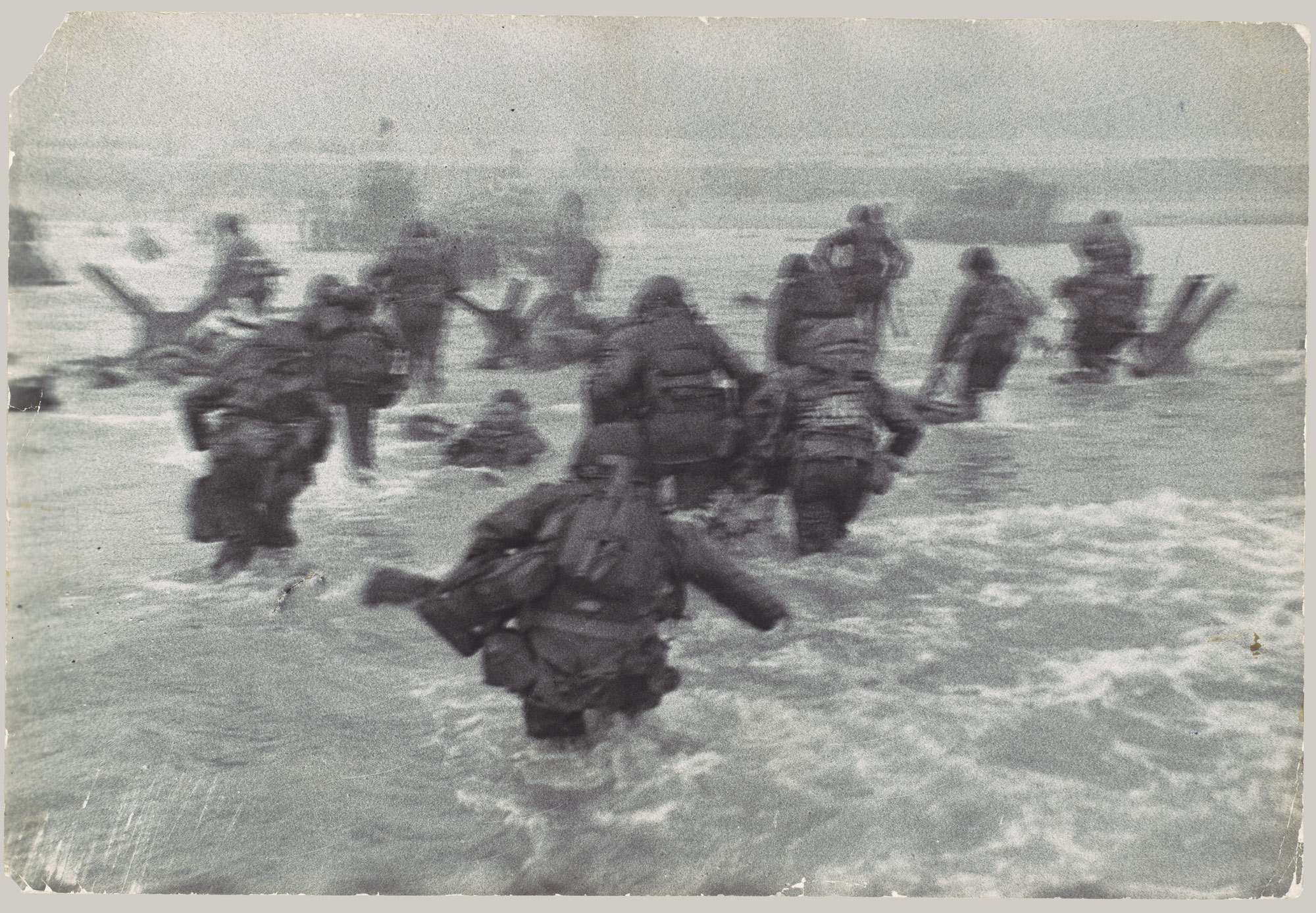
The alternate history of June 6, 1944 is too terrible to contemplate
There is an old preacher story, so old it is a cliche of bad sermons now, that goes like this: An angel awoke who had slept through the first two centuries after Jesus had gone down to earth and ascended back to heaven. The angel went to the Lord and asked, “Where did you go?”
Jesus replied, “I've been down on earth.”
Omaha Beach, Normandy, 6 June 1944
The angel asked, "How did it go?"
Jesus said, "They crucified me."
The angel protested, "You must have had a wide influence."
Jesus said, "I had twelve followers, and one betrayed me to my death."
The angel asked, "What will become of your work?"
Jesus said, "I left it in the hands of my friends."
"And if they fail?" asked the angel.
Jesus said, "I have no other plans."
That punchline, I think, is why D-Day remains so compelling. The specter of defeat on June 6, 1944 was overwhelmingly dreadful. The Allies had no other plans. There was no Plan B in case the landings were repulsed.
There are many "pivot" days in human history, when the course of human events swung in a new direction because of discrete actions. It is hard to find another moment in all history when so much rested on an outcome of one day as rested on the success of the Allies' landings on Normandy.
The Soviets, pushing toward Nazi Germany from the east in 1944, had clamored for years for America and Britain to open a second front against Germany from the west. A second front would compel Germany to draw soldiers and materiel away from the Russian front. Allied claims that operations in North Africa, southern Europe and indeed, the UK-US bombing campaign constituted a second front were scorned by Stalin.
Placating Stalin was one reason the Allies had to invade Germany through France. All the military and political leaders remembered early 1918, when the newly-in-power Soviet government under Lenin had made a separate peace with Imperial Germany. Even though all the Allies had agreed early in WW II that no separate peace agreements would be made, the nag was always there.
Moreover, neither Roosevelt nor Churchill had any desire at all to see all Germany overrun from the east and fall under the hammer and sickle. The only way to prevent that was to place American and British soldiers on the ground inside Germany.
Invasion through northern Europe was the only way to do that (Churchill's claim that an invasion from the south, through Europe's "soft underbelly," proved fantastical in rolling up the Italian peninsula. Whatever Europe's underbelly was, it wasn't soft.)
The Allies could afford to succeed by a mere whisker on the Normandy beaches. Indeed, the planned American and British timetable for operations commencing June 7 proved wildly optimistic. But they did succeed, rather handily most places, as it turned out, and that was enough.
But any failure could have been only catastrophic. As in all major military operations, logistics was the central issue. The moon and tide conditions were acceptable on only some days in May, June and July; in fact, May 19 was seriously discussed as the invasion date for some time. But the Allies' supreme commander, Gen. Dwight D. Eisenhower, postponed the invasion to June 5 because doing so would yield him an additional 100 landing craft, mostly LSTs, used to land tracked and wheeled vehicles directly onto the beach. (Bad weather caused the invasion to be postponed again until June 6.)
A little-known fact is that America was continually shuttling landing craft, both for vehicles and personnel, back and forth from Europe to the Pacific. The availability of landing craft was almost always the key point in setting landing dates for both areas.
A German victory at Normandy would probably have destroyed stocks of American landing craft by two or three years production. Not only could there not possibly been another landing even attempted in Europe for a very long time, Pacific operations would have been dramatically slowed. America was set to take the Philippines back from the Japanese beginning in October 1944. The invasions of Iwo Jima and Okinawa, both in the first half of 1945, were to follow. Significant loss of landing craft at Normandy would have thrown that timetable badly off.
Allied failure on the French coast would have meant enormous American and British casualties. Both the 82d and 101st Airborne Divisions would have been entirely destroyed because they could not have been relieved, having dropped inland. All their soldiers would have been killed or captured. The loss of life that defeat on the beaches would have entailed would have degraded the Allies' capability to try again soon almost as much as the loss of landing craft.
The Soviets certainly would not have slacked their offensives had Normandy failed. If anything, they would have pressed all the harder, but would have pressed equally hard for a much larger share of American war production, insisting that they were making better use of it than we were. As they would have been the only dog in the fight, the demands would have been hard for Roosevelt to resist. Not only would all Germany have become communist, so would France, whose communist cells were very active and which would have benefited greatly from having the Soviet army literally next door. Imagine the Iron Curtain falling at the English Channel. The Soviet bear would have easily swallowed countries like Denmark, The Netherlands and Belgium. Likewise, Greece's postwar communist insurgency would have succeeded. Italy might easily have turned communist also.
(Alternatively, the Nazis might well have shifted hundreds of thousands of soldiers from France to the eastern front. If so, they almost certainly would have shredded Soviet formations because, battalion for battalion, the German army was greatly superior and better led. The Soviets would still have won out, but it would have taken longer and at much greater cost all around.)
European Jews, of course, would have been wiped out since the "final solution" would have proceeded apace. Israel would not exist today. The Soviet Union might have become dominant in the Middle East and there's no point in even trying to speculate on what the next decades would have held for the Arabs (or Persians, since the Russians had long cast a covetous eye on Iran's year-round warm-water ports).
Roosevelt, of course, would not have been reelected that fall. He certainly would have sacked Eisenhower and Eisenhower's boss, Army Chief of Staff George C. Marshall. (Eisenhower would certainly have tendered his resignation. Marshall had survived the post-Pearl Harbor headrolling, but could not have survived failure at Normandy.) There's no point speculating what Republican President Thomas E. Dewey would have done with the office, but it is fair to say he would not have pushed for the creation of the United Nations, which was mainly Roosevelt's brainchild (for good or ill, take your pick), nor would there have been any reason for Stalin to cooperate with its formation, anyway.
Britain's people were incredibly war weary by mid-1944. Success in Normandy emboldened them to see the war to its bitter, bloody end. They remembered all too well the defeat of Dunkirk, when the British army had been evacuated from the French coast at the war's beginning, leaving behind its dead, almost all its vehicles and most of its weapons. Failure at Normandy would have caused Prime Minister Churchill's unemployment faster than Roosevelt's.
I have little doubt that some form of British peace party would have gained the Parliamentary majority and the PM's office. Might the Brits have sued Hitler for a separate peace? Maybe. Already strongly tended toward socialism, it's not hard reasonably to imagine that the UK itself would have turned communist by the 1950s had the Soviets dominated all western Europe.
Without Britain (and I'm treading very speculative ground here, I admit), America could not have continued to oppose Hitler, nor have offered any resistance to Soviet dominion of practically all Europe after they had cleaned up the Nazis. We would have continued to make war against Japan, of course. But consider that with sea-land operations slowed greatly by loss of materiel at Normandy, Japan would probably have been bombed into true oblivion; the Pacific War's end would have been greatly postponed at terrible cost of human life - American, Japanese and persons under Japanese occupation, who were dying in 1945 at the rate of 500,000 per month. Whatever Japan's postwar history would have been, it would not have resembled what it actually was.
All these things lay in the hands of fewer than 200,000 American, Canadian and British soldiers stepping onto French soil on one day. It was a burden that we should pray will never rest on human shoulders again.
End note: What of the atom bomb? It was originally envisioned for use against Naxi Germany, but Germany surrendered before the bomb was ready. With a lengthened war in Europe, could the atom bomb have restored US-UK fortunes there? I would argue that an expanded use the A-bomb from the two that actually were used is no victory. However it might have reestablished US power on the continent, such cannot be considered positively by any stretch of the imagination.
Wherever politics tries to be redemptive, it is promising too much. Where it wishes to do the work of God, it becomes, not divine, but demonic. - Pope Benedict XVI, Truth and Tolerance; p. 116.
Rescue workers surround a passenger plane which skidded off a runway at Tegucigalpa airport in Honduras, May 30, 2008.
I've landed a few times at Tegucigalpa, Honduras' airport, and let me tell, you, it can be a hairy ride. There is one runway. From the south, Runway 20, the front end of the runway sits atop a high, steep bluff. It's like landing an airliner on an aircraft carrier, minus the arresting cables.
Undershoot and you hit the mountain. Overshoot, and you hit the mountain at the other end of the runway. Approaching from that direction means your glide path pretty much has to match the descending slope of the mountains as you approach on final, like this:
I made that approach in a Tennessee Air Guard C-130, having hitched a ride from Panama to return to Joint Task Force Bravo, based in Honduras' Comayagua Valley, in 1989. Since I was a native Nashvillian, I was invited to make the whole flight sitting atop an upturned tool box on the flight deck.
The pilots, two airline captains back in the States, had decided to tease the air defense batteries of then-Communist Nicaragua by flying three miles plus one hundred yards off its west coast. "There's another one," one would say whenever the panel warning light lit to signify that yet another missile-targeting radar had illuminated the plane. Didn't seem to bother them much, but I spent several minutes peering out the right window, looking for rocket contrails.
Over Tiger Island, at the juncture of Nicaragua, Honduras and El Salvador, we banked into a very steep right turn to avoid overflying either of the other two countries. We spent several minutes trying to find a gap in the cloud deck below us. But the deck was solid, so "into the weather" we went.
The cloud was thick. We didn't drop below it until we were already on long final to Teguc ("tuh-goose" as we called it). I was looking at the dense gray inside of clouds one moment, and the next I was staring at treetops just a couple of hundred feet below. We tracked the mountainside all the way down, descending probably 3,000 feet while remaining only a couple of hundred feet above the ground all the while.
Last Friday, five were killed when an El Salvador airliner, pictured above, skidded off the runway in bad weather. The wonder is not that crashes happen there, but that so few happen. No doubt the airports' reputation "as one of the most treacherous airports in Latin America due to a difficult approach" puts pilots on the keen, making them treat the landing as less routine than elsewhere.
Sort of like the airport at St. Maarten, which ends barely off the beach.