Thursday, July 11, 2013

What do you put in church visitor packets or new welcome folders?

What do you put in your church visitor packet or new welcome folder?:

Justin – When we create Welcome Packets for churches we recommend including information about your beliefs, a list of ministries/opportunities your schedule of services, and pictures of your pastor/staff.

Deborah – Hi Chris, We ask for info such as: Are you just visiting or looking for a new home church, or have a prayer request.  Basic info, address, phone number etc. Would you like to be contacted by the pastor or home visit. Office hours, service and Sunday School times. Phone numbers etc.

Lawrence - The gospel of John, welcome notes with the pastor’s and church leader’s address and phone numbers to contact in case of needs, the church activities and motto.  A gift token and hope to see you again note with Jesus love you.

Matthew - When I was at one church we made a DVD that had people if church talking about the missions vision and values of the church. We also showed pictures and videos of other things we did in the community.

Christopher - Tracts, a contact information sheet, and a church events schedule for the current month.

Nodela  – We give our first time visitors gift bags that contain: visitors card to fill out and return, ministry brochure, church administrator business card, pen, pad, candy, monthly calendar, a thank you and invitation note card, prayer card written by my Bishop, a sermon CD and one of my Bishop’s books.  On the outside of the bag I place a portion of our mission statement. I then follow up with more information about our ministry and then a “hello” note card for those that do not have a church home. Many have been receptive of this method and pleasantly surprised to receive it. Some have come back and purchased additional CDs or DVDs.

Richard - I’m partial to the Pocket Testament League’s Gospels of John which have the plan of salvation on the first few pages. They’re especially good for New believers Packets.

John - We used to put in a magnet with the church’s name and address and church times for the fridge. Some good candies (Wurthers), a $5 gift card to Tim Horton’s ( or Starbucks for some of you), and a church pen (only use good quality), and a simple short relevant tract.

Nick - I wish churches would include the pastor’s theological positions so you can determine at the front end if you’re a good fit.

Tom - Our packet includes the Folded Cover with Welcome on front, Church Name & Location, Inside: Information card for visitor to fill out and a Thank you card is mailed later for visit.  Also, card inviting them to a Daily Telephone Scripture Message, A Bic Clic Stic pen.  Many churches give imprinted pens to their visitors.

Lisa - From the perspective of someone who has visited many churches, I appreciate when the packet includes a current church newsletter (so I’m aware of events), a statement of the policies of the church, a bulletin, a name tag, and a snack (one church I went to, Sts. Martha and Mary Episcopal Church in Eagan, MN, offered a snack of M & M’s, perhaps a play on its initials).

Michael - Besides the usual items describing the church, CD of the message and some fun things like coffee mugs and pens with the church logo and some goodies one church includes a $5.00 visa card so the visitor could buy gas for a return visit. This church also hand delivered the welcome packet to the home the next day after the first visit

Bookmark and Share

Sunday, July 7, 2013

How Jesus invented individual liberty


A free nation may be understood as one that is not under occupation or domination of another nation. In that sense the old Soviet Union was a free nation. But it was not was a nation of liberty.

Freedom is a political condition. Liberty or its lack is a way of life condition, the ability of a people to live their lives as they wish, with minimum assistance or interference from the state. America's Founders sought to bring forth both a country free of British occupation and a people living in liberty. As Lincoln later put it, America is "a nation conceived in Liberty." Liberty is enjoyed by persons, not by governments. A government may be free, but only persons can be in liberty.

The Declaration of Independence says that one of the unalienable rights of human beings is the right to the pursuit of happiness. No right to achieve it, only the right to pursue it. However philosophically the Founders may have conceived of happiness, they definitely understood that happiness is personal and that the nature of its pursuit was something for each man or woman to decide how best to achieve. That is what liberty means. Our Founders knew that public liberty required private virtue and that liberty did not mean there should be no restraints, but that’s a topic for another day.

My thesis is that the entire idea of individual liberty was invented by Jesus of Nazareth. Literally no one in the world, Jew or Gentile, had conceived of individual, personal liberty before Jesus.

In Jesus’ day the Jews were neither free nor at liberty. Judea, the rump remainder of the ancient, independent Jewish kingdoms, was under direct Roman occupation. The Romans, however, had little interest in how the Judeans lived. As long as the Jews paid Rome’s taxes and accepted Roman dominion peaceably, the Romans were satisfied. The Romans did not even govern Judea directly but through native authorities.

Because of Rome, the Jews were not free. But their lack of liberty was their own doing. Everyone in the ancient Near East, Jews and Gentiles, were tribal. Like today’s Arab Muslims, the Jews identified themselves first by their religion, then their family, clan and tribe, almost always in that order. These groupings defined the norms of behavior and determined almost everything about how its members lived.

Here is a real-world example. In 1982 I was a U.S. Army captain attending the Field Artillery Officer Advanced Course at Ft. Sill, Okla. There were a large number of foreign officers attending. The Arab contingent was pretty large, and most of them were Saudis. But in my section there were two Egyptian lieutenant colonels and one major.

The two light colonels and I became good friends. Their names were Solomon and Osman. They were great guys and real party animals, as Muslim men often are when they reach the decadent, non-Islamic West.

Anyway, one day the entire class of 300 or so was taking a tactics exam in an auditorium-type room. We all sat at long, folding tables and opened the exams when told to start. Needless to say, all the US officers had long ago internalized the credo, "An officer does not lie, cheat, steal nor tolerate those who do." Cheating on this or any other assigned work would end a career!

The first section of the test was multiple choice. To my right rear sat all the Saudi officers in a row. Very soon, we all heard a slue of Arabic, followed by a clear enunciation of the letter, "B." A moment later, more Arabic, then "D." Repeat, ending with "A." And so on.

Throughout the test, the Saudis made no attempt to disguise their verbal collaboration. I was irritated and I was not the only one. But we knew nothing would be done about their cheating for political reasons, and besides, foreign officers' scores did not affect our class standing.

A couple of days later I asked Lt. Col. Solomon why the Saudis were so blatant in their cheating. He broke into laughter and replied, "They were not cheating. The Saudi lieutenant colonel fills the role of the sheikh while they are here. The major next to him was reading his answers to all the rest so they could make sure they did not score higher than him on the test. If they did, it would bring great shame to him and would be dishonorable for the junior officer. Very bad problem, that." 

So to be a first-century Jew or Gentile was to live like that. To be a member of, say, the tribe of Benjamin was to be told what your occupation would be, when you could work and when you could not, whom you would marry, where you would live, what you may do and when, how to treat your parents and relatives, how to raise your children, what you must teach them, how you must worship and when and where, how you must dress, what you may eat and when you may eat it, and countless other things.

The very concept of individual liberty was non-existent. If you could go back in time and tell an ordinary Judean that the God-given rights of men and women were the right to life, liberty and the pursuit of happiness, no one would have understood you any more than if you had tried to explain  suborbital mechanics or antibiotics.

This was social system into which Jesus was born. And he set about it with a wrecking ball.

Here is why I say that Jesus of Nazareth invented individual liberty:

1.                Jesus denounced the social system of honor and shame that dominated how people lived and related with each other.
2.                Jesus directly refuted the idea that blood relationships could determine how an individual lived his life.
3.                Jesus insisted that the heart of true religion was not obligations imposed upon a person externally, but was an ethic of love from within.

In an honor-shame system, one’s social standing is determined by how well one conforms to the norms of the group. (Anyone remember their teen-age years?) These are not systems found among today's Jews, whether in Israel or elsewhere. Jesus wasn't denouncing Judaism (duh) but a wider-ranged social order that inhibited righteousness. 

Honor-shame systems work differently for men than for women. For men, the focus is on where you stand in the pecking order. To be in debt to someone else, either financially or in obligation, is shameful. To have others obligated to you is honorable. To accomplish is honorable, but if you take too many steps up the ladder at one time, that is shameful.

How the family and clan are shamed or honored by its members is especially important. Hence the sixth Commandment, “Honor your father and your mother.” To bring shame upon one’s elders was literally to risk death. In Matthew 17, Jesus recounts this accusation against him: “The Son of Man came eating and drinking, and they say, ‘Here is a glutton and a drunkard, a friend of tax collectors and sinners.’”

Jesus knew what Deuteronomy 21 says,
“If someone has a stubborn and rebellious son who does not obey his father and mother and will not listen to them when they discipline him, ... 20 They shall say to the elders, “This son of ours … is a glutton and a drunkard.” 21 Then all the men of his town are to stone him to death.

People accusing Jesus of drunkenness and gluttony were not being merely contemptuous. They were issuing a death threat. Jesus knew it, but he was undeterred.

In Luke 9, Jesus told a man, “Follow me.”
But he said, “Lord, permit me first to go and bury my father.” But he said to him, “Allow the dead to bury their own dead; but as for you, go and proclaim everywhere the kingdom of God.”
Here Jesus openly committed mutiny against the entire way that Jewish society was organized and understood in that day. This man says he will follow Jesus after his father dies. If his father had already died, he would have been buried within 24 hours and the man would have already been able to follow Jesus. He is not at liberty to do so now because of externally-imposed constraints.

Jesus responds that the man was trapped in the way of death. Leave the way of death behind now, Jesus says, and proclaim the kingdom of God.
Another [man] also said, “I will follow you, Lord; but first permit me to say good-bye to those at home.” But Jesus said to him, “No one, after putting his hand to the plow and looking back, is fit for the kingdom of God.”
Jesus tells this fellow not even say goodbye to his family. In other words, do not linger in the way things are now, not even to bid it farewell. You can’t plow a furrow backward so don’t even look that way.

That both these conversations took place in the context of family relationships highlights the serious sedition Jesus was mounting against the entire social order of his time. In that day and place, family relationships were absolutely everything. That Jesus was willing to take a chainsaw to the very fundamental way his entire society was organized illuminates how serious he was about a new way of living. At the end of Matthew 12,
   While Jesus was still talking to the crowd, his mother and brothers stood outside, wanting to speak to him. Someone told him, “Your mother and brothers are standing outside, wanting to speak to you.”   He replied to him, “Who is my mother, and who are my brothers?” Pointing to his disciples, he said, “Here are my mother and my brothers. For whoever does the will of my Father in heaven is my brother and sister and mother.”
Jesus entirely redefined a fundamental fact about not only the basis of the honor-shame system but the whole society itself: the preeminence of blood relationships.

True family would no longer be defined by accident of birth. Who one’s father was of no importance any more – this in network of societies, both Jewish and Gentile, where the words, “Name, son of father’s name” or "name of the house of name" was a common way of referring to oneself.

Henceforth, people were to be members of a family of equals in which there was only one Father, God himself.

Men could gain honor or lose it. Women, however, had nowhere to go but down. A woman’s honor was determined by her sexual status, namely:
  • Was she married? To be a spinster was dishonorable. To be a widow was more unfortunate than dishonorable, though dishonor was attached to it some. 
  • If married or widowed, did she have children? Being childless was dishonorable.
  • Was she chaste before marriage and virtuous after marriage? Sexual purity and fidelity practically defined honor for women, though, as Proverbs 31 explains, to be married with children and to be industrious with a good business sense was the most honorable status of all for a woman.
Jesus kicked this norm down, too. He denounced sexual sin but he denounced also the idea that a woman’s worth was irrevocably damaged by it. So Jesus openly talked with a Samaritan woman of loose morals at a well one day, explaining that he knew all about her highly-checkered past, but that it didn't matter because her future under God’s grace was more important than her past under sin’s grip.

Luke 7 relates when Jesus went to dinner at the home of Simon the Pharisee. A sinful woman of the city, name and occupation unknown, came to Jesus with a jar of ointment. She stood behind him at his feet, weeping, and began to bathe his feet with her tears and to dry them with her hair.

Simon objected that if Jesus really was a prophet, he would have know what kind of sinful woman she was. Jesus rebuked him and told the woman, “Your sins are forgiven ... go in peace.” This unnamed woman’s status of sinful dishonor was only important to Jesus insofar as it enabled her to come to him for forgiveness and a reset.

Jesus simply rejected the rigid behavioral norms of his day in favor of what the apostle Paul later called “a more excellent way.”

Jesus redefined the most basic relationships of his day so that circumstances of birth and relationship could not set one’s worth. Each individual was liberated to control his or her own destiny by relating primarily to God, and through God to everyone else.

Which is to say: there is no greater honor than to be adopted by God and be the brother or sister of Christ. It was not being born that mattered in living, it was being born anew.  Spiritual rebirth supersedes all other arrangements. Hence, in Christ,
There is neither Jew nor Gentile, neither slave nor free, nor is there male and female, for you are all one in Christ Jesus (Gal. 3.28).
These were not merely new teachings, they were positively revolutionary. No one was bound any longer by conferred status; all were liberated by divine endorsement of their inherent worth as beloved of God. Life in Christ brings personal liberation from every kind of spiritual bondage, including but not limited to politics, self-indulgence, selfishness, self-righteousness, entertainment and even religion itself.

Christ has set us free for freedom’s own sake. It is not through religion that we are freed; it is through the life, death and resurrection of Jesus. We obey the moral commandments of Jewish tradition and the teachings of Jesus, both in order to gain freedom and because we have already been freed.

"It is for freedom that Christ has set us free" (Gal. 5.1): free to love, free to live in joy and peace. Free to be generous in all we have, free to know our worth is God given, not human determined, free to live in ways that please God.

Free at last!
Free at last!
Thank God Almighty,
We’re free at last!

Thursday, July 4, 2013

The myth of Gettysburg's Little Round Top

Monument to the 20th Maine near the summit of 
Little Round Top, Gettysburg battlefield
On July 2, 150 years ago, one of the most heralded combat actions in US Army history took place. It was the second day of the battle of Gettysburg when the volunteers of the 20th Maine Regiment defended a hill known as Little Round Top (LRT henceforth) against the determined attacks of the 15th and 47th Alabama regiments. Other CSA regiments attacked elsewhere along the Union line.

LRT was key terrain because it sat just south of the end of the Union line which was entrenched along Cemetery Ridge, running northward from LRT to the small town of Gettysburg. "Key terrain" in military parlance is that terrain which, when occupied by a military force, affords a distinct advantage to the force possessing it. In this case, LRT afforded a comprehensive observation point over most of the battlefield, especially of Union positions, and a location from which enfilading fire could be placed upon much of the Union line along Cemetery Ridge. "Enfilading" fire is when the long axis of the beaten zone (where the rounds fall) corresponds to the long axis of the target, as opposed to defilade, when most or all of the target is outside the beaten zone.

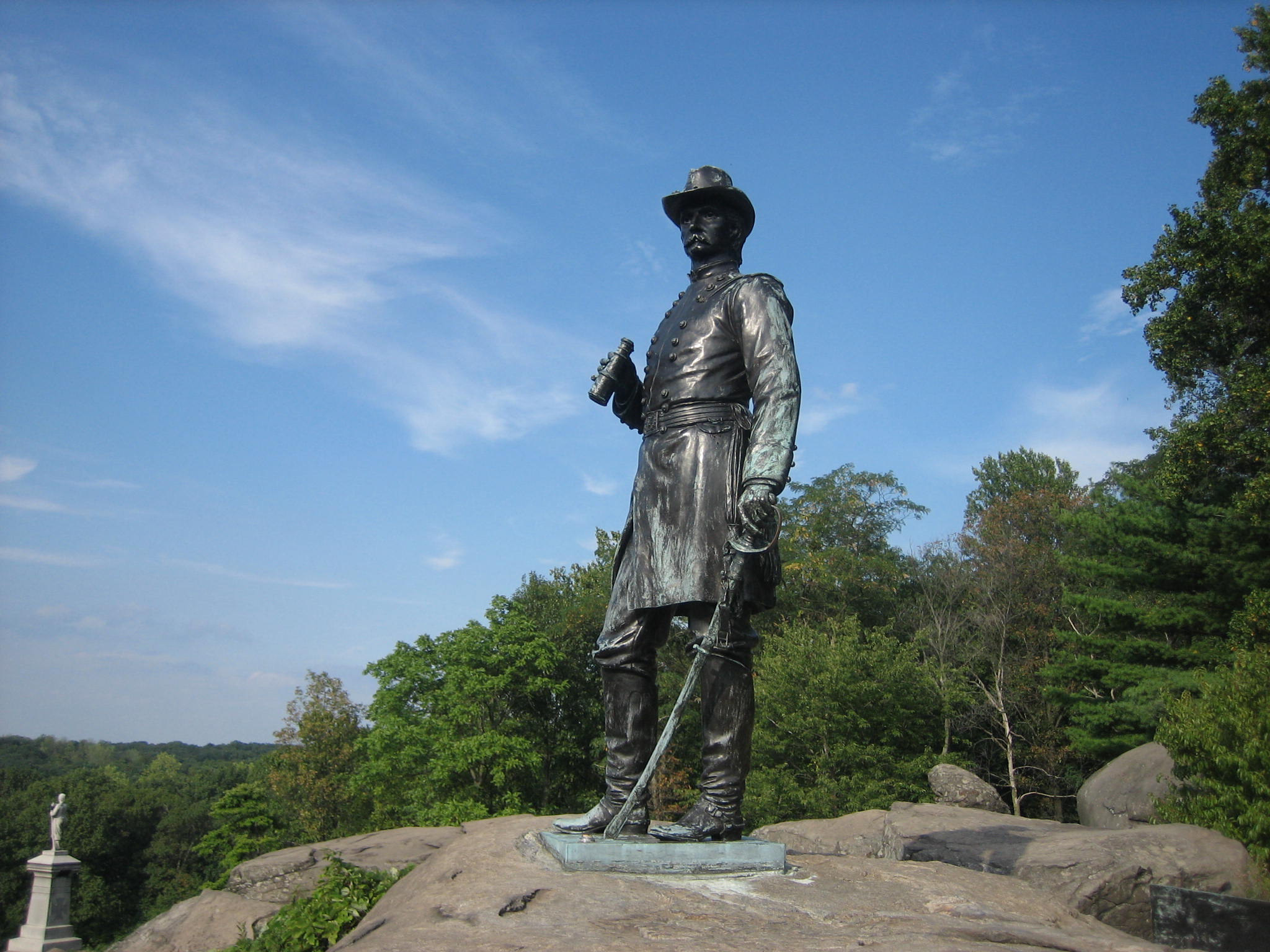
Statue of Maj Gen. Warren atop Little Round Top. 
The general was called the "Savior of the Union" by 
the northern press for recognizing the hazard if 
CSA troops had gained possession of the hill.
On July 2, the second day of the battle, Maj. Gen. Governeur Warren, chief engineer of the Army of the Potomac, went to the peak of LRT to observe the battlefield and was shocked to discover that the hill was unoccupied. Spotting CSA formations maneuvering to occupy it, Warren sent an urgent notice to Col. Vincent Strong of the 1st Division, V Corps, who immediately sent a brigade to the area.

The 20th Maine wound up gaining the summit of LRT, arriving only 15-20 minutes before the Confederate regiments, who promptly attacked. The Maine troops were commanded by one of the most remarkable military figures America has ever produced. Colonel Joshua Chamberlain, the 20th Maine's commander, had no military experience or training before the war, spending his life in the bookish realm of Bowdoin College, where he taught classical studies and was an ordained minister.

Maj. Gen. Joshua Chamberlain
The battle of Little Round Top began his reputation but there was much more to come in the war for him. By war's end, he had been wounded six times. He was the only man in the Union army promoted to a higher rank (brigadier general) while a battle literally raged around him, this by Gen. Ulysses Grant at Petersburg. President Lincoln later brevetted Chamberlain to major general.

At Appomattox, Grant appointed Chamberlain to command the Union troops receiving the surrender of arms and colors from the various Confederate formations, probably the highest honor Grant could have conferred on any officer. Chamberlain went on to serve as governor of Maine and president of Bowdoin College. He was somewhat belatedly awarded the Medal of Honor for his command at LRT, receiving the decoration in 1893. He died in 1914 at age 85, the last Civil War soldier of either side to be counted as dying of wounds, having never fully recovered from his grievous battle wounds.

On July 2, 1863, Col. Chamberlain took 386 soldiers to the top of LRT. Within about an hour, 29 were dead, 91 wounded, and 5 missing, losses of one-third of their strength. The two CSA regiments had been repulsed with heavy losses themselves. The 20th Maine held the hill through the next day, although by then the center of the battle had shifted to the center of the Union line, where three divisions of CSA infantry attacked and were repulsed with very heavy loss. Since that day, the 20th Maine has been credited with, minimally, preventing the Union line from being turned by the Confederate troops which, it has been said for 150 years, would have meant the rout of the Union army at Gettysburg.

Had the Union lost LRT, it is universally acknowledged, none of the events of July 3 would have transpired as they actually did. The heavy losses the Army of Northern Virginia suffered on that day would not have occurred. The way instead would have been free for Gen. Robert E. Lee to advance the army toward Washington, D.C., with the battered Army of the Potomac offering only ineffectual resistance. Hence, the popular imagination holds that Chamberlain and the 20th Maine actually saved the Union itself from defeat.

Sorry, no.

In fact, a compelling case can be made that the battle for Little Round Top, for all its incredible bravery and lethality, was nothing more than a local action with little actual effect upon the battle of Gettysburg as a whole, much less upon the fate of the whole Union.

When I was finishing my military career in the 1990s, I worked for Maj. Gen. Peter Berry, a Maine native and devoted Chamberlain fan. He even had a bust of Chamberlain in his office and owned some of Chamberlain's original papers. Maj. Gen. Berry was also a close friend of one Brig. Gen. Nelson, who was the chief of military history for the whole Army. (He was a real historian, too, with a Ph.D. in the field from Princeton and published books and monographs.)

So the two generals got all us staff officers on an Army bus one day (we were stationed in Washington) and off we went to tour the Gettysburg battlefield, conducted at every point by the US Army's chief of military history, which would seem to me to be as about an authoritative docent as you could get. Brig. Gen. Nelson explained early on that as a Nebraska native, he had no apologist position for either side.

As we stood near the Warren statue at Little Round Top, Brig. Gen. Nelson explained the course of the action there and then why it didn't matter much in the outcome of the battle. The terrain at the time was  wooded. The summit of the hill was mostly cleared, but there was no road up the hill and the ground was still timbered in many places and generally very rough. Nelson pointed out that although LRT enfiladed the southern half of the Union line, small arms fire against the Union lines would have been wholly ineffective because of the engagement distances. Had the Confederates taken LRT, Nelson said, they would have had excellent observation of the disposition of Union formations, which would have been a real advantage.

But the Union commander, Gen. George Meade, would have adjusted his tactics and lines accordingly and almost certainly would have sent troops to attack LRT. A larger hill nearby, called Round Top (later, Big Round Top) was already in Union hands (though fighting for its possession continued until the next day). Artillery atop that hill could have effectively bombarded CSA troops on LRT, also.

No, said Nelson, the only way LRT could have afforded the CSA a location from which to inflict actual damage upon Union forces was artillery fire upon the Union line. But that would have required the Confederates to clear perhaps hundreds of yards of wooded terrain, irregular and rough, all uphill, then drag the cannon and ammunition up. This would have been no easy task as an exercise, but in actual combat, under fire or attack, probably could not have been accomplished at all and would have taken well into July 3 to get done at in any event. And Lee could not have afforded to wait on it.

Bottom Line: the battle of LRT has remained in the public imagination as a decisive action of the whole war. But in fact, its outcome more likely than not did not affect even the outcome of the battle. Here is an interactive, chronological map of the Gettysburg battle. A clip from the movie, "Gettysburg," which shows the 20th Maine's final, desperate and successful attempt to stave off defeat, is below.

.

And finally, speaking of things Civil War, there is the fabled "rebel yell." The largest Civil War veterans reunion ever held was at Gettysburg on the battle's 50th anniversary in 1913. More than 50,000 Civil War veterans of both armies attended, though not all had fought at Gettysburg, of course.

One story of the 1913 reunion I read said that when thousands of the Southern veterans lined up before Cemetery Ridge and together wailed out the rebel yell, a loud moan of despair arose from the Union veterans on the ridge. PTSD?

The elderly Confederate line advanced at a walk while the Union veterans crouched behind the stone wall of The Angle and other places along the old defensive line. No one else made a sound. When the two formations were only a dozen feet apart, suddenly all semblance of old military discipline was broken and the former enemies embraced and shook hands and slapped each others' backs.

There is a recording, purportedly of an elderly Confederate veteran giving the rebel yell. His name was Thomas Alexander of the 35th North Carolina Regiment, who made the recording in 1935 for a radio station at a regimental reunion. Here is the recording, followed by a contemporary digital special-effects manipulation of Alexander's yell to emulate that of a whole infantry company.


  Bookmark and Share

Wednesday, July 3, 2013

The "right of the people peaceably to assemble" doesn't mean Christians

Rehoboth Denies Free Speech and Freedom Rally
When asked in writing for a permit to hold a beach service in Rehoboth, Pastor Robert Dekker recieved this reply: 
"I am so sorry to inform you that I cannot grant your request to have church services on the public beach in Rehoboth. I cannot mix Church and State. I trust you understand. Wishing you the very best." 
The church is saying "Regardless of your faith, all people should be hightly concerned over this civil rights violation" - what are your thoughts?
After being denied a "permit" for a church service on Rehoboth Beach a few weeks ago, Pastor Robert Dekker of New Covenant Presbyterian will be preaching a public sermon on July 4 at 930am entitled "A line in the sand". This sermon will be preached on the beach at the end of Rehoboth Avenue. The public is invited to assemble peacefully.
What are your thoughts?
http://www.delaware1059.com/features/062813-ncp.mp3
Here's the church flier
http://www.delaware1059.com/features/Church.pdf
So this does not mean anything any more, I guess:

AMENDMENT I

Congress shall make no law respecting an establishment of religion, or prohibiting the free exercise thereof; or abridging the freedom of speech, or of the press; or the right of the people peaceably to assemble, and to petition the government for a redress of grievances.
That the First Amendment's restrictions are directed at the US Congress does not matter. Because of the doctrine of "incorporation," the Bill of Rights applies to state law as well as federal law.

Where is the ACLU when you need it?

Bookmark and Share

Are we first in the universe?

Enrico Fermi was one of the leading lights of physics in the 20th century. About mid-century he pondered the possibility of life on other worlds and calculated that once a species achieved rudimentary space travel technology, it should be able to reach the farthest points of the Milky Way galaxy in only five million years.

Since the galaxy is billions of years old, he expressed what became known as Fermi's Paradox by asking a simple question, "Where is everybody?"

The belief that the universe must be teeming with life, and much of it must be highly intelligent, has come to be known as the "theory of mediocrity" of the Earth and its inhabitants. It is the idea that there is nothing exceptional about our planet, its life forms and especially homo sapiens, that we are all merely average examples of that found across the galaxy.

That belief (which has no actual scientific data to back it up) gave rise to the still-ongoing SETI project (Search for Extraterrestial Intelligence). However, SETI continues to come up empty and some of its researchers are starting, perhaps, to ponder a shocking possibility - that homo sapiens is one of the first, maybe even the only, highly-intelligent life form to have developed in the galaxy.

Science writer Mark Thompson explains that even a 14-billion-year-old universe may not be old enough to result in planets teeming with life, especially intelligent life.
It seems that the evolution of stars precluded the formation of rocky planets much before the appearance of Population I stars. If that is the case, and adding a generous margin for error, it looks like the first planets like Earth would have formed no earlier than 8 billion years ago. 
If that is true, then it may well be that we are not necessarily the first life, but perhaps amongst the first intelligent life (as we know it) to evolve.
Furthermore, there is no teleology in evolution theory. No outcome is inevitable, there are no such things as "higher" life forms. There is only survival, or not. Hence, technological, inventive beings are not a rational or inevitable development of evolution at all. There is no "rational" development of life in the first place and no evolutionary outcome is inevitable in any way.

Harvard biologist Ernst Mayr has pointed out that since life first appeared on Earth, there have been an estimated 50 billion species. And yet only one, us, has developed high intelligence. Mayr says that such intelligence does not obviously offer a species survival advantage and hence may be so rare that homo sapiens may be a "one off" in the universe.

In 2011 I put together a slide presentation for the topic to discuss Fermi's Paradox at church. You will probably be surprised at the conclusion. Here 'tis:


But for argument's sake, let us stipulate that in the known universe there are at least 200 billion species that are at least as intelligent as homo sapiens. Sound like a lot? It averages only one per galaxy.

Bookmark and Share

Sunday, June 30, 2013

Syrian "rebels" slaughter Catholic priest

Christian martyrdom is not only an ancient phenomenon.
On Sunday, June 23 the Syrian priest François Murad was killed in Gassanieh, in northern Syria, in the convent of the Custody of the Holy Land where he had taken refuge. This is confirmed by a statement of the Custos of the Holy Land sent to Fides Agency. The circumstances of the death are not fully understood. According to local sources, the monastery where Fr. Murad was staying was attacked by militants linked to the jihadi group Jabhat al-Nusra.
Father Francois Murad,
martyred in Syria
This  was a deliberate attack and targeted murder. The jihadists (read: al Qaeda) brutally beheaded Fr. Murad and posted  an explicit video of the killing. More info: Syrian Jihadists behead Catholic priest

This will not deter the Obama administration from pushing ahead to supply military assistance and materiel to the Syrian "resistance," which is completely dominated by al Qaeda. In fact, Secretary of State John Kerry has already pushed for the United States to directly bomb Syrian government targets.

 Helping the Syrian rebels would be like helping Frank fight Jesse over who would run the James gang. The murder of this priest is a tiny harbinger of the kind of bloodbath to come if the Assad regime falls.

Thursday, June 27, 2013

What we need to unlearn

Some thought-provoking stuff from the Paducah district of the Memphis Conference of the UMC, one essay by the district superintendent and the other by the district's lay leader.

First to be published was the Rev. Sky Sky Lowe McCracken's essay, "Things for United Methodist preachers to unlearn..."

Then Susan Sadler Engle's essay, "Things for United Methodist laity to unlearn — from a layperson’s POV"

Supreme Court and same-sex "marriage"

Opinions are abounding on the consequences of the Supreme Court's rulings issued yesterday on the federal Defense of Marriage Act (DOMA) and its dismissal of a defense of California's Proposition 8 (a ballot initiative that banned same-sex marriage (SSM) in California).

In the DOMA case, the Court struck down Section 3 of the law but left the rest of the law intact. The struck section forbade federal recognition of same-sex couples as married, reserving it for only male-female married couples.

In the Prop 8 case, the Court ruled that the challenge to a lower court's ruling invalidating Prop 8 had no standing before the Court because the plaintiffs were private citizens who had no standing to mount the challenge. This left the lower court's ruling unaffected and Prop 8 remains therefore overturned by the lower court.

So what is the potential effect on the United Methodist Church? According to our Book of Discipline, which is our canon law, UM clergy will not perform any type of ceremony validating same-sex "marriage," no matter where performed or under what name they may be called. Furthermore, such ceremonies may not be performed on any UM Church property, no matter who officiates, Methodist or not.

I hope to post a thorough response soon, but for now, here are some links that I commend to you.

UM Reporter: "US Court rulings impact same-sex couples"

My own relevant post, "State should do weddings, Church marriages"

"A secular argument against same-sex marriage"

"IRS could revoke non-profit status for religious institutions over same-sex marriage"

"The Supreme Court’s Marriage Decisions by the Numbers," by the conservative Heritage Foundation, which says nothing much has changed as the result of either ruling.

"Justice Anthony Kennedy's contempt" at Politico

"Marriage Is Dead And The Church Is Next," at National Catholic Register

"The Impact of Today’s Gay Marriage Decisions," by Constitutional Law Prof. Ilya Somin.

And don't overlook, "The Case for Polygamy" at Daily Caller

"Gay lobby’s next target: Benefits in all 50 states" at The Hill

Git yer tinfoil hat on, folks


Ok, this is going to be a very unusual post for me because the topic is UFOs. So get your tinfoil hat on and take a ride.


This all started when I was searching YouTube for national-security related vids when a search result caught my eye, entitled, UFO Alien Disclosure by Canadian Minister of Defense May 2013. (Apparently this video is not embeddable.)

The former Canadian defense minister in question is Paul Hellyer, who served in that role (equivalent to the US secretary of defense) in the 1960s. In this and other videos, he states unambiguously that UFOs are non-terrestrial craft, directed by extra-terrestrial, highly intelligent beings. That makes Mr. Hellyer the most senior person I have ever heard of who claimed this.

(I personally lean toward the side of the scientists who say that the odds of human beings having come into existence are so incredibly remote that concluding homo sapiens is alone in the universe is quite reasonable.)

Without offering here any opinion of whether Hellyer's claims have merit, in a different interview he gave he made reference to a book written by someone named Corso, an American colonel. Hellyer said that an American Air Force general told him that every word of the book was true. Hellyer said he had no way to assess the veracity of the book's claims personally, except that being a defense insider the language of the book rang true and that the contexts of the book were convincing.

It was easy to find the book on Amazon, especially since it is the only book that the late Lt. Col. Phillip Corso wrote. It's called The Day After Roswell. Since it was only $6 on Kindle, I downloaded it.

Again, I am not here affirming or debunking Corso's claims (he died in 1998 at age 83). But I kept  Hellyer's observations in mind about how the book read like it was written from an "inside baseball" perspective. And Hellyer is right.

Corso served as a White House member of the National Security Council in the 1950s and as deputy of the US Army's Foreign Technology Office in the Pentagon from 1960-1963. He claims in the book that his personal office in the Pentagon held the cabinet in which was stored the Army's files of what really happened at Roswell and some actual artifacts from the UFO that crashed there. Exploiting alien technology for mass production for military and later civilian use was his main job there.

At any rate, Corso says that all the services distrusted the CIA (Corso says that as an intelligence officer he knew the CIA was well penetrated by the Soviet KGB). But the part that stuck me as absolutely authentic and from someone who had truly "been there" was this passage:


This is so cogent, so authentic that it is what makes me think that whether Corso's UFO claims are objectively true, Corso was relating what he believed to be true. Accounts I have read by former Soviet spies confirm what Corso says about the deep suspicion the KGB and the Communist Party had of each other. (In fact, the Party, the Soviet army and the KGB were all highly suspicious and extremely competitive of each other.) Corso spends a lot of time explaining the politics of the multiple duchies inside the Pentagon and the strategies they all employed to "steal the bacon" from one another - much like their Soviet counterparts except without the Soviet's level of hostility. It was no different in Corso's years at the Pentagon than it was during mine there, 30 years later.

Final point. Here is what Corso says are the main exploitations the United States gained from the Roswell crash.

Project Horizon was the Army's plan for a permanent moon base that never got farther than the drawing board. HARP, despite its tinfoil-hat status today, was nothing more than a concept to send base materials to the moon cheaply. It did move from drawing board to testing, but no farther.

Not all these technologies were derived directly from alien technology. Depleted uranium was no alien invention, it was (and is) produced by nuclear-power plants as spent fuel. Army R&D realized that because of its extremely high density, solid projectiles made of DU, traveling at hypervelocity, would be devastatingly powerful at impact. This was ultimately affirmed during the Gulf War of 1991 and again in Iraq and Afghanistan by US tanks firing such rounds at a mile per second. But the reason DU was developed as a weapon, Corso says, was to shoot down UFOs.

Same with particle-beam weapons that work by focusing beams of electrons against a target. It was not a technology found on the Roswell craft. Hypothesizing that the craft was likely brought down by a lightning strike, which is a high-energy electron beam, research was oriented toward, basically, generating our own lightning. The whole point of President Reagan's Strategic Defense Initiative, in fact was to develop anti-UFO weapons for which defense against Soviet ICBMs was a happy bonus.

Whether you consider Corso credible or not, it is fascinating reading, especially if you already have some familiarity with the military or political subcultures of Washington, D.C.

Bookmark and Share

Friday, June 21, 2013

Constitutional amendment would strip churches of rights under law

They are at it again, this time in the US Senate.

I wrote at length in 2011 of US Rep. Jim McGovern's (D.-3rd District, Mass.) proposed "People's Rights Amendment" to the US Constitution that would define "person" or any part of "the people," as the Constitution uses the term, to mean only human beings. 

That means, as McGovern stated explicitly, that any kind of corporation, including incorporated churches (which almost all are), would have no standing in courts as possessing rights under the law. So if, for example, your city government wanted 30 feet of your church's property to widen a road, the city can just show up one morning and start bulldozing. As the church is a legal non-entity regarding property rights, the legal doctrine of eminent domain would not apply. 

And your church would not be able to contest the taking in court since, as a Constitutionally-defined non-person, the church would have no legal standing to file a suit, anymore than could a bird whose nest was destroyed by the bulldozers.

Before you say I am going overboard, go to the 2011 post and read the analyses of Constitutional scholars I quoted at length, especially UCLA Law School Prof. Eugene Volokh, one of the most-frequently cited legal scholars in America (including by US Supreme Court justices). 

Well, as we used to say in the Army, "BOHICA!" - Bend Over, Here It Comes Again. U.S. Sen. Jon Tester (D.-Mont.), is sponsoring essentially the same amendment in the US Senate, though without the Leninist title McGovern gave his version. Senator Chris Murphy (D-Conn.), is co-sponsor.

Tester's web page about the amendment is here.

The full text of the resolution to Congress proposing the amendment is here: Tester's Constitutional Amendment.

Here is Prof. Volokh's commentary on the Tester amendment, with a key phrase boldfaced and super-sized.
The proposed amendment would authorize Congress, states, and local governments to, for instance, (1) restrict what most newspapers publish, (2) restrict what most advocacy groups, such as the ACLU, the Sierra Club, and the NRA, say, (3) restrict what is said and done by most churches, and (4) seize the property of corporations without just compensation. (It might also allow restrictions on the speech of unions, depending on whether they are seen as “corporate entities.”) 
Nearly all major newspapers and magazines are owned by corporations; the same is true of book publishers, movie studios, record labels, and broadcasters. Indeed, if you want such entities to be able to raise money for their operations through the stock market, you have to have them be organized as corporations. Likewise, most nonprofit organizations are organized as corporations — that, too, makes sense, since it makes sense to have the ACLU run as a corporate entity rather than as a sole proprietorship owned by one person, or a partnership owned by a few people. Churches are likewise often organized as corporations, sometimes with a special sort of corporate status. 
Under the proposed amendment, all these groups — as well as ordinary businesses — would lose all their constitutional rights. Instead of “strict scrutiny” for content-based regulations of the press or of nonprofit advocacy groups, Congress and state and local governments would be free to impose any restrictions they “deem reasonable.” 
And section 3 will do nothing to reinstate any such rights, because it protects only “the people’s” rights, and “the people” is defined in section 2 to expressly exclude corporations. Nor would section 3 protect corporate-run newspapers or advocacy groups on the theory that restriction those organizations’ speech would deny the constitutional rights of individual reporters or organization leaders. The government would still be freed to restrict those reporters and leaders from speaking using corporate resources, which is to say speaking in the pages of the newspaper or using the offices or assets of the organization. (After all, when corporations speak about elections — the thing that the Senators are, I assume, trying to stop — it is also individual managers who speak using the corporate form; but the argument for restricting such speech is that the managers should speak only using their own resources, not corporate funds.) 
So goodbye, First Amendment protection for the New York Times, CNN, the ACLU, the NRA, and the Catholic Church. Goodbye, any right to just compensation when a corporation’s property is taken — whether the corporation is a large business or a small mom-and-pop company. Goodbye, any rights to due process when a corporation’s property is seized. Goodbye, any protection for corporations (again, even small family-run businesses) from unreasonable searches and seizures, or excessive fines. That’s what Senators Tester and Murphy’s amendment calls for.
So: am I too paranoid, or not paranoid enough?

Here is Tester's own explanation:


Bookmark and Share

Wednesday, June 19, 2013

Say No to Syria Intervention!

Secretary of State John Kerry leads the war faction in the Obama administration, insisting that American warplanes should begin bombing Syria right away.
In the past few days, the White house announced that it will begin sending military materiel to Syrian rebels. This decision comes in the wake of the administration's determination that Syria's ruling Assad regime had used chemical weapons, including the nerve agent sarin, on the insurgents. This use constituted Assad crossing one of the Obama administration's "red lines," so named because crossing them would be seen as an intolerable act that could not be passively encountered by the United States.

International agencies estimate that the chemical attacks killed 100-150 people. As IBD puts it, "That's in addition to the more than 90,000 Syrians killed by conventional weapons that didn't seem to prompt any action."

Government Executive reports that Secretary of State John Kerry pushed hard for the United States to bomb key Syrian targets after the chemical use was confirmed.
On Thursday, President Obama confirmed what reports had been speculating for a few weeks: Syrian President Bashar al-Assad had used chemical weapons, notably sarin gas, on his own people, and tripping the president's "red line" that would rouse the United States to greater action. The response includes arming and training the rebels. It turns out that Secretary of State John Kerry also wanted the response to include an air strike on Syrian airfields, according to Jeffery Goldberg at Bloomberg View. 
According to Goldberg, Kerry's "vociferous" thoughts on the matter were not received well by Chairman of the Joint Chiefs of Staff Martin Dempsey during a meeting in the situation room last Wednesday.
(My own experience of working in the Pentagon from 1990-1993 is that the state department is considerably quicker to reach for the sword than the defense department.) The reason Kerry's push did not prevail is that Joint Chiefs Chairman Gen. Martin Dempsey made it clear that a few runs on target would do no good, that if the bombing was not be be merely symbolic, it would require a sustained, large effort of no short duration.

Secretary Kerry lost the debate that day, but the desire is out in the open: there is a powerful faction within the Obama administration that wants direct military action by the United States against the Assad regime.

My position is that no just rationale can be proffered for American intervention in the civil war, whether by supply, air campaign or boots on the ground. Such action fails to meet the standards of the two major influences that have shaped American military action since the country's founding: Just War theory and Realpolitik, or foreign-affairs Realism.

Realpolitik and the national interests

Realpolitik is the easier of the two to deal with, so I'll start with it. Realpolitik "refers to politics or diplomacy based primarily on power and on practical and material factors and considerations, rather than ideological notions or moralistic or ethical premises." The United States has (let us be thankful) not been skilled in its practice - both the Bay of Pigs and Vietnam War come to mind as two prominent, recent examples.

In Syria, however, even if the Obama administration was inclined toward Realpolitik it would find there is no upside for American power interests in intervention. Simply put, the outcome of the  civil war there is wholly immaterial to the national-security interests of the United States. The fight is not a fight between repressed Jeffersonian democrats and their cruel oppressors. It is a fight between what we may understand as a Stalinist regime in power and a fascist movement that wants to replace it.

There are no good guys in this war. It is not a war about repression vs. liberty. It is a war about who will do the repressing. As Atlantic Council managing editor James Joyner puts it, "Syrian Rebels Today, Syrian Taliban Tomorrow."
Radical Islamists now dominate the Syrian opposition. And you’re arming them. Reuters (“Syria’s Islamists seize control as moderates dither“):
During a 10-day journey through rebel-held territory in Syria, Reuters journalists found that radical Islamist units are sidelining more moderate groups that do not share the Islamists’ goal of establishing a supreme religious leadership in the country. 
The moderates, often underfunded, fragmented and chaotic, appear no match for Islamist units, which include fighters from organizations designated “terrorist” by the United States.
The Syrian resistance, such as it is, is dominated by foreign al Qaeda elements. If the resistance loses, Assad's Syria will become even more of an Iranian client than it already is. If the resistance wins, Syria will be a a Muslim Brotherhood client with a strong share of Saudi Salfism thrown in for good measure.

So what is the Syrian civil war really about? It is another round in the centuries-old conflict between Sunni and Shia Muslims (in which Assad is ironically neither). Understand, the conflict between Sunnis and Shias is not a religious conflict, it is political. The Islamic-theological differences are actually rather minor. They dispute who should be authoritative in setting doctrinal standards for Muslims, but this springs from a centuries-old schism over Mohammed's successors as leaders of Islam. Islam itself is basically identical for both.

The center of Shia Islam is Iran, which named the United States the Great Satan in 1979 (Israel, by contrast, was only named the Little Satan). Al Qaeda began as a Sunni movement arising from the local jihad against the Soviet army declared by a Palestinian Sunni cleric living in Saudi Arabia. The occasion was the USSR's invasion of Afghanistan in December 1979. Out of the Islamic resistance to the USSR, led by Saudi Arabia and Pakistan, was born the organization that Osama bin Laden would use to form al Qaeda, whose hatred of all things American need not be explained further.

This history helps illuminate why both sides in Syria can each hate the United States as much (or more) as they hate one another. Whether the rebels prevail or Assad, neither outcome is inherently more desirable for the United States than the other. So simply from a Realpolitik point of view, there is no upside for the United States to intervene in any fashion.

There is, however, considerable downside, not least would be the expenditure of American blood and treasure to achieve goals that are unclear, mostly undefined, in a campaign of of indefinite duration, for no possible outcome that benefits the security of the country.

Syria Intervention and Just War theory

The failure of Realpolitik being understood, we may confront the moral issue with greater probity. The issue is simply stated: Does the violence and deaths of non-combatants in Syria justify the United States to kill Syrian soldiers (an inevitably civilians) and raise the level of violence there to even greater heights (there being no more violent or destructive military on the face of the earth than America's)?

That is really the central question of the use of force within the framework of Just War theory, devised by the Roman Catholic Church over the centuries between St. Augustine and St. Thomas Aquinas, who gave the theory its final polish. JWT, as I will short-type it henceforth, holds that there are only two circumstances in which war may be justly fought:
  • Actual self defense against aggression
  • To defend the innocent and otherwise defenseless against aggression
Catholic author Nicholas G. Hahn III says that Syria meets the latter criterion. In trying to rebut Senator Rand Paul's speech against intervention, Hahn writes,
Should Paul know anything about Augustine or Aquinas, he would know that war is sometimes necessary and a moral obligation. 
Aquinas quotes Augustine approvingly that a just war is "one that avenges wrongs, when a nation or state has to be punished, for refusing to make amends for the wrongs inflicted by its subjects, or to restore what it has seized unjustly." Even the United States Conference of Catholic Bishops, in its 1993 statement, defined casus belli where force may be employed to "correct a grave, public evil." 
Perhaps Paul should also read George Weigel's First Things primer on how pre-emption is simply another word for defense -- and defense, after all, fits perfectly within the just war tradition.
Now, I have been reading George Weigel's tomes on JWT and related issues for many years and I join Mr. Hahn in my admiration for his insights. But Hahn and his ideological allies simply fail to make a case here. Here is why.

JWT conceptually exists in three parts:
  1. Just cause for starting the war.
  2. Just conduct of the war.
  3. Just ending of the war.
Criterion 1 simply means a nation may not justly go to war for selfish gain hiding behind a smokescreen of moral language. That Mr. Hahn injected the word "pre-emption" into a discussion of moral necessity sort of gives the game away. Preemption (hit them before they can hit you) is not wholly without moral content but it is mainly a tactic of Realpolitik. Just whom would the United States be pre-empting? Assad? Al Qaeda? Iran? Russia?

Criterion 2 usually understood to mean that conducting the war may not be done more unjustly than the injustice sought to be remedied. This is not a matter of counting corpses killed by one side or the other and saying (as American critics of our entry into Afghanistan post-9/11 did) that we may not take more lives protecting the innocent than the number of innocent lives lost at the hands of the aggressors.

As my friend, Catholic cleric (and US Army War College graduate) John Krenson explained to me, if the cause is just and the objectives are just, then just conduct is the minimum violence necessary to attain the just objective. And that minimum violence might be very great, indeed.

This is known as the problem of the "Sanguinary Calculus," meaning how much suffering and death we may justly inflict in order to bring about the objective we desire. I would appeal to my readers to consider the years of American fighting in Iraq and Afghanistan and ponder whether they give us any cause for confidence. Would we still be in Syria eight to 10 years from now?

Let us remember Douglas MacArthur's warning that, "Prolonged indecision is never a just aim of war."

The sanguinary calculus must also include American lives. I would like to hear advocates of intervention tell me the plea they give to their own children why they should join the Marines to go fight Assad in Syria and what they will say when their children are killed or maimed. (For the record, I thought that invading Iraq was clearly justified by JWT and my eldest son did fight in Iraq as a Marine. My second son is today an officer in the Air Force Reserve.)

Or is this moral crusade only to be fought by children of others? As there is no American national-security interest at stake at all, I believe I am justified in insisting that intervention advocates put their own blood on the line and not simply outsource their morality.

I have not yet encountered an intervention advocate explain exactly why Syria is a special case. If Syria is a "yes," why would North Korea be a no? After all, the Kims' successive regimes have literally starved to death millions of their own subjects. Does not that call more strongly for American direct action to rescue?

In fact, the list of places in the world where the US would be morally justified in mounting military action to defend the innocent is very long. But it would be impossible for us to do so. And that requires exercising another principle of war, distinction or discrimination. If not everyone, then who and why? If there is an especially compelling reason we should intervene in Syria and not Lower Zambezi, then let advocates make it. But they do not even attempt.

There is neither a strong moral nor national security case to be made for US intervention. Intervention fails both just war theory and Realpolitik.

Endnote: On the other hand, Foreign Policy's Daniel Drezner says that in fact the Obama administration has been engaged in Realpolitik in Syria and that the recently-announced plan to send arms to the rebels is the logical extension of it.
[T]his is simply the next iteration of the unspoken, brutally realpolitik policy towards Syria that’s been going on for the past two years.  To recap, the goal of that policy is to ensnare Iran and Hezbollah into a protracted, resource-draining civil war, with as minimal costs as possible.  This is exactly what the last two years have accomplished…. at an appalling toll in lives lost
This policy doesn’t require any course correction… so long as rebels are holding their own or winning. A faltering Assad simply forces Iran et al into doubling down and committing even more resources.  A faltering rebel movement, on the other hand, does require some external support, lest the Iranians actually win the conflict.  In a related matter, arming the rebels also prevents relations with U.S. allies in the region from fraying any further.
Unlike Mr. Drezner, I don't think the administration is clever enough for this.

Update: David Goldman in an Asia Times op-ed points out that there is no good end in Syria no matter what the Western powers do.

Bookmark and Share