Showing posts with label Bible. Show all posts

Monday, April 29, 2019

Does God have a plan for your life? Well, not really.


Well, not so fast. Is this claim actually supported by Scripture?
Immediately after the Day of Pentecost and its empowerment of the church by the Holy Spirit, Peter and the other disciples began preaching the Gospel of Jesus Christ in Jerusalem. Acts records that "great numbers of both men and women" were converted to faith in Christ by their preaching. As a result, the Jewish high priest and some allies on the Jewish high council had the apostles arrested and locked in prison.
But during the night an angel of the Lord opened the prison doors, brought them out, and said, 20 'Go, stand in the temple and tell the people the whole message about this life.' 21When they heard this, they entered the temple at daybreak and went on with their teaching" (Acts 5:19-21).
When the council discovered it, they had the Temple police bring Peter and the others to stand before them.
Acts 5:27-32:
   27 When they had brought them, they had them stand before the council. The high priest questioned them, 28 saying, “We gave you strict orders not to teach in this name, yet here you have filled Jerusalem with your teaching and you are determined to bring this man’s blood on us.”
   29 But Peter and the apostles answered, “We must obey God rather than any human authority. 30 The God of our ancestors raised up Jesus, whom you had killed by hanging him on a tree. 31 God exalted him at his right hand as Leader and Savior that he might give repentance to Israel and forgiveness of sins. 32 And we are witnesses to these things, and so is the Holy Spirit whom God has given to those who obey him.”

“We must obey God,” the apostles said. I have to tell you, I am not impressed by those words. God commands it! That was what Osama bin Laden declared before 9/11, when he said that it is the duty of every Muslim to kill infidels wherever they are found. Since then al Qaeda, ISIS, and other such groups have made grisly work of what they insist is divine duty, most recently a week ago in Sri Lanka.
Now, it's easy to point fingers at Muslim terrorists. In fact, it's required, but it doesn't get us Christians off the hook. When I was a boy, I worked a couple of summers in the now-gone Woodlawn Market in Nashville. The owner was the staunchest racist I ever met in person. He was absolutely ironclad in his belief that God's will was that black people be oppressed. He was convinced beyond persuasion otherwise that black skin was the mark of Cain. Cain was the first murderer in the Bible, whom God sent to exile with every hand against him. Racism was to Pappy literally a holy duty.
I am guessing that most of us can think of someone who was convinced he or she was obeying God in things we thought were disturbing, even shocking. So I read Peter's retort to the high priest as potentially troubling. "There's what you want and there's what God wants," Peter is saying. "And we obey God, not you."
That's real in-your-face stuff, and following verses explain that the officials there were so vexed at Peter's defiance they wanted to kill the apostles.

I am going to take the high priest's side here, at least for a moment. I don't defend his desire to have Peter killed. But the high priest and I have something in common. We're both clergy of well-established religions. When something upsets the apple cart of proper religious order, we get our hackles up and immediately set about trying to bring it under our control.
Of course, this makes us no different from business managers or most parents. But what makes the issue especially nettlesome for clergy is that we formally recognize that the Holy Spirit is supposed to be breaking in and upsetting our apple cart. In fact, I often think that one on the main reasons the Holy Spirit came to enliven the church on the Day of Pentecost was to stir things up and keep believers on their toes.
Nonetheless, there are some issues for all of us, the church assembled, to consider.
One is that if it is unacceptable to excuse sin by saying like Flip Wilson's character Geraldine, "The devil made me do it," then it is equally unacceptable to use a claim of divine mandate as an excuse for doing what oneself wants to do. Cathy and I knew a woman in Virginia who told us that she knew it was God's will for her to win the lottery because she would give more than a tithe of the jackpot to the church. True story.
"God requires it" has been used to justify everything from simple murder to mass murder to tyranny and oppression. So the claim that one is acting from divine authority deserves to be regarded with deep suspicion at least at first.

On the other hand there is a real chance that someone really might be acting under God's command, and therefore we must leave the possibility open.
So how to tell?
I think a crucial key is found in what Peter went on to say: “We are witnesses,” he said, to what we testify. Which is to say, God did not reveal Christ to me privately, but publicly, with others, all of whom attest to this truth.
This is important because the unambiguous testimony of the apostles in the New Testament is that Christian faith and practice are not solitary ventures. Everywhere the apostles went they did two things, never separated from one another: they brought people to confess faith in Christ as risen Lord and organized the new believers into churches.
The apostle Paul explained more than once that the body of Christ present in the world today is the aggregation of Christ's present disciples organized as the church. I have found no evidence in the New Testament that people can live Christian lives apart from the church belonging to Jesus Christ.
More than thirty years ago my pastor in North Carolina put it this way: "I won't tell you that you can't be a good Christian outside the church. I'll tell you that you can't be any kind of Christian outside the church." That statement struck me as pretty stark at the time. We Americans are stiff-necked individualists. We pretty much think that whatever we want to do we should be able to do on our own, but that's not how the New Testament sees it.
Anyone can be religious outside the church, but Jesus did not minister, teach, suffer, die and rise just to make us religious. Religions are a dime a dozen. Founding another one sure didn't require God's incarnation, or Christ's passion, death and resurrection. We are not called to be merely religious, but to be transformed and made anew in Christ's likeness – to be a new people, a new kind of community. So when we think God has some special demand for us, or someone makes that claim to us, we need to discern whether its context is related to the present body of Christ. Whom does the command serve, Christ or self?
And that leads to the second way to assess a claim that “God commands it.” It is the famous lawyers’ question, “Who benefits?” The apostles gained nothing from preaching Christ but severe tests of their character, their faithfulness, perseverance, and fortitude. All were killed but one for insisting that they had to obey God rather than human authority. They might have been killed the day of this passage had not a wise rabbi spoken against it. So, who benefited? By the standards of the world, none of the apostles did.
The experiences of the apostles and other devoted Christians through the centuries is that God play his cards pretty close to the vest. God’s commands often do not make sense to us or do not appeal to us. God generally leads us only one step at a time. So, I am leery of visionaries with grand plans, all filled in from start to finish, because I don't see in the Bible where God explains that he has
God did not give Moses a plan. He gave him a command.
a plan. He gives commands, such as telling Moses, "Go tell Pharaoh to let my people go," and that was that. When the Lord spoke to Paul on the Damascus road, he did not lay out Paul's apostolic mission to him, culminating in being crucified in Rome. Christ simply told him, "Now get up and go into the city, and you will be told what you must do" (Acts 9:6). Even Peter, in today's passage, had no sense of grand mission. He didn't tell the high priest, "God wants me to be the foremost of all his apostles and become the first bishop of Rome, founder of what will become the worldwide Roman Catholic Church." All he understood God wanted him to do was preach the Gospel. He started out a street-corner preacher and there is no evidence that on his own account that he thought God wanted him to be anything else.
God's commands are pretty simple, at least at first. Sometimes they may not make a lot of sense and leave one wanting to ask him, Why? But enlightenment is not the point; we leave that to the eastern mystics. Obeying God is the point.
Speaking of obedience, there are some basic commandments of Christ that are obligatory of all Christian people and churches wherever found. These commandments are not mysterious; they are clearly stated in the Scriptures: pray, give, love, forgive, help, worship. Bear one another's burdens, esteem others more highly than oneself. Love God, love neighbor. Be baptized. Consider our lives lost to the world and gained in Christ. Use all that we have to the glory of God and the building up of the kingdom of Heaven. These are the foundational commands God give us.
The story is told of a star college football player named Eddie. Almost every week the school paper had a photograph of Eddie leaping across the goal line for a touchdown or jumping high into the air catching an impossible pass. Oh, Eddie was good! The cheerleaders loved him. Eddie loved them back. 
One day, Eddie went to the coach and said, “Coach I’m not coming to practice anymore.” The coach said, “Eddie, are you quitting?” Eddie replied, “Oh, no, I’m not quitting. I’ll still dress for the games on Saturdays. But you know Mondays? Mondays you make us to do wind sprints. And Tuesdays is grass drills and strength training. Wednesdays is full contact practice. Thursdays is special team drills. I don’t like all that. I’m not going to do any of that anymore. But come game time, Coach, you can count on me. I’ll catch those passes, I’ll make those touchdowns, I’ll get my picture in the paper. And after the game I’ll go out with the prettiest cheerleader. I like all that! But man, I’m not going to suffer through your practices anymore.”
Now ask yourself whether come Saturday the coach sent Eddie into the game.
So, another test of discerning whether we are given a particular command from God is to ponder whether we have been faithful in carrying out God's general commands. If God cannot trust me do the basics, why would he command me to accomplish the special? 
Jesus said, "Whoever can be trusted with very little can also be trusted with much, and whoever is dishonest with very little will also be dishonest with much" (Luke 16:10).
But suppose you work through all those things and conclude that God indeed is giving you a special command or laying upon you a special obligation. What then? Then Peter's courage is a model. Peter had to know the tempers flaring at him and his fellow disciples. Before the council, recognizing the danger, Peter and the disciples stood their ground precisely because they were under God's mandate.
The pressures and excuses the world lures us to turn from following Christ are innumerable. They are also hard to resist because to say yes to Christ we must say no to something, or someone, else – for example, Sunday morning league sports (but now I’m meddling). But to obey God, staying on course is the only faithful option. Only coincidentally will the world at large approve of our faithful service, but that's okay. The world's applause is far more spiritually dangerous than its jeers.


New Testament scholar Robert Wall wrote (NIB) that Peter’s “heroic retort to the high priest" served “missionary ends.” Peter was a “witness to God’s salvation of Israel. He [was] not the leader of a movement of protest but a movement of God."
And that is what we are under God's command to do: proclaim salvation through Jesus Christ our Lord. May we be satisfied with God's direction for each day, not for our sake, but for the sake of those who know him not.

Saturday, December 9, 2017

Pope Francis and changing the Lord's Prayer


Pope Francis has announced to the Roman Catholic Church that they have been praying the Lord's Prayer wrong. (Catholics call the prayer the "Our Father," after the first two words of the prayer.)

Francis wants to re-word the phrase, "And lead us not into temptation," because it implies that God might lead us into temptation if God wanted. And as we all know, temptation is bad. Francis suggests that Catholics pray instead, "Do not let us enter into temptation".

Actually, both the traditional phrasing and Francis' rewording miss the point.

Matthew and Luke to do not agree exactly on the words of the prayer. In Matthew 6, the prayer is thus (New Revised Standard Version):
9  Our Father in heaven,
    hallowed be your name.
10     Your kingdom come.
    Your will be done,
        on earth as it is in heaven.
11     Give us this day our daily bread.[c]
12     And forgive us our debts,
        as we also have forgiven our debtors.
13   And do not bring us to the time of trial,[d]
        but rescue us from the evil one.[e]
The brackets are footnotes:
c. Or our bread for tomorrow 
d. Or us into temptation
e. Or from evil. Other ancient authorities add, in some form, For the kingdom and the power and the glory are yours forever. Amen.
Luke puts it this way, a somewhat shorter prayer:
Father,[a] hallowed be your name.
    Your kingdom come.[b]
3     Give us each day our daily bread.[c]
4     And forgive us our sins,
        for we ourselves forgive everyone indebted to us.
    And do not bring us to the time of trial.”[d]
The footnotes are:
a. Other ancient authorities read Our Father in heaven 
b. A few ancient authorities read Your Holy Spirit come upon us and cleanse us. Other ancient authorities add Your will be done, on earth as in heaven 
c Or our bread for tomorrow 
d. Or us into temptation. Other ancient authorities add but rescue us from the evil one (or from evil)
Note that the NRSV, a very recent translation (as translations go) does not use "temptation" at all. Why?

In Greek, the expression is καὶ mē μὴ εἰσενέγκῃς εἰς πειρασμόν, pronounced kye mē eisenenkēs hēmas eis peirasmon. The last word, peirasmon, does mean temptation and is used to mean that elsewhere in the Gospels. But the NRSV is correct not to use it here. 

In Matthew and Luke, Jesus is teaching his disciples what to expect for the rest of their lives as they follow his will: opposition, including lethal opposition. Jesus has already used peirasmon to mean "trial" in the prarable of the sower who went out to sow in Luke 8: the seeds that fall on the rock are those who “have no root; they believe for a while, and in time of testing (peirasmou) fall away.”

In teaching the disciples the Lord's prayer, Jesus is instructing them what to rely on as the build the Kingdom of God from its inception:

  • God is as close as a father. God is a person, not an impersonal influence.
  • God will provide for their essential needs
  • God will forgive their missteps and sins along the way, but they must be forgiving of others, too.
  • Pray for your work to be done before the time of trial.
  • But trust God to protect them from the demonic powers opposing them.
What is the time of trial?

Luke 4 relates that just after Jesus was baptized by John, he "was led by the Spirit in the wilderness, 2 where for forty days he was tempted by the devil." There, for "tempted," is that pesky word peirasmon again. This time in the desert was a defining time for Jesus, for the nrtemptations show that at stake was whether Jesus would be faithful to his identity, which Luke has just explained was announced by God, "You are my Son, the Beloved; with you I am well pleased" (Luke 3.22). 

In the desert, Jesus cannot both affirm his co-identity with God and yield to Satan's three lures, to care for himself, Jesus, first; to worship him, not God; and to test God's ability to save. These are not mere temptations. They are very serious trials for a famished and fatigued Jesus to endure. At stake here is whether Jesus will stay the course, or not.

This is probably the kind of forecast Jesus is warning his disciples about. True, Jesus may be referring in saying "the time of trial" to the end of the age, when he will return to place everything under his feet. But I don't think so. I think Jesus is saying, if I may paraphrase, "Pray that the work God places before you will be done before you face the ultimate temptation, which will be a great trial for you: whether to denounce me and leave the calling I will place before you, to go into the world and make disciples." 

This is not a certain reading, of course. But it's worth noting that Jesus also told his disciples that while they were accepting even death for following him ("Take up your cross and follow me"), even death was not the ultimate trial. Persecution, torture, execution are not trials in themselves, they are admittedly-horrific potential consequences of following Christ. No, the trial in the Our Father prayer is that which leads to abandonment of the Way, to exit the path that Jesus has already trod. The trial is spiritual, not physical-temporal, and Jesus promises elsewhere (i.e., Matt. 24.9-14; Mk. 13.9-13) that those who endure the time of trial without falling away will be saved. 

The apostle James reinforced this point, writing "Blessed are those who remain steadfast under trial (peirasmon), for when they have stood the test they will receive the crown of life, which God has promised to those who love him." Peter wrote, "Beloved, do not be surprised at the fiery trial (peirasmon) when it comes upon you to test you…. But rejoice insofar as you share Christ’s sufferings ..." (James 1.12, 1 Peter 12.13). 

So how to render this troublesome phrase, "lead us not into temptation"? By folding it into the greater theme of the whole prayer. If I were Pope, I'd offer this:

Our Father in heaven,
    your name is holy always. 
Bring forth your kingdom.
Your will be done on earth as it is in heaven.
Give us each day what we need. 
And forgive us our sins,
    as we also have forgiven those have sinned against us.
And do not bring us to the time of defining trial,
    but rescue us from those who oppose you.

This is more paraphrased than I would like. The challenge in translating biblical texts (or any foreign-language texts) is always to translate as succinctly as possible, to stay as true to the original text as one can. But that does risk losing nuance and context, which the author simply assumed the readers would already know. 

By the way, Holy Father, I am available for consultation for a very reasonable fee!

Sunday, February 12, 2017

We become what we focus on


The severest punishment God ever lays upon us is to let us have what we want.
"Where there is no vision, the people perish: but he that keepeth the law, happy is he."
Proverbs 29.18, King James Version

This is probably the most well known rendering of that short verse, but it poorly communicates what the verse is trying to say. The KJV was done in the very early 1600s and for today, it just is not a good translation.

"Vision" refers to spiritual sight, more properly, spiritual insight. The verse, properly understood in its context and intention, is actually one of the most important warnings and assurances in the entire Bible.

Try this: When the people lose sight of God’s will, they go astray, but they prosper when they keep God’s law.

"The people" in the verse does not refer just to a worshiping congregation, but in the context of its time, a national people, the people of ancient Israel. The verse is talking about national consequences of ignoring God and the benefits of cleaving to God's commandments.

Bible Gateway has a long list of different translations and renderings. The ERV's translation is probably the best: "If a nation is not guided by God, the people will lose self-control, but the nation that obeys God’s law will be happy."

One Hebrew word study I read said that the real thrust of the verse is that when the nation loses sight of godliness, it descends into anarchy. We become what we focus on. When we lose sight of God and God's will for our lives, we become ungodly. That never ends well, either for individuals, churches or nations.

Here is a key point: God commandments were revealed to humanity. We did not make them up. We are so far removed from their revelation that we think that morality, as we understand it, is the natural way that people live together. In fact, the societies around the ancient Jews and early Christians were brutal. The Romans considered mercy, charity and forgiveness to be vices, not virtues. Roman parents beat their children for the showing weakness of mercy. Human morality absent divine commandment is base and as Proverbs says, descends finally into anarchy. We will either rule our passions or be ruled by them. As St Paul put it, "God can't be disregarded" -- note well, not "should not be" or "must not be," but cannot be disregarded; it is not possible. He continued, "You will harvest what you plant."

Morally, our capacities are weighted toward the negative side of the scale. People intend greater good than they achieve. Treaties, alliances, aid organizations, political parties, civic groups, even churches – all begun for good reasons to accomplish good things, and all fall short of what their founders intended.

 Hence the necessity of God giving the moral law. My friend and former co-author Rabbi Daniel Jackson wrote, "There are obvious logical elements of the Law of Sinai that might be deduced logically (or rationally). Yet, much of the Scriptures is based on directives and rules that [we] would not have known if the Scriptures did not tell [us] so."

God's Law frees us from the baser demons of our being so that we may discover the better angels of our nature. Every choice to depart from God's Law chips away at our integrity as persons belonging to Jesus. Integrity matters!

During his time as a rancher, Theodore Roosevelt and one of his cowpunchers lassoed a maverick steer, lit a fire, and put a branding iron in it to heat. The part of the range they were on was actually owned by Gregor Lang, one of Roosevelt's neighbors. According to the cattleman's rule, the steer therefore belonged to Lang. Roosevelt saw his employee, the cowboy, raise the glowing branding iron toward the steer, but it was Roosevelt's brand. "Wait, it should be Lang's brand," he said.

"That's all right, boss," said the cowboy. "Lang will never know."

"Drop that iron," Roosevelt demanded, "go back to the ranch, get your things and get out." Roosevelt later explained, "A man who will steal for me will steal from me."

Integrity, says Webster's, is "adherence to moral and ethical principles; soundness of moral character; honesty." And that takes the willingness and ability to cleave to a standard, whether you call it the law or a code or something else. Choices matter, and the choices we make are not isolated from one another.

The issue is more acute for young people than for me or those older than me. It sounds trite to say but it's nonetheless true that we grew up in a different time than you. The advice to "do your own thing" was unknown to us and we would never have even thought of agreeing that something may be right for you and wrong for me, or vice-versa, depending on our own inclinations, points of view and what we simply want to believe.

The problem is that to be a modern man or woman is to believe in nothing. Or more accurately, to believe in nothing in particular. Americans have come to prize personal autonomy so much that the spirit of this age gleefully embraces that nothing underlies fundamental reality, making, in the words of David Hart, "a fertile void in which all things are [claimed] possible, from which arises no impediment" to our desires and therefore we may decide for ourselves what is right or wrong and what we choose.


Which is to say that modern America as a whole no longer believes that there are objective criteria by which to judge our choices because being able to choose in the first place is the highest good there is. Therefore, all judgment, whether divine or human, infringes on choosing – and being able to choose according to one's own standards exercises "an almost mystical supremacy over all other concerns."

This is a purely modern idea. In centuries past, even before Jesus was born, true human freedom was understood as liberation "from whatever constrains us from living a life of rational virtue" and that led to our intellectual and spiritual flourishing. Freedom was the ability to overcome "our willful surrender to momentary impulses, [including] our own foolish or wicked choices."
"In this view of things [said Hart], we are free when we achieve that end toward which our inmost nature is oriented ... and whatever separates us from that end -- even if it comes from our own wills -- is a form of bondage. We are free not merely because we can choose, but only when we have chosen well."
For to choose poorly is to enslave ourselves to the impermanent, the irrational and eventually the destructive. Simply choosing, unconnected from divine guidance and godly standards, is to choose ultimately to reject freedom and to be enslaved to what Paul called the body of death and finally to choose to perish rather than attain everlasting life.

God's law enables human beings to be freed from the shackles of spiritual and mental bondage that prevent us from being saved in this life and the next. Paul's advice of Romans 12 holds true: "Do not be conformed to this world, but be transformed by the renewal of your mind, that by testing you may discern what is the will of God, what is good and acceptable and perfect."

Even Jesus understood that a life of choosing rightly is not easy. "Enter through the narrow gate," he said, "for the gate is wide and the road is easy that leads to destruction, and there are many who take it. For the gate is narrow and the road is hard that leads to life, and there are few who find it."

What to do and how? Paul tells us that in Philippians 4:8: “… Whatever is true, whatever is honorable, whatever is just, whatever is pure, whatever is pleasing, whatever is commendable, if there is any excellence and if there is anything worthy of praise, think about these things.”

It's not easy to live rightly to remain free. It is bondage to death and sin that is easy. But we can break those chains if we keep focused on God. Then we will be free indeed.

See also, "How Jesus invented individual liberty."

Wednesday, March 30, 2016

"10 Things You Should Know about the Resurrection"

10 Things You Should Know about the Resurrection

I would quibble a little with number 2 on the list, "Belief in Jesus's physical resurrection is the defining doctrine of Christianity." I mean, he is definitely on target here, as I insisted in seminary class one day.

My quibble is certainly not with the assertion that resurrection is at the very core of Christian faith - and not just the resurrection of Jesus! - but with his words, "physical resurrection."

That is not how the New Testament describes what happened, for its strong implication is that Jesus's physically dead body of Friday evening was reanimated or resuscitated in the tomb and departed from it.

But there are no passages in the New Testament that say that. In fact, distinctly from it. In 1 Corinthians 15, the apostle Paul says carefully,
But someone may ask, “How are the dead raised up? And with what body do they come?” ... The body that is sown is perishable, it is raised imperishable; it is sown a natural body, it is raised a spiritual body. If there is a natural body, there is also a spiritual body.
The women on that first Easter morning encountered the empty tomb, had no idea what happened to the body. To this day we still cannot explain what happened to the corpse. Jesus was raised bodily from death, but it seems that the same fleshly body that went into the tomb was not the very same body of the risen Lord.

After all, when Mary Magdalene saw Jesus, he had been transformed from a broken, bloody, ravaged and shattered corpse into glorified Risen Lord. Yet she did recognize him, though it took some prompting on his part.

When Mary talked with the risen Lord, she knew he was still Jesus. His identity continued from his life into his resurrection. But the embodiment of his resurrection, the Christ, was not the same as his embodiment as Jesus.

So resurrection is not simply the reanimation of a lifeless body. What happens to our earthly body seems to be unimportant. It would seem that identity, but not materiality carries over from this life to the resurrected life, but that is not easily grasped, as even Paul saw.

Bookmark and Share

Tuesday, June 2, 2015

Yes, Jesus did talk about homosexuality

One of the favorite tropes of the wing of the UMC (and not just the UMC) in promoting marriage between same-sex persons, or ordination of practicing homosexuals, is that Jesus never condemned homosexuality and in fact never even mentioned it.

Well, the list of acts we today consider illegal or immoral that Jesus never mentioned is long indeed. "Arguments from silence" are logically unsupportable and inherently deficient. Jesus never talked about whether democracy was superior to monarchy, either. He never talked about whether interest should be charged on loans nor what rate would be usurious. So to say, "Jesus never said homosexuality is unacceptable" is not a serious argument.

Nor is it a true one. There are multiple answers rebutting the claim. One was explained by Vanderbilt Prof. Amy-Jill Levine, a world-class New Testament scholar (and a supporter of the pro-homosexual agenda). She explained in class one day that in both testaments, Jewish prophets spoke to issues that did not accord to obedience to the Law and didn't spend time mentioning popular conduct or attitudes that did accord with the Law. The Law, she said, was clear that homosexual acts were forbidden; Jesus's silence on the topic simply means that the first-century Judeans were not in defiance of the Law on the matter. (That is not to say that there was no one committing homosexual acts then, just that there was popular understanding and strong social mores that the acts were forbidden by the Law.)

When Jesus did speak to sexual relations between persons, it was in such a manner that excluded homosexual acts from permissibility.

Porneia is the word used in the Gospels in which Jesus explained how a husband and wife were permitted to divorce. It used to be translated simply as "adultery," but porneia actually encompasses a broader range of sexual immorality. For example, Paul used the word in 1 Cor. 5 to refer to incest. In non-biblical Greek usage, porneia was used by Greek authors to refer to a wide range of sexual conduct of both heterosexual and homosexual kind, often referring to pagan temple prostitution. But porneia definitely was used to refer to homosexual acts, though not only them.

It simply is not credible that Jesus, a faithful first-century Jew and expert on Jewish Law, would have used the word in a way that excluded homosexual acts, or that his teaching on marriage (the context in which he spoke about divorce) indicated anything but exclusion of same-sex "marriage." Example, Matthew 19:
3 Some Pharisees came to him to test him. They asked, “Is it lawful for a man to divorce his wife for any and every reason?”

4 “Haven’t you read,” he replied, “that at the beginning the Creator ‘made them male and female,’5 and said, ‘For this reason a man will leave his father and mother and be united to his wife, and the two will become one flesh’? 6 So they are no longer two, but one flesh. Therefore what God has joined together, let no one separate.”

7 “Why then,” they asked, “did Moses command that a man give his wife a certificate of divorce and send her away?”

8 Jesus replied, “Moses permitted you to divorce your wives because your hearts were hard. But it was not this way from the beginning. 9 I tell you that anyone who divorces his wife, except for sexual immorality [porneia], and marries another woman commits adultery.”
Jesus very clearly defined marriage solely as between a man and a woman. There is no wiggle room in his meaning. The idea that same-sex "marriage" could credibly be included in how Jesus spoke about marriage in this or other passages simply cannot be sustained. The use of porneia shows definitively that homosexual acts were proscribed by Jesus, though illicit heterosexual acts were as well.

To Jesus, sexual relations were licit only between a man and a woman who were married to one another, and no other sort of marriage was even imagined, much less implicitly endorsed.

Sunday, February 22, 2015

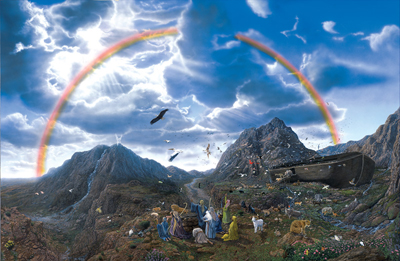
First Sunday of Lent: God, Noah, Us

Genesis 9:8-17                                                       
   8Then God said to Noah and to his sons with him, 9“As for me, I am establishing my covenant with you and your descendants after you, 10and with every living creature that is with you, the birds, the domestic animals, and every animal of the earth with you, as many as came out of the ark. 11I establish my covenant with you, that never again shall all flesh be cut off by the waters of a flood, and never again shall there be a flood to destroy the earth.”
   12God said, “This is the sign of the covenant that I make between me and you and every living creature that is with you, for all future generations: 13I have set my bow in the clouds, and it shall be a sign of the covenant between me and the earth. 14When I bring clouds over the earth and the bow is seen in the clouds, 15I will remember my covenant that is between me and you and every living creature of all flesh; and the waters shall never again become a flood to destroy all flesh. 16When the bow is in the clouds, I will see it and remember the everlasting covenant between God and every living creature of all flesh that is on the earth.” 17God said to Noah, “This is the sign of the covenant that I have established between me and all flesh that is on the earth.”


The story of Noah and the ark is the capstone of the first several chapters of the Bible and makes little sense without those chapters as prologue. The chapters relate that over the generations after Adam and Eve left the Garden of Eden the human race had become thoroughly corrupted and sinful.  So perverse did humanity become that in the sixth chapter of Genesis we read that, “The LORD was grieved that he had made human beings on the earth, and his heart was filled with pain.”
So God decided to clean the earth of its corruption by flood. There was a good man, Noah, whom God told to build an huge ship. Noah was to put aboard a male and female of every species. All this Noah and his family did, and God set loose flood waters which covered the whole earth. “Everything on dry land that had the breath of life in its nostrils died” (Gen 7:22).
After a few months the waters subsided and the ark was grounded. Noah and the animals went forth, Noah worshiped God and God promised:
“Never again will I curse the ground because of man, even though every inclination of his heart is evil from childhood. And never again will I destroy all living creatures, as I have done. As long as the earth endures, seedtime and harvest, cold and heat, summer and winter, day and night will never cease” (Gen 8:21-22).
In other words, after the flood nothing about humankind had changed and the world would continue on the same way it had before.
There are some serious questions raised by the Noah story that have no easy answers. Pastor Nathan Nettleton wrote that it would be difficult to find a church person who had never heard of Noah's Ark. Yet it would be almost as difficult to find anyone who can actually explain what the story’s relevance is to us here and now. He wrote,
“Many could perhaps tell you that God sent a flood to wipe out the world, and that a man named Noah built a big lifeboat and took his own family and breeding pairs of every kind of animal on board so that, after the flood, God could make a fresh start for life on earth beginning with them. Beyond that, this story is usually reduced to just an animal story for kids, or used as another battleground for those who want to fight over whether every story in the Bible is factual historical account of an actual event.”
For me, the story, taken at its face reading, is not wholly favorable about God’s goodness. It seems to present God as a marauding tyrant. He causes a flood that destroys all life except for one family safe aboard the ark. Yes, Genesis says that humanity was entirely corrupt and Noah alone was righteous. But even so, God’s destruction of all humankind seems, shall we say, extreme, especially when he also killed all the animals, who presumably could not have been corrupt. In this story, God often seems neither good nor loving on the whole and hardly worthy of worship. This place is not the only place in the Jewish scriptures where God's management of the world is presented harshly. The entire book of Job, for example, bluntly questions both God's competence and goodness.
I personally can spiritually function in a universe governed by a God who might not know quite everything, or who might not be able to control everything, but if God is not totally, wholly, purely good, then there is no choice but despair. If God is not wholly good, we are in the hands of a cosmic trickster no matter what creeds we recite or what claims we make about Jesus or anything else.
In the Noah story, I am shocked at what seems to be God’s murderousness. I am unwilling blithely to say that the people then deserved drowning in the flood. I know my own sin and I know that the sins of humanity in the last hundred years reduce the corruption of Noah’s generation to that of amateurism.
However, despite the shock of God's violent judgment, the story emphasizes God’s goodness over any other characteristic. There is repeated attention to the boarding of the ark, to lists of people and animals and birds that are saved, and to the chronology of the event. Attention centers on salvation rather than on judgment, on what God does to preserve creation.[1]
But so deeply embedded in human beings is sin that at the end of the Noah story, humankind is not changed. The human race, symbolized by (in fact, consisting of) Noah and his family, get off the ark no different than when they went aboard. Noah planted a vineyard, made wine and passed out drunk. When he woke up he condemned one of his children and all that child’s descendants to slavery. There is not the slightest indication in the Noah story that anything about humankind will be different after the flood than before.
It is not human beings whom the flood changes, so what then was the point of the whole drill? This question has vexed Christians for centuries and given employment to legions of religion professors and their doctoral candidates. Unless something has changed at the end of the flood story, then we are left with God as an impulsive mass slaughterer. That is a God whom we would fear, but not love, revere or worship.
So: what is different after the flood, what has changed as a consequence of the flood?
God. God has changed, God is different. I do not mean that God is different in power or character after the flood than before. Indeed, God says plainly in Malachi 3.6, “I the Lord do not change.” But there is a change nonetheless.
God makes promises to humanity after the flood, but human beings make no promises to God in return. God vows never to allow such a catastrophe to overtake the earth again but God neither solicits nor expects any kind of vows from human beings.
Nonetheless, God describes limits on how he will deal with human sin. Since destroying sinners, deserved though the destruction is, didn't destroy sin, God declares he will not repeat it in the future. (The Malachi verse in full supports this: “I the Lord do not change. So you, the descendants of Jacob, are not destroyed.”)
Having grieved at the state of humankind before the flood, God vows henceforth to endure human wickedness. God decides to bear the human condition of sin and corruption in himself, for the human race is incapable of escaping its sinfulness.
At the end of the Noah story, God has decided to work within human sin and perversity. God promises to stick with the world, come what may in the way of human wickedness. God makes this promise, not in spite of human failure, but because of it. The way into the future cannot depend on human ability; sinfulness so defines humanity that, if human beings are to live, their very existence must be undergirded by the divine promise. Hence, because of human sinfulness, God promises to do all that is necessary to redeem creation.
Noah’s story asks, why does God stand for human sin? It answers: because God promises to save the world, not destroy it. God commits his holy self to enter into the human world of pain to absorb it into God’s self. Hence we have the words of Paul in his letter to the Romans (chapter 3):
23 since all have sinned and fall short of the glory of God; 24 they are now justified by his grace as a gift, through the redemption that is in Christ Jesus, 25 whom God put forward as a sacrifice of atonement by his blood, effective through faith. He did this to show his righteousness, because in his divine forbearance he had passed over the sins previously committed; 26 it was to prove at the present time that he himself is righteous and that he justifies the one who has faith in Jesus.
So it turns out that the world is not governed by a murderous God after all, but one who is indeed purely good and faithful, even to the point of death on a cross, that the world would be saved by love and not destroyed by violence.

Next week: The only way out of a sinkhole


[1] New Interpreter’s Bible, “Genesis,” by Terence Freitheim

Saturday, December 20, 2014

Whaddya know, the Bible is right about sex and marriage after all

On The Liberal Marriage Hypothesis - NYTimes.com

But when you look specifically at sex itself, at patterns of actual sexual activity and their link to marital happiness and longevity, direct evidence for a permissiveness premium is extremely hard to find. And for women, almost all the the data points sharply in the opposite direction. Notwithstanding the potential for regrets, women who only had sex with their future spouse are more likely to be in a high quality marriage than women who had a higher number of sexual partners. Divorce rates are higher for women with multiple premarital partners than women who had only one; they’retwice as high for women who have cohabitated serially than women who only cohabitated with their future husband. Independent of marriage, relationship stability is stronger when sex is initiated later, and monogamy and a restricted number of sex partners isstrongly associated with female happiness and emotional well-being, period. And these results hold irrespective of education levels, as this piece by Brad Wilcox and Nicholas Wolfinger points out: There’s a stronger correlation between multiple premarital partners and marital instability among less-educated Americans, but well-educated Americans, too, show much stronger marital outcomes when they have fewer premarital partners. (And interestingly, the usual connection between education and stability disappears entirely for people who married their first partner: They’re equally unlikely to divorce no matter whether they attended college or not.)

Wednesday, December 3, 2014

I love the smell of greens on Advent Sunday mornings


Mark 1.1:
The beginning of the good news of Jesus Christ, the Son of God. 
Work with me here:

"Good news" was a common expression in the ancient world. Most often was used in military contexts, to report victory in battle. When a general or emperor was told there was "good news," they immediately knew the army had won.
But "good news" was also used to describe important events in the lives of the top people of the Roman empire. For example, the birthday of Caesar Augustus was always announced as, "good news for the world," since Caesar was ruler of the world known to them at the time. 
The ancient term "good news" was always plural. The good news of Augustus's birthday was the announcement of one good tiding among others. But Mark uses "good news" in the singular, making sure his readers knew that the advent of Jesus in the world was not simply one fine thing among many good things. It is a stupendous, exceptional event that is unique and unequaled.
This rhetorical device was intended to evoke a belief and understanding in the minds of the hearers of the Gospel. It was intended to make them perk up and take notice.
One way to understand the meaning of Mark's word is this:
"The beginning of the victory of Jesus Christ, the Son of God."
"Christ" is Greek for, "anointed one." But the Greeks didn't use the word in association with their gods whom they believed lived on Mount Olympus. So Jesus the anointed one, the Son of God, would not have made much sense to a Greek.
However, in the Old Testament there are references to the priests being anointed, repetitive references to kings of Israel being anointed, and also some prophets. There is even a description in Isaiah of the Persian King Cyrus being anointed. In most of these contexts, the anointed one is described as one to whom God gives victory.

"The beginning of the victory of Jesus the Triumphant, Anointed One of God, the Son of God."
I think that gets more accurately to the sense of what Mark was trying to convey.


Tuesday, January 28, 2014

Ancient Jews and dancing bears


There is an old saying that the remarkable thing about a dancing bear is not how well it dances, but that it dances at all.

So why, exactly, would the ancient Hebrews be the sole people of their day who understood things that scientists have only recently confirmed? The remarkable thing is not that they got so much right, but that they got anything right at all, because no one else of their day did.

Click here.

This, too.

Monday, January 13, 2014

Women speaking in church and Holy Communion

I have had occasion recently to engage in theological reflection on three questions:

On what basis do we Methodists ordain women or even allow women to read Scripture or lead prayers in worship?


Is Holy Communion required to be offered weekly?

Is unleavened bread required for Communion?


1. Women speaking in church.
Paul's wrote in 1 Timothy 2:11, "I do not permit a woman to teach or to have authority over a man... ."  
The key to understanding the passage is the word "to have authority over" (in Greek, authentein). 
This is the only verse in the whole New Testament where authentein is used. The word appears nowhere else in the whole Bible. Everywhere else in the New Testament refers to the authority of church leaders, a different word is used, exousia, which means "authority" in our usual sense of the word. See here.

So why did Paul use authentein in 1 Timothy when everywhere else he uses exousia? Since Paul was extremely well educated, we must conclude that he used this different word on purpose, knowing full well the difference of meaning and intending to communicate that different meaning.

And the meaning of authentein is, bluntly, sex. In the use of the day, authentein was a distinctive word used to describe the activities of temple prostitutes. 
In Corinth, on the hill of Acropolis, the Greeks had erected the great Temple of Aphrodite, the goddess of love.  There were, at any one time, up to one thousand prostitutes serving the temple.  Among the Greeks, it was considered a supreme act of worship to the goddess Aphrodite for a man to engage in sexual relations with these priestess-prostitutes. Evidently such practices were finding their way into the early church.  Clement of Alexandria even complained about certain groups among them who had turned the agape feast into a drunken sex orgy.  Interestingly enough, he refers to those engaging in those activities as authentai.
This should provide considerable illumination to the passage.  Rather than advocating a position of subservient inferiority for women in the church, the passage would more accurately be related, "I do not allow a woman to evangelize through prostitution and sexual seduction, as the pagans do; these women must be silent."
Much more detail here, although it is not a casual read:
http://godswordtowomen.org/kroeger_ancient_heresies.htm

This is a key excerpt, pointing out that if Paul was so resistant to women's active role in the church, then it is an odd position for him to take since elsewhere in his ministry, he,
... brought Priscilla as well as her husband Aquila to Ephesus to serve in a teaching capacity (Acts 18) and made significant use of women in his ministry.  He hails several [women] as fellow-laborers in the gospel (Rom. 16:1-15; Phil. 4:2f.) and asks the church to give submission to such as these (I Cor. 16:16).  He stated furthermore that in Christ there is neither male nor female and that before the Lord there is neither man without the woman nor woman without the man (Gal. 3:28; 1 Cor. 11:11f.).  How can this attitude be reconciled with the text in I Timothy? 
It is reconciled by understanding that Paul was forbidding recently-converted, pagan women from bringing pagan, sexual worship into the Church, but not from reading the Scriptures aloud as part of Christian worship. 
2. The Lord’s Supper - is weekly required?
The obvious question is, "Required by whom?" It can only be required by either the Lord or mortals. If required by the Lord, then yes, it is required. But is required simply by other church people, then it is not required except by tradition; certainly there is no divine commandment in that case. 
There is no command by Christ to take Communion every week. Jesus said, “Do this, as often as you drink it [the Communion cup], in remembrance of me,” but did not specify how often that had to be. It is reasonable to conclude that he left the frequency up to his followers. Nor is there anywhere in the rest of the New Testament where the apostles mandated a particular frequency for taking Communion. 

Of course, there is no biblical argument to be made against weekly Communion. Yet neither is there sound biblical certification mandating weekly Communion. Some advocates point to Acts 20:7-12 as proof that the early church took communion weekly, but the passage does not say that; it is an eisegetical reading (deciding what you want the passage to say before you read it). That the early church took the Lord’s Supper every Sunday is a reasonable but by no means certain reading of the text. 

In short, Jesus himself seems to have left the frequency of Communion up to his followers, and that should be good enough for us.
(Some Methodists do argue in favor of weekly Communion, though not on the basis of divine mandate. See here: http://um-insight.net/blogs/teddy-ray/why-weekly-eucharist%3F/)
3. Use of unleavened bread in Communion
In New Testament Greek there was a specific word for unleavened bread, azumos. But Matthew 26.26 states that, “As they were eating, Jesus took artos,” which is the word used for common household leavened bread.
Jesus did not use unleavened bread at the Lord’s Supper. We know this for two reasons:

1. The Bible says he did not, which I just explained, 

2. The Lord’s Supper is not an imitation of Passover, in which the Jews eat unleavened bread. The Lord’s Supper is not the same as a seder, or Passover ritual meal. Even though Jesus and the disciples had celebrated the seder that night, it is clear from the narrative that Jesus, in the Last Supper, was not part of the seder meal nor intended to be. Jesus moved beyond the Covenant of Sinai, commemorated by the seder, in inaugurating the New Covenant foretold by Jeremiah; in fact, Jesus specifically said so in explaining the wine, the “cup of the New Covenant.”
The Baptist Bulletin addressed the question this way:
The Last Supper took place during the Jewish Feast of Unleavened Bread, so Jesus and the disciples may have eaten that easily accessible, plentiful unleavened bread that night. But whether or not this use would indicate a requirement for Communion in our day is in question. Nowhere in the New Testament are we specifically commanded to use unleavened bread. Also, the Feast of Unleavened Bread was a Jewish observance. Should we be bound to something in the Dispensation of the Church that might compare with other Jewish ceremonial customs and laws we do not observe? There seems to be no account of the early New Testament church where unleavened bread mattered.
Using unleavened bread for Communion is neither required nor forbidden. See also:

Oh, we Methodists do use real wine in Communion. Welch’s grape juice is, in fact, non-alcoholic wine.

Wednesday, December 11, 2013

Here is a Christmas-related quiz I put together a few years ago. First four pages are the questions, the last six are the answers and explanation. Covers the Bible, religious traditions and secular history. 

Tuesday, April 2, 2013

Christianity is founded on facts, not myth

The "New Atheist" movement is a small number of very vocal, influential men (I know of no women in the loose affiliation) who are evangelistically, even angrily atheist. The best known figure is Oxford biology professor Richard Dawkins, who travels around Europe and America giving speeches and seminars on why belief in a deity, especially Christian belief, is misguided and uneducated at best, and is moronic stupidity or even dangerous at worst. (Lately, though, Dawkins has begun to vent his ire against Muslims, also.)

In fact, there is nothing new about New Atheism. None of their arguments are original with them. Yet they are undeniably effective to some degree in quashing inquiring minds from exploring the tenets of theistic faith, probably nowhere more effective than here in the United States.

That the tomb was empty is not the big deal. That the body lived again is.
Of all the claims of truth made by Christianity, a single one is the fulcrum of our faith: “The third day he rose from the dead.” All of Christian faith is founded on the Easter proclamation, “He is risen!” Absent that, we got nuthin’.

And nothing is frankly what increasing numbers of Americans think we've got. On Good Friday, the respected polling firm Rasmussen Reports released a poll that showed that the number of Americans who believe that Jesus rose from the dead has dropped 13 percent since only last year. The poll question was the same this year as last, “Do you believe that Jesus Christ rose from the dead?” Last year, 77 percent said yes. This year, 64 percent said yes.

Of the 36 percent who did not affirm Jesus’s resurrection, 19 percent rejected it outright, a staggering 12 percentage point jump from last year. Seventeen percent said they weren't sure.

Christian faith is founded on historical facts, verifiable facts, facts that even non-Christian historians and scholars agree are true. And yet probably only a small number of typical mainline Protestants, including Methodists, would be able effectively to recount and relate what they mean.

So on April 7, I will begin a sermon series on the factual, historical bases that Jesus arose from the dead.

The series will address these topics:

April 7 - Overview and discussion of, "What is truth?"

April 14 - The Easter story itself and why it is solidly historical.

April 21 - The various alternative explanations that have been offered over the last couple of centuries attempting to show why the Easter proclamation is actually false.

April 28  - What the apostles meant by resurrection in the first place and what it has to do with us.

May 5  - Conclusion and maybe even a few minutes for discussion.

I hope you will join us!

Bookmark and Share

Monday, February 18, 2013

What makes them think it's Jesus?

This portrait is of . . . whom?


The Associated Press: Ohio school board votes to keep Jesus portrait up:
JACKSON, Ohio (AP) — An Ohio school district decided Tuesday night to keep a portrait of Jesus hanging in the school where it's been 65 years, denying a federal lawsuit's claim the portrait's display unconstitutionally promotes religion in a public school. 
The Jackson City Schools board offered a constitutional justification of its own in voting 4-0 to keep the portrait up in its middle school, saying it must protect students' free speech rights. The vote drew cheers and applause from the dozens of people gathered in the elementary school gymnasium. 
After huddling with attorneys in closed session for more than an hour, the school board said the portrait belongs to the student group that put it up, the Hi-Y club. The portrait's frame is inscribed with the club's name and the Christian-based service group is the portrait's owner, not the school, the board said.
So there is a portrait of a man hanging in the school that the ACLU and presumably some others have challenged in court as a violation of the Establishment Clause because, they say, it is a portrait of Jesus.

Why do they think that? To say that it or any other representation of a man's face is a portrait of Jesus is as valid as saying that someone has a photograph of Charlemagne.

There is no such thing as a portrait of Jesus. No one knows what Jesus looked like. No one who knew him in person has been alive for more than 1,900 years. There has survived no contemporary, reliable description of his appearance.

A few years ago, Time magazine ran a cover story on what Jesus probably looked like, based on ethnic lineages of first-century Judeans. The cover featured this portrait:


The image was made by forensic anthropologists in Britain working with the skulll of a verified first-century Judean man. Popular Mechanics also reported on this image:
Using methods similar to those police have developed to solve crimes, British scientists, assisted by Israeli archeologists, have re-created what they believe is the most accurate image of the most famous face in human history. 
But the anthropologists never said that Jesus actually looked like this. The image's features are best understood as generalized features of Judean men during Jesus' day. The image is presented as one of Jesus' likely general, not specific appearance.

So the ACLU goes to court to have a federal order to take down a portrait of Jesus in a school. I say again: on what basis can the ACLU claim that the identity of the subject of the portrait is Jesus? After all, the most common modern representation of Jesus (the first picture of this post) bears little resemblance to the only (disputed) historical (but nonbiblical) description of Jesus:
The only physical description of Jesus that does exist is from a copy of a letter from the Roman consul Lentulus to the Roman Emperor Tiberius.  This document was discovered in a Monastery with copies of other ancient documents.  According to the copy of the letter, the original letter from the consul was dated to the 12 year of the reign of the Emperor Tiberius.  Scholars have historical verification that a certain Roman consul named Lentulus was in Judea at the time of Jesus' trial and crucifixion. His influential family is mentioned by the Jewish historian Josephus in his book Antiquities of the Jews. Scholars are divided, however, as to the authenticity of the letter.  Lentulus' letter is presented an official report to the Emperor Tiberius.  In his letter Lentulus describes the condemned man named Jesus of Nazareth as having: a noble and lively face, with fair and slightly wavy hair; black and strongly curving eyebrows, intense penetrating blue eyes and an expression of wondrous grace.  His nose is rather long.  His beard is almost blonde, although not very long.  His hair is quite long, and has never seen a pair of scissors.....His neck is slightly inclined, so that he never appears to be bitter or arrogant.  His tanned face is the color of ripe corn and well proportioned.  It gives the impression of gravity and wisdom, sweetness and good, and is completely lacking in any sign of anger.  (Holy Land Magazine, Franciscan Holy Land Press, Spring 1998). Whatever information Tiberius received concerning the strange progress of events concerning the death of this Jew, he was shaken enough to present a shocking suggestion to the Roman Senate.  There is some historical evidence to support the claim that Tiberius was so convinced of Jesus' resurrection from the dead that he attempted to have Him declared a "god", but the Roman Senate refused to approve this provincial Jew's admission to the Roman pantheon of gods.
(Italics original) The historicity of this description is disputed, however, and not generally accepted by historians.

Update: The thought occurs to me that the school's Hi-Y club should just get an art student to draw or paint a representation of a first-century Judean man and hang it on the wall with no claim of a particular identity of the man represented. Then let the ACLU try to prove that it is of Jesus. Of course, the ACLU would first have to prove that it knows what Jesus looked like to begin with. Or maybe the club and school could just use that defense now.

 Bookmark and Share