Showing posts with label Middle East. Show all posts

Monday, October 21, 2019

Kurds, Turkey, Syria - and US forces


Link to article


I worked with Petraeus when we were both at the Pentagon. He was a major then, promoted to Lt. Col. not long after I came to know him. I respect him immensely. He and US Marine Gen. James Mattis were the key, essential players in redirecting US strategy in Iraq away from the disastrous Rumsfeld model. I have never met Mattis, but have nothing but greatest respect for him. Marines I have known who worked with him are in awe, and that says a lot. 


So when Petraeus and Mattis both sharply disagree with the administration's decision, I have no choice but to pay attention. 


But having said that, I would say their view is very solidly an establishment one. S
enior military officers prosper very well. They gain their rank and status not only because of the military skills, but their political skills as well. They retire as comfortable members of the country's political class and often wind up with lucrative corporate consultancies and defense-related boards. I have seen this play out with three- and four-star generals I worked for. I do not blame them, actually, but we need to understand that they are far too invested in the status quo to try to change it. It what got them their rank and positions in the first place. Their incentives to change it are exactly zero. (This also applies to senior diplomatic personnel.) 

I wrote a long essay in 2008 on why the US should exit NATO, but of course, with both the outgoing Bush and incoming Obama administrations, there was so much Old Guardism at work that there was (and is) no chance. Petraeus and Mattis (and I, for that matter) were raised militarily and strategically with a Cold War, organizational mind-think that has not significantly subsided. They still think that what G. Washington warned against, "entangling alliances," should be normative and are simply the way things get done. 

Fifteen years ago Petraeus and Mattis and some others were the Young Turks. Now they are the Old Guard. And that should temper how we assess what they say. 


None of this is to say that all will turn out well today. In fact, it would be insane to say so. I mean, point to one time in the last several hundred years that things have worked out well in the Middle East! 

But it is also a real error to assume that had a mere 50 US troops been left in place, that everything would now be unicorns and rainbows. Turkey did not ask our permission to incur. They simply announced they were doing it. Turkey did not ask Trump to withdraw the troops; Trump just got them the heck out of the way. It would be nice for Petraeus and others to say how they would have responded to Turkey's announcement that it was coming, instead of just clutching their pearls in protest. They know better because they many times had to think through questions such those as I pose later in this essay. They know how to do it, but now they do not need to do it because the media will smile kindly upon them if they don't. And that is the problem.

My take: 


There is no solution to the problem of the Kurds. The Kurds have been screwed, they are being screwed, and they will continue to be screwed, because only Iraq, Turkey, and Syria (and Iran, as if) can resolve the issue and all of them see the Kurds as tools to be used for their own purposes against the others. No Western nation can possibly have any effective role - not the USA, not Britain, not NATO, not nobody.

The Kurdish PKK is Turkey's main target. The PKK, Partiya KarkerĂȘn Kurdistan, is a Marxist faction that has been launching cross-border raids into Turkey since 1984 - as have other Kurdish factions. The PKK is classified as a terrorist organization by the Turks -- and by the US, the European Union, NATO, and even Japan.

Anyone who is denouncing the withdrawal of a few dozen US troops from the affected area of Turkish operations, insisting they should not have been withdrawn, should first answer one basic question:
 
If you were president, would you have ordered US troops to stay in place and resist the Turkish incursion by force of arms? 

Then proceed to these:
  • If you would have given that order:
    • What is your strategic goal?
    • How many US troops are you are willing to have killed to attain that goal? 
    • Once US troops are killed, what would be your response? 
    • How many Turks are you willing to kill to attain the strategic goal? 
    • Would you escalate the violence if the Turks do not withdraw? If so, would you restrict US combat strikes to only the incursion area, or would you strike Turkish forces still inside Turkey proper? For either answer, explain why.
    • How will you ensure the safety of thousands of US Air Force personnel, aircraft, special weapons, and family members at the Turkish air base at Incirlik, Turkey? There are also large numbers British and Spanish military personnel there. 
    • Would you ask for a congressional authorization of use of military force against Turkey? 
      • If yes, are you really willing to go to war with a decades-long, US-ally member of NATO? 
      • If not, why not? Would you wage war against Turkey anyway?
          
  • If you would not have given that order:
    • What is your strategic goal?
    • Why would you leave the troops in place rather than withdraw them, if they are not to fight?
    • What would you have done specifically different from what the administration has done, and why?
Anyone who will not address those topics before slamming the administration is not thinking about this seriously at all. And yes, that includes congressional members of both parties and, I regret, many of my ministry colleagues who have posted about this topic.

Finally, here is a pretty well-balanced article that explains why Trump did not sell out the Kurds while also pointing out that Erdogan is pretty much a thug himself. (But we knew that.)

Sunday, February 3, 2019

How ISIS drove Muslims to Christian Faith

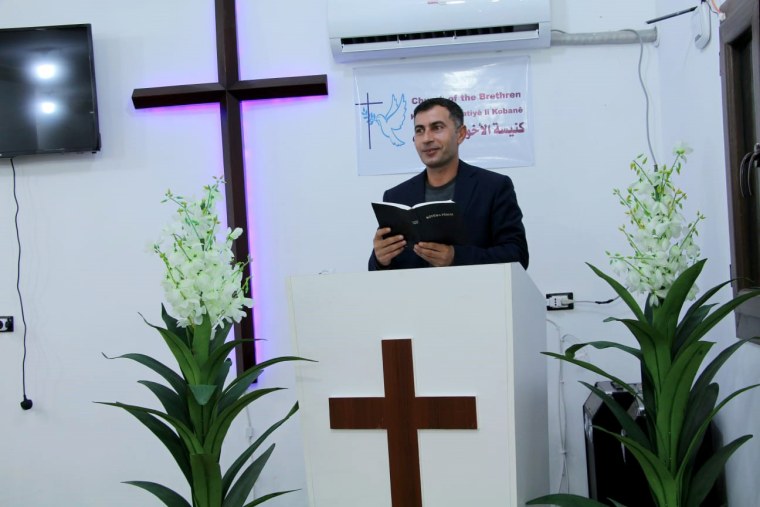
NBC News: Life under ISIS led these Muslims to Christianity "If heaven is made for ISIS and their belief," said one convert, "I would choose hell for myself instead of being again with them in the same place, even if it’s paradise."
While residents are still dealing with the emotional scars left by the brutality of ISIS, Omar says many people in Kobani have been open-minded about Christianity.

Image: Omar reads the Bible at the Church of the Brethren

Omar reads the Bible at the Church of the Brethren in Kobani, Syria.  NBC News
“Most of the brothers here converted or come to church as a result of what ISIS did to them and to their families,” he added. “No one is forced to convert. Our weapon is the prayer, the spreading of spirit of love, brotherhood and tolerance.”

Monday, December 17, 2018

Why is Christmas on December 25?

Whatever date Jesus was born, it almost definitely was not December 25. So why do we date Christmas on it?

One of the ways we know that Jesus' birth birth almost certainly did not take place on Dec. 25 is because the Gospel of Luke states that when Jesus was born, "there were shepherds in the fields keeping watch over the flocks by night." But Dec. 25 is in winter, of course, and Israel gets cold. Flocks would not be herded in the fields overnight, but brought into protective shelter, probably by the end of October and almost certainly by mid-November.

Just why Christmas Day falls on Dec. 25 was originally only a question for the Western (Latinate) Church because Christmas fell on Jan. 6 for the Eastern Orthodox Church, which later adopted the Dec. 25 date. Even so, Jan. 6,
... is still the date of the celebration for the Armenian Apostolic Church and in Armenia, where it is a public holiday. As of 2012, there is a difference of 13 days between the modern Gregorian calendar and the older Julian calendar. Those who continue to use the Julian calendar or its equivalents thus celebrate December 25 and January 6 on what for the majority of the world is January 7 and January 19. For this reason, Ethiopia, Russia, Ukraine, Serbia, the Republic of Macedonia, and the Republic of Moldova celebrate Christmas on what in the Gregorian calendar is January 7; the Church of Greece celebrates Christmas on December 25.
Christ's Mass (hence, Christmas) did not become an official festival day on the Roman Church's calendar until 300 years or so after Jesus. There was not much debate about placing it on Dec. 25. Modern historians used to argue that the Pope selected the date in order the Christianize a still-practiced Roman holiday celebrating the lengthening of daylight hours just after the winter solstice had passed. This idea has come under increasingly skeptical scrutiny, however, As Slate explains, (Why is Christmas in December?): 
The reasoning goes that the growing church, recognizing the popularity of the winter festivals, attached its own Christmas celebration to encourage the spread of Christianity. Business historian John Steele Gordon has described the December dating of the Nativity as a kind of ancient-world marketing ploy ...

This alternative explanation is sometimes deployed to dismiss the notion that the holiday had pagan roots. In a 2003 article in the journal Touchstone, for example, historian William Tighe called the pagan origin of Christmas “a myth without historical substance.” He argued at least one pagan festival, the Roman Natalis Solis Invictus, instituted by Emperor Aurelian on Dec. 25, 274, was introduced in response to the Christian observance. The pagan festival “was almost certainly an attempt to create a pagan alternative to a date that was already of some significance to Roman Christians.” According to Tighe, the pagans co-opted the Christian holiday, not the other way around.
In fact, an early Christian Carthaginian scholar named Tertullian reported the calculation that the 14th of the Jewish month of Nisan (the day of the crucifixion according to the Gospel of John) in the year Jesus died was equivalent to March 25 in the Roman (solar) calendar. March 25 is, of course, nine months before December 25; it was later recognized as the Feast of the Annunciation, or the commemoration of Jesus’ conception. Thus, like important martyrs before him, Jesus was believed to have been conceived and crucified on the same date of the year, March 25, meaning that exactly nine months after the date of his conception, Dec. 25, Jesus was born. 

So, ascription of Dec. 25 to Jesus' birth took place 74 years before Emperor Aurelian instituted a Roman, pagan celebration of the winter solstice. So we can cast aside the idea that Christmas' dating was to take over an existing pagan holiday. There was, at the time, no pagan holiday to take over.

But wait! as they say on TV. There's more! Further complicating the debate is that there seem to be mathematical reasons for the Dec. 25 date that rest upon modern computational science, not legend.

A fascinating analysis of just what was the star that led the wise men to Bethlehem is given at Bethlehemstar.net. Here is my summary.

After Jesus was born, wise men, or Magi, from the east made their way to Judea. Being astronomers, they had read the stars and concluded that a new king had been born to the Jews. This is related in Matthew chapter 2.

No historian today claims that there nothing happened in the sky that corresponds, somehow, to what the wise men saw. Just what it was has been a scientific quest for about 400 years, since Johannes Kepler developed the first mathematical description of how the heavens worked. Kepler, whose equations are still used by NASA and astronomers around the world, himself spent may laborious hours trying to calculate the position of the planets and stars above the ancient Near East in the year of Jesus’ presumed birth, 6 BC. But he found nothing.

Since Kepler, many others have suggested that the star Matthew describes might have been a comet or a supernova, but there are no records of such events at this time anywhere in the ancient world, especially in China, whose astronomers were detailed, meticulous record keepers.

Jesus was presumed to have been born in 6 BC based on a book by the ancient Jewish historian Josephus, whose book, Antiquities, says that Herod died in 4 BC. Since clearly Jesus was born in the time of Herod, Jesus had to have been born before 4 BC, a year or two before.

But in fact, Herod did not die until 1 BC. This date is in fact what Josephus wrote, and is so stated in manuscripts of his book dated earlier than 1544. It was in 1544 that Antiquities was first set to the printing press. In that first edition, the typesetter erroneously set the wrong year of Herod’s death, and this edition became the standard from which all subsequent editions were made, including the one Kepler used.

Computers today solve Kepler’s equations in a snap. And what astronomers now know is that in September, 3 BC, the planet Jupiter came into conjunction with the star Regulus. That is, when viewed from the earth, Jupiter and Regulus appeared to touch or come very close together.

Jupiter is the largest planet. The ancients called it the king of planets. Regulus was called Rex by the Romans, Latin for king. In Persian its name was Sharu, which also meant king. To an ancient astronomer, for the king of planets and the king of stars to come together would have been weighted with portents. But Jupiter and Regulus did this not merely once, but three times over the course of the next year.

After appearing to touch Regulus, Jupiter’s path moved beyond. But after a few months, earth caught up with and passed Jupiter in its orbit. Jupiter then appeared to move backwards in the sky. This movement is called retrograde. All planets’ paths retrograde when seen from earth, that’s why they are called planets, which is Greek for “wanderer.” So Jupiter went back and touched Regulus again. Then the earth moved on and by September of 2 BC, Jupiter had retrograded once more and had touched Regulus a third time.

To astronomers as skilled as those of Babylonia heritage and learning, which the wise men almost certainly were, this three-time conjunction of the king of planets with the king of stars would have started them packing. But why did they decide that the Jews had anything to do with it?

All three conjunctions took place within the backdrop of the constellation Leo, the lion. The lion is the symbol of the Jewish tribe of Judah, which takes it name from a son of Jacob named Judah. In Genesis chapter 49, Jacob gives his son, Judah, the lion as his symbol and then dictates that only Judah’s descendants shall provide the rulers for subsequent generations. King David was a member of the tribe of Judah and so was Jesus’ father, Joseph, according to Matthew chapter one.

The wise men were obviously conversant with the relationship of lions with the tribe of Judah and Judah’s parentage of all the kings of Israel. The wise men may well have been (though probably weren't) Jews themselves, since a thriving Jewish colony remained in Iraq until a generation ago even though the Jews’ captivity in Babylon was ended in 538 BC. The kingly conjunctions of Jupiter and Regulus within the constellation of the lion were all the wise men needed to start heading toward the Roman province of Judea, which we know as Israel.

But what they did not know was just where the new king was born. So they stopped at the palace of the Roman vassal, King Herod, to inquire. Herod’s counselors quoted a prophecy from Micah that said the Messiah would be born in Bethlehem.

At Herod’s deceitful urging, the wise men went to Bethlehem, only five miles from Jerusalem. In the sky, Jupiter had just begun a third retrograde, this one, however, not to be followed by a conjunction. The thing about planetary retrogrades is this: just as a planet appears to reverse direction, it seems to stand still in the sky.

Here is what computers using Kepler’s equations show. Jupiter’s full stop for this retrograde took place on December 25, 2 BC. If you had been in Jerusalem on that evening, you would have seen the kingly planet Jupiter motionless in the sky almost due south, directly above Bethlehem. And better yet, its stationary position was in the middle of the Constellation Virgo, the Virgin.

However, many of the detailed explanations of these planetary and stellar phenomena, such as this one, do not seem to account for the fact that Dec. 25 on our calendar today is an altogether different date in the ancient world, as I briefly referenced above. December 25 on our calendar is 13 days further along than on the Roman Julian calendar used at the time the Pope officially designated Dec. 25 as Christmas Day. The original Dec. 25 date then corresponds (as above) to Jan. 7 on our calendar. So to be historically picky about it, the Russian church, for example is celebrating the date correctly on Jan. 7.

But wait! There's more! When modern astronomers say that Jupiter's "full stop" occurred on Dec. 25, 2 BC, which Dec. 25 do they mean, Gregorian (modern) or Julian (ancient)? They mean modern. If Jupiter's progression/retrogression transition was in process on Dec. 25 Gregorian, that means that the Magi arrived in Bethlehem on Dec. 12 Julian.

They did not get there the day Jesus was born. We know from Matthew that Jesus was born in a barn and laid by his parents in a manger, or feeding trough, after birth. Yet Matthew 2 clearly states, "On coming to the house, they saw the child with his mother Mary, .. ."

How old was Jesus by then? We have insufficient information to know. Presumably, Joseph, Mary and Jesus could have moved from the barn to the house the day after Jesus was born. It's not far fetched to imagine that room for a newborn and parents was made somehow. 
One clue, however, lies in that Herod directed the Magi to come back and report to him once they found the one whom the Magi had referred to as the "one who has been born king of the Jews."

The Magi did not go back to Herod. Herod, never one to countenance potential rivals to his throne (he had even executed his own sons), ordered soldiers to Bethlehem:

[H]e was furious, and he gave orders to kill all the boys in Bethlehem and its vicinity who were two years old and under, in accordance with the time he had learned from the Magi.
In my view, the best interpretation of this narrative is that the Magi had no idea specifically when Jesus was born, but based on the sequence of astronomical observations, above, concluded it had to have been within the two years prior to their arrival at Herod's court. Another key may be that Matthew quotes the Magi as referring to Jesus as "born king of the Jews," not "newborn" king of the Jews. Hence, Herod's order to slaughter boys up to the age of two.

It is important, from an historical and biblical perspective, though not necessarily from a practical one for the Church, to confirm Dec. 25 (Julian, anyway) as the date the Wise Men got to Bethlehem, not the date Jesus was born. That date, I'm afraid, will likely forever remain unknown.

End note: David A Weintraub, Professor of Astronomy, Vanderbilt University, explains how Matthew's account makes use of some ancient astronomical and astrological (not very separate disciplines back then) terms that help us understand what the star narrative means; "Can astronomy explain the biblical Star of Bethlehem?"

Sunday, August 21, 2016

Stunning movement of the Lord in Iraq

Despite threat from ISIS, 100 children receive First Communion in Iraq


Details: 
The first communion Mass in Alqosh was an historic moment for a “frontier town” that has been under threat from the militants of the Islamic State (IS) for a long time. Now it can “hope for peace and normalcy” around these hundred children, said Mgr Basil Yaldo, auxiliary bishop of Baghdad and close associate of the Patriarch Louis Raphael Sako.
The Chaldean primate presided over the ceremony that was attended by “all the priests of the city, the nuns and more than 700 people. The faithful were excited because for the first time, the patriarch celebrated communions in the community.” 
Like many other towns in Iraqi Kurdistan, Alqosh too welcomed scores of refugees.
“Life in the area is almost back to normal,” said the vicar of Baghdad. “We hope that soon the whole plain [of Nineveh] can be liberated from the jihadists, and that refugees can return to their villages.” 
The work to secure the area, he added, has “already started and for the past two days Iraqi troops have launched the battle to liberate the villages surrounding Mosul.” 
…Addressing the boys and girls who received the first communion, Patriarch Sako urged them not to abandon their land, the city of Alqosh, but to stay and help in the reconstruction “because there is a (Christian) heritage to be preserved. ” 
The Chaldean primate, Mgr Yaldo noted, also called on young people to “be stronger, come to church and participate in the life of the Christian community as one participates in the life of a family.” 
After the service, the children asked Patriarch Sako some questions. One of them, Mgr Yaldo noted, said that when he “grows up he wants to become a priest to serve the poor and the needy.” 
The patriarch could not hold back his emotion after listening to such words, adding that “it is important to support and share the suffering.”

Monday, August 11, 2014

We are adopting the Middle East Model, and it's not Islam

The Nile could not be managed by independent satrapies

In his book, Cannibals and Kings, anthropologist Marvin Harris explains the difference in the development of nation-state governments in the "hydraulic kingdoms" of the Middle East and the "rainfall economies" of northern Europe. In both cases the issue affecting formation of government was water and the creation of wealth. These were agricultural economies, with agricultural production being the foundation of all wealth. In the Middle East, water meant rivers since there was little rainfall, and management of rivers required a strong central-planning agency.

In the case of Egypt's Nile, that led to an all-powerful pharoahite government, a pattern mostly duplicated elsewhere in the ancient Middle East. Therefore, wealth became concentrated in the central government because the rulers controlled the means of production and the water resources production required.

In northern Europe, rivers were hardly necessary to agriculture because of reliable, year-round precipitation. Because wealth creation was therefore dispersed, so was political power. Nowhere in the hydraulic kingdoms was there the equivalent of European systems of kings, dukes, barons, counts or marquis, all of whom did not depend on the king or the king's government to till the land and grow its wealth. They therefore had the means to resist the near-total centralization of power found in the Middle East. When such centralization did occur, it was an aberration and short-lived.

When the means to create wealth is dispersed, political power is dispersed along with it. Wealth gains political power, but political power is not needed just to create wealth. In the Middle East, however, wealth came from political power because there was no means to create wealth of significance apart of political power. So for centuries, nay millennia, the way to become wealthy there was first to gain political power.

This pattern survives to this day. Saddam Hussein, for example, was a nobody of limited material means until he literally murdered his way into power in Iraq in 1979. It was after gaining control of Iraq's government that Saddam became wealthy beyond all avarice.

Now the point of this little history lesson is this: In the United States, the means to create wealth and the exercise of political power in public office are being steadily unified. We are already well along to adopting a Middle East model. Since the Obama administration came into being, the wealthiest counties of America and the most politically-powerful counties of America have for the first tome become the one and same - all concentrated in and around Washington, D.C. Through minute regulation of economic activity, America's political class is deliberately suppressing wealth creation over the broad expanse of the country, while funneling tax dollars to favored cronies. Remember, for example, Solyndra?

At the same time, the political figures are using their offices to gain personal wealth. Consider Senator Harry Reid, the majority leader and hence one of the most powerful figures in Washington. He was born into poverty, growing up in a home that had no running hot water or indoor toilet. His first job in D.C. was working the night shift as one of the Capitol Hill Police. Yet after entering national office, his personal wealth has arisen to as much as $10 million.

But what sent me into writing this post was today's report that the champion rent seekers of all time, Bill and Hillary Clinton, "turned the State Department into a racket to line their own pockets" while she was secretary of state.
“These documents are a bombshell and show how the Clintons turned the State Department into a racket to line their own pockets,” said Judicial Watch President Tom Fitton. Judicial Watch and the Washington Examiner teamed to seek and publish those documents today. “How the Obama State Department waived hundreds of ethical conflicts that allowed the Clintons and their businesses to accept money from foreign entities and corporations seeking influence boggles the mind,” said Fitton, adding, “That former President Clinton trotted the globe collecting huge speaking fees while his wife presided over U.S. foreign policy is an outrage." The Examiner reported that the former president gave 215 speeches and earned $48 million while Hillary Clinton was at State.
Welcome to the potentate kingdom of the United States.

Update, Dec. 2017: And the beat goes on: "Census Bureau: 5 Richest Counties Are D.C. Suburbs"


Bookmark and Share

Tuesday, March 18, 2014

Syrian Islamists video ritual murder of Christians

At Westview UMC we have been praying for Christians under persecution throughout the world, especially Syria. Here is why.

Think religious human sacrifice is not being practiced any more? You don't know Islam.
 
A new angle of the brutal execution-style murders of Christians by Muslims in Syria is being discovered. Walid Shoebat reports that they have now begun conducting “ritual human sacrifices” by firing a bullet to the head or slitting the throat of their intended victims. 
Shoebat is a former member of the terrorist Palestine Liberation Organization who converted to Christianity. 
In the video the speaker uses the word Qurban just before firing one by one at a row of men lined up on the floor. That term, according to Shoebat, “can only signify a sacrifice, which indicates that the filmed slaughter is nothing but a ritual human sacrifice.” Shoebat says, “Christians are being killed in these very rituals every day, and the bloodshed will not stop. We must work together to rescue them.” 
He is working with a Syrian Orthodox nun, Sister Hatune Dogan, to help Christians in Syria, Iraq, Jordan and Turkey who are victims of religious persecutions.
Be aware before you watch the video (link at bottom): It is very graphic video of actual murders of a dozen or so men by shooting them in the back of the head. There is no cut away because these Satanic killers want the world to know what they are doing. They are proud of it. They say that God demands it.

Allah is not God! Allah in fact is an invented idol, no more real than the pagan gods represented by figurines and statues in the ancient world. Islam is idolatry.

The number one threat to freedom, liberty, human dignity and flourishing in the 21st century is not climate change. It is Islam. Islam itself is irretrievably corrupt and irredeemable. Islam is a religion of death and murder, and nothing but.

I looked up in Muslim sources what "Qurban" means, just to be sure. Here is a grab of its definition from rasoulallah.net.


The video is here: http://www.liveleak.com/view?i=ae0_1394505392 

Bookmark and Share

Monday, September 9, 2013

Westview symposium on CBS affiliate

Here is the segment the local CBS affiliate broadcast last night of Westview UMC's symposium on "Christian Faith and Making War," regarding the potential war with Syria. We held it Sunday at 5 p.m.


I hope to have content of the session posted here in the next day or two.

Friday, September 6, 2013

Prayer for this time of looming war

I wrote this prayer for Westview's Sunday-evening prayer service on the eve of Congress' return to session to debate and vote the resolution of war against Syria.

Any other church that wishes to use it, feel free. I do not ask for author credit, but I do ask that if you modify it please do not indicate authorship.

Prayer for our country

Leader: Almighty God, you rule all the peoples of the earth.
All: Inspire the minds of all women and men to whom you have committed    the responsibility of government and leadership in the nations of the world. Give to them the vision of truth and justice, that by their counsel all nations and peoples may work together. Give to the people of our country zeal for justice and strength of forbearance, that we may use our liberty in accordance with your gracious will. Forgive our shortcomings as a nation; purify our hearts to see and love the truth.

We pray especially for these persons in positions of authority:

President Barack Obama, for wisdom, resoluteness, clarity of purpose, and insightfulness of vision.
Hear our prayer, O Lord, for our president.
Secretary of State John Kerry, that our relations with other nations may be honorable and just.
Hear our prayer, O Lord, for the secretary of state.
Secretary of Defense Chuck Hagel, that should war come it may be fought justly and the lives of the innocent be protected.
Hear our prayer, O Lord, for the secretary of defense.
General Martin Dempsey and all leaders of our military, that our service men and women may be sent into battle prepared and soundly led.
Hear our prayer, O Lord, for the leaders of our armed forces.
Speaker of the House John Boehner, that the House of Representatives be led wisely and that debate be unhindered by partisan purposes.
Hear our prayer, O Lord, for Speaker Boehner.
Senate Majority Leader Harry Reid, that deliberations of senators be bold,  for the common good of all in justice.
Hear our prayer, O Lord, for Senator Reid.
All members of the Congress, for sober decision of great responsibility, especially the representative of this district, [name of your district's House member] and Senators [names of your state's senators].
Hear our prayer, O Lord, for Representative [name] and Senators [names].
We plead with you, O Lord, to rest your Spirit upon the nation of Syria, that the innocent suffer not, that right be established in justice and peace. Be very present with all affected there by the sword of war and with the refugees dispossessed by violence. We raise up to you especially our brothers and sisters in Christ in that war-torn land.
Hear our prayer, O Lord, for the people of Syria. Be the fortress for your children there.
Holy Lord, you commanded us to pray for our enemies. So we raise to you Bashar al-Assad, who does not know your liberating grace and love. We pray God that he and others leaders of his regime will come to acknowledge you alone as saving Lord, placing their whole trust and confidence in your redemption through Christ Jesus, and set aside implements of destruction, that your justice may be better established upon the earth.
Hear our prayer, O Lord, for Bashar al-Assad.
Hear our prayer, O Lord, and let our cry come unto thee.
In humility we bow before you, O Lord, for you alone are our Savior and Redeemer, our refuge and strength, a very present help in trouble. In the name of our Savior, Jesus Christ, we pray. Amen.

Tuesday, September 3, 2013

Christian Faith and Making War - a Symposium and Prayer Service


As you know, President Obama has asked the Congress to authorize him to order military strikes against Syria. Congress will take up the issue when it returns to session this coming Monday. Because of this fact, Westview UMC announces:


Christian faith and Making War - Symposium at Westview UMC, Sunday, Sept. 8 at 5 p.m. Prayer service for our government, our nation and the people of Middle East to follow at 6:30. 

7107 Westview Drive, Fairview, Tenn.


Christian traditions have a long history of theology about war and peace going back to the formative years of the church. At 5 p.m. Sept. 8, the day before Congress returns to session to debate going to war with Syria, Westview UMC will hold a symposium on what Just War Theory is and what it means.

The purpose is to help people learn and use faith-based tools and the insights of church thinkers over the centuries to decide their own positions on this looming war. This and the prayer service afterward will be non-partisan. We will be devoted toward "faith seeking understanding," and imploring the grace and wisdom of God to guide our Congress, our president, our national policy and to rest also upon all the people of Syria, especially those already suffering from the war there.

I will send out more information as the date approaches. I hope that you will come be part of this time to be united in our baptism and seek the presence of God in the extremely serious decisions our government will take next week.

Just for the record, I am a retired U.S. Army artillery officer with extensive military operations experience, including service at the Pentagon as a plans officer. I hold a degree in philosophy from Wake Forest University, a divinity degree from Vanderbilt and I am a graduate of the U.S. Army’s Command and General Staff College.

All persons, regardless of religious affiliation, are invited to the symposium and the prayer service. Westview UMC is located at 7107 Westview Drive, Fairview, Tenn. 

Monday, September 2, 2013

Just War Theory and Syria Strikes, Part One

Can we frighten this man into killing
people only conventionally?
I am framing this inquiry in the context of Just War Theory (JWT henceforth), a theological inquiry in Christianity going back at least to Saint Augustine, 354-430. It's most robust treatment was by St. Thomas Aquinas, 1225-1274, whose exposition was so thorough that it still forms the basis of modern theory.

Today my main points are that going to war requires at least three questions to be answered in the affirmative, below. In this post I'll only address the first for brevity's sake and leave the other two for later.

1. Is there just cause for the war?

2. Is the war authorized by proper authority?

3. Is it wise to wage the war?

Is there just cause for war?

Just Cause of war is the fundamental question, of course. I remember reading a (probably apocryphal) story of a South Seas island native chieftain who after a large battle between the US Marines and the Japanese in WW2 asked the American commander who was going to eat the vast quantities of flesh of the slain soldiers.

The Marine general explained that neither the Japanese nor Americans killed people for food.

"What barbarians you are!" the chief replied, "To kill for no good reason!"

Historically, Western thought on war, heavily influenced by Christian theology, has held that war cannot be separated from larger concerns of nations, and in fact is one part of national relationships. "Politics is the womb in which war develops," said German officer and theorist Carl von Clausewitz. More famous is his observation that, "War is not an independent phenomenon, but the continuation of politics by different means."

JWT has generally held that the political just cause for war is pretty narrowly expressed: either to defend one's own nation from actual or imminent attack, or to protect innocent third parties from deadly aggression or oppression. Some years after the American Civil War, Union General William T. Sherman put it simply: "The only just aim of war is a more just peace," which is a political goal. Absent its political orientation, warfare becomes just what the South Seas chieftain said, an exercise in pointless killing.

Not all JWT theorists agree that a nation may strike pre-emptively even in the case of clearly imminent attack, but since no one in the Obama administration claims that Syria poses any kind of military threat to the US, I'll not address the self-defense tenet here.

The question then becomes one of protection of the innocent, and whether chemical weapons are sui generis so that American warmaking on their users is justifiable for that reason alone. That is, in a civil war in which everyone agrees that at least 100,000 people on all sides have died, untold numbers of whom were murdered outside the laws of war but by conventional means, is the use of chemical weapons by itself a just cause for the US to wage war on Syria, a nation not at peace with itself but with which the US is now at peace?

If the answer is no, then war making against Syria cannot morally be done. If the answer is yes, as the administration clearly claims it is, we move to the next crucial inquiry of JWT - the war we wage must be justly conducted.

I'll shape this discussion around the JWT tenet of proportionality. The doctrine of proportionality is simply stated that the means of conducting the war must be proportionate to the goal for which the war is waged. Another way of looking at it is that while the just ends desired do not justify any means to attain them, they absolutely justify some means. The tenet of proportionality, then, is to assess what the justified means are, then employ those means and not the unjustified ones.

Which leads directly to the question: what exactly is the goal here? The president, secretary of state and others, in multiple remarks and interviews, have specifically announced three key objectives:

A. There is no intention of effecting regime change in Syria.

B. The strikes are to punish Assad's regime for using chemical weapons.

C. The strikes are intended to deter Assad (and others) from using such weapons in the future.

Are these just objectives of war? If so, it is apparently just to "punish" Assad for using chemical weapons, but not just to remove him from rule. Why?

In fact, is punishment itself a just aim of war? This tends to slide the war into a legal enforcement mode, which indeed the president has more or less confirmed in his insistence that Assad has violated "international norms." We thus circle back to the previous paragraph: why is it just to punish Assad but leave him in power - when it was his criminal exercise of power that is at the heart of the violation?

The question of means

"Without killing," wrote Clausewitz, "there is no war." Conducting war is a matter of intentional lethality. In the proposed war against Syria, then, this is the question of means: What constitutes a level of violence inflicted upon the Assad regime that is effective deterrence against using WMDs by the regime again or, in future years, deters other bad actors in the region?

The centering question of the doctrine of proportionality is using the violence necessary to achieve the war's objectives while not using excessive violence to do so. To employ too little violence is as disproportionate as to employ too much. It is unjust to wage war ineffectively even for a just cause.

Hence, campaign planning for the upcoming strikes will necessarily involve a massive amount of guess work on what level of lethality and destruction needs to be inflicted upon Syria to ensure the Assad regime never uses chemical weapons again. But that is a heavily psychological calculation for which an answer is practically impossible!

The reason is that we do not know the calculations Assad used to to order the chem-weapons attack in the first place. What was going through his mind when he gave the order? We don't know, although the intercepted messages the Obama administration says it has should offer some clues. Even so such messages, originated mostly by subordinates and oriented toward action rather than rationale, are many levels removed from what Assad was thinking, and since making him fearful of re-use is a stated goal of the president, our own calculations' margin of uncertainty is bound to be very vast.

As for deterring leaders of other nations, assessing what example to make of Syria to deter them is like entering a dark room blindfolded, in the dead of night in a dense fog, to look for a black cat that may not even be there. Does anyone really expect that the Iranian government will abandon its goal of attaining nuclear capability just because the United States mounted a bombing campaign against Syria that the president has already promised would be "brief and limited?"

All of these things mean that the proportionality calculus has no answer. It is like a math question to solve the value of X in which both the variables and constants are also unknown. We do not know how much death and destruction to inflict upon Syria to persuade the regime to refrain from using a single class of weapons in the future, and have no realistic prospect that we even can know. And this is a problem cubed for deterrence of other national regimes.

So the question: Even stipulating that the use of chemical weapons is a just cause for the proposed war, can the war be justly waged when we have no way of assessing, within reasonable margins of error, what waging it will require to achieve its stated goals?

When I was assigned to the Pentagon during the planning for Operation Desert Storm, the first ground war against Iraq in 1991, Army Chief of Staff Gen. Carl Vuono emphasized that in our planning we needed to remember two simple concepts: "Hope is not a method and wishes are not plans." Good advice now, too.

Bookmark and Share

Wednesday, August 28, 2013

What is the fierce urgency of bombing now?


As you surely know, President Obama has all but pledged that he will order American armed forces to attack Syria soon. Media reports say that the strikes will begin as soon as tomorrow (Thursday, Aug. 29) or slightly later. 

According to a Wall Street Journal report, administration officials, speaking both by name and with indirect attribution, say the strikes will be "brief and limited" with no more than 50 targets inside Syria to be struck. 

White House spokesman Jay Carney said, "I want to make clear that the options that we are considering are not about regime change." That means that Syrian dictator Bashir Assad, who presumably ordered last week's chemical attacks against insurgent-held territory, is deliberately excluded from threat. 

So far no one in the administration has defined, therefore, exactly what is the reason for the upcoming strikes except to say in fairly vague language that Assad's regime must be punished for violating "international norms" against using chemical weapons. 


Terry Newell, founder of Leadership for a Responsible Society, has excellent questions about the impending Syria strike that have not been answered by the administration. The first question is to the point:
What justifies intervention in this particular case? The answer would seem obvious, but the United States does not intervene in all nations which commit atrocities against their own people. Why is this case different?
Indeed. The war has already claimed 100,000 lives. Why does the manner of death of the 350 or so killed last week make it imperative for America to go to war? So far, no one has explained just exactly what makes this attack fundamentally different except for the violation of "international norms." But as Mr. Newell points out, that happens, often with more lethality, all around the world (North Korea anyone?) and we do nothing. 

Why Syria, why now, and especially, to modify slightly a phrase of one of the president's own campaign speeches: What exactly is the fierce urgency of bombing now?

The UK's Guardian newspaper says that the justification is humanitarian. (Understand that in Britain, the legal authority for war is different than for the United States.) Nonetheless, I will, for argument's sake, stipulate that  bombing Assad's forces might be justified under humanitarian concerns. However, what the Guardian is conflating is the difference between moral justification of war and legal basis for it. They are not the same. 

Under just war theory, both just cause and rightful authority are required (among other elements). In Syria today there may be just cause for Western intervention, but so far there has been no rightful authority for it. 

Under US law this is drawn more sharply than under most European law. Since the dawn of the American republic, the Congress and the presidents have generally agreed that the president may order US forces into combat against another nation, solely on his own authority, if and only if there is: 

1. Imminent danger of attack from the other power, so imminent that time taken for Congressional deliberations would hinder defense against it, or, 

2. To protect actual threat against US citizens abroad, or to rescue them from actual danger.  

The Obama administration has not asserted that either of these conditions pertain in the case of Syria. 

Therefore, if Obama orders US strikes against Syria, no matter the moral justification of them, the United States will have failed the test of rightful authority, which rests in Congress alone. The war will be unjust because it will be illegal. 

If the cause is humanitarian for violations of "international norms," then the president is obligated to state what are the norms. There is in fact no international "norm" against chemical warfare. The revulsion western nations have had against chemical weapons since World War One has never resulted in treaties binding on non-signatory nations. 

Syria is not a party to either the Biological Weapons Convention of 1972 or the Chemical Weapons Convention of 1993. Neither of these treaties have ever been considered binding on non-signatories, unlike, say, conventions against piracy or slavery, which are acknowledged to be universally binding whether a country signed them or not. This is neither to defend Assad nor excuse the chemical attack. It is to point out that "violating norms" is an invention for going to war that has no precedent in US law or custom. 

Syria flatly poses no threat to the United States that justifies making war upon it. Furthermore, there is no threat to the Syrian people that is so imminent that no time dare be spent in Congressional deliberation to authorize the strikes, if strikes there should be. If there is such a threat, the president should explain why, with 100,000 already dead, a few more days of deliberation is unwarranted. After all, under the Constitution, the president can order the Congress back into session. If Obama wanted, he could have the Congress deliberating within 36 hours. 

There is, by the way, no UN Security Council resolution on this issue, nor any justification for the strikes to be found under the UN Charter. In fact, the UN Charter admonishes nations not to interfere or intervene in the domestic affairs of other nations, which is what the Syrian civil war is. If there is any international norm at play here, that is it. And that is the norm that the United States is about to violate.

We'd do well to remember the ancient proverb. "Decide in haste, repent in leisure." This is by any measure a true rush to war. Why all of a sudden the "fierce urgency of now" and not after Congressional authority?  

Well, perhaps here is a clue. According to the Wall Street Journal report, a "senior White House official" told CNN that, "Factors weighing into the timing of any action include a desire to get it done before the president leaves for Russia next week."

Draw your own conclusions about what that means.

Where is the United Methodist Church on this? The church's General Board of Church and Society already has multiple entries about today's commemoration of Dr. Martin Luther King's "I Have a Dream" speech, but only two entries total on Syria, neither since Aug. 5, long before this issue arose.

It used to be that the United Methodist Church stood against illegal, aggressive wars no matter who started them. Now, not so much. Silence from the board, silence from the bishops. And, I suppose, silence from the pulpits.

If US forces are to attack Syria, it cannot rightfully be done absent Congressional authorization. That would not make an attack wise by any means, but it would make it legal, and at the minimum that should be the starting point.

Update, Aug. 29: The ranking Democrat member of the House Judiciary Committee agrees.

Wednesday, June 19, 2013

Say No to Syria Intervention!

Secretary of State John Kerry leads the war faction in the Obama administration, insisting that American warplanes should begin bombing Syria right away.
In the past few days, the White house announced that it will begin sending military materiel to Syrian rebels. This decision comes in the wake of the administration's determination that Syria's ruling Assad regime had used chemical weapons, including the nerve agent sarin, on the insurgents. This use constituted Assad crossing one of the Obama administration's "red lines," so named because crossing them would be seen as an intolerable act that could not be passively encountered by the United States.

International agencies estimate that the chemical attacks killed 100-150 people. As IBD puts it, "That's in addition to the more than 90,000 Syrians killed by conventional weapons that didn't seem to prompt any action."

Government Executive reports that Secretary of State John Kerry pushed hard for the United States to bomb key Syrian targets after the chemical use was confirmed.
On Thursday, President Obama confirmed what reports had been speculating for a few weeks: Syrian President Bashar al-Assad had used chemical weapons, notably sarin gas, on his own people, and tripping the president's "red line" that would rouse the United States to greater action. The response includes arming and training the rebels. It turns out that Secretary of State John Kerry also wanted the response to include an air strike on Syrian airfields, according to Jeffery Goldberg at Bloomberg View. 
According to Goldberg, Kerry's "vociferous" thoughts on the matter were not received well by Chairman of the Joint Chiefs of Staff Martin Dempsey during a meeting in the situation room last Wednesday.
(My own experience of working in the Pentagon from 1990-1993 is that the state department is considerably quicker to reach for the sword than the defense department.) The reason Kerry's push did not prevail is that Joint Chiefs Chairman Gen. Martin Dempsey made it clear that a few runs on target would do no good, that if the bombing was not be be merely symbolic, it would require a sustained, large effort of no short duration.

Secretary Kerry lost the debate that day, but the desire is out in the open: there is a powerful faction within the Obama administration that wants direct military action by the United States against the Assad regime.

My position is that no just rationale can be proffered for American intervention in the civil war, whether by supply, air campaign or boots on the ground. Such action fails to meet the standards of the two major influences that have shaped American military action since the country's founding: Just War theory and Realpolitik, or foreign-affairs Realism.

Realpolitik and the national interests

Realpolitik is the easier of the two to deal with, so I'll start with it. Realpolitik "refers to politics or diplomacy based primarily on power and on practical and material factors and considerations, rather than ideological notions or moralistic or ethical premises." The United States has (let us be thankful) not been skilled in its practice - both the Bay of Pigs and Vietnam War come to mind as two prominent, recent examples.

In Syria, however, even if the Obama administration was inclined toward Realpolitik it would find there is no upside for American power interests in intervention. Simply put, the outcome of the  civil war there is wholly immaterial to the national-security interests of the United States. The fight is not a fight between repressed Jeffersonian democrats and their cruel oppressors. It is a fight between what we may understand as a Stalinist regime in power and a fascist movement that wants to replace it.

There are no good guys in this war. It is not a war about repression vs. liberty. It is a war about who will do the repressing. As Atlantic Council managing editor James Joyner puts it, "Syrian Rebels Today, Syrian Taliban Tomorrow."
Radical Islamists now dominate the Syrian opposition. And you’re arming them. Reuters (“Syria’s Islamists seize control as moderates dither“):
During a 10-day journey through rebel-held territory in Syria, Reuters journalists found that radical Islamist units are sidelining more moderate groups that do not share the Islamists’ goal of establishing a supreme religious leadership in the country. 
The moderates, often underfunded, fragmented and chaotic, appear no match for Islamist units, which include fighters from organizations designated “terrorist” by the United States.
The Syrian resistance, such as it is, is dominated by foreign al Qaeda elements. If the resistance loses, Assad's Syria will become even more of an Iranian client than it already is. If the resistance wins, Syria will be a a Muslim Brotherhood client with a strong share of Saudi Salfism thrown in for good measure.

So what is the Syrian civil war really about? It is another round in the centuries-old conflict between Sunni and Shia Muslims (in which Assad is ironically neither). Understand, the conflict between Sunnis and Shias is not a religious conflict, it is political. The Islamic-theological differences are actually rather minor. They dispute who should be authoritative in setting doctrinal standards for Muslims, but this springs from a centuries-old schism over Mohammed's successors as leaders of Islam. Islam itself is basically identical for both.

The center of Shia Islam is Iran, which named the United States the Great Satan in 1979 (Israel, by contrast, was only named the Little Satan). Al Qaeda began as a Sunni movement arising from the local jihad against the Soviet army declared by a Palestinian Sunni cleric living in Saudi Arabia. The occasion was the USSR's invasion of Afghanistan in December 1979. Out of the Islamic resistance to the USSR, led by Saudi Arabia and Pakistan, was born the organization that Osama bin Laden would use to form al Qaeda, whose hatred of all things American need not be explained further.

This history helps illuminate why both sides in Syria can each hate the United States as much (or more) as they hate one another. Whether the rebels prevail or Assad, neither outcome is inherently more desirable for the United States than the other. So simply from a Realpolitik point of view, there is no upside for the United States to intervene in any fashion.

There is, however, considerable downside, not least would be the expenditure of American blood and treasure to achieve goals that are unclear, mostly undefined, in a campaign of of indefinite duration, for no possible outcome that benefits the security of the country.

Syria Intervention and Just War theory

The failure of Realpolitik being understood, we may confront the moral issue with greater probity. The issue is simply stated: Does the violence and deaths of non-combatants in Syria justify the United States to kill Syrian soldiers (an inevitably civilians) and raise the level of violence there to even greater heights (there being no more violent or destructive military on the face of the earth than America's)?

That is really the central question of the use of force within the framework of Just War theory, devised by the Roman Catholic Church over the centuries between St. Augustine and St. Thomas Aquinas, who gave the theory its final polish. JWT, as I will short-type it henceforth, holds that there are only two circumstances in which war may be justly fought:
  • Actual self defense against aggression
  • To defend the innocent and otherwise defenseless against aggression
Catholic author Nicholas G. Hahn III says that Syria meets the latter criterion. In trying to rebut Senator Rand Paul's speech against intervention, Hahn writes,
Should Paul know anything about Augustine or Aquinas, he would know that war is sometimes necessary and a moral obligation. 
Aquinas quotes Augustine approvingly that a just war is "one that avenges wrongs, when a nation or state has to be punished, for refusing to make amends for the wrongs inflicted by its subjects, or to restore what it has seized unjustly." Even the United States Conference of Catholic Bishops, in its 1993 statement, defined casus belli where force may be employed to "correct a grave, public evil." 
Perhaps Paul should also read George Weigel's First Things primer on how pre-emption is simply another word for defense -- and defense, after all, fits perfectly within the just war tradition.
Now, I have been reading George Weigel's tomes on JWT and related issues for many years and I join Mr. Hahn in my admiration for his insights. But Hahn and his ideological allies simply fail to make a case here. Here is why.

JWT conceptually exists in three parts:
  1. Just cause for starting the war.
  2. Just conduct of the war.
  3. Just ending of the war.
Criterion 1 simply means a nation may not justly go to war for selfish gain hiding behind a smokescreen of moral language. That Mr. Hahn injected the word "pre-emption" into a discussion of moral necessity sort of gives the game away. Preemption (hit them before they can hit you) is not wholly without moral content but it is mainly a tactic of Realpolitik. Just whom would the United States be pre-empting? Assad? Al Qaeda? Iran? Russia?

Criterion 2 usually understood to mean that conducting the war may not be done more unjustly than the injustice sought to be remedied. This is not a matter of counting corpses killed by one side or the other and saying (as American critics of our entry into Afghanistan post-9/11 did) that we may not take more lives protecting the innocent than the number of innocent lives lost at the hands of the aggressors.

As my friend, Catholic cleric (and US Army War College graduate) John Krenson explained to me, if the cause is just and the objectives are just, then just conduct is the minimum violence necessary to attain the just objective. And that minimum violence might be very great, indeed.

This is known as the problem of the "Sanguinary Calculus," meaning how much suffering and death we may justly inflict in order to bring about the objective we desire. I would appeal to my readers to consider the years of American fighting in Iraq and Afghanistan and ponder whether they give us any cause for confidence. Would we still be in Syria eight to 10 years from now?

Let us remember Douglas MacArthur's warning that, "Prolonged indecision is never a just aim of war."

The sanguinary calculus must also include American lives. I would like to hear advocates of intervention tell me the plea they give to their own children why they should join the Marines to go fight Assad in Syria and what they will say when their children are killed or maimed. (For the record, I thought that invading Iraq was clearly justified by JWT and my eldest son did fight in Iraq as a Marine. My second son is today an officer in the Air Force Reserve.)

Or is this moral crusade only to be fought by children of others? As there is no American national-security interest at stake at all, I believe I am justified in insisting that intervention advocates put their own blood on the line and not simply outsource their morality.

I have not yet encountered an intervention advocate explain exactly why Syria is a special case. If Syria is a "yes," why would North Korea be a no? After all, the Kims' successive regimes have literally starved to death millions of their own subjects. Does not that call more strongly for American direct action to rescue?

In fact, the list of places in the world where the US would be morally justified in mounting military action to defend the innocent is very long. But it would be impossible for us to do so. And that requires exercising another principle of war, distinction or discrimination. If not everyone, then who and why? If there is an especially compelling reason we should intervene in Syria and not Lower Zambezi, then let advocates make it. But they do not even attempt.

There is neither a strong moral nor national security case to be made for US intervention. Intervention fails both just war theory and Realpolitik.

Endnote: On the other hand, Foreign Policy's Daniel Drezner says that in fact the Obama administration has been engaged in Realpolitik in Syria and that the recently-announced plan to send arms to the rebels is the logical extension of it.
[T]his is simply the next iteration of the unspoken, brutally realpolitik policy towards Syria that’s been going on for the past two years.  To recap, the goal of that policy is to ensnare Iran and Hezbollah into a protracted, resource-draining civil war, with as minimal costs as possible.  This is exactly what the last two years have accomplished…. at an appalling toll in lives lost
This policy doesn’t require any course correction… so long as rebels are holding their own or winning. A faltering Assad simply forces Iran et al into doubling down and committing even more resources.  A faltering rebel movement, on the other hand, does require some external support, lest the Iranians actually win the conflict.  In a related matter, arming the rebels also prevents relations with U.S. allies in the region from fraying any further.
Unlike Mr. Drezner, I don't think the administration is clever enough for this.

Update: David Goldman in an Asia Times op-ed points out that there is no good end in Syria no matter what the Western powers do.

Bookmark and Share