Nashville Public Radio interviews Vanderbilt Divinity School New Testament Prof. Amy-Jill Levine, who was my main NT professor there during my M.Div. studies. Web page here.
Showing posts with label Judaism. Show all posts
Showing posts with label Judaism. Show all posts
Thursday, February 14, 2019
Thursday, February 11, 2016
Why we should not do Jewish Passover meals in church
There is a habit that waxes and wanes in churches over time, that of holding Jewish Passover during Holy Week, sometimes during the Holy Thursday service itself. Sometimes you may hear the Passover referred to as a Seder meal, but Seder simply means "order," not Passover. That is, any Jewish meal that follows a liturgical or ritualistic order can be a Seder, Passover or not.
But there are several problems with Christian churches co-opting this distinctly Jewish religious practice. One is that the Gospels are not unanimous that Jesus celebrated Passover on Thursday night. Passover is in the synoptic Gospels but not in John, which says that the Last Supper was the night before Passover. Also, even in the synoptic Gospels it is pretty clear that the Lord's Supper, on which we model Holy Communion, is not the same as a Passover meal; after all, it was after the supper was over that Jesus took the cup to offer it to his disciples as his blood shed for them and "for many for the forgiveness of sins." These differing accounts in the Gospels should make it clear that trying to press any specific actions into any particulars of Jewish Passover ritual of that or any time is problematic at best.
Practicing a Passover in a Christian church, especially on Holy Thursday, risks conflating a Passover meal with Holy Communion and confusing the two in the understanding of what either is. They cannot, and so should not, be co-identified with one another.
This is what Taylor Watson Burton-Edwards, director of UM worship resources, has written on the topic:
First, any specific connections between the Last Supper and Passover ritual in the time of Jesus are actually impossible to establish. There are no reliable texts describing Jewish Passover practices at all until the third century, and there is no way to demonstrate that these texts, which are themselves rather sketchy on some points, reflect what first century practice would have been. Thus, trying to recreate a first-century order for Passover or imagine what it may have been is just that—an act of imaginative speculation, not an act of responsible historical interpretation. It should also be noted that Jewish Passover Seder practice today is also not based on these third century texts, nor does it claim nor try to be. Instead, it consciously embraces the later history of the development of this rite beginning in the late middle ages and into current times.
So if there was a Seder for Passover in the first century at all, literally no one today knows or can claim to know what it looked like.
Second, Jesus chose perhaps the most non-distinctive elements of the Passover meal -- bread and wine, common to all meals -- as the signs and bearers of his body and blood in all the biblical accounts of the last supper in the gospels and I Corinthians. Given conflicting accounts between Luke and the others about which cup of wine Jesus used to designate his blood, there is no way to conclude decisively, on biblical grounds, what the meaning of that cup would have been related to a first century Seder, even if we had access to a definitive text.
Third, the earliest forms of Christian Eucharistic prayers bear far more resemblance to Jewish thanksgivings for meals (Q’iddush) or for Sabbath than to anything we see from the third century or even later medieval Jewish Seder texts.
This is not a problem nor seen as a problem by Judaism. Judaism understands itself to be a developing religion. Not everything for them was settled in the biblical period. There is always more to be understood.
But it is a serious problem for 21st century Christians trying to read much, much later Jewish liturgical practices onto whatever Jesus was doing with his disciples in the first century.
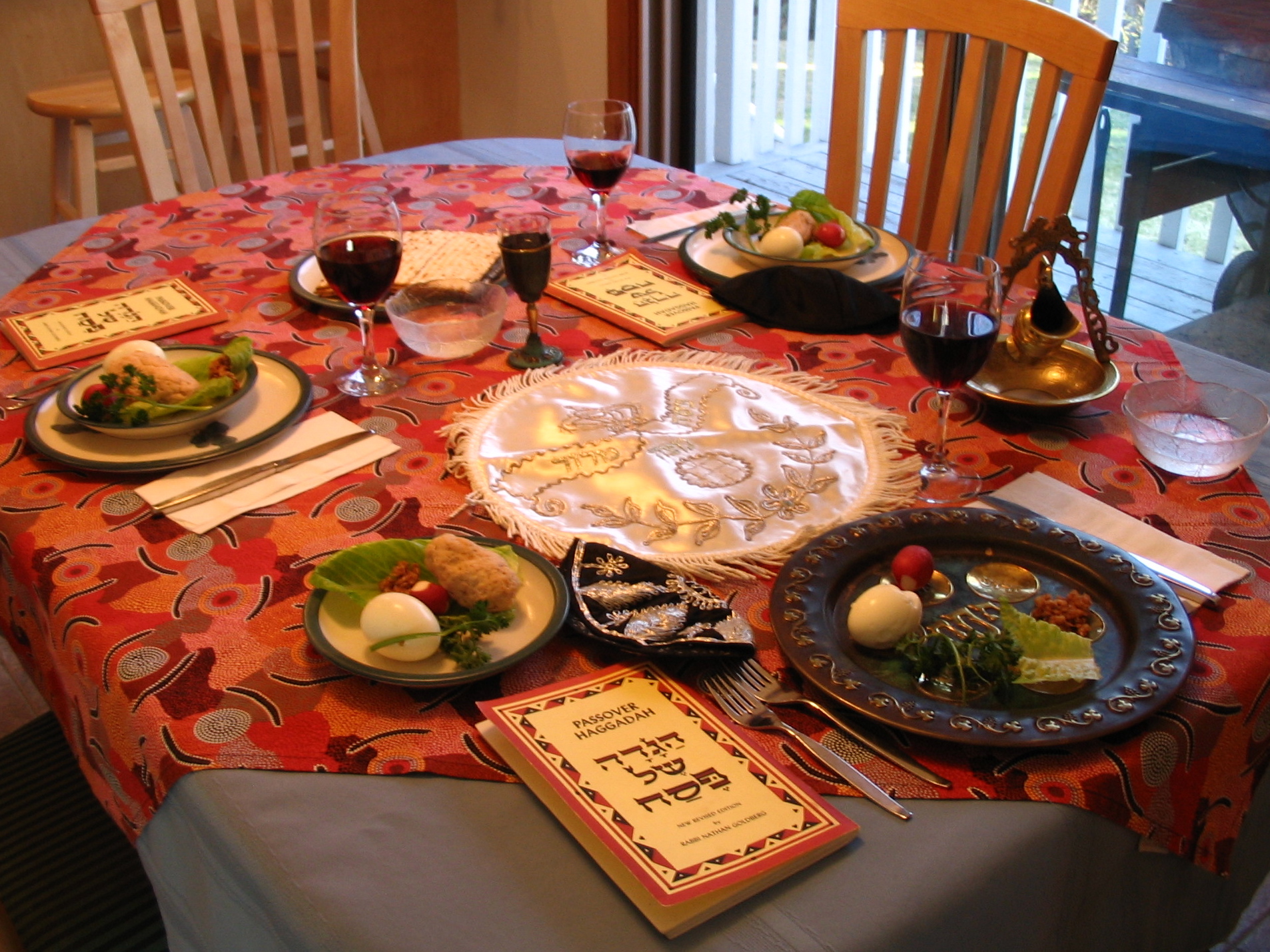 |
| A modern Passover meal setting. This is not how Jesus celebrated Passover. In fact, we have no idea how Jesus celebrated Passover |
Practicing a Passover in a Christian church, especially on Holy Thursday, risks conflating a Passover meal with Holy Communion and confusing the two in the understanding of what either is. They cannot, and so should not, be co-identified with one another.
This is what Taylor Watson Burton-Edwards, director of UM worship resources, has written on the topic:
The United Methodist Book of Worship has this to say about Seder practices. "United Methodists are encouraged to celebrate the Seder as invited guests in a Jewish home or in consultation with representatives of the Jewish community, thus respecting the integrity of what is a Jewish tradition and continuing the worthy practice of Jews and Christians sharing at table together. Celebrating the modern meal without a Jewish family as host is an affront to Jewish tradition and sometimes creates misunderstanding about the meaning of the Lord's Supper.But there is more. Most of what follows is derived from UM sources and discussion and historical studies of the subject.
First, any specific connections between the Last Supper and Passover ritual in the time of Jesus are actually impossible to establish. There are no reliable texts describing Jewish Passover practices at all until the third century, and there is no way to demonstrate that these texts, which are themselves rather sketchy on some points, reflect what first century practice would have been. Thus, trying to recreate a first-century order for Passover or imagine what it may have been is just that—an act of imaginative speculation, not an act of responsible historical interpretation. It should also be noted that Jewish Passover Seder practice today is also not based on these third century texts, nor does it claim nor try to be. Instead, it consciously embraces the later history of the development of this rite beginning in the late middle ages and into current times.
So if there was a Seder for Passover in the first century at all, literally no one today knows or can claim to know what it looked like.
Second, Jesus chose perhaps the most non-distinctive elements of the Passover meal -- bread and wine, common to all meals -- as the signs and bearers of his body and blood in all the biblical accounts of the last supper in the gospels and I Corinthians. Given conflicting accounts between Luke and the others about which cup of wine Jesus used to designate his blood, there is no way to conclude decisively, on biblical grounds, what the meaning of that cup would have been related to a first century Seder, even if we had access to a definitive text.
Third, the earliest forms of Christian Eucharistic prayers bear far more resemblance to Jewish thanksgivings for meals (Q’iddush) or for Sabbath than to anything we see from the third century or even later medieval Jewish Seder texts.
This is not a problem nor seen as a problem by Judaism. Judaism understands itself to be a developing religion. Not everything for them was settled in the biblical period. There is always more to be understood.
But it is a serious problem for 21st century Christians trying to read much, much later Jewish liturgical practices onto whatever Jesus was doing with his disciples in the first century.


Tuesday, January 28, 2014
Ancient Jews and dancing bears

So why, exactly, would the ancient Hebrews be the sole people of their day who understood things that scientists have only recently confirmed? The remarkable thing is not that they got so much right, but that they got anything right at all, because no one else of their day did.
Click here.
This, too.
Wednesday, December 19, 2012
Why is Christmas in December? - Slate Magazine
Why is Christmas in December? - Slate Magazine:
Update: Many of the detailed explanations of these planetary and stellar phenomena, such as this one, do not seem to account for the fact that Dec. 25 on our calendar today is an altogether different date in the ancient world. December 25 on our calendar is 13 days further along than on the Roman Julian calendar used at the time the Pope officially designated Dec. 25 as Christmas Day. The original Dec. 25 date then corresponds to Jan. 7 on our calendar. So to be historically picky about it, the Russian church and others that still use the Julian calendar for religious dating are correctly celebrating the date on Jan. 7.
But wait! There's more! When modern astronomers say that Jupiter's "full stop" occurred on Dec. 25, 2 BC, which Dec. 25 do they mean, Gregorian (modern) or Julian (ancient)? They mean modern. If Jupiter's progression/retrogression transition was in process on Dec. 25 Gregorian, that means that the Magi arrived in Bethlehem on Dec. 12 or so Julian.
They did not get there the day Jesus was born. We know from Matthew that Jesus was born in a barn and laid by his parents in a manger, or feeding trough, after birth. Yet Matthew 2 clearly states, "On coming to the house, they saw the child with his mother Mary, .. ."
How old was Jesus by then? We have insufficient information to know. Presumably, Joseph, Mary and Jesus could have moved from the barn to the house the day after Jesus was born. It's not far fetched to imagine that room for a newborn and parents was made somehow.
 One clue, however, lies in that Herod directed the Magi to come back and report to him once they found the one whom the Magi had referred to as the "one who has been born king of the Jews."
The Magi did not go back to Herod. Herod, never one to countenance potential rivals to his throne (he had even executed his own sons), ordered soldiers to Bethlehem:
It is important, from an historical and biblical perspective, though not necessarily from a practical one for the Church, to confirm Dec. 25 (Julian, anyway) as the date the Wise Men got to Bethlehem, not the date Jesus was born. That date, I'm afraid will likely forever remain unknown.

The reasoning goes that the growing church, recognizing the popularity of the winter festivals, attached its own Christmas celebration to encourage the spread of Christianity. Business historian John Steele Gordon has described the December dating of the Nativity as a kind of ancient-world marketing ploy. ...But there seem to be mathematical reasons for the Dec. 25 date that rest upon modern computational science, not legend.
This alternative explanation is sometimes deployed to dismiss the notion that the holiday had pagan roots. In a 2003 article in the journal Touchstone, for example, historian William Tighe called the pagan origin of Christmas “a myth without historical substance.” He argued at least one pagan festival, the Roman Natalis Solis Invictus, instituted by Emperor Aurelian on Dec. 25, 274, was introduced in response to the Christian observance. The pagan festival “was almost certainly an attempt to create a pagan alternative to a date that was already of some significance to Roman Christians.” According to Tighe, the pagans co-opted the Christian holiday, not the other way around.
Update: Many of the detailed explanations of these planetary and stellar phenomena, such as this one, do not seem to account for the fact that Dec. 25 on our calendar today is an altogether different date in the ancient world. December 25 on our calendar is 13 days further along than on the Roman Julian calendar used at the time the Pope officially designated Dec. 25 as Christmas Day. The original Dec. 25 date then corresponds to Jan. 7 on our calendar. So to be historically picky about it, the Russian church and others that still use the Julian calendar for religious dating are correctly celebrating the date on Jan. 7.
But wait! There's more! When modern astronomers say that Jupiter's "full stop" occurred on Dec. 25, 2 BC, which Dec. 25 do they mean, Gregorian (modern) or Julian (ancient)? They mean modern. If Jupiter's progression/retrogression transition was in process on Dec. 25 Gregorian, that means that the Magi arrived in Bethlehem on Dec. 12 or so Julian.
They did not get there the day Jesus was born. We know from Matthew that Jesus was born in a barn and laid by his parents in a manger, or feeding trough, after birth. Yet Matthew 2 clearly states, "On coming to the house, they saw the child with his mother Mary, .. ."
How old was Jesus by then? We have insufficient information to know. Presumably, Joseph, Mary and Jesus could have moved from the barn to the house the day after Jesus was born. It's not far fetched to imagine that room for a newborn and parents was made somehow.
The Magi did not go back to Herod. Herod, never one to countenance potential rivals to his throne (he had even executed his own sons), ordered soldiers to Bethlehem:
[H]e was furious, and he gave orders to kill all the boys in Bethlehem and its vicinity who were two years old and under, in accordance with the time he had learned from the Magi.In my view, the best interpretation of this narrative is that the Magi had no idea specifically when Jesus was born, but based on their sequence of astronomical observations concluded it had to have been within the two years prior to their arrival at Herod's court. Another key may be that Matthew quotes the Magi as referring to Jesus as "born king of the Jews," not "newborn" king of the Jews. Hence, Herod's order to slaughter boys up to the age of two.
It is important, from an historical and biblical perspective, though not necessarily from a practical one for the Church, to confirm Dec. 25 (Julian, anyway) as the date the Wise Men got to Bethlehem, not the date Jesus was born. That date, I'm afraid will likely forever remain unknown.
Thursday, October 4, 2012
Is Misfortune God's Doing?
Is Misfortune God's Doing? An Excerpt From Harold Kushner's New Look at 'The Book of Job.' – Tablet Magazine:
There is one place in the Bible where serious theological conversation about the nature and thought process of God does take place, prompted by the conflict between the human wish to see the world as a moral sphere where people get what they deserve, where everything happens for a reason, and the inescapable reality that ours is a world where good people suffer for no apparent reason. The book of Job is a full-length argument about whether the misfortunes that befall ostensibly good people come to them from the hand of God. If we want to believe that ours is a moral world, the scene of justice and fairness, we need to confront the arguments presented in what is probably the most challenging book in the entire Bible: the book of Job. ...
The first thing you need to know about the biblical book of Job is that there are two of them. There is the Fable of Job, a very old, simple folktale of faith maintained and rewarded, found in chapters 1, 2, and 42 of the biblical book. And then there is the Poem of Job, a much later, more complicated work comprising the large middle section of the book. A lot of people reading the Bible don’t realize that. They assume it is a single work, a theological sandwich composed of two slices of pious theology wrapped around a dense filling of hard-to-follow religious poetry.
Saturday, June 30, 2012
England braces for "circumcision tourism"
The Telegraph:
In what has been described as a landmark decision, a court in the city of Cologne said circumcision violated a child's "fundamental right to bodily integrity" and that this right outweighed the rights of the parents. ... Jewish groups [protesting the decision] were supported by leaders of Germany's large Muslim population "I feel the decision is discriminatory and counters efforts to promote integration," said Ali Demir, chairman of the Islamic Religious Community in Germany. "This is a harmless procedure that has thousands of years of tradition and a high symbolic value. "We will end up with circumcision tourism to neighbouring countries," he added.Here is one of the most interesting things in the article.
The court case revolved around a four-year-old Muslim boy who was circumcised at the request of his parents but was later admitted to hospital with bleeding. The doctor was charged and tried for grievous bodily harm but was acquitted on the grounds he had parental consent. Prosecutors appealed against the decision but the doctor was again acquitted, this time owing to the imprecise nature of the law.Get that? The first trial ended in acquittal, so the prosecution got to try him again. "Double jeopardy" ain't a game hosted by Alex Trebek; it's a living legal principle in most of Europe.
Friday, December 25, 2009
Five Jewish Women
The Gospel of Matthew 1:1-6, 18
1 A record of the genealogy of Jesus Christ the son of David, the son of Abraham:
2 Abraham was the father of Isaac, Isaac the father of Jacob, Jacob the father of Judah and his brothers,
3 Judah the father of Perez and Zerah, whose mother was Tamar, Perez the father of Hezron, Hezron the father of Ram,
4 Ram the father of Amminadab, Amminadab the father of Nahshon, Nahshon the father of Salmon,
5 Salmon the father of Boaz, whose mother was Rahab, Boaz the father of Obed, whose mother was Ruth, Obed the father of Jesse,
6 and Jesse the father of King David. David was the father of Solomon, whose mother had been Uriah’s wife. . . .
18 This is how the birth of Jesus Christ came about: His mother Mary was pledged to be married to Joseph, but before they came together, she was found to be with child through the Holy Spirit.
Matthew begins his gospel with the Jewish genealogy of Jesus. Unlike Luke’s genealogy, which traces Jesus’ ancestry all the way back to Adam, Matthew stops at Abraham. Also, only Matthew mentions any women in Jesus ancestry. Besides Mary, there are four. They are Tamar, Rahab, Ruth and the wife of Uriah the Hittite.
Let’s hear the story of each of these women.
Tamar’s Story
Perez, the firstborn of Tamar, was the father of Hezron. Hezron was the father of Ram, Ram the father of Amminadab, Amminadab the father of Nahshon, Nahshon the father of Salmon. Salmon was the father of Boaz, whose mother was Rahab. . . .
1 A record of the genealogy of Jesus Christ the son of David, the son of Abraham:
2 Abraham was the father of Isaac, Isaac the father of Jacob, Jacob the father of Judah and his brothers,
3 Judah the father of Perez and Zerah, whose mother was Tamar, Perez the father of Hezron, Hezron the father of Ram,
4 Ram the father of Amminadab, Amminadab the father of Nahshon, Nahshon the father of Salmon,
5 Salmon the father of Boaz, whose mother was Rahab, Boaz the father of Obed, whose mother was Ruth, Obed the father of Jesse,
6 and Jesse the father of King David. David was the father of Solomon, whose mother had been Uriah’s wife. . . .
18 This is how the birth of Jesus Christ came about: His mother Mary was pledged to be married to Joseph, but before they came together, she was found to be with child through the Holy Spirit.
Matthew begins his gospel with the Jewish genealogy of Jesus. Unlike Luke’s genealogy, which traces Jesus’ ancestry all the way back to Adam, Matthew stops at Abraham. Also, only Matthew mentions any women in Jesus ancestry. Besides Mary, there are four. They are Tamar, Rahab, Ruth and the wife of Uriah the Hittite.
Let’s hear the story of each of these women.
Tamar’s Story
My name is Tamar . My story is told in Genesis, chapter 38. I was widowed at a young age when my husband, Er, died. He was a wicked man, so the Lord shortened his life. Er’s father, Judah, told Er’s brother Onan to lie with me so that I could have a child to inherit Er’s estate. But Onan didn’t want to father a child who wouldn’t be his own, so he didn’t carry through with his duty. Not long afterward, Onan died. We think he died because he did not carry out his responsibilities, which was wrong in the eyes of the Lord.
Judah then said to me, “Live as a widow in my house until my young son Shelah grows up.” So I went to live in Judah’s house. After a long time Judah’s wife died. When Judah had recovered from his grief, he went to Timnah, to the men who were shearing his sheep.
When someone in the household told me Judah was on his way to Timnah to shear his sheep, I took off my widow’s clothes. I covered myself with a veil to disguise myself, and went to the village of Enaim. Enaim is on the road to Timnah.
You see, Judah’s third son, Shelah, had now grown up. But Judah had not given me to him as his wife. Without a husband and children, I would be destitute in my old age. No one would be obligated to care for me. Everyone knew it was a terrible fate for a woman to grow old alone.
When Judah saw me, he didn’t recognize me because of the veil I was wearing. In fact, he thought I was a prostitute. Not realizing that I was his daughter-in-law, he went over to me by the roadside and said, “Come now, let me sleep with you.” “And what will you give me to sleep with you?” I asked.
“I’ll send you a young goat from my flock,” he said. I replied, “I want something as collateral for your payment until it arrives.”
Judah said, “What collateral should I give you?”
I answered, “Your seal and its cord, and the staff in your hand.” That would be something like your modern drivers’s license and house keys. So Judah gave them to me and he slept with me. As the result, I became pregnant by him.
After I left, I took off the veil, put on my widow’s clothes again, and went home. Meanwhile Judah sent the young goat by a friend in order to get his collateral back, but of course, he did not find me.
About three months later someone told Judah, “Your daughter-in-law Tamar is guilty of prostitution, and as a result she is now pregnant.” Judah said, “Bring her out and have her burned to death!”
As I was being brought out to be burned, I sent the collateral to Judah with the message, “I am pregnant by the man who owns these. See if you recognize whose seal and cord and staff these are.”
Judah recognized them and said, “She is more righteous than I, since I wouldn’t give her to my son Shelah.” He never slept with me again.
When the time came for me to give birth, we discovered I would have twins. As I was giving birth, one of the twins put out his hand; so the midwife took a scarlet thread and tied it on his wrist and said, “This one came out first.”
But when he drew back his hand, his brother came out, and she said, “So this is how you have broken out!” And he was named Perez.
Then his brother, who had the scarlet thread on his wrist, came out and he was given the name Zerah.
Perez, the firstborn of Tamar, was the father of Hezron. Hezron was the father of Ram, Ram the father of Amminadab, Amminadab the father of Nahshon, Nahshon the father of Salmon. Salmon was the father of Boaz, whose mother was Rahab. . . .
Friday, October 16, 2009
"Why Jews Pray"
First Things has an essay by Rabbi Ben Greenberg, Orthodox Jewish Chaplain of Harvard University as well as the Orthodox Rabbi of Harvard Hillel, called, "Why Jews Pray."
Every moment that we stop and begin to move our lips in prayerful words towards God is a testament to the notion of purposeful creation. The basic ability to pray, to yearn for a connection to God, demonstrates the meaningfulness of life. Yet, this only explains a broad universalistic Jewish motivation for prayer. What lies at the core of Jewish prayer?Not a long essay and well worth your time.
The question is answered, like most Jewish questions, with a debate. Maimonides (Laws of Prayer 1:1) argues that it is a commandment to pray to God everyday based on the verse “And you shall serve the Lord your God.” The service being referred to in this verse is none other than prayer as the sages in the Talmud (Tractate Taanit 2a) had already noted. However, for Nahmanides (Notes on the Book of Commandments, Positive Commandment 5), the commandment to pray applies only when the community is faced with great distress and then, in that moment, it is an imperative to affirm our belief in a God that listens to prayers and intervenes.
We are thus presented with two differing reasons for Jewish prayer. On the one hand, as expressed by Maimonides, praying daily is of fundamental importance. One can speculate a myriad of reasons why this would be so. On the other hand, however, prayer is only necessary when the community is faced with a tremendous difficulty and needs to turn to God and cry out for help in that very moment. ...
Maimonides, then, is in agreement with Nahmanides that meaningful prayer arises only when one is in a state of difficulty. But the difference lies in the application of difficulty to the circumstances of life. Nahmanides considers trouble to be something that can only manifests itself as a distinct and recognizable event, Maimonides, however, sees life itself as full of difficulty and burden. The very nature of what it means to be alive is one that is rife with existential strife and tension that necessitates daily prayer.
Monday, August 3, 2009
How low can we go?
David Warren writes that Western civilization can't get any lower:
But is euthanasia the lowest depravity? It is, to use David's metaphor, a big, flopping fish indeed, but not the biggest.
There is a specificity to Christian faith - and we must include Christianity's parent, Judaism - that assigns transcendent value to this life even while it remains deeply hopeful in the promise of life to come. God, said Jesus in Matthew's Gospel, is not God of the dead, but of the living. So while Christian faith is no guarantee of immunity from depression, it does immunize against despair and hopelessness (as David briefly discusses).
Is there today another culture that glorifies death and hence enhances enhances hopelessness? Alas, there is, and the fish flopping therefrom are bigger than the ones of the West. It is the lands of the Islamic ummah.
Islam formally infuses little to no value in this life and in this world. Allah is remote and unconnected to this world. Allah has given the Quran to humankind through Mohammed (so goes the story) but Allah is himself not present in human life in any way. There is no chance in Islamic thought that Allah could possibly be embodied among us - this Christian idea is very specifically rejected in the Quran - and there is no concept whatever of the Holy Spirit, or, as the Jewish Scriptures put it, the Presence of the Lord.
Hence, from Islam's formative days, Muslims have affirmed that they love death rather than life:
The many symptoms of civilizational decay that lay partly concealed beneath the surface of society only recently came into full view, in the open pornography, the open nihilism, the despairing flippancy, visible throughout our contemporary public life. But the pond was long draining, and it is only now we see fish flopping in the mud.While I am entirely in agreement with David's position on euthanasia, I am not sure I agree that, "It will be hard to go lower." Euthanasia is not merely a symptom of hopelessness, as David shows earlier in his column. It is also the greatest act of societal narcissism. As others have written about the rise of narcissism in Western life, I'll not belabor it here.
Euthanasia is the final "life issue," the clincher for what the last pope called "the culture of death." Even when legalizing abortion, we agreed only to the slaughter of human beings we could not see. It was still possible to look away, to pretend we were not killing "real people," only "potential people." But when we embrace so-called "mercy killing," we embrace slaughter not only for the sick and old, but ultimately, the "option" of easy suicide for ourselves. It will be hard to go lower.
But is euthanasia the lowest depravity? It is, to use David's metaphor, a big, flopping fish indeed, but not the biggest.
For, despite the moral emptiness of a euthanasia-accepting society, the society itself is still focused on life. Now, it is life only under "normal" conditions, not a life stricken by illness or dementia. And, dangerously, not a life that requires expensive medical care to maintain. It is a society that rejects less than optimum life (which is what it means to talk about "quality of life") and wishes simply to shove aside those not enjoying it (whatever it is, which no one define).
Nonetheless, it is not a society that has actually embraced death and glorifies death. Such societies have existed. Rome was one, a very harsh culture in which mercy was a vice, not a virtue, and in which the gruesome deaths of men and women were public spectacles and sports. Not only gladiator combats, of course, but plain execution by means intended to inflict suffering before death. They included burning alive, being attacked by ravenous beasts and cruelest death of all, crucifixion, which was always a public spectacle precisely because it was (and is) the worst way to die devised by man.
David Warren points out the inverse relationship between religion and suicide rates. He cites the work of Tomas Garrigue Masaryk. "He was the 20th-century Czech thinker and statesman whose 1881 book, Suicide and the Meaning of Civilization, laid the foundation for much later social thought."
It was Masaryk's thesis that suicide rates, already at historical highs, and climbing, in the more industrially advanced parts of Europe by the 1880s, would continue to rise through the decades ahead, with decreasing religiosity and increasing modernization. He predicted that this trend would spread to regions yet untouched, as the symptoms of modernity reached them.Let it be noted that Masaryk was embedded in Christian Europe. As Christian devotion has declined, the "the real self-killer [which] is the absence of hope for the future" has risen, followed by a rise in suicide rates.
This was not so much a question of religious denomination, as of religious practice. There would be a rough, inverse correlation between church attendance and the suicide rate. Later statistical studies have borne this out, and Masaryk thus stands among the few sociologists whose work retains any empirical value.
There is a specificity to Christian faith - and we must include Christianity's parent, Judaism - that assigns transcendent value to this life even while it remains deeply hopeful in the promise of life to come. God, said Jesus in Matthew's Gospel, is not God of the dead, but of the living. So while Christian faith is no guarantee of immunity from depression, it does immunize against despair and hopelessness (as David briefly discusses).
Is there today another culture that glorifies death and hence enhances enhances hopelessness? Alas, there is, and the fish flopping therefrom are bigger than the ones of the West. It is the lands of the Islamic ummah.
Islam formally infuses little to no value in this life and in this world. Allah is remote and unconnected to this world. Allah has given the Quran to humankind through Mohammed (so goes the story) but Allah is himself not present in human life in any way. There is no chance in Islamic thought that Allah could possibly be embodied among us - this Christian idea is very specifically rejected in the Quran - and there is no concept whatever of the Holy Spirit, or, as the Jewish Scriptures put it, the Presence of the Lord.
Hence, from Islam's formative days, Muslims have affirmed that they love death rather than life:
Another chapter from early Islamic history — serving as a lesson for today's Muslims at war against the West — is the concept of the love of death. This originated at the Battle of Qadisiyya in the year 636, when the commander of the Muslim forces, Khalid ibn Al-Walid, sent an emissary with a message from Caliph Abu Bakr to the Persian commander, Khosru. The message stated: "You [Khosru and his people] should convert to Islam, and then you will be safe, for if you don't, you should know that I have come to you with an army of men that love death, as you love life." This account is recited in today's Muslim sermons, newspapers, and textbooks. ...An Islamist terrorist taking the nom de guerre of Marwan Abu Ubeida al-Jarrah was quoted by Time magazine thus:
Leading Muslim clerics often refer to the love of death. Chief Palestinian Authority cleric Mufti Sheikh Ikrimeh Sabri stated, "We tell them, in as much as you love life, the Muslim loves death and martyrdom. There is a great difference between he who loves the hereafter and he who loves this world. The Muslim loves death and [strives for] martyrdom." Saudi Sheikh Abd Al-Muhsin Al-Qassem in Al-Madina added: "The Jews preached permissiveness and corruption, as they hid behind false slogans like freedom and equality, humanism and brotherhood... They are cowards in battle... they flee from death and fear fighting... They love life."
Former head of the Al-Azhar Fatwa Committee Sheikh Atiyyah Saqr was asked the following question in an online chat room on March 22, 2004: "What, according to the Koran, are the Jews' main characteristics and qualities?" He explained one of their worst traits: "Cowardice and love for this worldly life are undisputable traits [of the Jews]." Hezbollah's Secretary General Hassan Nasrallah revealed in an interview after the recent prisoner swap between Israel and his group: "We have discovered how to hit the Jews where they are the most vulnerable. The Jews love life, so that is what we shall take away from them. We are going to win, because they love life and we love death."
"It doesn't matter whether people know what I did," he says. "The only person who matters is Allah and the only question he will ask me is 'How many infidels did you kill?'"Is it any wonder then, that al Qaeda and other Islamists embrace suicidism and "martydom" as glorifications? The depravity of Islamism would take more than a single book could document. (Contrast this terrorist's idea of what Allah will ask him with this Christian teaching.)
Friday, July 3, 2009
OK- this is strange
Reuters: "Turkish TV gameshow looks to convert atheists."
"It doesn't matter which religion you believe in, as long as you believe."
Really?
Imagine a parent saying to a child, "It doesn't matter what you eat for supper, as long as you eat something."
Child: "Okay, I'll take pizza and chocolate ice cream - forever."
But that wouldn't matter, would it, as long as the child is eating something?
Math teacher: "It doesn't matter what your answers are on the exam, as long as you write something."
Employer: "It doesn't how you spend your time on the job, as long as you show up."
Why are we so willing to dismiss religion with a wave of the hand - "anything I believe is okay" - but won't accept such a non-standard in any other arena of life?
I'm going to give an answer I know in advance will make some readers hackles rise. It's because to the vast majority of Americans today, their religion is a hobby rather than the ordering principle of their lives. Consider that this statement actually is acceptable: "It doesn't matter what your hobby is as long as you have one."
One man's hobby is golf, another's woodworking. One woman's hobby is gardening, another's crafts. No one thinks his/her hobby is better than another's, and they're right. Hobbies, in the long run, don't really matter. That's why we call them hobbies.
But rare indeed is the religion whose doctrines don't insist it doesn't matter in the long run - the very long run of eternity. So if someone treats one's religion no more importantly than a hobby, then he simply isn't taking his religion seriously.
To say that what we believe, religiously, doesn't matter as long as we believe something betrays, I think, a covert belief that death is the end of existence. If there is no life after death, then not only is one religion as good as another, so is atheism. Or, as the apostle Paul put it, "If the dead are not raised, 'Let us eat and drink, for tomorrow we die'" (1 Cor. 15:32).
However, if one does take seriously the possibility that we survive the death of our bodies in some meaningful sense, then the choice of religion becomes centrally important. For the three great monotheistic religions all teach that right beliefs in this life are of eternal importance for the next. Consider the orienting claims of Judaism, Christianity and Islam:
Judaism: "Hear, O Israel: The LORD our God, the LORD is one" (Deuteronomy 6:4), some translations thus: "... the Lord is our God, the Lord alone."
Christianity: "For God so loved the world that he gave his one and only Son, that whoever believes in him shall not perish but have eternal life" (Gospel of John 3:16).
Islam: "There is no God but Allah, and Mohammed is his prophet."
Now, one could, I suppose, maintain that all three are wrong and that eternal life, if it is to be gained at all, is achieved another way than taught by them. Yet the alternatives of world religions are not encouraging in that regard.
Buddhism, for example, teaches that when one dies one is immediately reborn as someone or something else until, eventually, final liberation from the cycle of death and rebirth is the attained by entering a state of Nirvana, the literal meaning of which is "to extinguish." Buddha himself made no claims about Nirvana other than that it was "indescribable" and "unutterable." Not much there to stake a hope on, I'd say.
As for Hinduism, its teachings on eternal life don't differ much from Buddhism's, they simply describe it differently and Hinduism does affirm the existence of deity - deities, in fact, since Hindus are generally willing to acknowledge the existence of any god you care to name because specific beliefs about God or gods is not considered essential. Like Buddhism, Hinduism seeks release from birth/rebirth until the Self is ultimately subsumed into universal identity "as a drop of rain merges with the sea."
Frankly, that doesn't float my boat, either. I want to be me in the afterlife - a better, perfected me, oh please, but still me. And I want you to be you, too.
Only Judaism, Christianity and Islam can hold out any hope for me in that regard. But they do not agree on how eternal life with God is to be achieved. Though Christianity is the child of Judaism, there are obviously some starkly defining differences, mainly the affirmation of the divine identity of Christ, but not only that. As for Islam, it formally claims that both Judaism and Christianity are corrupted religions resulting from revelations from Allah, but which were adulterated and changed by human sinfulness.
Each has, through history, excluded the others from validity as a way to life eternal. And yet, in that more than any other thing of life, it is most important to be right.
So how to choose, and on what basis? Well, this post is long enough, so I'll take that topic up another day.
ISTANBUL (Reuters) - What happens when you put a Muslim imam, a Christian priest, a rabbi and a Buddhist monk in a room with 10 atheists?Turkish religious authorities are not enthusiastic. Although Turkey's government is formally secular, the vast majority of Turks are Muslims. The TV program may have trouble finding an imam to appear. But its producers are undeterred.
Turkish television station Kanal T hopes the answer is a ratings success as it prepares to launch a gameshow where spiritual guides from the four faiths will seek to convert a group of non-believers.
The prize for converts will be a pilgrimage to a holy site of their chosen religion -- Mecca for Muslims, the Vatican for Christians, Jerusalem for Jews and Tibet for Buddhists.
"We are giving the biggest prize in the world, the gift of belief in God," Kanal T chief executive Seyhan Soylu told Reuters.Now let's take a harder look at that last statement. I've heard it a lot, even here in America.
"We don't approve of anyone being an atheist. God is great and it doesn't matter which religion you believe in. The important thing is to believe," Soylu said.
"It doesn't matter which religion you believe in, as long as you believe."
Really?
Imagine a parent saying to a child, "It doesn't matter what you eat for supper, as long as you eat something."
Child: "Okay, I'll take pizza and chocolate ice cream - forever."
But that wouldn't matter, would it, as long as the child is eating something?
Math teacher: "It doesn't matter what your answers are on the exam, as long as you write something."
Employer: "It doesn't how you spend your time on the job, as long as you show up."
Why are we so willing to dismiss religion with a wave of the hand - "anything I believe is okay" - but won't accept such a non-standard in any other arena of life?
I'm going to give an answer I know in advance will make some readers hackles rise. It's because to the vast majority of Americans today, their religion is a hobby rather than the ordering principle of their lives. Consider that this statement actually is acceptable: "It doesn't matter what your hobby is as long as you have one."
One man's hobby is golf, another's woodworking. One woman's hobby is gardening, another's crafts. No one thinks his/her hobby is better than another's, and they're right. Hobbies, in the long run, don't really matter. That's why we call them hobbies.
But rare indeed is the religion whose doctrines don't insist it doesn't matter in the long run - the very long run of eternity. So if someone treats one's religion no more importantly than a hobby, then he simply isn't taking his religion seriously.
To say that what we believe, religiously, doesn't matter as long as we believe something betrays, I think, a covert belief that death is the end of existence. If there is no life after death, then not only is one religion as good as another, so is atheism. Or, as the apostle Paul put it, "If the dead are not raised, 'Let us eat and drink, for tomorrow we die'" (1 Cor. 15:32).
However, if one does take seriously the possibility that we survive the death of our bodies in some meaningful sense, then the choice of religion becomes centrally important. For the three great monotheistic religions all teach that right beliefs in this life are of eternal importance for the next. Consider the orienting claims of Judaism, Christianity and Islam:
Now, one could, I suppose, maintain that all three are wrong and that eternal life, if it is to be gained at all, is achieved another way than taught by them. Yet the alternatives of world religions are not encouraging in that regard.
Buddhism, for example, teaches that when one dies one is immediately reborn as someone or something else until, eventually, final liberation from the cycle of death and rebirth is the attained by entering a state of Nirvana, the literal meaning of which is "to extinguish." Buddha himself made no claims about Nirvana other than that it was "indescribable" and "unutterable." Not much there to stake a hope on, I'd say.
As for Hinduism, its teachings on eternal life don't differ much from Buddhism's, they simply describe it differently and Hinduism does affirm the existence of deity - deities, in fact, since Hindus are generally willing to acknowledge the existence of any god you care to name because specific beliefs about God or gods is not considered essential. Like Buddhism, Hinduism seeks release from birth/rebirth until the Self is ultimately subsumed into universal identity "as a drop of rain merges with the sea."
Frankly, that doesn't float my boat, either. I want to be me in the afterlife - a better, perfected me, oh please, but still me. And I want you to be you, too.
Only Judaism, Christianity and Islam can hold out any hope for me in that regard. But they do not agree on how eternal life with God is to be achieved. Though Christianity is the child of Judaism, there are obviously some starkly defining differences, mainly the affirmation of the divine identity of Christ, but not only that. As for Islam, it formally claims that both Judaism and Christianity are corrupted religions resulting from revelations from Allah, but which were adulterated and changed by human sinfulness.
Each has, through history, excluded the others from validity as a way to life eternal. And yet, in that more than any other thing of life, it is most important to be right.
So how to choose, and on what basis? Well, this post is long enough, so I'll take that topic up another day.
Subscribe to:
Posts (Atom)