Tuesday, April 23, 2013

There are no inventions without inventors

In my readings preparing for my series on the historical fact of Jesus' resurrection, explanations of the claims that Jesus rose from the dead only fall into two groups.

Group One: Yes, he did.

Group Two: No, he didn't.

It is important to note that there are several facts of history that must be accounted for either to affirm or deny that Jesus rose from the dead. I identify five such facts; some scholars identify four and other six or more. (I did not include that Jesus really lived, for example, since pretty much no one today argues that he didn't.)

I explained the five facts here: Five Confounding Facts About Jesus' Resurrection

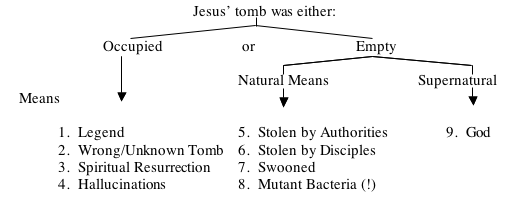
In "Reasons to disbelieve Jesus rose from the dead," I explained a number of alternative theories offered to account for why the Church began to proclaim Jesus risen.

One alternative theory I did not address is that Jesus did not rise from the dead, but that over the several decades after his execution a legend grew up around him so that by 40-50 years after his crucifixion, the Gospels began to be written describing Jesus as a risen Savior. 

But if you think about it, this explanation does not explain at all. The Church has always held that it was Jesus' resurrection that explains why the Church began to exist. The skeptics promoting the "later legend" theory say that the claim Jesus was resurrected is a much-later invention. 

But there are no inventions without inventors. So the later legend theorists should be able to explain why, absent the resurrection to begin with, the Church even started. But I have not seen any such explanation except, perhaps, his disciples tried gamely to carry on with Jesus' ethical and religious work but soon found that there was some extra "oomph" needed to keep it going. 

But as I explained in my first post,
Jesus broke no new ground there. Jesus simply expressed God’s previously-revealed truths in an especially-compelling manner. So a religious movement based just on Jesus’s ethical and moral teachings would be definitively Jewish, insignificantly different from the Judaism of his time, and certainly nothing to motivate twelve men to give their lives evangelizing the whole world in Jesus’s name. I mean, why bother? 
I was talking to a US Marine Corps veteran early this week and we briefly discussed the story of the founding of the Marine Corps. Marine lore has it that the Corps was founded in a bar, Tun Tavern in Philadelphia, to be exact. It was there that the first Marine Corps recruitment drive was held. 

Now here is the question: If the USMC was not actually founded at Tun Tavern, why would they later make it up? To what point? The Corps already would have existed if it had been founded elsewhere, elsewhen. What is gained by suppressing the true founding and inventing Tun Tavern? 

The same question applies to the stories about the resurrection of Jesus. Later-legend theorists can't just present us with their own counter claim that the resurrection is a later invention. They need to provide what the suppressed reasons were for the founding of the Church, why they were suppressed and why this particular legend was substituted. 

But they don't. 

Sunday, April 21, 2013

Reasons to disbelieve Jesus rose from the dead

But do they hold up? 

Last week I explained five historical facts that must be accounted for either to affirm or deny that Jesus rose from the dead. These facts do not rely on supernatural authority or a claim that they must be believed because the Bible is inspired Scripture.

Historians, and not just Christian ones, are in broad consensus that these were factual events, not claims invented by the church, especially since absent these facts there is no reason to assume there would have been a church to invent them in the first place.

Thus, seriously grappling with the claim that Jesus rose from the dead must include these facts in the explanation. Explanations must actually explain. Simply to deny these facts does not explain them. One might as well try to explain how the Civil War started by ignoring the attack on Fort Sumter.

Skeptics of the historical fact of Jesus's resurrection offer explanations that fall into four main categories:
1.  The key actors on Good Friday and Sunday morning botched what they were doing.
2.  Science proves Jesus’s resurrection is impossible.
3.  The accounts of Jesus’s resurrection are mythical of a kind common in the ancient world.
4.  The apostles were either deluded or they mounted a deliberate conspiracy of falsehoods.

The "they botched it" theories

The "Swoon Theory"

The first allegedly-botched job was the crucifixion, in which the Romans incompetently took Jesus down from the cross unconscious rather than dead. Joseph and the women entombed Jesus still alive. This is called the “Swoon” theory.

The swoon theory says that the coolness of the tomb and Friday’s partial application of funereal spices made Jesus come to his senses. Before dawn Sunday he rolled away the stone, and found some workman’s clothes, causing Mary Magdalene to mistake him for a gardener. So the swoon theory does explain why the women found the tomb empty and why the presumed gardener claimed he was Jesus.

But it assumes that 
  • the brutal flogging that Jesus received from the Romans, 
  • the shredding of his head by a wreath of thorns, 
  • hanging on the cross with nailed hands and feet, 
  • and the deep piercing of his chest by a Roman spear, 
were all relatively minor injuries that 
  • left Jesus mentally fully competent, 
  • evoked too little bleeding to kill or much weaken him, 
  • insufficiently injured his hands and feet to degrade either his dexterity or mobility 
  • left him with enough physical strength to single-handedly roll away a one-ton stone from the tomb. 
  • had healed enough so that Mary did not recognize him as the recently-crucified Jesus. 
The swoon theory also ignores the fact that Jesus would have consumed neither food nor drink since Thursday evening but apparently suffered no ill effects from 84 hours or so without nourishment or water.

The theory assumes that Roman soldiers, of all people, did not know how to kill a defenseless man and ignores that their motivation to make sure Jesus was dead very very great: under Roman military law they could have been executed themselves for failing to carry out the sentence properly. 

The swoon theory also requires that Joseph and the women who partially prepared Jesus for burial on Friday did not detect that he still breathed and had a heartbeat, however weak it may have been. People in ancient times were very familiar with corpses. There were no funeral homes. Families did that work on their own. The women friends of Jesus, like any women of the day, knew very well about -
  • livor mortis, the collection of blood in the lowest parts of a corpse after the heart ceases beating, due to gravity. Livor mortis causes marked purpling of the body where it occurs and is usually noticeable starting about 20 minutes after death. A man dead on a cross would have been so colored at least from the knees down. If Jesus was not dead when he was removed, livor mortis would not have occurred and the women would certainly have noticed.
  • rigor mortis, the stiffening of the limbs of a corpse caused by chemical changes in the muscles. A corpse is highly resistant to manipulation because of this. To be fair to the swoon theory, though, it take between 4-6 hours after death for rigor mortis to set in. Jesus was probably entombed by then. 
The swoon theory, then, requires not only that the Roman soldiers blundered the crucifixion but that the women were blind to the lack of empirical evidence that Jesus was dead, evidence which was common knowledge in their day.

The swoon theory does not explain
  • why Mary said Jesus was risen rather than survived. 
  • why Jesus apparently needed no medical care or convalescence. 
  • with whom Jesus lodged after his botched crucifixion, because he is nowhere presented as hanging out with his old friends.[1]  
  • why Paul and James said they knew Jesus risen 
  • why the Church would begin with such energy and devotion 
  • why the apostles suffered hard lives and cruel deaths to insist that Jesus was a risen Savior rather than merely a lucky guy. 
  • why the Romans did not mount a manhunt for the surviving Jesus when we know that when the Romans wanted you dead, they meant it. (The Romans didn't hunt for Jesus after the historical resurrection, either, when Peter et. al. were proclaiming him risen. Why? Because the Romans knew darn good and well they had killed him on the cross.)
An explanation, actually to explain, cannot create more unresolved issues than it tries to solve. The swoon theory thus fails.

The “wrong-tomb” theory 

This theory simply says that on Sunday morning the women mistakenly went to an unused, open tomb, talked with a gardener whom they mistook for Jesus, then excitedly told the disciples that Jesus’s tomb was empty and Jesus was risen.

However, 
  • The women were not looking for an open, empty tomb. They had asked themselves en route how they would get the stone rolled away. So, when coming to an open, unused tomb, why didn't they keep going? Wrong-tomb theorists do not say, except to claim that the women were confused. ("They went to the wrong tomb because they were confused. How do we know they were confused? Because they went to the wrong tomb." A bit circular, eh?)
  • Having already been to Jesus's tomb on Friday, they knew which tomb to go to.
The wrong tomb theory does not explain 
  • why the gardener Mary conversed with claimed he was Jesus 
  • why Mary called him Lord when he knew and she thought that Jesus was dead elsewhere.
  • why the gardener told Mary to tell the disciples he would meet them in Galilee. 
The wrong-tomb theory also echoes the ancient belief that women could not be trusted to relate facts rather than addle-headed nonsense. Its unspoken precept is, “Let me tell you what those idiot women did.”

No historian concerned about his reputation promotes either the swoon theory or the wrong-tomb theory any more, but many people still argue them.

Scientific objections to the resurrection

Many people you will witness to will reply that science shows it to be impossible. In fact, science shows no such thing. There are some scientists who say the resurrection is scientifically impossible. But there are many other scientists who profess religious faith. For example:
A scientific discovery is also a religious discovery. There is no conflict between science and religion. Our knowledge of God is made larger with every discovery we make about the world. - Joseph H. Taylor, Jr., who received the 1993 Nobel Prize in Physics for the discovery of the first known binary pulsar, and for his work which supported the Big Bang theory of the creation of the universe.
Astronomers … have proven … that the world began abruptly in an act of creation… . And they have found that all this happened as a product of forces they cannot hope to discover… . That there are what I or anyone would call supernatural forces at work is now, I think, a scientifically proven fact. – Robert Jastrow , Astronomer, physicist and founder of NASA’s Goddard Institute of Space Studies.
The common belief that… the actual relations between religion and science over the last few centuries have been marked by deep and enduring hostility… is not only historically inaccurate, but actually a caricature so grotesque that what needs to be explained is how it could possibly have achieved any degree of respectability. – Colin Russell, Cambridge University historian of science.
Both religion and science require a belief in God. For believers, God is in the beginning, and for physicists He is at the end of all considerations… To the former He is the foundation, to the latter, the crown of the edifice of every generalized world view. – Max Planck, Nobel Prize physicist, founder of quantum theory, one of the most important physicists of the 20th century).[2]
Two other examples are Dr. Francis Collins, head of the human genome project and currently director of the National Institutes of Health and Dr. John Lennox, professor and Fellow in Mathematics at Oxford University. There are many others.

Sociologist Elaine Ecklund surveyed 1,700 scientists and conducted personal interviews with 275 of them at elite American universities, seeking to find out what their views on religion were. She writes:[3]
After four years of research, at least one thing became clear: Much of what we believe about the faith lives of elite scientists is wrong. The [presumed] ‘insurmountable hostility’ between science and religion is a caricature, a thought-cliché, perhaps useful as a satire on groupthink, but hardly representative of reality.
Most of the non-religious scientists Ecklund interviewed said that they just were not interested in religion questions, any more than a Methodist preacher would be much interested in how to mass produce elemental isotopes. And unlike the rest of America, younger scientists are more religious than older ones.

So it is important to understand the difference between what science, as a discipline, can do and what scientists may personally believe. Scientists may deny or affirm the resurrection, but science as a discipline can neither rebut nor confirm it. Here’s why:

Science can neither prove nor disprove historical questions, though science can help answer many historical details. Science can neither prove nor disprove that George Washington crossed the Delaware river to fight Hessian forces at Trenton, New Jersey on Christmas night, 1776, for example. It's not a scientific question. The resurrection of Jesus is an historical question that the sciences might aid in answering. But science as a discipline cannot determine the answer.

One big reason is that the scientific method can't adequately address miracles. The error some scientists make is in therefore saying that there are no such things as miracles. Consider this: Imagine that someone at the end of our church service someone stated, “Speaking as a lawyer, I have determined that this church has one of the most skilled accompanists in Tennessee.” Now that is probably true, but it’s not a legal question. Similarly, science by definition investigates the natural world and so cannot speak definitively about supernatural events, which is what the resurrection is.

Scientific integrity requires that scientists and non-scientists alike recognize that there are limits to scientific knowledge. Failing this is the main error of the so-called New Atheist movement, whose advocates insist that 
  • only science reveals the Real, 
  • only science can discover truth 
  • scientific knowledge is exhaustive and inherently unlimited. 
But these claims are themselves not testable with the scientific method. They are not scientific claims, but claims of faith in science, or scientism. Richard Lewontin, an evolutionary biologist and geneticist, explained in The New York Review of Books in 1997 (link) that scientism has a ...
... prior commitment to materialism. It is not that the methods and institutions of science somehow compel us to accept a material explanation of the phenomenal world, but, on the contrary, we are forced by our a priori adherence to material causes to create an apparatus of investigation and a set  of concepts that produce material explanations ... . Moreover, that materialism is absolute, for we cannot allow a Divine Foot in the door.
But nothing about Jesus' resurrection overturns science at all. Before he was Pope Benedict, Cardinal Ratzinger wrote that the resurrection is 
... no contradiction of clear scientific data. The Resurrection accounts … speak of something new, something unprecedented -- a new dimension of reality that is revealed. What already exists is not called into question. Rather we are told that there is a further dimension, beyond what was previously known.  
The Mythical Story theory

The next rebuttal of the resurrection is the claim that stories about a divine hero dying and returning to life were a dime a dozen among ancient peoples and that Jesus's resurrection is just another example. In this claim, “Jesus Christ is a mythological character along the same lines as the Greek, Roman, Egyptian, Sumerian, Phoenician, Indian or other godmen, who are all presently accepted as myths rather than historical figures.” [4]

However, experts in the field are not making this claim. Professor Norman Geisler of Loyola University explains, “No Greek or Roman myth spoke of a literal incarnation of a monotheistic God into human form by way of a literal virgin birth, followed by his death and physical resurrection.”

Nor were such stories very common at all. Only about fifteen such ancient stories are identified by claimants.

British scholar Norman Anderson argues, 
The basic difference between Christianity and the mysteries is the historic basis of one and the mythological character of the others. The deities of the mysteries were no more than ‘nebulous figures of an imaginary past,’ while the Christ whom the [apostles] proclaimed had lived and died only a few years before the first New Testament documents were written.
As Peter told the people of Jerusalem on Pentecost, you know this Jesus of whom I speak. Peter was not referring to a mythical figure of a hazy, distant past, but one whom his hearers had known personally.

Furthermore, “Most of the evidence for the alleged similarities from the pagan myths date between the second to fourth centuries,” [5] long after the New Testament had been written. If anything, most of those ancient myths are likely based on Jesus rather than the other way round.

Also, myth theorists must explain why the fiercely monogamous Jews would have adopted pagan myths to promote the Jewish Jesus and why they would have falsely claimed Jesus dead and risen when the existing, well-developed concept of the messiah had never included such a concept.

Finally, the pagan-myth hypothesis makes no attempt at all to grapple with the historical facts that are, well, facts, not myth.  

The apostles were deluded or frauds

Last is the claim that the apostles were either deluded or they mounted a deliberate conspiracy of falsehoods. Almost no one claims any more that the apostles were deliberately lying because, as J.P. Moreland put it,
The disciples had nothing to gain by lying and starting a new religion. They faced hardship, ridicule, hostility, and martyr's deaths. In light of this, they could never have sustained such unwavering motivation if they knew what they were preaching was a lie. The disciples were not fools and Paul was a cool-headed intellectual of the first rank. There would have been several opportunities over three to four decades of ministry to reconsider and renounce a lie.
Let’s look at the delusion angle. Today’s leading figure in promoting this theory is German scholar and self-admitted atheist Gerd Ludemann, who says in What Really Happened to Jesus that the apostles undeniably believed what they proclaimed, but were so psychologically distraught from the cruel death of Jesus that they all suffered exactly the same hallucination that Jesus was alive again. Ludemann says that the source of the disciples’ visions were psychological processes which occurred “completely without divine intervention.” Therefore, “A consistent modern view must say farewell to the resurrection of Jesus as a historical event.”

(Ludemann taught for several years at Vanderbilt Divinity School, the source of my own M.Div. I began there just after he had returned to Germany so I did not study under him. However, What Really Happened to Jesus was an assigned book in my New Testament class.)

On its face the delusion theory seems plausible. But I would submit that it fails for these reasons:
  • First, delusion theory presumes from the outset that the resurrection is false. When its greatest proponent is a self-described atheist, it sort of gives the game away.
  • Second, the delusion theory does not explain why the tomb was empty or why deluded apostles would admit that a woman first bore the Easter message.
  • Third, that the apostles’ delusion was caused by their psychological need to regain company with Jesus is suspect because the pre-resurrection disciples seem less devoted to Jesus than the theory demands. John 11, for example, records that eleven of the twelve were so upset with Jesus that they wanted to quit and go home, staying only because Thomas talked them into it. Every disciple abandoned Jesus to his fate when he was arrested, hardly evidence of such intense love and loyalty that they would later see hallucinations of Jesus alive.
  • Fourth, the theory does not explain why Paul and Jesus's brother James became deluded as well. Neither man followed Jesus before his death; Paul never even met him. Ludemann simply dodges this question altogether.
Finally, such a delusion  seems unique in the entire world, having never occurred before or since. Ludemann attempts to show analogous delusions in other figures or groups of people in other historical occasion, but they are actually present only superficial similarities; most are actually more dissimilar than similar. 

If the apostles were deluded, then I want that same delusion! It is a delusion that inspires people to become the finest they can be, to exhibit and live the highest virtues and to order their lives around love, integrity, faithfulness and devotion to the good of all. Delusion? May we all hope to be equally deluded.

Coming April 28: Just what did the apostles mean by resurrection, anyway, and what does it matter to us?

Endnote: The explanation that the the tomb was empty because someone had stolen Jesus' body is one I covered in a previous post.

Saturday, April 20, 2013

The main obstacle

Christian Apologetics QuotesYou are free in our time to say that God does not exist. You are free to say that He does exist but He is evil. You are free to say like some poor satirists that He would like to exist if He could. You may talk of God as a mystification or a metaphor. You may boil him down with gallons of long words or boil him to the rags of metaphysics, and it is not merely that no one punishes you for it, but nobody protests. But if you speak of God as a thing like a tiger—as a reason for changing one's conduct—then the modern world will stop you somehow if it can. We are long past talking about whether an unbeliever should be punished for being irreverent; it is now thought irreverent to be a believer. - G.K. Chesterton 

Christian Apologetics QuotesAnyone who is making an impact is going to draw fire. It’s written in the bloodstream of the universe. An oft-repeated platitude is, “If you’re flying over the target, you’re going to catch flack.” Or as Elbert Hubbart stated, “To avoid criticism do nothing, say nothing, be nothing.” If you are someone who is putting (or will one day put) your hand to the plow of God’s work, you will invite criticism. And the more valuable your contribution is to the kingdom of God, the more severe the criticism will be. – Frank Viola (from, Three Kinds of Critics & How to Respond to Them

More.

Friday, April 19, 2013

Job well done in Boston!

Unlimited kudos to the law enforcement team that apprehended Suspect 2 this evening.
The events of this past week were tragic; but what was highlighted 24/7 was the professionalism of law enforcement and the dangers we all face everyday. Most of which go unseen and unheard. The average American never sees the mechanic fix the car, they just thank them when it runs. This week we all got to see the mechanics work and they performed admirably! - Kevin Carroll on FB 
Really quite a stunning piece of police work and inter-agency professionalism.

 Bookmark and Share

Tuesday, April 16, 2013

Reasons Jesus did not rise from the dead

Last Sunday I spoke about the "Five Confounding Facts About Jesus' Resurrection." These are facts that must be explained and accounted for either to affirm or deny that Jesus rose from the dead. These facts do not rely on supernatural authority or a claim that they must be believed because the Bible is inspired Scripture. 


On April 21 I will speak about the main various explanations that have been offered to explain the facts of Easter morning without concluding that Jesus rose from the dead. In brief, these alternate explanations are:
  1. Science proves Jesus’s resurrection is impossible.
  2. The accounts of Jesus’s resurrection are mythical of a kind common in the ancient world.
  3. The apostles were either deluded or they mounted a deliberate conspiracy of falsehoods.
  4. The key actors on Good Friday and Sunday morning botched what they were doing (the "Swoon" theory and the "wrong tomb" theory).
(The "swoon" theory: Jesus did not actually die on the cross (that is, the Romans botched the crucifixion) and was entombed alive. Awaking Sunday morning, he rolled away the stone, found some clothes and then spoke with the women who came to the tomb to finish preparing his body for burial.

The "wrong-tomb" theory: Jesus did die on the cross, was entombed on Friday but on Sunday the women mistakenly went to an unused, open tomb, talked with a gardener whom they mistook for Jesus, then excitedly told the disciples that Jesus’s tomb was empty and that Jesus was risen.)

I hope to cover these topics adequately in a reasonable time! Sunday afternoon I'll post the finished text here. If you are around our area, I hope to see you this Sunday!

Monday, April 15, 2013

The problem with church "insiders"

Lots of FB posting by Methodist ministers of this link: "Why 'Insiders' Are Killing Your Church." The author's thrust is that churches say they want to grow and reach new people, but they really don't.
Countless numbers of leaders and members of churches have given in to a Christian consumerism. They embrace a mentality that gives ample rhetorical support to evangelistic intent, but resists violently at the point of implementation because — at the point of actually “doing” it — it “costs” them.

In other words, scratch the surface of a sacrificial, pick-up-your-cross, to die is gain, eat my flesh and drink my blood, Christian,

… and you have an it’s-all-about-me, spiritually narcissistic, turned-inward, meet my needs, feed me, consumer.

Don’t believe me?

Let’s listen in:

“Of course I want to reach lost people,”

… but I’m not going to see us change the music.

… but I’m not going to lead a capital campaign to raise the money.

… but I’m not going to park far away.

… but I’m not going to risk stirring things up right now in the church.

… but I’m not going to attend a different service time.
And so forth. It should be noted, btw, that church insiders are clergy, too.

I think that essay is a little harsh in some places, but there is a lot of truth in it. We see the same dynamic at work in other areas of our lives, too. Consider, for example, the debates about federal spending and runaway entitlements spending. Voters ideologically approve cutting the budget but operationally we don't want programs that benefit ourselves to be on the block. For example, my parents are in their 80s. Do I really want Medicare to be cut? Baby boomers, of whom I am one, are just starting to retire in large numbers. Do I think that Social Security spending should be lowered?

What we have at work in many of our churches (including whole UM Conferences, heck, the entire denomination!) is a kind of cogntitive dissonance between what we approve of in principle and what we will actually support in practice. Bill Easum and Tom Bandy summed it up this way, note the tag line at the end:


Tuesday, April 9, 2013

"10 Honest Observations from a Former Church Insider"

A former pastor explains how his perspective on things churchy changed once he was no longer inside the institution. Read the whole thing. A selection:

10. This is going to sound terrible, but I’m surprised how little church means to me now that I’m not a church insider. 
When I was a church insider, I operated under the assumption that what we were offering people was going to fill some deep gap that they had and knew that they had, but now that I am a church outsider, I’m a perfectly content guy. I don’t feel like something is missing. Maybe it is, but it doesn’t feel that way.   
I think pastors and church leaders too often assume that people that don’t show up on Sunday are lonely or deficient in some way, but it’s just not the case in my world and probably isn’t the case with others. 
I listed this first because I think if I knew that people felt that way when I was a pastor I would have offered them something different and talked to them differently.  
It changes everything. 
7. The sermons are rarely memorable. This is a huge problem because in every church we’ve visited the sermon is clearly designed to be the crescendo/centerpiece of the entire service.   
I won’t tell you where we went last, but I can’t tell you even one sentence from the sermon and I listened the whole doggone time.
6. In my church training, I always learned that parents will go to a church that they like just a little bit if the kids LOVE it...
But that parents will leave a church they like a lot if the kids don’t like it.  
It’s true.  I preferred one church in New York personally but the kids didn’t like it at all.  We went back one time. The kids didn’t like it again. I loved it. We never went back.  DOUBLE DOWN ON WHAT YOU DO FOR KIDS. Make it even bigger and better than what you do for adults!!
4. When I pastored Courageous Church we spent an outrageous amount of time on announcements.  
I was slightly aware that we spoke of our announcements too many times. Now that I am on the other end of things, IT IS CRAZY.  

The Facts of Christian Faith Number Two


Last Sunday I began my series on why and how Christian faith is founded on facts, not myth. A slightly abbreviated version of April 7's message is here: "Truth and Christian Faith."

This Sunday's message is, "The Facts of Faith." Here is a preview of the historical facts under girding the factual event of the resurrection of Jesus:

  1. The founding of the Church has never been explained on any basis that leaves Jesus unresurrected.
  2. Jesus’s tomb was discovered empty on the Sunday after he died on the cross.
  3. The first person to claim that Jesus rose from the dead was a woman.
  4. Many other people also said they saw Jesus risen from the dead. These accounts are dated to very soon after Jesus’s death.
  5. The apostles who proclaimed Jesus’s resurrection and who founded the Church were all killed for doing so, except John, who died in exile. None recanted even when it would have saved their lives. We know it would have because Roman officials’ letters of the day say so.
  6. Paul actively persecuted early believers but then suddenly ceased and soon after became a vigorous apostle for Jesus. Jesus’s own brother, James, never followed Christ until after Jesus’s death and then James became the head of the Jerusalem church. 

Skeptics have never explained any of these facts in a way that both leaves Jesus dead and results in the Church being established in the way that it was. 

None of these facts reply on supernatural authority. They are historically-based claims of no different nature than accounts of other ancient figures or events. I'll explain the import of them in more detail this Sunday. 

Monday, April 8, 2013

Truth and Christian Faith

This is a slightly abbreviated version of my sermon yesterday. It is the first of a series on why and how Christian faith is founded on facts, not myth.

Christianity rests on a single claim. I call it the fulcrum of our faith. All of Christian faith is founded on the Easter proclamation, “He is risen!” Absent that, we got nuthin’.
And nothing is frankly what increasing numbers of Americans think we've got. On Good Friday, the respected polling firm Rasmussen Reports released a poll that showed that the number of Americans who believe that Jesus rose from the dead has dropped 13 percent since only last year. The poll question was the same this year as last, “Do you believe that Jesus Christ rose from the dead?” Last year, 77 percent said yes. This year, 64 percent said yes. Over the last five years, the drop has been steepest among teens and young adults. In fact, one-third of adults under 30 claim no religious affiliation at all (see "Growing Up 'None' ").
Of the 36 percent who did not affirm Jesus’s resurrection, 19 percent rejected it outright, a staggering 12 percentage point jump from last year. Seventeen percent said they weren't sure.
First Peter 3.15 tells us, “Always be prepared to give an answer to everyone who asks you to give the reason for the hope that you have.” Seems like we who know Jesus arose are not doing that very well.
And so my reasons for this sermon series. Christian faith is founded on historical facts, verifiable facts, facts that even non-Christian historians and scholars agree are true. And yet my guess is that only a very small number of typical mainline Protestant church members, including us Methodists, would be able effectively to recount and relate those facts and what they mean in a way that would at least move some of the 19 percent who deny Jesus’s resurrection to the group who at least admits the possibility.
I will be frank – what I seek to inculcate in my flock is greater conviction of the truth of the Christian proclamation that “Christ is risen, he is risen indeed.” Conviction is not mere agreement to a proposition. Conviction is a belief held so powerfully that it transforms the way we live. As Wesley explained, if we say we believe something but it makes no difference in the way we spend our time or our money, then it is belief without conviction. Conviction changes us.
Here is how I plan to proceed:
  • I mentioned a couple of weeks ago that while interrogating Jesus on Good Friday, Pontius Pilate asked him what I think is probably the second-most-important question is the Bible: “What is truth?” This question strikes to the heart of the American church and that is what I will address today.
  • Next Sunday I will talk about the Easter story itself and why it is solidly historical.
  • On April 21 I will then do my best to recount the various alternative explanations that have been offered over the last couple of centuries claiming to show why the Easter proclamation is actually false, even if the apostles thought it was true.
  • On April 28 my topic will be what the apostles meant by resurrection in the first place and what it has to do with us. On May 5 I’ll try to wrap everything up.

Now on to Pilate’s question. What, indeed, is truth?
Truth bears authority, so debates about what is true necessarily are also about what has authority. Here are some expressions we have all used in the contests over truth and authority:
•  “Nobody has the right to tell me . . .” (fill in the blank),
•  “The rule book says that . . .”
•  “I saw on TV . . .”
•  “Research has shown that . . .”
•  “The Bible says . . .”
•  “I read on the internet . . .”
•  “My feelings are . . .”
All these statements are claims of truth and authority. Christianity has a set of claims, too – many claims. There is at least one claim that is extremely offensive. We don’t like being offensive, especially in this sensitive era. The greatest social sin you can commit today is to offend someone’s nationality, ethnicity, educational background, political affiliation, what have you. We are nice people and we want others to think so. So in our commendable urge not to offend anyone we risk watering down the Gospel because we won’t embrace the offensiveness inherent in the Christian proclamation.
Frederica Mathewes-Green, a Christian writer, related that she was invited to appear on a panel in a secular setting to discuss spiritual nurturing in everyday life. She told the assembly that if you were raised in a Christian tradition, then explore it more and learn more about it. It will enrich your life. If you were raised in some other religious tradition, she said, explore and learn about Christianity anyway. Christianity is for everyone and its welcome transcends all earthly boundaries. After she finished, the panel’s moderator looked at her like a naughty kindergartner and told the group, “What Frederica meant to say was that there are many spiritual paths and all should be honored in the spirit of multiculturalism.”
“Wow!” she thought. “I had no idea that was what I was trying to say!”
This incident, she said, illustrates the most offensive part about Christianity. We make exclusive claims. We affirm some things and reject others. For example, we don’t say that whatever you believe is okay, as long as you are sincere. Sincerity does not equal truth. can easily be sincerely wrong. 
The offensive part of Christianity is not that we proclaim Jesus as our Lord, but that we proclaim Jesus is everyone’s Lord. Hindu, New Age, Jewish, Mormon, Moslem, Catholic or Protestant, capitalist or socialist, Asian or African or European, Indian or aborigine, atheist or pagan—it matters not what you think about Christ or whether you even acknowledge Jesus. Jesus is still your Lord and your eternity is in his hands whether you like it or not. (See, "Almost All Religions Are Exclusive.") 
So we try to avoid offense by saying that Christian living will make you a better person, or will give you peace or joy or any other side effect of Christian conviction. These may be true but they are also entirely uncompelling to non-Christians. The real message is simply that Christ preserves us for eternal life with God. We do not follow Christ just to be better or happier people, but to belong to God forever and lead others to belong also.
Nowadays religion is out, but spirituality is in. The difference seems to be that spirituality is highly individual and doesn't take commitment. So people claim they are seeking spiritual development but have no use for religion.
“That’s nice,” we reply. “You’re just seeking truth in your own way.” We sure aren’t going to offend anyone by telling them that if for this life only they are “spiritual,” they are of all people most to be pitied. That’s so intolerant and narrow minded!
Now listen. You can be as spiritual as they come without Jesus. You can be so cosmically conscious that the Dalai Lama looks a reprobate next to you. Spirituality is actually pretty easy. Just get a mantra and affirm yourself. But you won’t be any closer to eternal life with God than before.
Jesus said that if you know him, you know God. More than that, to know God you have to know Jesus. So when we try to proclaim the Gospel, we’re sort of stuck. We have a message that can be inherently offensive, Jesus declaring that he is truth in the flesh and that to get to God you have to go through him. We proclaim this message to a generation of folks who don’t believe there is any such thing as objective truth in the first place, and if there is it is certainly not religious truth, and they shun religion anyway.
At the end of every spiritual quest lies only oneself, just as empty and mortal as ever. We should invite the spiritual seekers to come on our journey and walk along the Jerusalem road with us. At the end of our walk is not us, but the cross of Calvary and beyond the cross is the empty tomb. From the empty tomb emerged not just some spiritually-enhanced version of ourselves, but the flesh and blood embodiment of what God promises us.
We need to think about how to communicate the Gospel to a generation that values visual imagery more than the written word. A generation that wants spirituality but not religion. A generation that is skeptical of any claim to truth and authority, especially religious claims. A generation that is less inclined to join anything than their parents. A generation that is busier than their parents were, and is much more likely to have only one adult heading a household. And we need to reach out to them without diluting the Gospel.
We are a people of the fact of resurrection, not persons of a proposition. We belong to the truth because we belong to the Risen One. Jesus is the truth and life itself. That truth will never change, but how we proclaim it must change. We cannot complacently just water our own garden while outside a drought desiccates the land.
So: What are the facts about Christian faith and why do we say they are facts? We’ll go there next week.

Growing up "none"


An ordained minister relates what it was like growing up "none," with no church affiliation at all, and why she became a Christian (link).

Since "nones" are fastest-growing religious category in America today, we'd better learn what's behind it. I thought this insight was to the point:
"I never went to any of those churches [that tried to make Christian faith easy]. Instead I went to the places that didn't try to make it easy. I found the ones that didn't dumb it down. I didn't want answers or to be entertained. I wanted to wrestle with the big questions. I wanted to worship in authentic community. I wanted to make the hard choices that faith demands. I wanted to follow Jesus. And I wanted a church that would show me how to do that. 
And at the end of the day, I think a lot of "nones" might like that too."
Yep.

Almost all religions are exclusive

Rav Zacharias:
All religions are not the same. All religions do not point to God. All religions do not say that all religions are the same. At the heart of every religion is an uncompromising commitment to a particular way of defining who God is or is not and accordingly, of defining life’s purpose. Anyone who claims that all religions are the same betrays not only an ignorance of all religions but also a caricatured view of even the best-known ones. Every religion at its core is exclusive. – Ravi Zacharias (from, Jesus Among Other Gods: The Absolute Claims of the Christian Message) 
So why are church members so reluctant to embrace the inherent exclusivity of the Christian message?

Related: "Survey: Doctrine remains a struggle in churches"

A LifeWay Research study on "Doctrinal Positions," released April 5, shows 81 percent of churchgoers agree, in regard to salvation, that "When you die, you will go to heaven because you have confessed your sins and accepted Jesus Christ as your Savior." 
Yet 26 percent of church-goers concurrently believe that "If a person is sincerely seeking God, he/she can obtain eternal life through religions other than Christianity," while 57 percent disagree.
"Consumers in America are accustomed to having endless combinations of choices for every want in life," said Ed Stetzer, president of LifeWay Research. "Biblical truth is radical because it teaches that eternal life is a relationship with God through Jesus Christ alone."
This was a survey done in Southern Baptist churches, which generally adhere to doctrinal clarity in their teaching and preaching somewhat more firmly than mainline Protestant churches. The latter do indeed have clear doctrinal standards, but they usually are interpreted more, um, flexibly than Baptists'.

Tuesday, April 2, 2013

Christianity is founded on facts, not myth

The "New Atheist" movement is a small number of very vocal, influential men (I know of no women in the loose affiliation) who are evangelistically, even angrily atheist. The best known figure is Oxford biology professor Richard Dawkins, who travels around Europe and America giving speeches and seminars on why belief in a deity, especially Christian belief, is misguided and uneducated at best, and is moronic stupidity or even dangerous at worst. (Lately, though, Dawkins has begun to vent his ire against Muslims, also.)

In fact, there is nothing new about New Atheism. None of their arguments are original with them. Yet they are undeniably effective to some degree in quashing inquiring minds from exploring the tenets of theistic faith, probably nowhere more effective than here in the United States.

That the tomb was empty is not the big deal. That the body lived again is.
Of all the claims of truth made by Christianity, a single one is the fulcrum of our faith: “The third day he rose from the dead.” All of Christian faith is founded on the Easter proclamation, “He is risen!” Absent that, we got nuthin’.

And nothing is frankly what increasing numbers of Americans think we've got. On Good Friday, the respected polling firm Rasmussen Reports released a poll that showed that the number of Americans who believe that Jesus rose from the dead has dropped 13 percent since only last year. The poll question was the same this year as last, “Do you believe that Jesus Christ rose from the dead?” Last year, 77 percent said yes. This year, 64 percent said yes.

Of the 36 percent who did not affirm Jesus’s resurrection, 19 percent rejected it outright, a staggering 12 percentage point jump from last year. Seventeen percent said they weren't sure.

Christian faith is founded on historical facts, verifiable facts, facts that even non-Christian historians and scholars agree are true. And yet probably only a small number of typical mainline Protestants, including Methodists, would be able effectively to recount and relate what they mean.

So on April 7, I will begin a sermon series on the factual, historical bases that Jesus arose from the dead.

The series will address these topics:

April 7 - Overview and discussion of, "What is truth?"

April 14 - The Easter story itself and why it is solidly historical.

April 21 - The various alternative explanations that have been offered over the last couple of centuries attempting to show why the Easter proclamation is actually false.

April 28  - What the apostles meant by resurrection in the first place and what it has to do with us.

May 5  - Conclusion and maybe even a few minutes for discussion.

I hope you will join us!

Bookmark and Share