Thursday, July 18, 2019

Doctor shortages and medical-school loan payoffs


The LA Times reports, "California doesn’t have enough doctors. To recruit them, the state is paying off medical school debt."
Federal, state and local governments have increasingly turned to loan forgiveness programs as the competition for doctors has become more aggressive nationwide. Two-thirds of physicians finishing their training said they’d been contacted more than 50 times by job recruiters, according to a 2019 survey by physician staffing firm Merritt Hawkins.

California will spend $340 million paying off doctors’ debts using Proposition 56 tobacco tax revenue. This month, the state offered its first awards — 40 dentists received $10.5 million in debt relief while 247 physicians received $58.6 million.

California’s program is aimed at increasing the number of doctors who see Medi-Cal patients in a state experiencing a shortage of healthcare providers. The number of physicians who accept Medi-Cal patients — and the low reimbursement rate that comes with them — hasn’t kept pace with the rapid expansion of the state’s healthcare program for the poor, which covers 1 in 3 residents in the state.
One of my son's medical degree was paid by the US Air Force. He owes them years of service for the payoff. He is presently an Air Force surgeon, and by the time his years of payback are done, he will have 13 years on active duty - more if he elects to pursue a medical fellowship certification.

The states' doctor shortage (California is not the only one) was fully predictable. I even predicted it 10 years ago in my essay, "Doctor shortages and health-care price controls." (I have to say, though, that I was far from the only voice saying this.)
However one might describe the economic system of American health care, "full free market" ain't it. Probably the best description of how we get medical care is that it is brokered to us: "Health care does not equal health insurance."

The costliness of health care rests largely on the fact that its provision became brokered long ago by insurance companies. We buy "coverage" from insurance companies instead of medical care from providers. The insurance company is intermediate between the consumer and the provider. Unlike say, stock brokerages, which have to compete with each other for consumers and so lower both costs and price, health insurance companies operate in monopolistic fashion. The competition between health-insurance companies is so low that there are no competitive pressures to reduce price, only internal costs. The result? Lower reimbursements to providers and higher premiums to consumers.

We have almost a doubling effect of price controls in play here. First, the government, command rations medical care by controlling the prices its insurance programs will pay, especially Medicaid but also Medicare. Then we have health-insurance companies effectively price controlling medical care because they often, if not usually, tell doctors that they won't pay more (or much more) than the Medicare rate. As Healthsymphony.com puts it, Medicare is such an important part of the health-care economy "because of the precedence set by its claims payment practices."

The inevitable result of price controls, no matter by what mechanism implemented, is shortage of the price-controlled good or service. That doesn't mean that the service is scarcer, that is, physically rarer. Medicaid's low payments schedules have not reduced the total number of doctors. It has produced a shortage of medical care available to patients by halving the number of doctors who will accept Medicaid payments.
We are in the mess we are in because we make two (at least) critical errors of understanding. The first is that health care is a resource that is simply available for those who need it, or that can be made mostly-equally available through proper legislation and regulation. The second error is that medical care and access to it can be rationed by command more equally, economically and fairly than by demand.

But health care is not a resource to be exploited. Medical facilities and doctors are not phenomena of nature, like water or petroleum are. Hospitals don’t just appear. They are produced. Medical care is not a resource that can be "mined" through more regulation to be more plentiful. Medical care is a contracted, individual service.

Hence, before we uncritically head-nod to the claim that health care is a human right, we might ponder what commentator Philip Niles observed: the real question is not whether health care is a human right, but "How much health care is a human right?" Good question, since health care is finite.

Medical care is always going to depend on these three things:

  1. Availability -- Can you see a doctor reasonably quickly and reasonably near?
  2. Quality -- Will you receive good, appropriate, and effective medical care?
  3. Price -- Can you afford to pay for it, either through insurance or through the massively-higher taxes that, for example, candidate Bernie Sanders said would have to be enacted?

Basically, pick two. Because no matter how medical care is structured, all three will not operating at the same time, and it may not even be two of the three.

Tuesday, July 16, 2019

The post-2020 UMC

"For now we see through a glass, darkly ... ." 
1 Corinthians 13.12

For those who have heard that two bishops of the UMC have proposed a plan to schism the denomination while trying to maintain some level of connectionalism, here are two good analyses. The plan is the product of Bishops Scott Jones and David Bard. It is proposed for next year's general conference to enacted (or not) by a simple majority vote. The plan envisions “two or three self-governing” denominations being birthed from United Methodism.

First the United Methodist News Service release is here.

Second, "Thoughts on the Bard-Jones Plan," by Chris O'Ritter. 

Third, "The Bard-Jones Plan: 'Cooperative Separation',” by David F. Watson.

Thursday, July 4, 2019

The Theology of America


There are certain occasions when events on the secular calendar give us the opportunity to pause and reflect on religion in America. The Fourth of July is an obvious occasion. I want to take this day to reflect on the religious underpinnings of our country and explain why I believe there is an actual theology of America and what it means.
I think that the theology of America was best summarized by Thomas Jefferson in his 1774 essay, "A Summary View of the Rights of British America." There he stated, "The God who gave us life gave us liberty at the same time. The hand of force may destroy but cannot disjoin them."
Editorialist James Freeman wrote that based on the standards of our day, “Thomas Jefferson was a religious nut.”
   Jefferson was a big believer in religious liberty, but he certainly wasn't shy about mentioning God in official proceedings. In the final paragraph of the Declaration of Independence, Jefferson asks twice for God's help in creating the country. And the Declaration was not the only work of Jefferson's in which he gave credit to a higher power. . . .
   In his Notes on Virginia of 1782, Jefferson writes: "Can the liberties of a nation be thought secure when we have removed their only firm basis, a conviction in the minds of the people that these liberties are of the gift of God?"
If we disregard the Founders’ religious faith, we have no answer to the question, Where do our rights come from? Jefferson's religious ideas, shared by representatives from the thirteen colonies, are the reason we have a United States and the reason that We the People are in charge.


However much it is claimed that Jefferson and most of the other Founders were more secular than religious, there is no escaping that Jefferson's writings are permeated with God consciousness. It's true that Christ does not figure into his political writings, but God does, and frequently. What gave Jefferson and his fellow revolutionaries the right to be so, well, revolutionary? Whence came their idea that the people should rule instead of a king or a parliament of nobles? How could they claim that the right to life, liberty and the pursuit of happiness was "unalienable," meaning beyond the rightful power of any government either to grant or deny? Why did they talk about human rights to begin with and where do rights come from?
According to Thomas Jefferson and his fellows, the ultimate answer to all those questions was simple: God. Only cynics say that the religious convictions of the Founders were not central to their determination to risk their lives, their fortunes and their sacred honor for a single claim: that all human beings are created equal and that they are endowed by their Creator with certain rights that may not be rightfully denied them. And yes, the Founders did exclude African-Americans from this claim, but let us also acknowledge that Jefferson, among others, said explicitly that God's righteous day of reckoning and judgment upon slave-owning America would come. And it did.
The whole justification for the American revolution was that the divine rights of the people trumped the divine rights of kings that European monarchs claimed to have. Human rights come from God, not government. When the British government usurped them, it was the God‑given right of the people of America to cast off the that government and form their own. That is what the Declaration of Independence says, and that is what the Founders did. Freeman wrote, "If you could sum up Jefferson's political views in one sentence, you would say: He believed that God and reason allow people to rule themselves."
One of the genius things our Founders did was create a civil society in which enormous numbers of different Christian denominations and nowadays, different religions, find a home. Our history has seen times of sectarian strife, but it never descended to open combat as it has in, say, Northern Ireland. A lot of Protestants were suspicious of whether Catholic John F. Kennedy would cleave to the Vatican rather than the Constitution, but their fears were unfounded. In 2004, orthodox Jew Joe Lieberman ran for president and then was the nominated candidate for vice president and no one worried whether he would cleave to Jerusalem rather than the Constitution.

The American ideas of freedom and liberty are drawn from religion. Jefferson was saying that human liberty is inherent in the creative acts of God in bringing forth humankind to begin with. Creation was not a static event, it is a dynamic process of bringing forth the image of God in humankind and the world at large. The creation stories in the book of Genesis show that the realms of the divine and creation overlap. God is powerful, but creation has power too; a certain degree of independence and freedom is built into creation by God's very acts of creating.
In the original paradise, the Garden of Eden, Adam and Eve were given the run of the garden and meaningful work to do. They were free agents of their own will. Yet there were limits. God commanded them that they could eat the fruit of any tree except one. Their freedom had its limits. When they crossed that limit, they were less free, and Genesis relates that as generations passed, humankind became steadily even less free.
Eventually the story leads to Egypt, where the Hebrews found themselves in chattel slavery to Pharaoh. They had no freedom at all.
The twin images of slavery and freedom shape the entire theology of both Jews and Christians. Always God is a liberator. The central story of the Jews is that of Moses leading the children of Israel from slavery in Egypt to freedom in the Promised Land. At their start, slavery. At their ending, freedom. But neither the slavery nor their freedom is the high point of the story. The high point is what happened at Sinai. The high point, the defining moment, was when God gave them the Law.
The Law of Moses defined freedom in two ways. On the one hand, the law defined what was forbidden. On the other, it stated what was obligatory.
There is always a tension between the forbidden and the mandatory. But the Bible seems clear that human freedom is found somewhere between the limits of what may not be done and what must be done. With no limits there is no freedom because there is no orientation on God. Without obligations there is no justice, without prohibitions there is no community. The surest way for persons or societies to fall into bondage is to ignore prohibitions and obligations. Falling into slavery is easy, staying free is hard.
The apostle Paul said that creation itself is in bondage to decay, an amazing statement for a pre‑scientific man to make. Science today confirms that the universe is running down and cosmologists now seem convinced that the universe will keep expanding forever, until the time comes when energy states will be even, and nothing will ever change.
As for we men, women and children, we are born slaves to this decay. At the end lies the grave. We know that. We fear death because our mortality looms over everything we do. Human customs and culture are shaped by the end of life in ways we cannot even uncover, to degrees we do not recognize. Such is our slavery to the fear of death.
Christians have tended to think of Jesus' gift of life as some sort of afterlife, but Christ is concerned about far more of our lives than what happens after they end. Christ frees us not only from the fear of personal death but from our slavery to a death‑shaped culture. With death overcome, the family of God is empowered to inaugurate a new order of living and a new kind of life.
Jesus explained in the Gospel of John (8:34‑36), "Very truly, I tell you, everyone who commits sin is a slave to sin. 35The slave does not have a permanent place in the household; the son has a place there forever. 36So if the Son makes you free, you will be free indeed."
Through Christ, we are freed from sin and from servitude to the things of this world which inhibit godly living: greed, jealousy, anger, resentment, racism, selfishness – all the hundreds of things we put under the general label of sin. We are freed from sin and the fear of death.
So liberated, we should be able to live positively in ways not possible before. Justice, the right ordering of things in human affairs, is the result of this spiritual freedom. So the fuller Law of the Hebrews recognized this fact. Deuteronomy 10:12‑13 and 17‑18 says to the nation of Israel:
12 So now, O Israel, what does the LORD your God require of you? Only to fear the LORD your God, to walk in all his ways, to love him, to serve the LORD your God with all your heart and with all your soul, 13and to keep the commandments of the LORD your God and his decrees that I am commanding you today, for your own well‑being. 17For the LORD your God is God of God's and Lord of lords, the great God, mighty and awesome, who is not partial and takes no bribe, 18who executes justice for the orphan and the widow, and who loves the strangers, providing them food and clothing.
Those are some of the divine obligations people have as they live in community. Yet our nation's founding documents make no mention of the obligations and responsibilities, they seek to ensure only our rights. In fact, Jefferson wrote that the whole purpose of government is to secure the rights that God gave us. He ignored codifying the obligations God lays on us.
I think that is a good thing. I shudder to think what our civil life would be like if our Constitution required things of the people rather than limited the power of government. It is always too easy for the law, whether civil or religious, to cease being a guide and become a slave-master. George Washington warned that even democratic "Government is not reason; ... it is force. Like fire, it is a dangerous servant and a fearful master."
In both our civil and religious life, we would do well to remember Paul's admonition to the Corinthians, 1 Cor 10:23: "‘Everything is permissible' – but not everything is beneficial. ‘Everything is permissible' – but not everything is constructive.'" The absence of limits in America's founding documents is not an oversight. The Founders expected the people to understand the limits of libertine anarchy on the one hand and political slavery on the other.
John Adams wrote in a letter to his wife, "We have no government armed with the power capable of contending with human passions unbridled by morality and religion. . . . Our Constitution was made only for a moral and religious people. It is wholly inadequate to the government of any other."
Justice William O. Douglas wrote in a majority opinion of a Supreme Court case, "We are a religious people whose institutions presuppose a Supreme Being."
The Constitution guarantees our rights, but not our liberty. It is our religion under the providence of the God of the Bible that secures our liberty. Liberty is maintained by faith in powers greater than government, by living out God’s call to know the truth of freedom in God’s way of life. When we make government the object of our faith, when we decide that our liberty depends on government, we will live under political bondage.
Various commentators of the American religious scene point out that America is becoming less and less religious. A lower percentage of Americans regularly attend church or synagogue than in past times.
But the fact is that Americans are still just as religious as before, it's just not Jewish or Christian religion they are practicing. Increasing numbers of people are turning to forms of spirituality that are private and personal, not public and social. These forms of religion are, at their base, selfish and self‑centered. While this is certainly their right, I fear that over time the obligations of freedom will be ignored, and the justice of our freedom will be degraded. Self‑centered persons do not prosper, and neither do self‑centered societies or nations. Paul warned the Galatian Christians (Gal 5:13‑14):

13 For you were called to freedom, brothers and sisters; only do not use your freedom as an opportunity for self‑indulgence . . . For the whole law is summed up in a single commandment, "You shall love your neighbor as yourself."                                                          
Freedom is God's will. Certain rights are God‑given and cannot be rightfully denied by human authority. God's gift of freedom carries the obligation to live godly lives under his guidance and to love our neighbor as ourselves. Our rights and our obligations reinforce one another, guard one another, preserve one another. Together they comprise our freedom.

Saturday, June 15, 2019

Speaking my language

Yesterday in his closing homily of the annual conference of the Tennessee Conference, Bishop Bill McAlilly urged the people of the conference to understand that while times for the UMC today are rocky, we should, "Take a breath and carry on" with the full ministries of the church.

I turned to my wife, Cathy, and said, "That is speaking my language" since I am a retired US Army officer. So that deserves a meme!


Or as we put it in my former career:


Tuesday, June 11, 2019

Electric cars pollute more than diesel

So says the University of Cologne as reported by The Brussels Times, Belgium: "Electric vehicles emit more CO2 than diesel ones, German study shows."

Electrics' killer? Life-cycle pollution, compared to diesel cars - what it takes industrially to obtain the raw materials and turn them into finished, operating vehicles, operate them during their life span, and dispose of them when the reach the end. And the core of the problem is batteries.
When CO2 emissions linked to the production of batteries and the German energy mix – in which coal still plays an important role – are taken into consideration, electric vehicles emit 11% to 28% more than their diesel counterparts, according to the study, presented on Wednesday at the Ifo Institute in Munich.

Mining and processing the lithium, cobalt and manganese used for batteries consume a great deal of energy. A Tesla Model 3 battery, for example, represents between 11 and 15 tonnes of CO2. Given a lifetime of 10 years and an annual travel distance of 15,000 kilometres, this translates into 73 to 98 grams of CO2 per kilometre, scientists Christoph Buchal, Hans-Dieter Karl and Hans-Werner Sinn noted in their study.

The CO2 given off to produce the electricity that powers such vehicles also needs to be factored in, they say.

When all these factors are considered, each Tesla emits 156 to 180 grams of CO2 per kilometre, which is more than a comparable diesel vehicle produced by the German company Mercedes, for example.

The German researchers, therefore, take issue with the fact that European officials view electric vehicles as zero-emission ones. They note further that the EU target of 59 grams of CO2 per km by 2030 corresponds to a “technically unrealistic” consumption of 2.2 litres of diesel or 2.6 litres of gas per 100 kms.

These new limits pressure German and other European car manufacturers into switching massively to electric vehicles whereas, the researchers feel, it would have been preferable to opt for methane engines, “whose emissions are one-third less than those of diesel motors.”
ZeroHedge explains:
A battery pack for a Tesla Model 3 pollutes the climate with 11 to 15 tonnes of CO2. Each battery pack has a lifespan of approximately ten years and total mileage of 94,000, would mean 73 to 98 grams of CO2 per kilometer (116 to 156 grams of CO2 per mile), Buchal said. Add to this the CO2 emissions of the electricity from powerplants that power such vehicles, and the actual Tesla emissions could be between 156 to 180 grams of CO2 per kilometer (249 and 289 grams of CO2 per mile).
An electric car such as a Tesla is not powered by electricity. It is powered by coal; the electricity is just a means of transfer.


The same problem, btw, exists in the nearly-mythical hydrogen-powered car. The hydrogen has to come from somewhere. Atoms of H It do not exist in nature unbound to other elements. And you always use more energy to obtain free hydrogen than you get from oxidizing it. Guess where that energy comes from?

Here is a good video that explains hydrogen's potential advantages but very present difficulties very well.


And then there's this:
 
GAO: "Biofuels Don't Lower Gas Price or Emissions" But biofuels give so much political mileage that this report will disappear without a sound.

Friday, June 7, 2019

Slavery and abortion - what's the diff?


What's the difference in the arguments offered today supporting abortion and the arguments used to support slavery until 1861?

None really: "Arguments for Abortion Mimic the Arguments for Slavery Before the Civil War."
Both the arguments for slavery in the 1800s and the arguments for abortion rely on a central claim: that a human being is less than human. The dehumanization of black people relied on pseudoscientific claims that they were inferior. The dehumanization of unborn babies relies on claims that they are "just a clump of cells" or part of a woman's body. In both cases, a growing movement of moral clarity demands that the dehumanized be granted a fundamental right long denied them: freedom and life. (Note: I am not saying abortion and slavery are the same, only that the arguments for them are similar.)
Read the whole thing.


In his debates with Stephen Douglas, Abraham Lincoln said, "If slavery is not wrong, then nothing is wrong." Slavery was the brutal exploitation of one class of human beings by another. Abortion is the actual destruction of one class of human beings by another. But that's different, we are told, because abortion is medical care.

God save us.

Update My colleague, Rev. Allan Bevere, links to a column by Frederica Mathewes-Green, whom he accurately says,
... is one of the best moral theologians alive today. She is substantive and nuanced in her arguments and is not carried away by the temptation to offer theology and ethics in quaint clichés and social media memes, which is sadly so prevalent today.

This is a must-read.
Here: "When Abortion Suddenly Stopped Making Sense"

Bookmark and Share

Monday, June 3, 2019

Surprise! Parents are the key influence on children

From the United Methodist Church News Service, "The secret to faith after high school? Parents!"
Parents’ faith is key 
The National Study on Youth and Religion found a factor that is “nearly deterministic” in turning this around. Eight out of ten (82%) young adults ages 24-29 who were still participating in their faith after being active in high school, had one thing in common.

The secret? Their parents.

Youth leaders agree. “Parents are the critical discipler, period,” said Seth Martin, former Lead Student Pastor and now Lead Director of The Road at Faithbridge United Methodist Church in Spring, Texas. “Student ministries aren't (or shouldn't be, rather) the primary spiritual mentors of students, but should instead subsidize the discipleship already taking place in the home.”
Read the whole thing.

And this, from Harvard University: "Kids Raised Going to Church Are Happier Adults, Study Finds"

But don't be these parents: "After 12 Years Of Quarterly Church Attendance, Parents Shocked By Daughter's Lack Of Faith"

Sunday, May 26, 2019

Why it's not about us

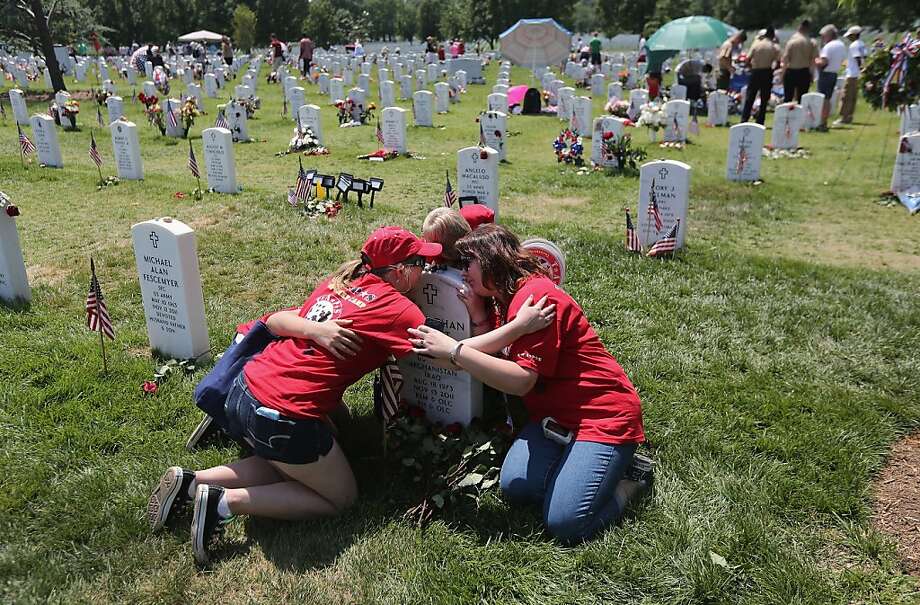
Why Memorial Day is not about us living veterans.


___________


Bookmark and Share

Wednesday, May 8, 2019

School shootings and social margins

We know about the shootings yesterday in Colorado:
Authorities have identified one of the two suspects in a shooting Tuesday at a public charter school in Colorado just eight miles from Columbine High School.

Devon Erickson, 18, has been held in the attack at STEM School Highlands Ranch in which seven students were injured and one killed, reported 9News, the Denver NBC news outlet.
The Wall Street Journal reports that the second suspect has been identified and is a juvenile girl, which crosses a threshold of feminine equality that we never would have wanted. I wrote most of what follows a year ago, just after a school shooting in Texas, but I hardly need to change a word.

It is chilling to think that what used to be outside the margins regarding guns and schools is now becoming normalized: "The Best Explanation for Our Spate of Mass Shootings Is the Least Comforting."
Writing in 2015, Malcolm Gladwell wrote what I think is still the best explanation for modern American mass shootings, and it’s easily the least comforting. At the risk of oversimplifying a complex argument, essentially he argues that each mass shooting lowers the threshold for the next. He argues, we are in the midst of a slow-motion “riot” of mass shootings, with the Columbine shooting in many ways the key triggering event. Relying on the work of Stanford sociologist Mark Granovetter, Gladwell notes that it’s a mistake to look at each incident independently:
But Granovetter thought it was a mistake to focus on the decision-making processes of each rioter in isolation. In his view, a riot was not a collection of individuals, each of whom arrived independently at the decision to break windows. A riot was a social process, in which people did things in reaction to and in combination with those around them. Social processes are driven by our thresholds—which he defined as the number of people who need to be doing some activity before we agree to join them. In the elegant theoretical model Granovetter proposed, riots were started by people with a threshold of zero—instigators willing to throw a rock through a window at the slightest provocation. Then comes the person who will throw a rock if someone else goes first. He has a threshold of one. Next in is the person with the threshold of two. His qualms are overcome when he sees the instigator and the instigator’s accomplice. Next to him is someone with a threshold of three, who would never break windows and loot stores unless there were three people right in front of him who were already doing that—and so on up to the hundredth person, a righteous upstanding citizen who nonetheless could set his beliefs aside and grab a camera from the broken window of the electronics store if everyone around him was grabbing cameras from the electronics store.
It works like this:


This "infectious" behavior is well known and described by people who study and teach leadership. Here are two real problems: First is what Granovetter describes: once there are enough early adopters of a behavior, then mass adoption easily follows. Hence, Gladwell describes school shootings as a "slow motion riot." But portents are that it won't stay slow.

Second is what is revealed by retired Army officer and psychologist Dave Grossman, who documents in Assassination Generation: Video Games, Aggression, and the Psychology of Killing and other works that more and more boys are growing up learning to kill vicariously through both popular media and electronic gaming - and that for increasing numbers the vicarious violence will give way to actual.

In one of his early works, On Killing, Grossman documented the great difficulty the US Army had in World War II in training its soldiers, especially infantrymen, actually to take the enemy's life. The leadership found that American men came into the military with deeply-inbred reluctance to harm other human beings, and that only a small minority of infantry even fired their rifles once in a firefight.

Grossman's thesis in what is happening to America today is that we have, as a whole society, widened the boundaries of what constitutes prohibited violence. Prior generations had mass murderers, of course, but even the most depraved killers in the not-too-distant past would never have even thought of shooting schoolchildren at their desks. Now it is, as Gladwell notes, becoming increasingly within the boundaries of conduct that society has moved.

In the coming days the editorialists and TV commentators will have a lot more to say. I do not expect their offerings to be much different from what they said after the Parkland, or Aurora, or Sandy Hook massacres or ... well, pick one. The media’s talking heads will recycle the same things they said before. We’ll hear a lot about America’s gun culture, and all the talk will be about guns and not about the culture.

Does America have a "gun culture?" You bet it does, and it this is it:

This movie was to open in Newtown, Conn., on Dec. 14, 2012, the
day of the killing rampage in Sandy Hook Elementary School.
Warner Bros. pulled the opening

The Hollywood gun culture:

Business Insider reprints part of an AskMen piece on
"
The 99 Most Desirable Women Of The Year."
Here is no. 99, 
Bérénice Marlohe, who plays Severine in Skyfall.
Glorifying violence, especially gun violence, is the present purpose of America's entertainment industry. This is what untold numbers of our children are doing in their homes:


The margins continue to be moved, whether we want it or not. Because there is too much money being made by murder-as-entertainment to give it up, and we the people are willingly paying for it.

One of the ways that the Columbine shooting remains key is in how subsequent school chooters have imitated it to some degree. Not every shooter, but enough to see that Columbine still forms a template. For example,
Some aspects of Friday's [Texas] shooting had echoes of the massacre at Columbine High School in 1999. The two teenaged killers in that incident wore trench coats, used shotguns and planted improvised explosives, killing 10 before committing suicide themselves.
As did the accused killer in Texas, except for the suicide. Reports say, though, that he told police he intended to commit suicide but found he could not go through with it.

As for this week's shootings? The WSJ article linked above concludes,
George Brauchler, the district attorney for the area, noted at the Wednesday morning news conference the number of mass shootings that the Denver region had endured over the years.

“If you had suggested to anyone behind me that within 20 years and 20 miles, we would have dealt with Columbine, the Aurora theater, Arapahoe High School,” he said, rattling off Colorado mass shootings, flanked by officials. “We would have thought you were mad.”

Steve Holley recalled being at his son’s school to pick him up just as the school was put on high alert because of the scare involving the woman obsessed with Columbine.

“It was just like, ‘Here we go again,’ ” Mr. Holley said of Tuesday’s shooting. “I remarked to one of the other parents we were waiting in the gym with: ‘This is the new norm.’ ”
"The new norm" - the slow-motion riot is not happening slowly any more.

Tuesday, April 30, 2019

State and other persecution of religious people

In last Sunday's lectionary passage from the book of Acts, the apostles are arrested for preaching that Christ is risen. They are questioned before the Jewish priestly Sanhedrin. The high priest reminds them that they had been ordered to stop such preaching.

Peter, speaking for all the apostles, responds, "We must obey God rather than any human authority." Acts records that had not a Sanhedrin member named Gamaliel argued otherwise, the apostles would have been executed that day.

Fast forward to today, and understand that there are still human authorities who will not countenance any resistance to their authority. China, for example, this month:


This was the destruction of one of the largest church buildings in the country. The Guardian reports,
Witnesses and overseas activists said the paramilitary People's Armed Police used dynamite and excavators to destroy the Golden Lampstand Church, which has a congregation of more than 50,000, in the city of Linfen in Shanxi province.

ChinaAid, a US-based Christian advocacy group, said local authorities planted explosives in an underground worship hall to demolish the building following, constructed with nearly $2.6m (£1.9m) in contributions from local worshippers in one of China's poorest regions.

The church had faced "repeated persecution" by the Chinese government, said ChinaAid. Hundreds of police and hired thugs smashed the building and seized Bibles in an earlier crackdown in 2009 that ended with the arrest of church leaders.

Those church leaders were given prison sentences of up to seven years for charges of illegally occupying farmland and disturbing traffic order, according to state media. 
And it is not just Christians. Muslims who have lived in China for centuries have suffered even worse: "Before-and-after photos show how China is destroying historical sites to monitor and intimidate its Muslim minority."
China is waging an unprecedented crackdown on a Muslim minority called the Uighurs, who live in the country's western frontier region, Xinjiang.

Muslims have for centuries settled in the region, sometimes referred to as East Turkestan.
As part of its crackdown, which has seen the installation of facial-recognition cameras and seemingly arbitrary detentions, China's government has also destroyed traditional Uighur architecture including mosques and large parts of an ancient city called Kashgar.

Before-and-after images show the extent of some of the destruction of these historical locations.

When the state is the religion, it will always crush or suborn all others. Could never happen here, though, right? Oh, the ground is being tilled already. I give you Harvard University, April 25, 2019, and the keynote speaker of the Faculty of Arts and Sciences "Diversity Conference."
We are pleased to announce that our keynote speaker will be Tim Wise, prominent anti-racism writer, educator, and activist. A moderated discussion with Tim will be led by Renee Graham, an associate editor and columnist at the Boston Globe.
This is the same Tim Wise who posted on his Facebook page in 2015:


This is America…people basing their beliefs on the fable of Noah and Ark, or their interpretation of Sodom and Gomorrah…rather than science or logic…If you are basing your morality on a fairy tale written thousands of years ago, you deserve to be locked up…detained for your utter inability to deal with reality…NO, we are not obligated to indulge your irrationality in the name of your religious freedom…but we will provide you a very comfortable room, against which walls you may hurl yourself hourly if your choose. Knock yourself out….seriously, knock yourself out, completely, for weeks at a time…I’m sorta kidding but not by much…I don’t believe lunatics like this should be locked up, but I do think they have to be politically destroyed, utterly rendered helpless to the cause of pluralism and democracy …the world is not theirs. They have no right to impose their bullshit on others. They can either change, or shut the hell up, or practice their special brand of crazy in their homes…or go away. Their choice. And this argument applies to any fundamentalist religionist of any faith who thinks they have a right to impose their beliefs on a secular, pluralistic society. Go away.
That is not only no problem for Harvard, it is positively commendable. However, persecution of Jews in America (though thankfully, not by the government) is growing. Not only the violent kind, such as the anti-Trump, anti-Jew gunman, John Earnest, who killed one and shot two others in the Chabad of Poway synagogue in Poway, California. Take for example, this cartoon published by The New York Times in its overseas pages this month:


Yes, that infamous propaganda rag of the alt-right, The  New York Times - oh, wait, you say, the NYT is not alt-right? Really? How can you tell?

No wonder that this week Serge Klarsfeld, France's most famous Nazi hunter, said, "There is no safe place on earth right now for Jews." In Washington to receive the Elie Wiesel Prize, the highest award given out by the United States Holocaust Museum, Klarsfeld told reporters,
... the cartoon was "insulting," for Trump as much as for Netanyahu who was "treated like a dog."

"It is an anti-Semitic cartoon, that is to say that Jews are guiding the world and that corresponds to a stereotype very common among the far right, which one also finds on the far left," he said.

Klarsfeld, who spent decades working to commemorate the victims of the Holocaust, is worried about the future of Europe and called on centrists to mobilize ahead of the next European elections.
 "Never has a far-right or far-left regime made its people happy and prosperous, inevitably the extremes of power lead to misery and barbed wire."
In rhetoric, the far left and the far right differ only in whom they identify as class enemies. Religiously, the alt-right hates Muslims. The alt-left hates Christians. And they both hate Jews even more. So in practice, there is no distinction with a difference.

Monday, April 29, 2019

Does God have a plan for your life? Well, not really.


Well, not so fast. Is this claim actually supported by Scripture?
Immediately after the Day of Pentecost and its empowerment of the church by the Holy Spirit, Peter and the other disciples began preaching the Gospel of Jesus Christ in Jerusalem. Acts records that "great numbers of both men and women" were converted to faith in Christ by their preaching. As a result, the Jewish high priest and some allies on the Jewish high council had the apostles arrested and locked in prison.
But during the night an angel of the Lord opened the prison doors, brought them out, and said, 20 'Go, stand in the temple and tell the people the whole message about this life.' 21When they heard this, they entered the temple at daybreak and went on with their teaching" (Acts 5:19-21).
When the council discovered it, they had the Temple police bring Peter and the others to stand before them.
Acts 5:27-32:
   27 When they had brought them, they had them stand before the council. The high priest questioned them, 28 saying, “We gave you strict orders not to teach in this name, yet here you have filled Jerusalem with your teaching and you are determined to bring this man’s blood on us.”
   29 But Peter and the apostles answered, “We must obey God rather than any human authority. 30 The God of our ancestors raised up Jesus, whom you had killed by hanging him on a tree. 31 God exalted him at his right hand as Leader and Savior that he might give repentance to Israel and forgiveness of sins. 32 And we are witnesses to these things, and so is the Holy Spirit whom God has given to those who obey him.”

“We must obey God,” the apostles said. I have to tell you, I am not impressed by those words. God commands it! That was what Osama bin Laden declared before 9/11, when he said that it is the duty of every Muslim to kill infidels wherever they are found. Since then al Qaeda, ISIS, and other such groups have made grisly work of what they insist is divine duty, most recently a week ago in Sri Lanka.
Now, it's easy to point fingers at Muslim terrorists. In fact, it's required, but it doesn't get us Christians off the hook. When I was a boy, I worked a couple of summers in the now-gone Woodlawn Market in Nashville. The owner was the staunchest racist I ever met in person. He was absolutely ironclad in his belief that God's will was that black people be oppressed. He was convinced beyond persuasion otherwise that black skin was the mark of Cain. Cain was the first murderer in the Bible, whom God sent to exile with every hand against him. Racism was to Pappy literally a holy duty.
I am guessing that most of us can think of someone who was convinced he or she was obeying God in things we thought were disturbing, even shocking. So I read Peter's retort to the high priest as potentially troubling. "There's what you want and there's what God wants," Peter is saying. "And we obey God, not you."
That's real in-your-face stuff, and following verses explain that the officials there were so vexed at Peter's defiance they wanted to kill the apostles.

I am going to take the high priest's side here, at least for a moment. I don't defend his desire to have Peter killed. But the high priest and I have something in common. We're both clergy of well-established religions. When something upsets the apple cart of proper religious order, we get our hackles up and immediately set about trying to bring it under our control.
Of course, this makes us no different from business managers or most parents. But what makes the issue especially nettlesome for clergy is that we formally recognize that the Holy Spirit is supposed to be breaking in and upsetting our apple cart. In fact, I often think that one on the main reasons the Holy Spirit came to enliven the church on the Day of Pentecost was to stir things up and keep believers on their toes.
Nonetheless, there are some issues for all of us, the church assembled, to consider.
One is that if it is unacceptable to excuse sin by saying like Flip Wilson's character Geraldine, "The devil made me do it," then it is equally unacceptable to use a claim of divine mandate as an excuse for doing what oneself wants to do. Cathy and I knew a woman in Virginia who told us that she knew it was God's will for her to win the lottery because she would give more than a tithe of the jackpot to the church. True story.
"God requires it" has been used to justify everything from simple murder to mass murder to tyranny and oppression. So the claim that one is acting from divine authority deserves to be regarded with deep suspicion at least at first.

On the other hand there is a real chance that someone really might be acting under God's command, and therefore we must leave the possibility open.
So how to tell?
I think a crucial key is found in what Peter went on to say: “We are witnesses,” he said, to what we testify. Which is to say, God did not reveal Christ to me privately, but publicly, with others, all of whom attest to this truth.
This is important because the unambiguous testimony of the apostles in the New Testament is that Christian faith and practice are not solitary ventures. Everywhere the apostles went they did two things, never separated from one another: they brought people to confess faith in Christ as risen Lord and organized the new believers into churches.
The apostle Paul explained more than once that the body of Christ present in the world today is the aggregation of Christ's present disciples organized as the church. I have found no evidence in the New Testament that people can live Christian lives apart from the church belonging to Jesus Christ.
More than thirty years ago my pastor in North Carolina put it this way: "I won't tell you that you can't be a good Christian outside the church. I'll tell you that you can't be any kind of Christian outside the church." That statement struck me as pretty stark at the time. We Americans are stiff-necked individualists. We pretty much think that whatever we want to do we should be able to do on our own, but that's not how the New Testament sees it.
Anyone can be religious outside the church, but Jesus did not minister, teach, suffer, die and rise just to make us religious. Religions are a dime a dozen. Founding another one sure didn't require God's incarnation, or Christ's passion, death and resurrection. We are not called to be merely religious, but to be transformed and made anew in Christ's likeness – to be a new people, a new kind of community. So when we think God has some special demand for us, or someone makes that claim to us, we need to discern whether its context is related to the present body of Christ. Whom does the command serve, Christ or self?
And that leads to the second way to assess a claim that “God commands it.” It is the famous lawyers’ question, “Who benefits?” The apostles gained nothing from preaching Christ but severe tests of their character, their faithfulness, perseverance, and fortitude. All were killed but one for insisting that they had to obey God rather than human authority. They might have been killed the day of this passage had not a wise rabbi spoken against it. So, who benefited? By the standards of the world, none of the apostles did.
The experiences of the apostles and other devoted Christians through the centuries is that God play his cards pretty close to the vest. God’s commands often do not make sense to us or do not appeal to us. God generally leads us only one step at a time. So, I am leery of visionaries with grand plans, all filled in from start to finish, because I don't see in the Bible where God explains that he has
God did not give Moses a plan. He gave him a command.
a plan. He gives commands, such as telling Moses, "Go tell Pharaoh to let my people go," and that was that. When the Lord spoke to Paul on the Damascus road, he did not lay out Paul's apostolic mission to him, culminating in being crucified in Rome. Christ simply told him, "Now get up and go into the city, and you will be told what you must do" (Acts 9:6). Even Peter, in today's passage, had no sense of grand mission. He didn't tell the high priest, "God wants me to be the foremost of all his apostles and become the first bishop of Rome, founder of what will become the worldwide Roman Catholic Church." All he understood God wanted him to do was preach the Gospel. He started out a street-corner preacher and there is no evidence that on his own account that he thought God wanted him to be anything else.
God's commands are pretty simple, at least at first. Sometimes they may not make a lot of sense and leave one wanting to ask him, Why? But enlightenment is not the point; we leave that to the eastern mystics. Obeying God is the point.
Speaking of obedience, there are some basic commandments of Christ that are obligatory of all Christian people and churches wherever found. These commandments are not mysterious; they are clearly stated in the Scriptures: pray, give, love, forgive, help, worship. Bear one another's burdens, esteem others more highly than oneself. Love God, love neighbor. Be baptized. Consider our lives lost to the world and gained in Christ. Use all that we have to the glory of God and the building up of the kingdom of Heaven. These are the foundational commands God give us.
The story is told of a star college football player named Eddie. Almost every week the school paper had a photograph of Eddie leaping across the goal line for a touchdown or jumping high into the air catching an impossible pass. Oh, Eddie was good! The cheerleaders loved him. Eddie loved them back. 
One day, Eddie went to the coach and said, “Coach I’m not coming to practice anymore.” The coach said, “Eddie, are you quitting?” Eddie replied, “Oh, no, I’m not quitting. I’ll still dress for the games on Saturdays. But you know Mondays? Mondays you make us to do wind sprints. And Tuesdays is grass drills and strength training. Wednesdays is full contact practice. Thursdays is special team drills. I don’t like all that. I’m not going to do any of that anymore. But come game time, Coach, you can count on me. I’ll catch those passes, I’ll make those touchdowns, I’ll get my picture in the paper. And after the game I’ll go out with the prettiest cheerleader. I like all that! But man, I’m not going to suffer through your practices anymore.”
Now ask yourself whether come Saturday the coach sent Eddie into the game.
So, another test of discerning whether we are given a particular command from God is to ponder whether we have been faithful in carrying out God's general commands. If God cannot trust me do the basics, why would he command me to accomplish the special? 
Jesus said, "Whoever can be trusted with very little can also be trusted with much, and whoever is dishonest with very little will also be dishonest with much" (Luke 16:10).
But suppose you work through all those things and conclude that God indeed is giving you a special command or laying upon you a special obligation. What then? Then Peter's courage is a model. Peter had to know the tempers flaring at him and his fellow disciples. Before the council, recognizing the danger, Peter and the disciples stood their ground precisely because they were under God's mandate.
The pressures and excuses the world lures us to turn from following Christ are innumerable. They are also hard to resist because to say yes to Christ we must say no to something, or someone, else – for example, Sunday morning league sports (but now I’m meddling). But to obey God, staying on course is the only faithful option. Only coincidentally will the world at large approve of our faithful service, but that's okay. The world's applause is far more spiritually dangerous than its jeers.


New Testament scholar Robert Wall wrote (NIB) that Peter’s “heroic retort to the high priest" served “missionary ends.” Peter was a “witness to God’s salvation of Israel. He [was] not the leader of a movement of protest but a movement of God."
And that is what we are under God's command to do: proclaim salvation through Jesus Christ our Lord. May we be satisfied with God's direction for each day, not for our sake, but for the sake of those who know him not.

Sunday, April 28, 2019

What the Judicial Council's rulings mean

An excellent, non-partisan summary by the rev. Katie Dawson, pastor at Immanuel United Methodist Church, which I have simply pasted below.

SUMMARY OF 2019 GENERAL CONFERENCE DECISIONS – MODIFIED AFTER JUDICIAL COUNCIL RULING

Decisions of the 2019 General Conference
Timeline for Implementation in Central Conferences
  • In general, when legislation before a GC is approved, it goes into effect on January 1 of the following year.
  • Central Conferences (outside the U.S.) have additional time because they are allowed to adapt and change the Book of Discipline to fit their context. These groups will not be meeting until after the 2020 General Conference.  This legislation gives them until May of 2021 to implement any of the legislation we approved at this special session.
 WESPATH Pension Liabilities and CRSP amendment.
  • These two pieces of legislation give guidance for if a local church leaves the UMC or if a clergy person terminates their conference relationship regarding pensions. The local church that leaves has to pay their share of unfunded pension liabilities.
  • An amendment was made that also notes that nothing in this legislation prevents the Annual Conference from collecting other obligations.
  • Clergy that terminate their relationship will have their pension benefits converted to the actuarial equivalent balance, which can continue to be invested in their personal defined contribution account through Wespath.
Traditional Plan
  • The eight petitions that will be implemented as of January 1, 2020 are:
    • 90032 #1 Update of the footnote that describes what a “self-avowed practicing homosexual” is according to recent Judicial Council decisions. This does not essentially change our Book of Discipline, rather notes current rulings.
    • 90036 #5 Expands episcopal responsibilities by adding that Bishops are prohibited from consecrating, commissioning, or ordaining people who are self-avowed homosexuals. (NOTE: Everywhere else in our Book of Discipline we use the word “practicing.”  This word was inadvertently left off of this piece of legislation, but it was never amended by the body.  This means that if someone is openly gay or lesbian, even if they are celibate, they cannot be consecrated/commissioned/ordained.)
    • 90042 #11 Mandatory Minimum Penalties for clergy who have been convicted of conducting same-sex weddings or celebrations of homosexual unions: First offense – one year suspension without pay. Second offense – termination of conference membership and revocation of credentials.  (Note: this is the ONLY mandatory penalty we have in the Book of Discipline)
    • 90043 #12 The District Committee on Ordained Ministry and Board of Ordained Ministry cannot approve/recommend for candidacy, licensing, commissioning or ordination, someone who does not meet the qualifications for ordained ministry (which include being a self-avowed practicing homosexual). The bishop shall rule unqualified candidates out of order.
    • 90044 #13 When a complaint/charge is brought to the Bishop regarding a violation, the Bishop has discretion about how to proceed. Now, the Bishop cannot dismiss the complaint, unless it has no basis in law or fact.
    • 90045 #14 One of the results of a complaint/charge is a Just Resolution. Now, Just Resolutions have to name all identified harms and how they will be addressed. The unconstitutional part is that it has to also include a commitment not to repeat the violation.  This line is removed and the rest remains.  
    • 90046 #15 One of the results of a complaint/charge is a Just Resolution. This changes the process so that the complainant has to be part of the process and has to agree with the resolution.
    • 90047 #16 One of the results of a complaint/charge is a church trial. Previously, the Church could not appeal those decisions.  This legislation allows the Church to appeal to the committee on appeals or to the Judicial Council.
Disaffiliation – Taylor/Minority Report Version
  • If a local church wants to disaffiliate over matters of human sexuality this is the process that can be used from Feb 27, 2019– Dec 31, 2023. It requires a 2/3 majority vote of professing members present at the charge conference.  Terms will be negotiated with conference Board of Trustees w/ advice of cabinet, and other conference officers. Standard terms will include: being able to leave with property with the exiting church paying for legal/transfer fees, any unpaid apportionments from the previous 12 months plus an additional 12 months of apportionments, its share of unfunded pension liabilities, and payment or assumption of all debts/loans/liabilities prior to departure.  The annual conference has to approve such an exit by a simple majority.